Vertiv: Muted Q1 and What it Could Mean

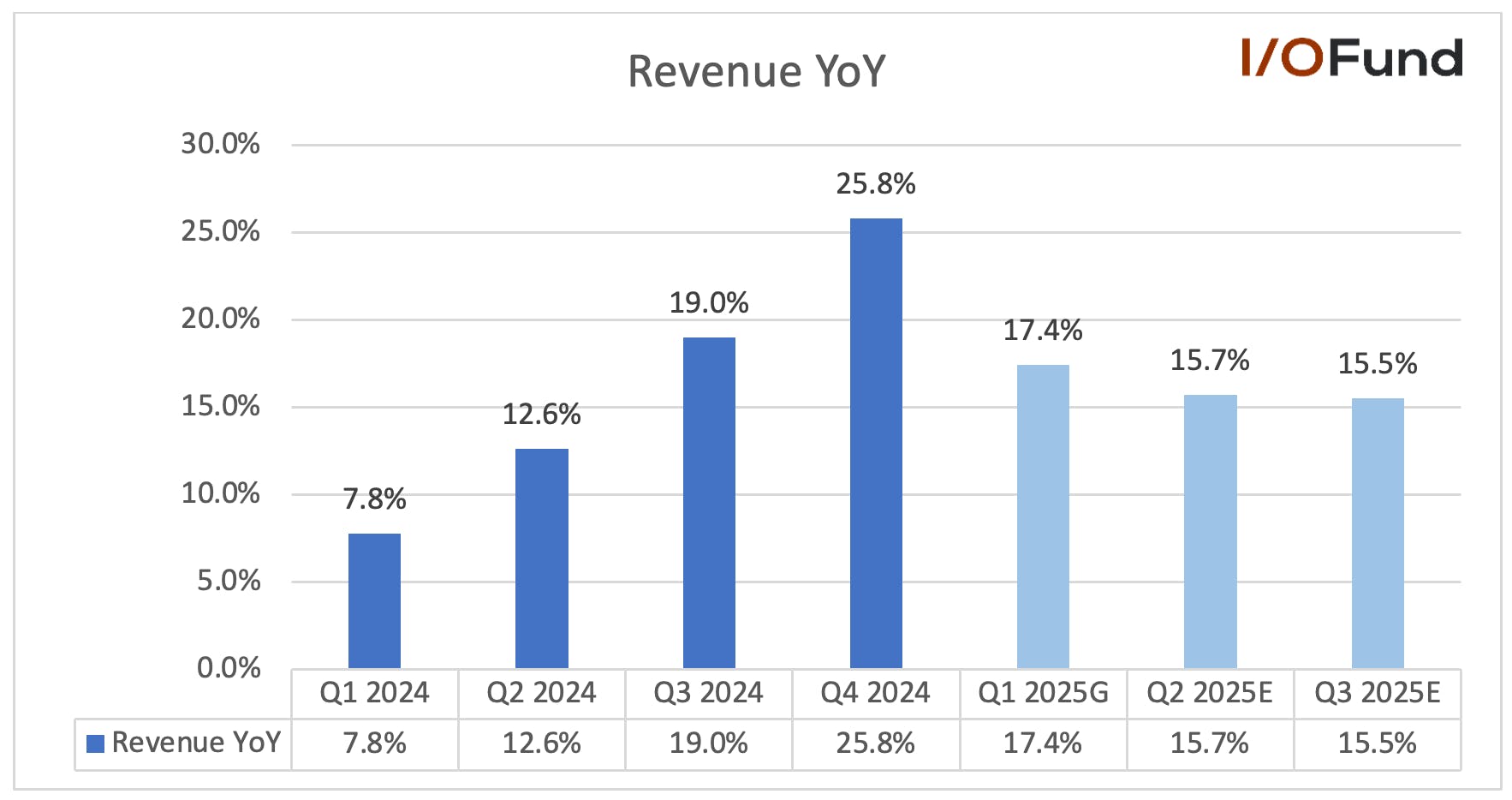
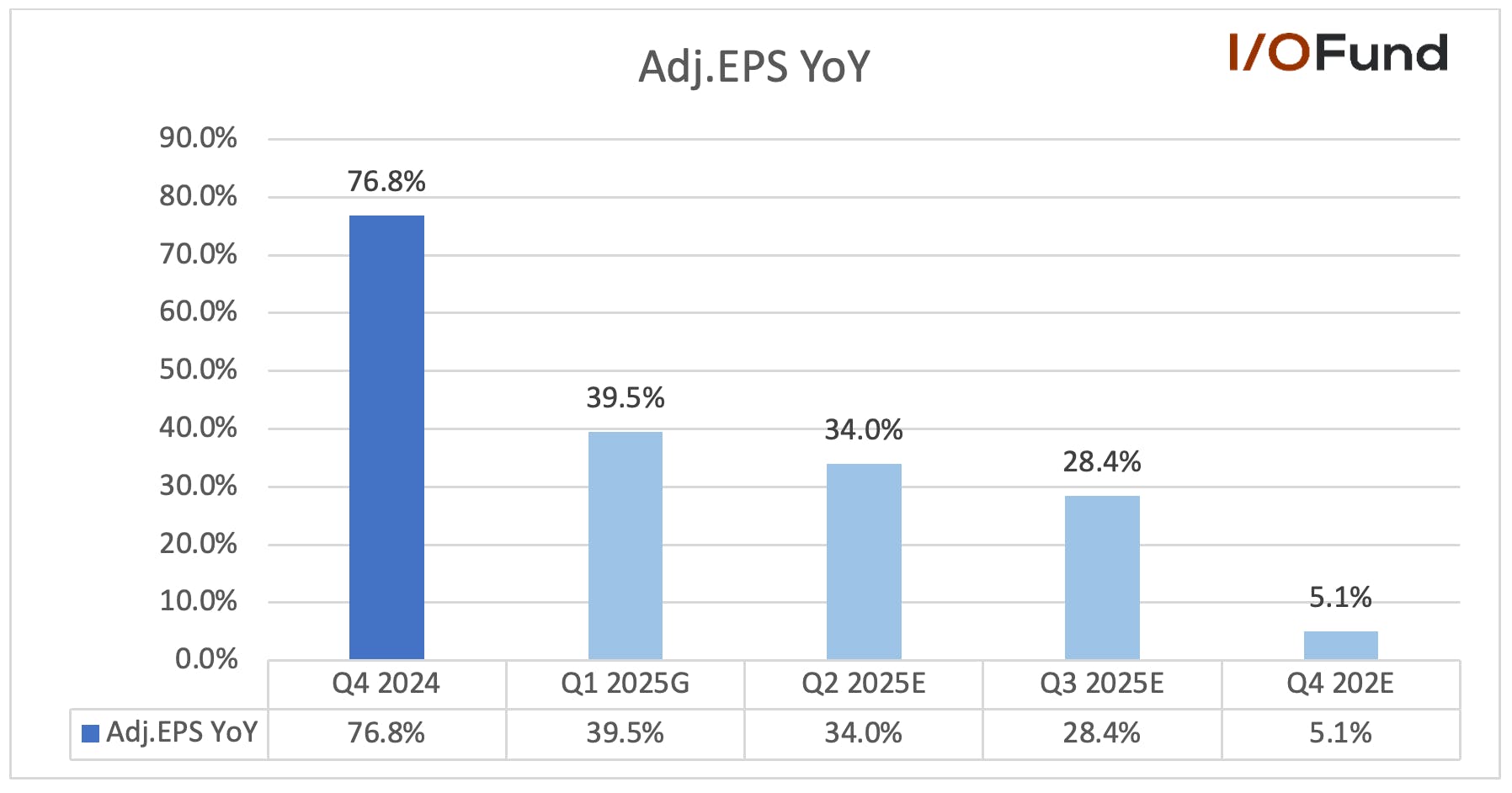
Vertiv reported exceptionally strong Q4 2024 results, but the midpoint guidance for Q1 2025 missed consensus estimates triggering a sell-off. The robust 25.8% YoY revenue growth and 77% YoY adjusted EPS growth in Q4 accented the drop-off into Q1 2025 revenue growth of 17.4% and adjusted EPS growth of 39.5%. Management stated that rather than a weak Q1, they had an “particularly strong” Q4.

Management now estimates 2025 sales at $9.2 billion at the midpoint—$75 million above November's guidance—even with a $125 million FX headwind. However, a $200 million Q4 revenue beat increased the revenue base, lowering full-year organic growth to 16% from 17%. Essentially, while absolute sales were higher, the beat diluted the year-over-year growth percentage compared to last year's forecast.

Perhaps a tad frustrating, management is contradicting itself by guiding for organic growth of 19% at the midpoint for Q1 but 16% growth for the fiscal year (i.e., slower growth later in the year) while also stating the following:

Mark Delaney   Goldman Sachs Group, Inc.

You spoke a bit already on the 1Q revenue outlook as a percent of the full year guide, but I'm hoping you can provide some more details on your expectations for the shape of the year from a top line perspective, and specifically if Blackwell supply chain readiness or other supply chain factors are gaining the revenue growth in the first half. And then on that topic, in particular with supply chain readiness, have you seen any changes in delivery schedules as a result of that?

David Fallon   CFO

Yes. I can address the first part, Mark. If you look at the shape of the year from a top line perspective and really from a profitability perspective, just like prior years, we expect sequentially increases each quarter as we progress through the year.

From a percentage of the whole, similar to the first quarter, which is comparable, maybe a little bit higher than what we saw last year. We would see the cadence as a percentage of total sales each quarter in '25 to be similar to what we saw in 2024, and that's also the case as it relates to adjusted operating profit.”

How can that be – that on one hand, we have sequential increases each quarter as it progresses throughout the year yet we see Vertiv guiding lower as the year progresses? My hypothesis is that any effects from the Blackwell delay will peak in Q2 and that is what is not being revealed, as it’s not required to be at this moment (only Q1 is required). This aligns to the H2 and mid-summer discussions from other suppliers. I covered this yesterday here in the analysis “AI Hardware Suppliers Forecast Muted H1, Strong H2 – and What it Might Mean for Nvidia.”

Given we had Vertiv and Super Micro report recently, I expand more on this analysis below.

More Info on What Vertiv Results Could Mean for Nvidia (and SMCI)

As you know by now, our spidey senses are up due to suppliers not coming in with convincing QoQ growth, leading me to be believe the larger GB200 systems are delayed. Although there were rumors prior to a Q1 delay, I believe the actual issue delaying the systems is newer in nature as suppliers were on track over the past few months and it’s something more recent causing the new commentary.

Vertiv is especially sensitive to this outcome as these larger systems necessitate the power and thermal management technologies that VRT offers. Meaning, as I’ve collected the various commentary from suppliers, I was especially keen to hear Vertiv’s report as the company would have to reveal if the larger systems were shipping or not as a key supplier. Where I think the issue resides goes beyond the headline numbers and is found in the QoQ/YoY growth percentages.

Last year, Vertiv was down (12.1%) due to seasonal sequential growth from Q4-Q1. This year, Vertiv is down (16.9%) from Q4-Q1. That’s not convincing in terms of a major ramp being on time that necessitates Vertiv’s direct liquid cooling technologies. What’s even more interesting in terms of validating this theory is that Vertiv’s full year guidance slightly missed:

“2025 sales are projected to be approximately $9.2 billion at the midpoint, approximately $75 million higher than the implied sales guidance in November. And this increase is despite an estimated incremental $125 million foreign exchange headwind. So on an absolute dollar basis, organic sales are up approximately $200 million from our November outlook. Of course, our full year organic growth is lower on a percentage basis from what we presented a few months ago, 16% at the midpoint versus 17%. But this is primarily due to the significant $200 million top line beat in the fourth quarter.”

If these assumptions are correct, remember that Nvidia’s revenue will not come to a screeching halt. The B100s, B200s and leftover Hopper GPUs will continue to drive sales. Yet, it’s the GB200s that define the Blackwell generation, and if these systems are truly delayed (still need confirmation from the horse’s mouth), the risk remains to the downside for the stock.

To compare, Super Micro is less sensitive as they offer a mix of air cooled and liquid cooled systems. As you know, SMCI has been growing rapidly from the Hopper generation, and thus, is not as dependent on Blackwell’s GB200s ramping. However, there are clues that SMCI is aligned with these assumptions as the company stated the following:

“Moving on to our technology progress, we are excited to announce that our NVIDIA Blackwell products are shipping now. We have begun volume shipments of both air-cooled 10U and liquid-cooled 4U NVIDIA B200 HGX systems. Meanwhile our NVIDIA GB200 NVL72 racks are fully ready as well.” – Super Micro CEO, Charles Liang

There was additional information that implies timing is off than previously expected on the GB200s, in the most recent quarter: “And especially talking about liquid cooling, we believe DLC or overall liquid cooling, market share, will grow all the way to 30% or even more in the next 12 months.” This is a change in tone as it was previously stated DLC would be 30% of market share in 12 months in the August call (six months ago): “we are targeting 25% to 30% of the new global data center deployments to use DLC solutions in the next 12 months.” – the original statement was implying H1 of 2025 but would now be implying H2 2025. This is important because, same as above with Vertiv, DLC is closely tied to the bigger GB200 systems.

These are subtleties that quant systems won’t be able to pick up on, but as someone who follows the AI market very closely from an investor’s POV, there is a marked change of tone in terms of the time on when the systems will be delivered. These management teams are being subtle to not get in the crosshairs with Nvidia while complying to SEC regulations around their guidance.

What if I’m wrong? I’m open to that. However, I don’t have one management team giving the green light on the GB200 systems, and these earnings reports and management commentary is only increasing in number.

I provide more information on Vertiv specifically in the Q&A below.

Vertiv Revenue Growth Driven by Hyperscale and Colocation Data Center Market

As stated, the weak price action is from a weaker Q1 and the nominal fiscal year guide miss, yet it’s understandable the market has jitters over a confirmed Blackwell supplier not being able to meet estimates. Equally understandable about the weak price action is the roughly 18% guide on fiscal year revenue compared to the 17.5% guide for Q1, implying little room for upside as we continue into the year. As stated, organic growth also illustrates a similar problem – Q1 at 19% midpoint compared to FY at 16% midpoint implies a weaker Q2 perhaps.

  • Q4 revenue grew by 25.8% YoY and 6.4% QoQ to $2.346 billion, compared to Q3 revenue growth of 19% YoY and 6.18% QoQ to $2.074 billion.
  • Q4 revenue of $2.346 billion beat consensus estimates for $2.16 billion by 8.61%, compared to Q3 revenue of $2.074 billion, beating consensus estimates for $1.92 billion by 4.79%.
  • Organic sales grew 27.1% YoY compared to 19.2% YoY in Q3. Revenue strength was driven by the hyperscale and colocation data center market. The pipeline increased sequentially, reflecting strength in data center project activity.
  • Vertiv had a significant number of new product launches in Q4, but customers wanted products ASAP resulting in overdelivering the top line by $200 million higher than midpoint guidance contributing to the particularly strong Q4.
  • Management’s Q1 2025 revenue guide is $1.900 billion to $1.950 billion, with a midpoint at $1.925 billion representing YoY growth of 17.44%, beating estimates by 0.26%.
Regional Segment Revenue Growth will Slow for EMEA

Vertiv collects its revenues from three geographical regions.

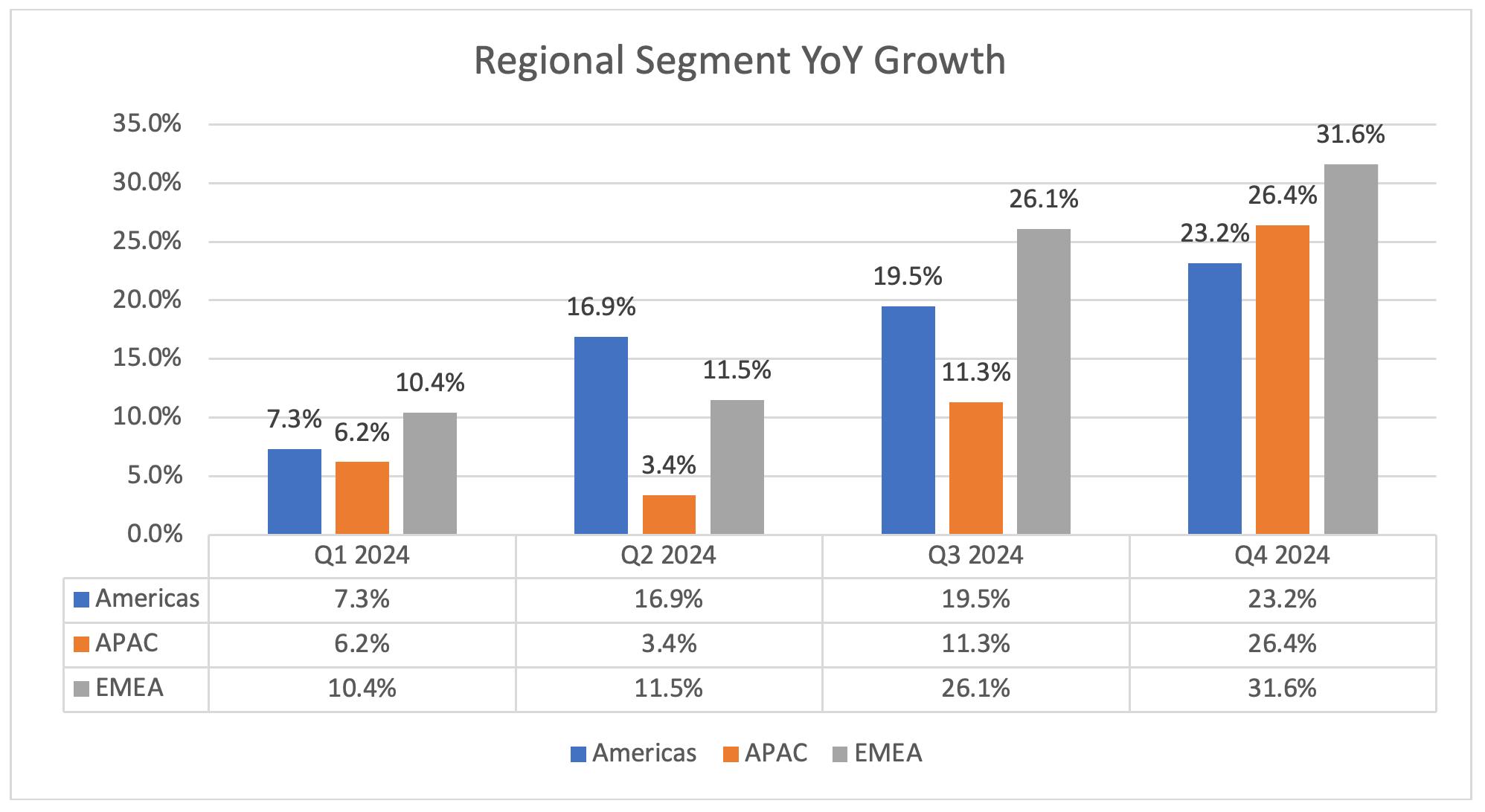
  • The Americas generates the bulk of the orders, followed by APAC (primarily India) and EMEA. Americas generated 23.2% sales and 25% YoY organic sales growth driven by strong demand in colocation and hyperscale market with strong contribution from switchgear, busway, liquid cooling and services.
  • APAC generated 26.4% sales and 27% YoY organic sales growth driven by continued recovery in China and strong market growth in India.
  • EMEA generated 31.6% sales and 33% YOY organic sales driven by demand from colocation and hyperscale markets across switchgear, chillers, modular solutions and services. The Americas trailing twelve-month order growth has surpassed 50%. Vertiv noted that Q1 growth forecasts for Americas is low 20s, APAC in mid-20s and EMEA trimmed to high single-digits, down from low high-teens, due to the timing of projects being pushed forward in 2025, and more challenging comparables.
Seasonally Weak Q1 Margin is Up 170 bps YoY

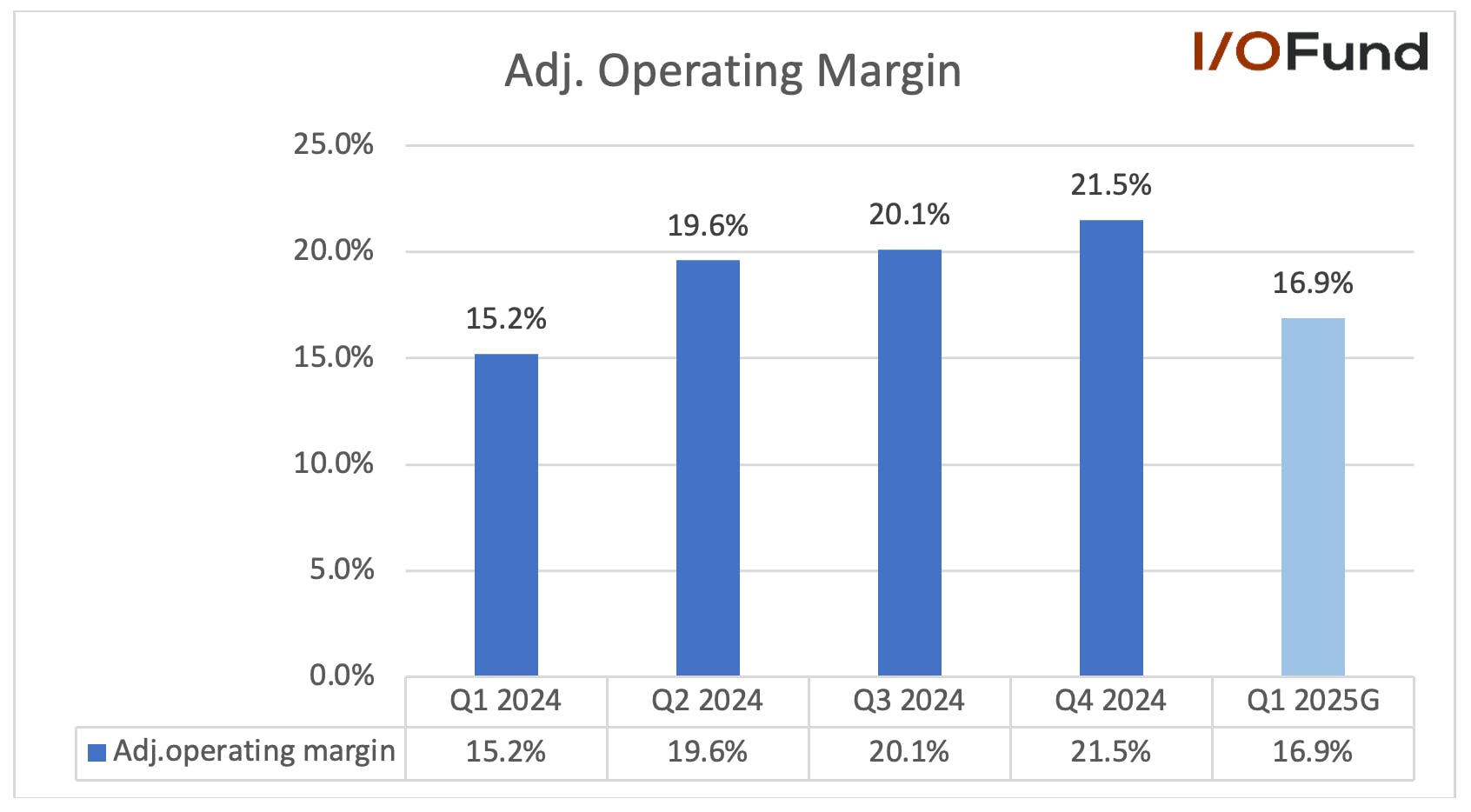
Adjusted operating margin rose 383 bps YoY to 21.5%, marking the fourth consecutive quarter of margin improvement. Adjusted operating profit was $504.3 million, firmly beating management’s earlier guide of $427 million to $447 million. Margin improvement was driven by improved variable contribution margin and lower fixed costs as a percentage of sales. Management is guiding Q1 2025 adjusted operating income of $315 million to $335 million with a midpoint of $325 million, which equates to a 16.9% adjusted operating margin.
Adjusted EPS Guidance Missed Consensus Estimates as Growth Slips

Q4 adjusted EPS rose 76.79% YoY to $0.99, beating consensus estimates for $0.82 by 20.73%. Adjusted operating profit is primarily driven by volume, commercial execution and productivity, partially offset by higher OPEX investment in growth capacity and ERD.

However, management guided Q1 2025 adjusted EPS range of $0.57 to $0.63, midpoint of $0.60, falling short of the consensus estimates of $0.64. This implies a 39.53% YoY growth rate at the midpoint versus consensus analyst estimates for 48.1%.
Steady Cash Flow as Debt Remains Flat But Net Leverage Improves to 1X

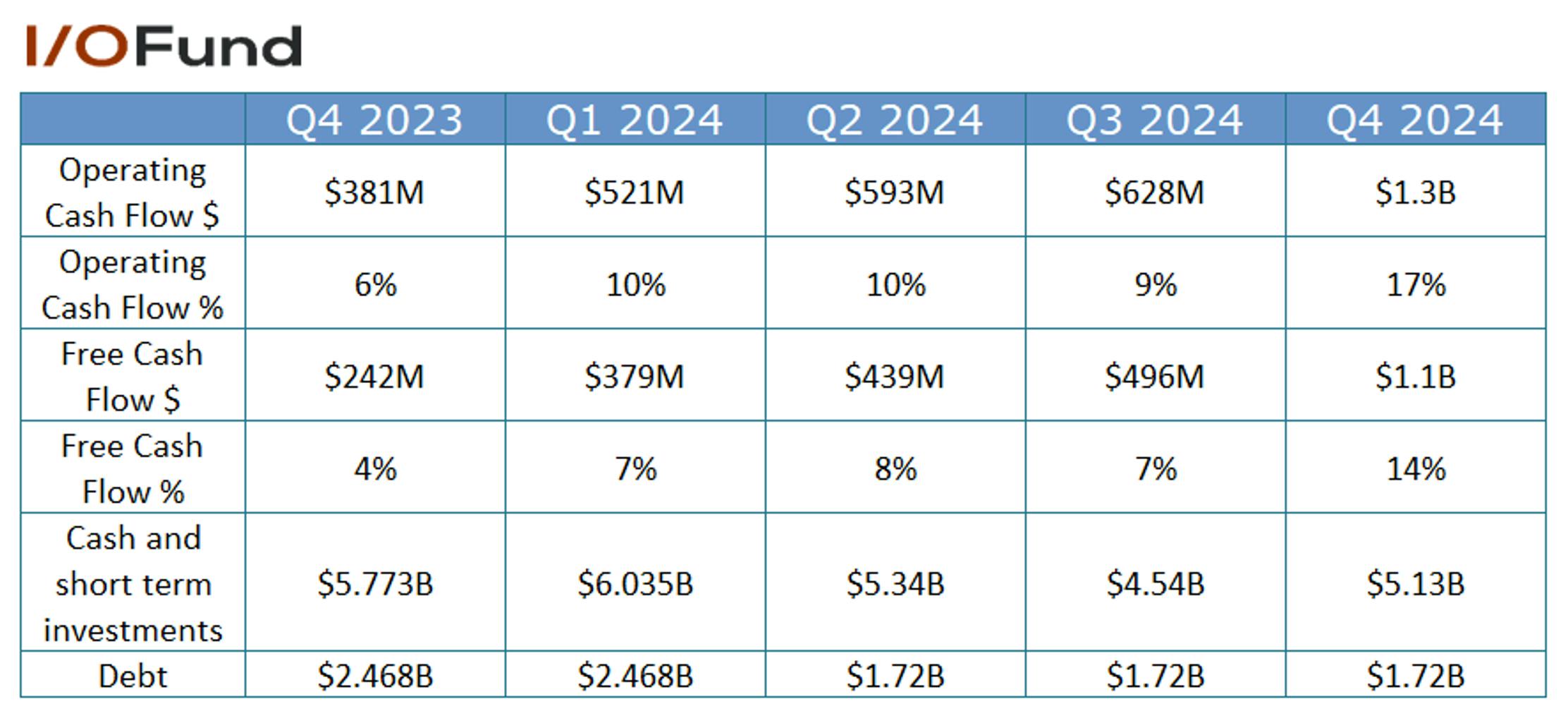
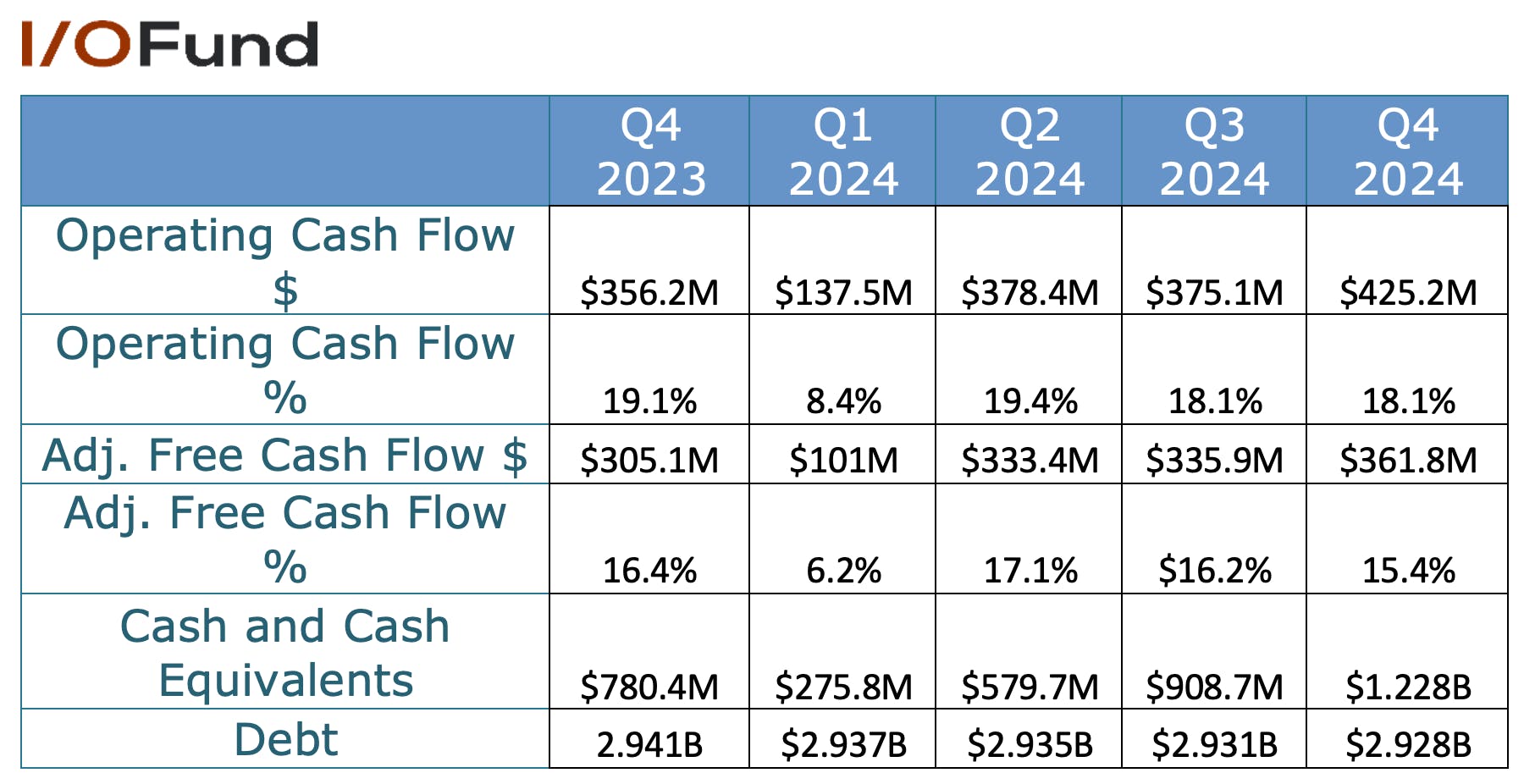
Q4 operating cash flow reached its highest levels in five quarters at $425.2 million. The operating cash flow percentage has remained steady between 19.4% to 18.1% for the past three quarters. Adjusted free cash flow rose to its highest level in six quarters to $361.8 million. Debt remained flat throughout 2024 closing the year at $2.93 billion, down from $2,934 billion in Q1, however net leverage has improved from 2.2X to 1X in the same period.

Vertiv generated over $1.1 billion in adjusted free cash flow in 2024, translating into a conversion of 103% after converting 114% last year. Adjusted free cash flow for Q1 2025 is expected to be higher YoY than Q1 2024.
Backlog Peaked in Q3 as Book-to-Bill Has Been Falling Since Q1 2024

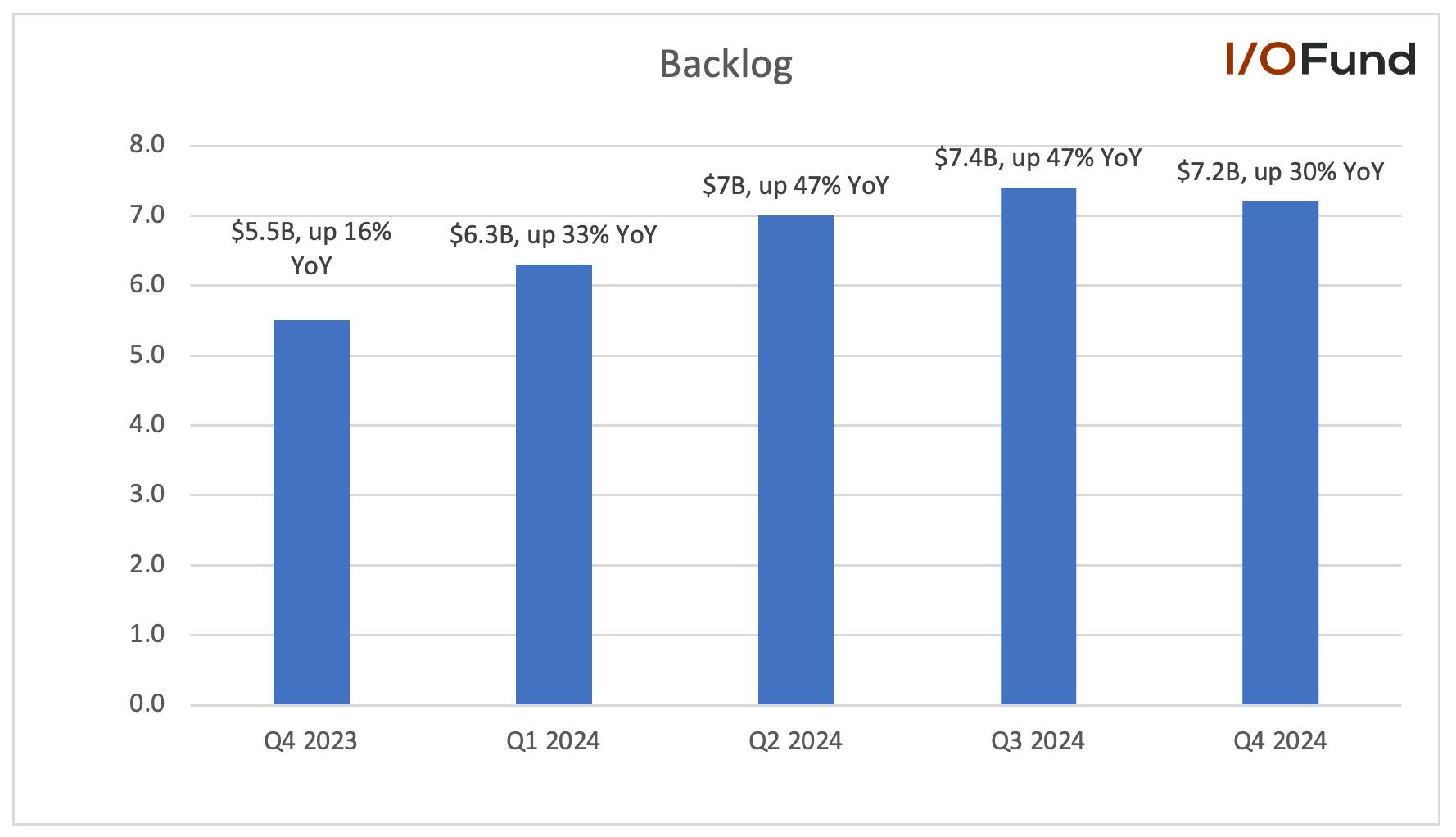
The backlog grew steadily for the past five quarters until Q4 when it dropped to 30% YoY and (2.7%) QoQ. However, the book-to-bill ratio peaked at 1.5X in Q1, dropping to 1.4X in Q2, 1.1X in Q3 and 1X in Q4. This may be due to seasonal normalization. Management stated that orders are historically “always lumpy”. The backlog to sales ratio is 78%, up from 69% in the prior year relative to 2024 actual sales.

While quarterly book-to-bill ratio has declined from 1.5X to 1X in2024, Vertiv’s trailing twelve-month organic orders are still up 30% YoY in Q4. Backlog growth trailed off in Q4 to 30% YoY down (2.4%) sequentially but still stand at $7.2 billion.
Valuation

Vertiv trades at a P/E of 76.59,  forward P/E of 32.16.
The price/sales (P/S) ratio is 5.88, forward P/S is 4.66 vs five-year avg P/S of 6.5.
The price-to-free cash flow ratio is 41.05
Debt-to-equity is 1.61.

Earnings Call:

Weak Q1 Questioned by Analysts:

Management defended Q1 by saying: “Now of course, Q4 was particularly strong. So we should not look at Q1 as a quarter-to-quarter, really look at the first quarter sales as the acceleration that has taken place. With a 19% organic growth in the first quarter, I feel very, very good about what that tells us about our overall trajectory” and also “it's actually higher than what we actually saw in 2024. So I would say there's actually a step-up in '25 versus the first quarter of last year, so certainly reflective in the 19% sales growth versus the 16% full year sales growth and then also a 31% increase in adjusted operating profit.”

However, I agree with the analyst sentiment that it doesn’t check out exactly. Per I/O Fund numbers, management is contradicting itself by guiding for organic growth of 19% at the midpoint for Q1 but 16% growth for the fiscal year (i.e., slower growth later in the year). Additionally, the QoQ/YoY has to be looked at which is lower than what typical seasonality would account for, as our numbers indicate Vertiv was down (12.1%) due to seasonal sequential growth from Q4-Q1. This year, Vertiv is down (16.9%) from Q4-Q1.

Here was one Q&A exchange that voiced these concerns.

Steve Tusa

Okay. And then just one follow-up for me. Obviously, there's a lot of focus on orders, I think, for good reason. Everybody's trying to discern the trend relative to these CapEx numbers, the pipelines that are obviously pretty eye-popping. You're now two quarters step down relative to what we see at your customers and the way they're spending in these pipelines. What is that disconnect?

Is there some sort of disconnect between you guys and everybody else talking about doubling their data center businesses? I admit, obviously, that's a lower base for some of these guys. But what is that disconnect between you and your customer spending that seems to have opened up here over the last two quarters?

Giordano Albertazzi

I don't think there is a disconnect, quite honestly. If you look at our orders trajectory last year, if you think about a 60% year-on-year growth in the first half of the last year, that's a lot of growth. When our customers talk about their CapEx, of course, they also talk about a lot of the silicon part of their CapEx, not all the data centers. So, I feel pretty good about our visibility of the market and what we win in the market. So, I don't think there is a disconnect.

Additional Q&A Points: Robust Colocation and Hyperscale Markets

Chairman David Cote noted that Vertiv’s stock price has been very volatile on the news, as shares surged higher on Stargate news and fell excessively on Deep Seek news, which was actually good news for them.

“I'd have to say, over the last two or three months, we've been actually quite surprised to see the overreactions to any kind of news in our stock, whether it was the Stargate up the Deep Seek, big crush downward, which made no sense, given that the news implying lower cost to compute, meaning More data, meaning more data centers, meaning more verdict was actually good, not negative.”

Furthermore, Cote also took a jab at the analysts for being overly critical in reaction to the orders data in the Q4 earnings release.

 “Again, orders are quite strong for us, but if you take a look at orders historically, they're always lumpy. They're just the way it is. It's just the lumpy quarter to quarter, and it seems to be masking the really good news we had in the fourth quarter regarding America's orders, especially as you look at hyper and colo, which is a focus for everyone extraordinarily strong.”

Vertiv had a significant number of new product launches in Q4, but customers wanted products ASAP resulting in overdelivering the top line by $200 million higher than midpoint guidance. Broad economic uncertainty entering 2025 in China, cautiously optimistic. Markets remain robust and have good visibility into the future. CEO Albertazzi is more confident in its five-year outlook than ever before. He stated:

“We believe our strong backlog and new product pipeline sets up very well for many years, as Dave noted in his remark, we have heard consistently also from the largest hyperscalers, that likely compute and LLM efficiency should drive more AI adoption. Most of these hyperscalers have confirmed significant increases in their capex span to support AI. This means large investments in data center builds that need our equipment and services.”

“In 2024 we expanded and strengthened our supply base and manufacturing footprint in the United States as part of our overall capacity strategy with the customer demand we see in the US. Vertical operating system is truly becoming part of the culture that is translating into tangible productivity gains, it is also liberating capacity needed to support the strong demand trajectory in combination with our ongoing footprint expansion.”

Management was adamant in making the point that they are a leader in power management. The system matters more than ever with the increasing densification of enabling AI data centers. Vertiv sees more opportunities to further integrate power conversion, distribution and thermal management in ways to simplify critical mechanical and electric infrastructure.

“Power Management represents approximately 1/3 of our total business, and we have been in this market for decades, at global scale, when we engage with our customers on their system designs, our full view of the power system enables us to help them properly scope the solution and right side each element of the infrastructure, we offer an holistic view of the total infrastructure and have access To and engagement with customers regarding their full facility design and challenges. Our visibility into the future of the IT load and our leading R and D allow us to partner with our customers to make their infrastructure, very importantly, future proof.”

Vertiv makes technology-based acquisitions early in the maturity curve that reinforce organic process and scale globally. For example, the BSC acquisition announced in December has high efficiency and capacity centrifugal chiller and heat reuse technology, which is increasingly being used to support high density compute application.

Conclusion:

The word “disconnect” used by the JPM analyst is a great word, as there is certainly a disconnect between what we’ve seen from Big Tech capex being raised to unprecedented levels nearing $300 billion, yet many suppliers including Vertiv are forecasting a muted Q1. Equally as questionable right now is Q2 as the suppliers we track closely seem to be in unison between the H2, mid-summer commentary. Vertiv did not say this directly, yet their guide implies something hidden in the middle of Q1 and FY. I’m guessing it’s Q2 and will keep you in the loop as we go along.

Should this happen, you can expect the news and pundits to stir up custom silicon eating into Nvidia’s GPU market share narratives, commoditization of hardware narratives as Nvidia isn’t that great after all, etcetera. The DeepSeek reaction is a warm-up to how fast sentiment can turn on a stock. Yet, any delays from Nvidia’s Blackwell systems aren’t going to matter in the long run – we know this capex is pointed straight at Nvidia and a handful of suppliers. It won’t even matter this time next year. Our plan is to load up at lower prices. If we trim, it will be nominal (you know we like to trim and get stocks lower, it’s our style). This was generally outlined for you here. You can expect more actionable information in the webinar tomorrow as well as through trade alerts.

I/O Fund Equity Analyst, Jea Yu, contributed to this analysis

Please note: The I/O Fund conducts research and draws conclusions for the Fund’s positions. We then share that information with our readers. This is not a guarantee of a stock’s performance. Please consult your personal financial advisor before buying any stock in the companies mentioned in this analysis.

Recommended Reading:

Monolithic Power Systems: A Back-Half 2025 Hyperscaler Story

  • Monolithic Power Systems posted top and bottom-line beats in its Q4 2024 results, closing 2024 with record revenues and issuing upside Q1 2025 guidance.
  • The Enterprise Data segment grew 121.7% in 2024, driven by AI servers, data centers and application power solutions.  The Company expects a slow start to 2025, accelerating in the second half of 2025 as hyperscalers ramp up and Monolithic Power is “… engaged across all the hyperscalers.”
  • Communications and Automotive segments will drive the growth in 1H 2025, as Enterprise Data gains traction again towards the year’s end.

Monolithic Power Systems designs, develops and produces power management integrated circuits (ICs), creating highly integrated power solutions that combine multiple functions into a single chip. It is widely believed that they supply power management solutions ICs and modules to the majority of NVIDIA GPUs, including Blackwell, and also supply them for AMD GPUs and Google’s TPUs. The company expects a slow start to 2025, supported by growth in its automotive segment and then acceleration into the second half of the year as Enterprise Data revenues rise with hyperscaler ramp-ups. The conference call felt like management was trying to downplay the ramp and brace analysts for a flattish year as Enterprise Data is expected to accelerate closer to years end.

Solid Q4 2024 Results Driven by EVs and AI

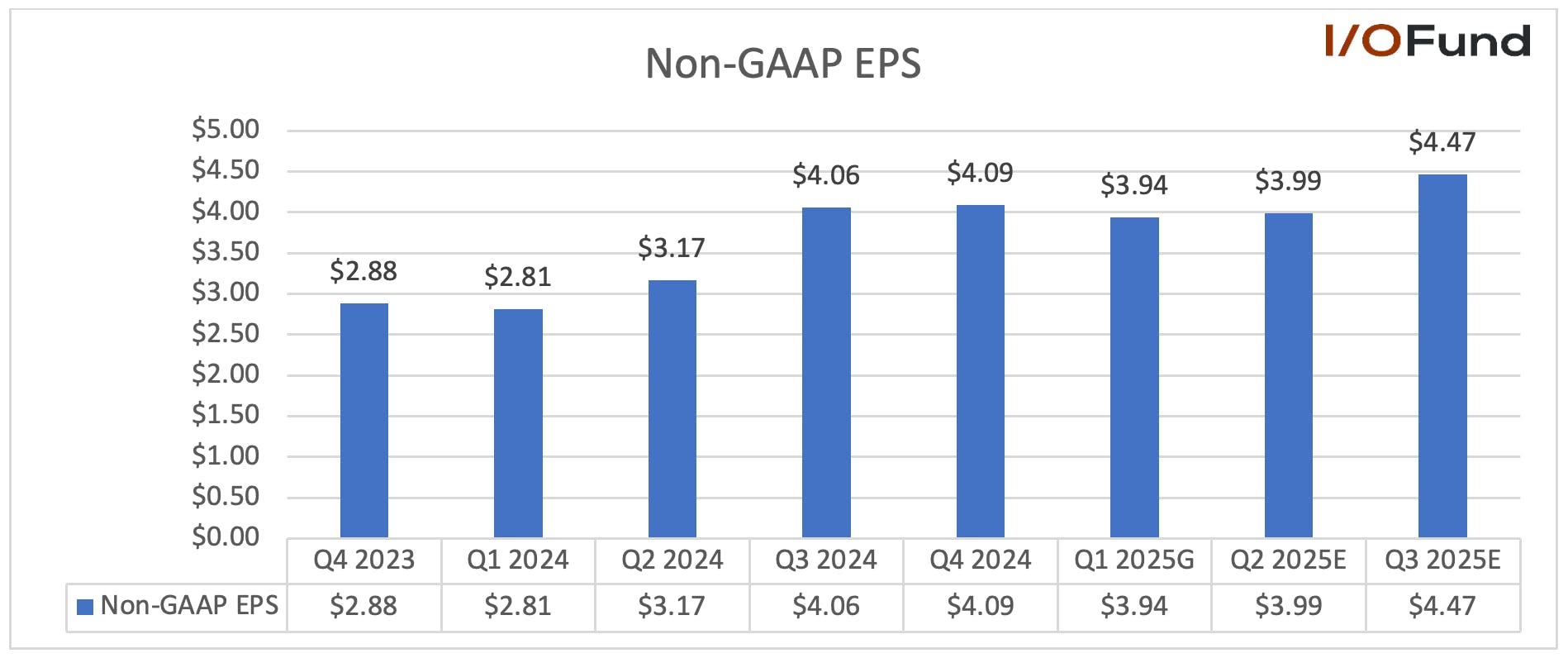
Monolithic Power reported Q4 2024 EPS of $4.09 versus $3.98 consensus estimates, beating by $0.11. Q4 2024 generated record revenues up 36.9% YoY and 0.2% QoQ to $621.7 million versus $608.09 million estimates, a $13.61 million beat. The company guided Q1 2025 revenues above consensus from $610 million to $630 million, mid-point of $620 million compared to $584.38 million consensus.

Revenue:  Record Q4 2024 Revenues

Monolithic Power reported record Q4 revenues of $621.7 million, up 0.2% QoQ and 36.9% YoY. Strength was attributed to the Automotive and Enterprise Data segments. The company guided Q1 revenue of $610 million to $630 million, mid-point at $620 million, representing 35.4% YoY growth, beating estimates by 6.1%. Notably, this is flat growth QoQ even though Nvidia’s Blackwell is expected to be ramping – this would indicate either MPS is not a key supplier for the B200s and rack-level systems or Blackwell is delayed, impacting the supply chain.

The company’s quarterly growth of 37% is higher than the 21% growth reported for the fiscal year, which is typically a good sign. However, despite the Q1 guide beating expectations, analysts are estimating a sharp deceleration to 9% growth for the September quarter.

Monolithic Power generates revenues through six segments:

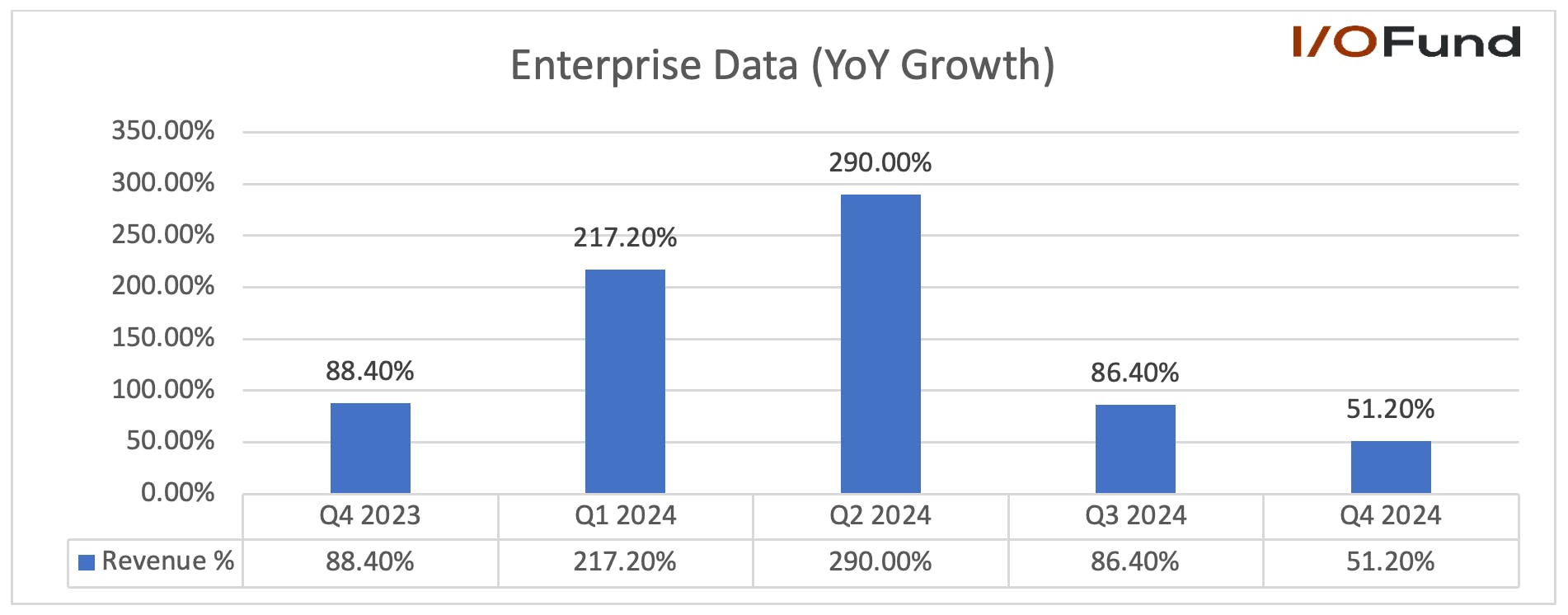
Enterprise Data focuses on providing power solutions to data centers, servers and networking equipment used in enterprise computing ecosystems. AI is a major driver in this segment. However, thriving data center revenue is lumped in with the legacy enterprise segment, which can provide lumpiness. Q4 revenue was up 51.2% YoY to $194.9 million. This is the strongest segment, generating full-year 2024 revenues of $716.2 million, up 121.7% YoY, driven by power management solutions for AI and server applications. It represents 32.5% of total 2024 revenue, up from 17.7% of total revenue in 2023.

CFO Bernie Blegan specifically pointed out in the Q&A call, “On industrial consumer, we have a lot of new product ramps, but those are likely to start to contribute at the end of 2025 and the enterprise data will be down.”

Blegan also added that Enterprise Data would accelerate, “Yes. Just to add a little bit of color to how we see the year rolling out, we believe that, we will be off to a slower start in the first half of the year. But as the year develops, the customer base is expected to broaden as hyperscalers launch their new products. We have multiple product ramps with both existing customers as well as with these new hyperscalers. So as Michael just said, we believe, it's likely to be a flattish year, but we believe that from a quality and supply availability perspective, we're in very good shape.”  

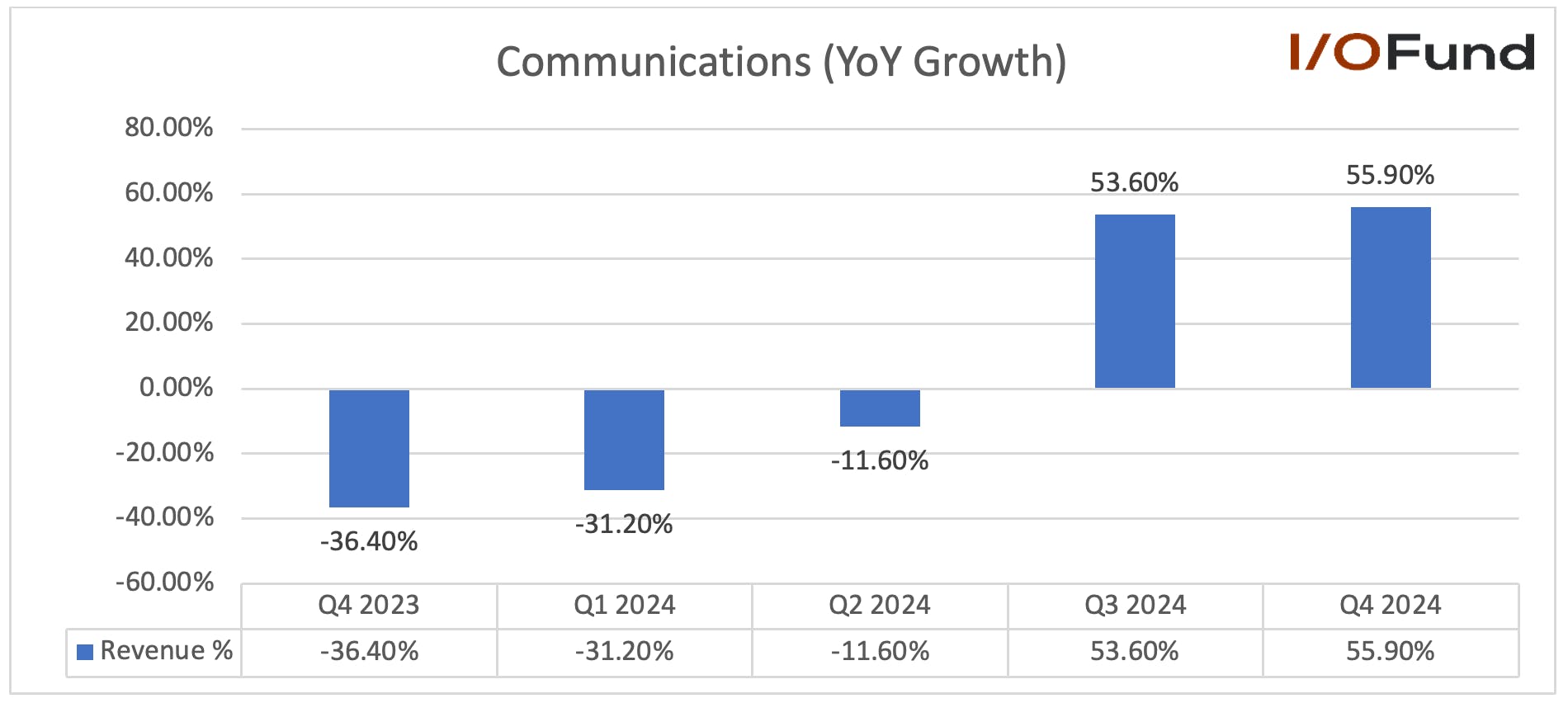
Communications provides power management solutions for infrastructure and communications systems including power integrated circuits (ICs) for optical modules, fiber optic communications, wireless communication base stations, routers and switches. Soft networking solutions partially offset the strong sales of optical modules and routers. Q4 revenues were down (11.2%) YoY to $63.8 million. Full year 2024 revenue rose 10.2% YoY to $225.9 million, representing 10.2% of total revenue, down from 11.3% in 2023.

Automotive focuses on automotive applications like advanced driver assistance systems (ADAS), ICs for battery management systems, infotainment systems, motor controls and various automotive applications.

This is one of the strongest segments generating strong sales of its highly integrated applications supporting ADAS. Monolithic Power’s silicon carbide inverters have higher efficiency, higher power density and can operate at higher temperatures than regular silicon. They were introduced for high-powered clean energy applications like electric vehicles (EVs), helping to reduce power losses in the motor drive system. EVs were around 75% of its Automotive revenues.

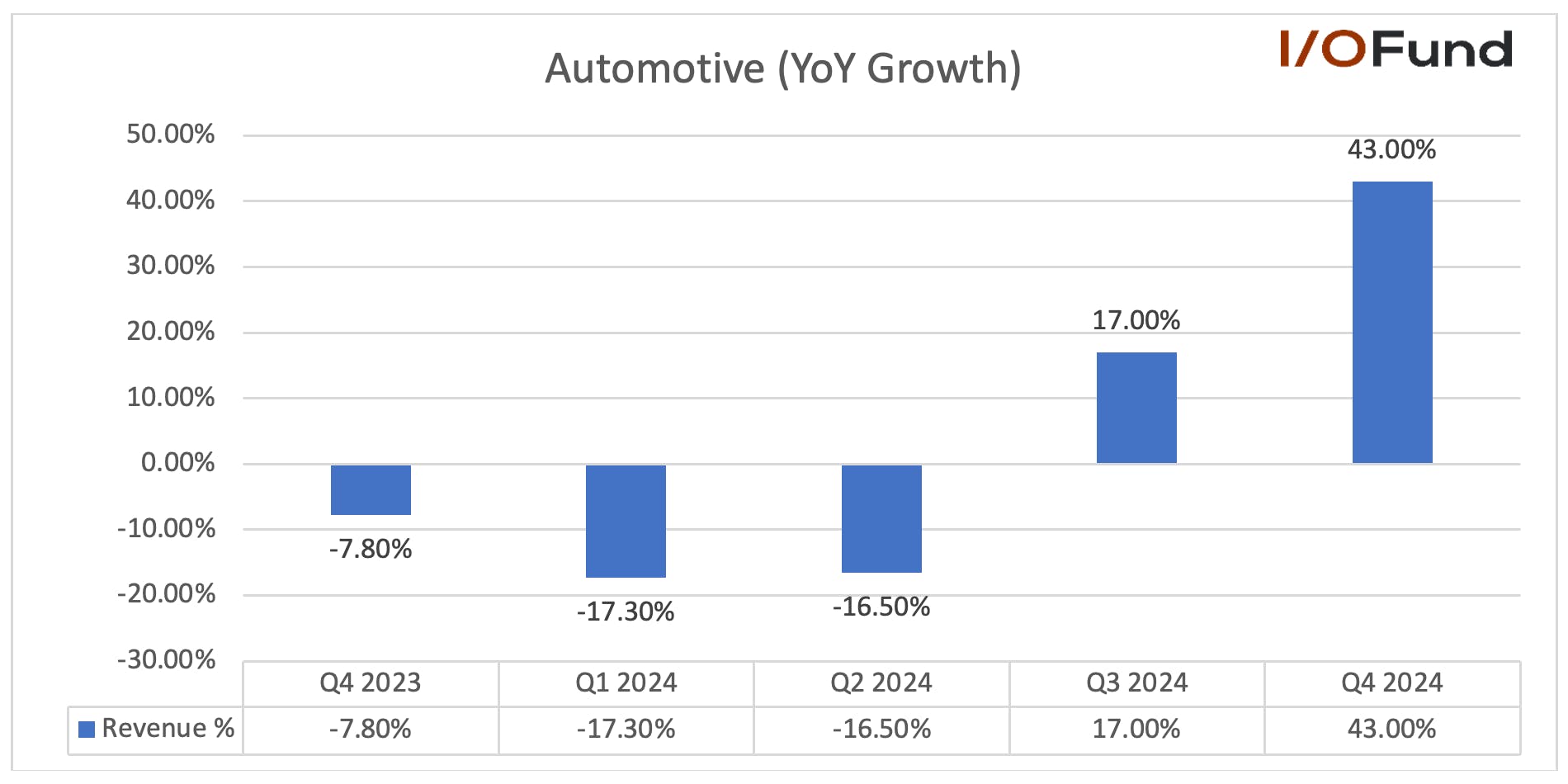
CFO Blegan pointed out, “Initial revenue is expected to ramp in late 2025. Other silicon carbide-based applications are expected to be introduced in multiple geographies during both 2025 and 2026.” Q4 revenues grew 43% YoY to $128.4 million. The full-year 2024 revenues rose 4.9% YoY to $14 million, representing 18.8% of total 2024 revenues, down from 21.7% in 2023.

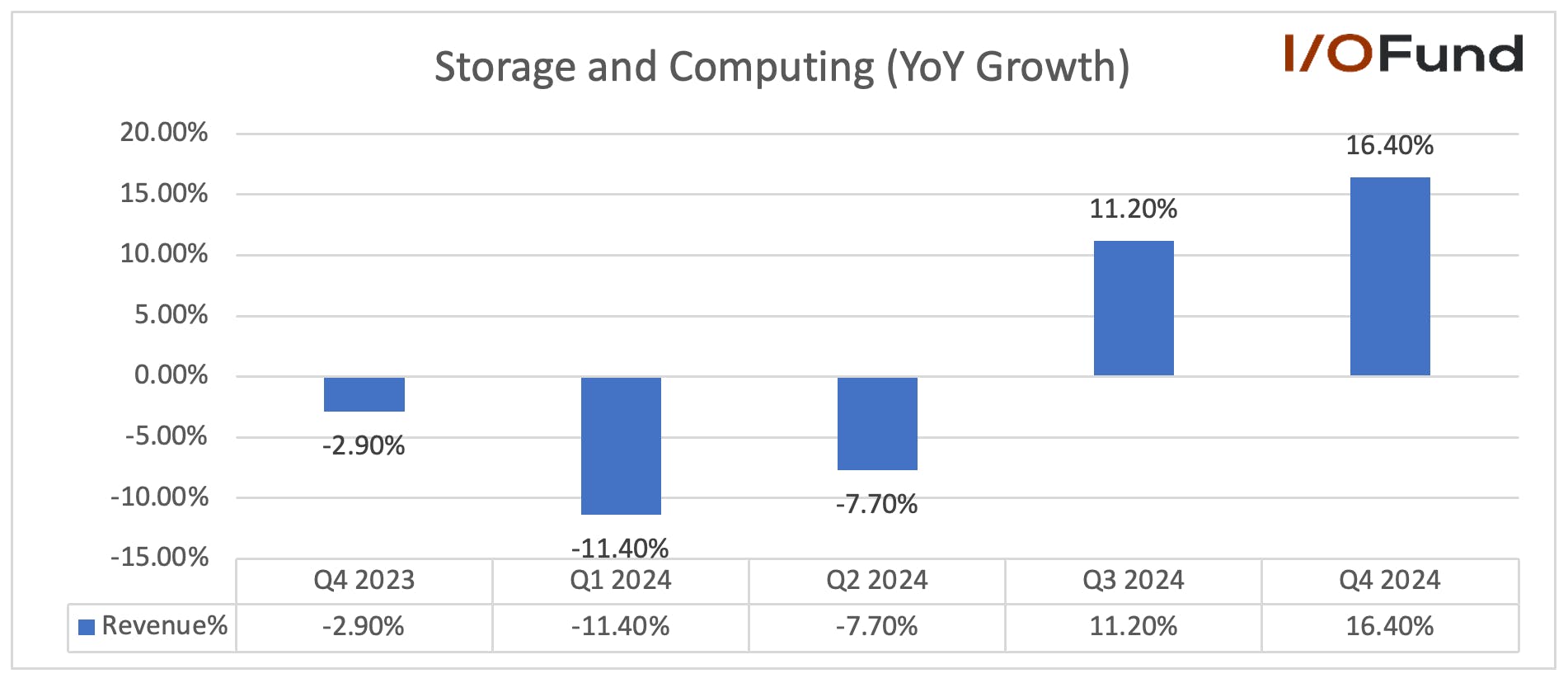
Storage and Computing provides power management for computing and storage devices like power ICs for solid-state drives (SSDs), hard disk drives (HDDs), and notebook and desktop computers. Q4 revenue was up 16.4% YoY to $136.5 million. The full-year 2024 revenues rose 2.1% YoY to $501.6 million, driven by increased sales of products for notebooks. This segment represents 22.7% of total revenue, down from 27% in 2023.

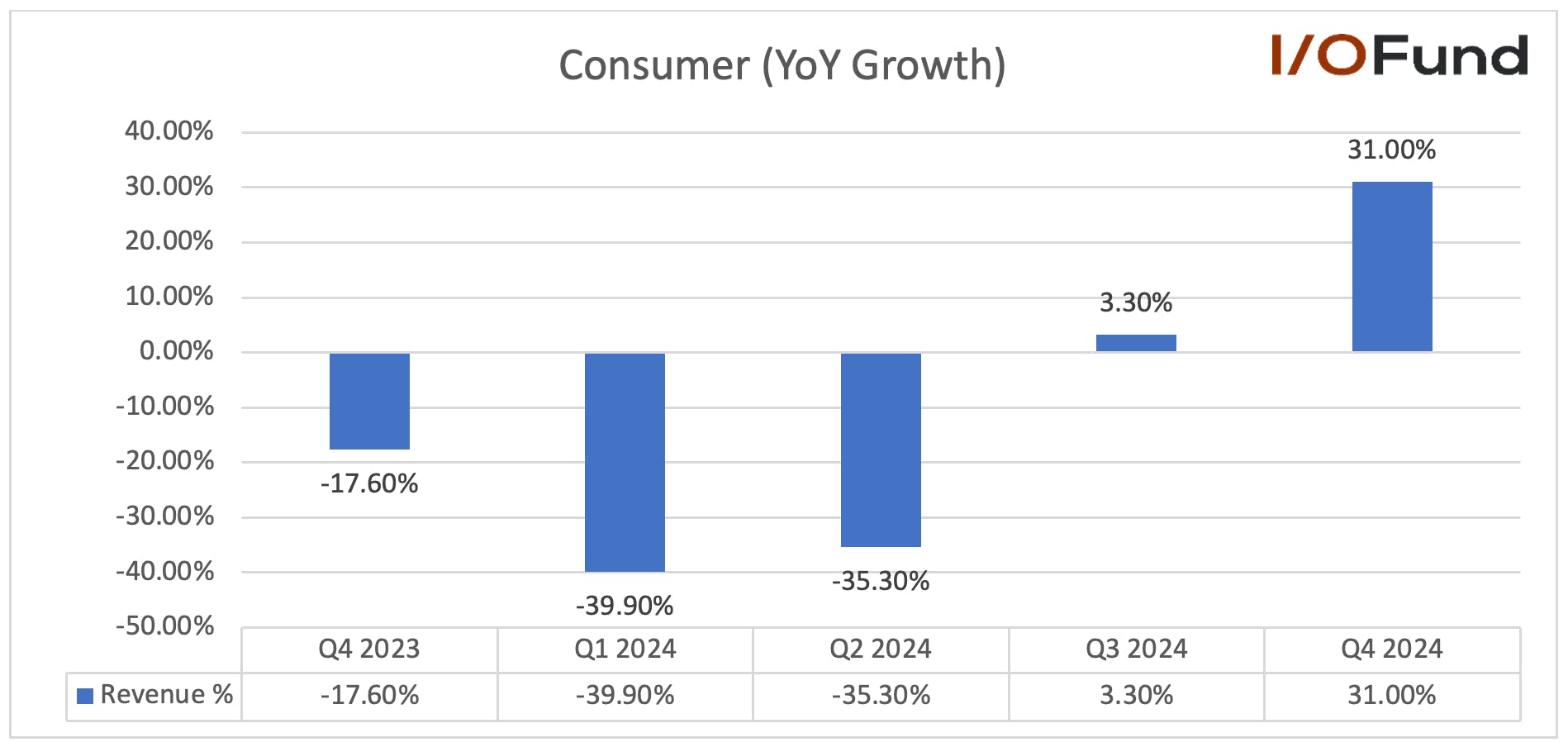
Consumer focuses on power management for consumer electronic devices, including power management ICs for smartphones, tablets, laptops and wearables. This segment has been weak due to the broad market weakness and lower sales of smart TVs, home appliances and gaming solutions. Q4 revenues rose 31% YoY to $57.3 million. Full-year 2024 revenue fell (13.9%) YoY to $202 million, representing 9.1% of total revenues, down from 12.9% in 2023.

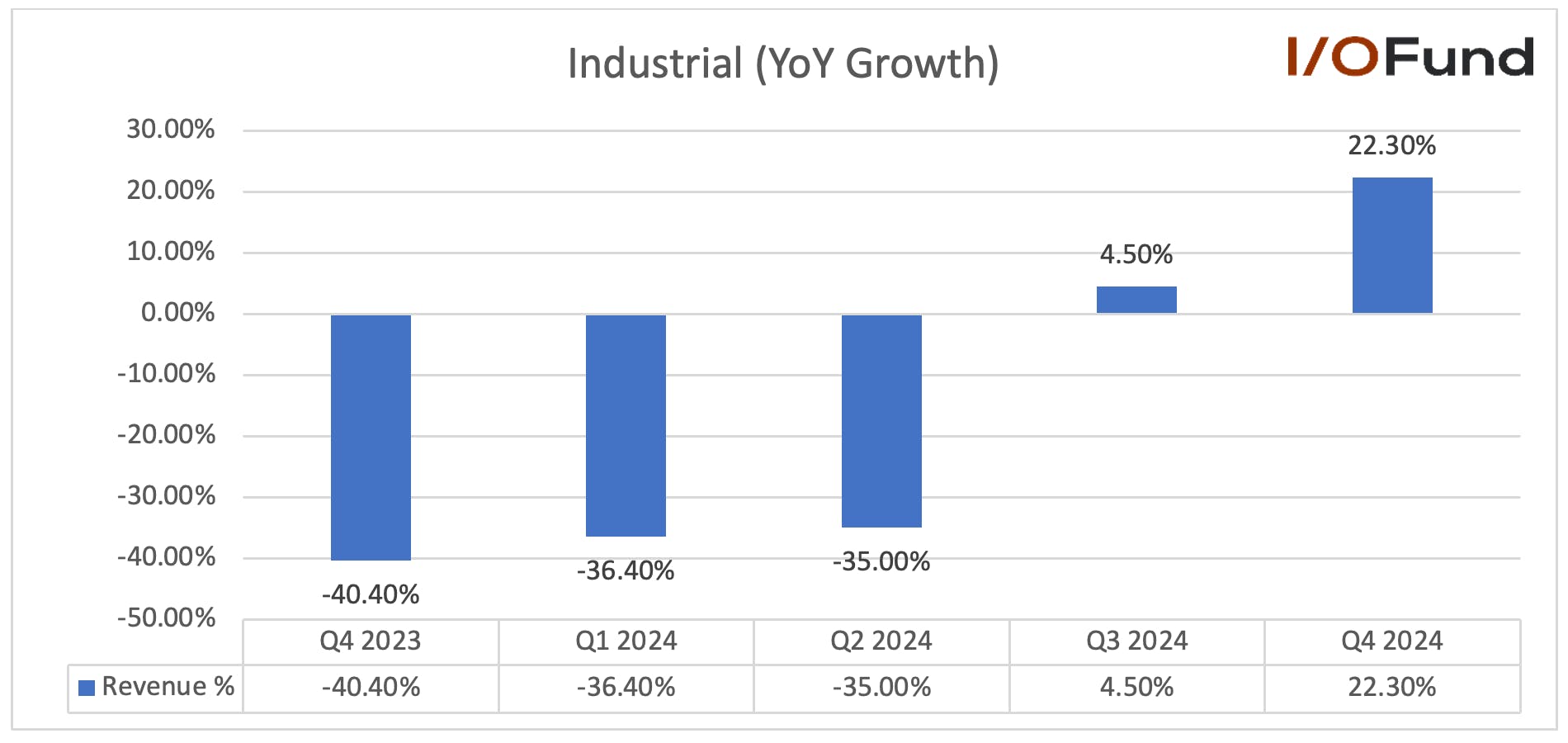
Industrial focuses on industrial applications like ICs for robotics, motor control, industrial automation, machinery and equipment. This division is weak due to market weakness across all industrial segments. Q4 revenue rose 22.3% YoY to $40.8 million. The full-year 2024 revenues fell 14.6% YoY and represent 6.7% of total 2024 revenues, down from 9.4% in 2023.

EPS: A Slow Start in 1H 2025 That Gains Traction in 2H 2025

Monolithic Power posted Q4 2024 non-GAAP EPS of $4.09, beating $3.98 consensus estimates by $0.11 or 2.9%. Management guided Q1 2025 non-GAAP EPS of $3.94, up 40.29% YoY. Margins are gradually improving.

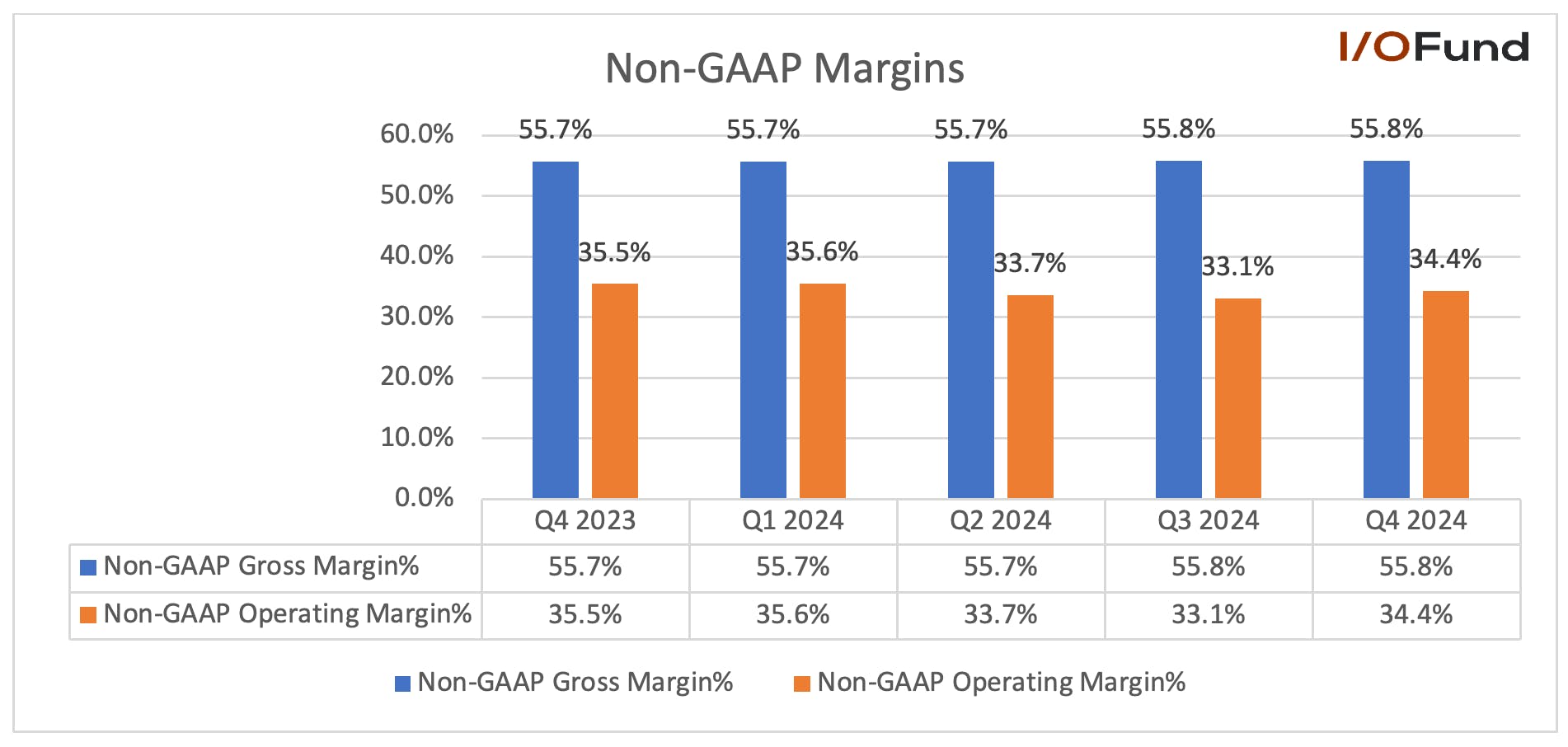
Margins have been steady with gradual improvement. In Q4:

  • Non-GAAP gross margin was 55.80%, up from 55.7% in the year-ago period.
  • The non-GAAP operating margin was 35.5%, up from 34.4% in the year-ago period.
  • Non-GAAP net margin was 31.9%, up from 31% in the year ago period.
  • Cash was $862.9 million, down from $1.1 billion in the year-ago period.
  • The Company completed repurchases in Q4 under a 2023 $640 million authorization.
  • The Company has returned 86% of its free cash to shareholders through share repurchases and dividends paid for the past three years ending December 2024.
  • The Company had no debt in 2023 and 2024.

Risks/Concerns: Three Customers Comprise Over 20% of Sales and Blackwell

Customer concentration is a concern as Q1, Q2 and Q3 and full-year had two direct customers, which were distributors, with more than 10% of sales and one indirect customer with more than 10% of sales. This means that three customers comprise over 20% of 2024 revenues.

Edgewater Research Says NVDA Cancelling 50% of Monolithic’s Backlog in November

There was speculation from Edgewater Research on November 11, 2024, that the company may have lost some market share in NVIDIA's Blackwell GPU line to Renesas and Infineon Technologies, as there may be performance problems with its voltage regulator modules and power management integrated circuits.

Edgewater analysts said, "We hear NVDA will go through their confirmed orders to MPWR for the next few quarters, but we hear NVDA has canceled half of MPWR’s backlog, cutting all of their unconfirmed orders," the analysts explained. "It appears that Renesas may see its Hopper allocation grow to 50% in 1Q or 2Q25, vs ~15% in 4Q24. We are not aware of plans for IFX to be qualified for Hopper. It sounds like NVDA Engineering has lost confidence in MPWR, and they have decided to focus on Renesas and IFX as their two primary suppliers." The analysts also noted that Monolithic's solution to the hopper issue was seen as a "stopgap measure" by several supply chain partners, as opposed to a true resolution to the root cause.

Monolithic Indicates No Changes from Nvidia

Monolithic Power filed an 8-K stating, “In calls with analysts on November 11, 2024, representatives of Monolithic Power Systems, Inc. (the “Company”) confirmed the Company has no performance issues and remains in NVIDIA Corporation’s bill of materials for its next generation systems. The Company’s Q4-2024 guidance remains unchanged.” It’s worth noting that they made a special effort to avoid mentioning any specific names during their Q4 2024 conference call, in accordance with their clients' requests. Customers have made it very clear they don’t want to be disclosed. Keybanc’s note indicates that MPWR has lost market share on the B200/GB200s but will “regain share on Blackwell Ultra in the second half of 2025 as well as the ramp of other AI platforms, including the Google TPU.”

Conference Call Q&A: H1 will be Flat Ahead of Hyperscalers Ramping in H2

The theme of the conference call was about the ramp-up occurring in the second half of 2025. Management really downplayed Enterprise Data in the first half of 2025.

They pointed out the slower start at the beginning of the year was expected as their hyperscaler clients start to ramp with their new offerings later in the year. While the exact timing of the ramp is hard to call they are engaged across all the hyperscalers. Management can't tell which ones will ramp or how much their ramp will be. They have to be ready to receive orders and have the supply chain intact.

Here's what CFO Blegan said in the call.

 “Yes. Just to add a little bit of color to how we see the year rolling out, we believe that, we will be off to a slower start in the first half of the year. But as the year develops, the customer base is expected to broaden as hyperscalers launch their new products. We have multiple product ramps with both existing customers as well as with these new hyperscalers. So as Michael just said, we believe, it's likely to be a flattish year, but we believe that from a quality and supply availability perspective, we're in very good shape.”

Monolithic Power will be ramping up inventory for the second half of 2025. CEO Hsing admitted their inventory and the channel inventory is low, “Our inventory is low, and the channel inventory is low. We're going to be ramping up. And the rest of our stuff, okay, Bernie.”

Enterprise data is expected to be flattish for the year for the whole segment not just AI. Hyperscalers are expected to ramp up in 2H of 2025. Ramps for Silicon Carbide (SOC) and Tensor processors are going to launch in the 2nd half. Existing customers have multiple new product launches in the 2nd half of the year. The trickle-down effect in memory, optical and networking is expected to ramp up in the second half.

CFO Blegen said this during the Q&A.

“As we look at the ramps for both the SOCs and some of the sensor processor products that are expected to come out, we've been prototyping those, but the revenue ramps are really weighted to the second half. In addition, some of our existing customers in the AI business in particular have multiple new products that they're ramping, and those will have different demand profiles as well.”

Management can't tell if it will move revenue needles in Q4 of 2025 or next year. Staying away from quarter-by-quarter but half-by-half for ramps and timing. No telling when the ramps will happen. While large customers are pushing out, others are pulling. Cautiously optimistic that the momentum is moving in the right direction.

CEO Hsing said this during the Q&A when asked about lumpiness of opportunities and trajectory.

“It's very difficult to say. Surely, you go by year-by-year, we don't go by year-by-year, but although we have to report a year-by-year. And I'll give you examples. Our large customers start to push out some product, pulling a lot of other ones. So we can't really tell. And other customers, other hyperscalers start to ramp. They start telling us we're going to keep a ramp, whether the ramp have effective move our revenue needles in Q4 over this year or Q1 over next year, we can't tell.”

Automotive Will Drive Growth Until Enterprise Data Ramps Up in H2

Automotive and Communications are long design cycles; automotive is 2-3 years and 4-5 years ahead of time for design wins, which makes it the easiest to predict. However, the timing of the ramps is hard to tell. They can predict within 6 to 9 mos. EVs in China are growing, supplemented by a European OEM in second half of 2025.

CFO Blegen said this when asked about a broader view into demand for 2025.

“When you look at the end markets, most of the ones that we have are long design cycles. And automotive probably lends itself to being the most predictive because we secure design win two to three years for an EV in advance of when it gets launched, or as many as four to five years for a traditional internal combustion. Now having said that, the timing of those ramps, when we get the design win comes to market, still remains a question mark. But within the context of six to nine months, we can be reasonably predictive. So in automotive, we see a continuation of what's been driving our last two quarters of growth as far as EVs in China. And those will be supplemented in the second half of the year more likely by a European OEM that is going to be bringing up an autonomous driving ADAS solution, as well as additional content opportunities in North American EV Company.”

The Communications segment finally started to grow last year and is in the very early stages of being able to ramp opportunities, particularly with fiber optics, and expects to grow from originally starting with two customers. Areas of strength are in optical, data center opportunity, versus legacy business.

“If you look at comps going forward, their area of strength that we've really been calling out is in optical, and we'd expect that to continue as part of the overall data center opportunity that you heard Michael talk about. So I think that's probably the biggest inflection point that you've seen over the past couple of quarters versus the legacy business.”

CFO Blegen also added.

“And then, when you look at the communications side, I think that is, we're very early stages of being able to ramp the revenue opportunities, particularly in fiber optics. We started out with two primary customers, but we expect that customer base to diversify over the year.”

What the Analyst Said After Q4 2024 Release

Analysts were positive on the results and conference call, with five analysts raising their price targets or ratings and one analyst lowering their price target:

  • Loop Capital raised the firm's price target on Monolithic Power to $760 from $660 and keeps a Buy rating on the shares. The company's Q4 results and Q1 guidance indicate that Monolithic Power continues to take market share in the PMIC (power management integrated circuit) and general analog market, just as the company has done year in and year out for nearly a decade, the analyst tells investors in a research note, “Monolithic Power's strong growth and the better-than-seasonal Q1 guide also reflects continued strong data center-specific revenue as well as cyclical strength in broader market.”
  • TD Cowen raised the firm's price target on Monolithic Power to $750 from $720 and keeps a Buy rating on the shares. The firm said its clean beat/raise was overshadowed by a weak 1H outlook and aggressive 2H ramp in MPS' key Enterprise Data segment.
  • Citi raised the firm's price target on Monolithic Power to $800 from $700 and kept a Buy rating on the shares. “The company reported strong Q4 results and guided Q1 sales better than feared as strength from the Auto, Computing and Storage businesses offset share loss in the Enterprise Data business.” the analyst tells investors in a research note. The firm views the results as reinforcing its thesis that Monolithic is a "long-term diversified quality compounder" that consistently delivers 10%-15% outperformance versus peers. It sees the investor day on March 20 as the next potential catalyst for the stock.
  • KeyBanc analyst John Vinh raised the firm's price target on Monolithic Power (MPWR) to $850 from $700 and keeps an Overweight rating on the shares. “Upside in the quarter was mostly driven by Auto, while guidance reflects strength in Auto, Memory, PCs, and Comms. Enterprise Data is expected to be down quarter-over-quarter in Q1 and flat for 2025 with growth expected to be the second half of the year weighted,” KeyBanc adds. The firm believes this reflects the loss of share on Nvidia's (NVDA) B200/GB200 platform and the regain of share on Blackwell Ultra in the second half of 2025, as well as the ramp of other AI platforms, including the Google (GOOGL) TPU.
  • Wells Fargo analyst Joe Quatrochi raised the firm's price target on Monolithic Power to $710 from $610 and keeps an Equal Weight rating on the shares. The firm notes the company delivered a better-than-expected Q1 guide as Ent Data's weakness will be offset by accelerating other end markets. While the 2025 Ent Data reset is now confirmed, Wells thinks investors could struggle with the first half vs the second half of 2025 end market revenue dynamics.
  • Deutsche Bank lowered the firm's price target on Monolithic Power to $815 from $900 and kept a Buy rating on the shares.

Valuation: Monolithic Systems Stock is Priced at a Premium

Monolithic Power stock trades at a premium. Its stock trades at a P/E of 76.84 and forward P/E of 41.32 vs the industry average of 38.82. The 5-year medium P/E is 79.92. Its price/sales ratio is 16.35, and forward P/S is 12.93. Its price to free cash flow (FCF) is 49.12 vs 62.56 industry average.  May 20, 2025, is the next Investor Day.

Conclusion:

Monolithic Power had a strong 2024, with Enterprise Data achieving 51.2% YoY growth in Q4. However, growth is expected to slow in the first half of 2025 and remain flat for the year as hyperscaler clients ramp up in the second half. Management is preparing by building inventories and strengthening supply chains, positioning the company well heading into 2026, despite uncertainty about the ramp-up's timing.

In the meantime, their automotive revenues continue to accelerate having closed Q4 with 43% YoY growth. Automotive tends to be more predictable and the growth in EVs especially in China is continuing the momentum. A European OEM will be ramping up autonomous driving ADAS solutions in the second half to keep the momentum thriving. After closing Q4 with 55.9% YoY growth, its Communications business is in the very early stages of a revenue ramp powered driven by fiber optics. Automobile and Communications will carry the growth in H1 through H2, while Enterprise Data will ramp up in H2 heading into 2026.

Automotive revenues accelerated with 43% YoY growth in Q4, driven by strong EV momentum in China and expected to continue with upcoming ramp of autonomous ADAS solutions from a European OEM in H2. The Communications business also posted robust growth, rising 55.9% YoY in Q4 as it initiates a fiber optics-driven revenue ramp. Together, these segments are expected to drive growth through H1 and H2, while Enterprise Data will ramp up in H2 heading into 2026.

It may be premature to invest in Monolithic Power at this time, but its sustained growth in the Automotive and Communications segments along with the Enterprise Data ramp up in H2 suggests that it could become a strong candidate for the portfolio as we exit 2025.

Jea Yu, Equity Analyst at the I/O Fund, contributed to this article.

Please note: The I/O Fund conducts research and draws conclusions for the Fund’s positions. We then share that information with our readers. This is not a guarantee of a stock’s performance. Please consult your personal financial advisor before buying any stock in the companies mentioned in this analysis.

Recommended Reading:

AI Hardware Suppliers Forecast Muted H1, Strong H2 — and What it Might Mean for Nvidia

We’ve heard from a handful of management teams that are direct suppliers to Blackwell over the last four business days, and the tone has shifted to more of a H2 discussion for rack-level systems. There are a few possibilities for this shift in tone, such as these specific suppliers are falling out of favor with Nvidia, but given that a variety of suppliers are echoing one another, it’s more likely that Nvidia’s GB200s are not completely on time to ramp in volume for Q1 and at least for part of Q2 as “mid-summer” and “H2” has come up repeatedly. 

This is not a prediction, as reading tea leaves or a crystal ball is not the service we offer. What we offer is analysis – a way of connecting the dots to make more informed decisions. Right now, according to our analysis and earnings calls, the risk to the downside has increased that Nvidia is not shipping on time for the more complex GPU systems. Should the analysis play out, it simply means we will get Nvidia’s stock lower for the next leg higher.

The comments offered below are subtleties, as the last thing a supplier wants to do is get in the crosshairs of Nvidia. Yet, we’ve had a handful of suppliers’ report, and I’m struggling to find the expected strong commentary for the March quarter and there is also an absence of strong commentary for the June quarter (as it currently stands).

I’ve been on back-to-back earnings calls and offer the following excerpts in terms of this conclusion.

Astera Labs: Aries PCIe Gen 6 Tone Changed

It makes sense to start with Astera because they were the most direct in terms of discussing merchant GPUs (i.e., Nvidia) not being the driver for Q1.

Astera stated they are shipping pre-production quantities for its Scorpio P Series and Aries PCIe Gen 6 solutions to maximize GPU throughput. The company stated: “These programs are driving higher dollar content opportunities for Astera Labs on a full rack and full accelerator basis and we expect volume deployments to begin in the second half of this year.”

What this comment implies is both the Scorpio P Series and PCIe Gen 6 will deploy in H2, yet originally, PCIe 6.0 was expected to ramp with support initially offered in the GB200s. Back in March, Astera demo’ed PCIe 6.0 for a wide range of Blackwell products.

There was also indication back in the August call that Gen 6 was confirmed to be used in Blackwell’s GB200, and there were initial shipments: “We have started shipping initial quantities of preproduction orders of our PCIe Gen 6 solution, Aries 6. We ship and support our hyperscaler customers initial program developments that are based on Nvidia's Blackwell platform, including GB200.”

There was further confirmation in the November call that preproduction volumes were shipping: “At the recent 2024 OCP Global Summit, we demonstrated the industry's first PCIe Gen 6 fabric switch, which is currently shipping in preproduction volumes for AI platforms.”

As Nvidia investors, we keep a close eye on these suppliers as they often can flag any issues with unparalleled accuracy. Given we are nose-down on many earnings reports over the past year regarding Nvidia’s AI systems specifically, there’s a notable change in tone for Astera to go from preproduction volumes to now shipping in volume in H2.

The following was discussed in the Q&A section:

“Now, if you look into 2025, we see both contributing growth. The first half of the year will be more predominantly the AI – internal AI accelerator programs. But if you get into the back half of the year, the transition on the merchant GPUs will also be very strong for us. This is where you'll see the custom rack configurations start to deploy and that’s where we see a big dollar increase in our contemporary GPU with Scorpio starting to ramp.”

On one hand this is a positive, but on the other hand, it raises questions as to why merchant GPUs (Nvidia) will be stronger in the back half of the year as this does not match the anticipated timing originally described by Nvidia’s management team with the CEO stating, “Blackwell production is in full steam. I think we're in great shape with respect to the Blackwell ramp at this point.”

There could be an argument made it’s unique to Astera Labs, yet we have seen something similar echoed across a few management teams recently.

Thomas O'Malley   Barclays Bank

Super helpful. And then my follow-up was just — I think it was Mike's commentary on one of the first questions here on the call. You talked about kind of the year 2025 on the Aries side, talking about how in the first half of the year, you would see more internal AI efforts followed by the second half of the year being more merchant GPU. That comment was a bit surprising to me given we're going through a big product transition now at the large customer of yours. So is there any change in the way that you see the ramp of 2025 versus where you did before? I would have anticipated maybe the merchant GPU being a bit stronger earlier in the year. Just any reason behind those comments that caught me a little off guard.

Michael Tate   CFO

Sure. Yes, so the — first of all, the merchant GPU drives both Scorpio and Aries. So the big incremental piece of the merchant GPUs is the score field content which is all new for us. The designs that we have are complex in nature, they're all new. So the — to get them — to productize and ramp we're looking at that to start off in the back half of the year. Right now, in the first half of the year's preproduction. These are all for custom configuration. So the customization adds a little bit of lead time to the volume rates.

Coherent: Tone on Pluggable Optics Versus Active Cable

In our analysis published last week, it was stated: “As we look at larger AI systems ramping this year, there is some evidence that issues around single-rack Blackwell systems have been resolved yet multi-rack interconnects continue to see issues with overheating. Even though Nvidia has stated they are on schedule with Blackwell, the B300s and next generation Rubin will very likely require more fine-tuning.”

However, there was a sudden change in Coherent’s tone around fiber optics versus copper, which we outlined here:

“Looking beyond traditional pluggable optics, there is an increasing amount of discussion around co-packaged optics (CPOs), which places the optical transceivers directly on the chip package, rather than using separate optical modules. This results in faster data transmission, reduced latency and higher bandwidth. This may be the best of both worlds: the performance of optical yet with reduced power consumption. Tracking this is especially important as since we last covered copper/Semtech, there have been reports that copper is “causing concurrent issues with overheating and glitching” with rumors Nvidia will launch a CPO switch at the upcoming GTC. That could mean Coherent will be a lead supplier for the anticipated CPO switch – we will be monitoring this closely.”

This later led to Semtech stating they expect sales of CopperEdge products to be lower than the $50 million guidance provided in the earnings call four weeks ago. Our team’s spidey senses were up following Coherent’s report (per the paragraph above), and thus, we respected the stop we provided to our Members in weekly webinars – here and here. The stop was hit on Friday with a trade alert stating the story had changed about 30 mins before market close. The context is important as it communicates that Semtech was also caught off guard as to changes with the server rack configuration with a sudden, unforeseen change in the last four weeks.

Regarding Coherent, if they were the beneficiary of pluggable optics replacing copper, one would assume a strong Q1. Yet when asked about the flat QoQ revenue on the call, the CEO stated it was not due to the AI-related segments: “It's pretty straightforward. We expect datacom and telecom to be up sequentially. And we expect the rest of our industrial related businesses to be down sequentially. And that net at the midpoint to be flat.”

Perhaps AI-related segments are remaining strong enough to not miss guidance, yet why are they not able to offset industrial weakness for sequential growth. That piece was left unanswered.

Read-through for Credo?

One potential read-through is that Credo is in a better position to gain the business following Semtech’s announcement with its AECs for AI backend networks. The company also offers optical DSPs and PAM4 solutions. The possibility of Credo gaining this business is an outcome we have been prepping for by owning a wide array of suppliers. Read more here.

With that said, it’s the sudden change of information from four weeks ago – announced Friday after market close — that marks a notable shift our Members should be aware of.

Power Management Integrated Circuits (PMICs):

This component is where the rubber meets the road as the thermal management issues Blackwell has been rumored to face are addressed with PMICs.

Monolithic Power Systems reported on Friday and had many comments about their ramp being H2 weighted: “Yes. Just to add a little bit of color to how we see the year rolling out, we believe that, we will be off to a slower start in the first half of the year. But as the year develops, the customer base is expected to broaden as hyperscalers launch their new products. We have multiple product ramps with both existing customers as well as with these new hyperscalers. So as Michael just said, we believe, it's likely to be a flattish year, but we believe that from a quality and supply availability perspective, we're in very good shape.”

On one hand, some analysts do not think MPS is designed into the Blackwell systems (Keybanc) whereas Truist is “highly confident” MPS is designed into the systems. According to this report, I lean with Keybanc that MPS is designed into Blackwell Ultra.

“(11/18) KeyBanc lowered the firm's price target on Monolithic Power to $700 from $1,075 and keeps an Overweight rating on the shares. The firm believes Monolithic Power will lose significant market share on Blackwell with the ramp of GB200/B200, as Hopper PMIC overheating issues have persisted on Blackwell. KeyBanc expects IFX to be the primary supplier on Blackwell, with Renesas having secondary share. While Monolithic Power is attempting to requalify, the earliest this likely could happen would be with Blackwell Ultra in the second half of 2025.”

“(12/16) Truist analyst William Stein lowered the firm's price target on Monolithic Power to $762 from $887 and keeps a Buy rating on the shares. The firm reiterated a cautious semiconductor and artificial intelligence sector view, but is more constructive on Nvidia (NVDA) and Monolithic Power (MPWR) while more cautious on Tesla (TSLA). While Monolithic Power's print position at Nvidia is in doubt today, Truist is "highly confident" that Monolithic is designed in to Blackwell, the analyst tells investors in a research note. The firm cut enterprise data revenue estimates for Q1 significantly, but highlights Monolithic's "likely top position across a breadth of AI customers, supporting solid growth over the next few years."

Yet another PMIC supplier that we covered on the Advanced side on Feb 5th, is stating that “We know that we're not the only one players going after this, so the share is still to be determined. The final design, everything is still to be finalized as well, too. So we're working closely with the customer. Again, at this point, we can say that we're targeting for a mid-year launch.”

This company is either discussing Blackwell Ultra with the B300s, or they are implying GB200s are delayed. After hearing from more component suppliers, the likelihood they are actually discussing Blackwell (and not Blackwell Ultra) has increased since we wrote the analysis last week.

Conclusion:

Investors should have a plan for this – ride out any weakness with the understanding there is $300 billion in capex and growing pointed right at AI hardware, or have a more active stance which includes risk controls such as stops on positions, hedging, etcetera. For the IOF, we hedge while having predefined price targets and predefined stops. For the most part, should the analysis we’ve presented above play out, then our goal will be to buy quality suppliers at lower prices. I firmly believe the suppliers that move Blackwell forward with be greatly rewarded, and the hard work we are putting in will be rewarded.

Direct liquid cooling suppliers report today at the bell (SMCI) and tomorrow before market open (Vertiv). Let’s see if they are aligned (or not) with the other suppliers offering a mixed Q1 outlook.

Regarding Nvidia, we recently trimmed 6% to re-allocate to Nvidia AI hardware suppliers. If we break $126 and/or $113, it’s my understanding we will trim more with the goal of loading back up sub-$100 and perhaps even sub-$90. Join the Advanced webinar this Thursday to find out more.

Please note: The I/O Fund conducts research and draws conclusions for the company’s portfolio. We then share that information with our readers and offer real-time trade notifications. This is not a guarantee of a stock’s performance and it is not financial advice. Please consult your personal financial advisor before buying any stock in the companies mentioned in this analysis. Beth Kindig and the I/O Fund own shares in NVDA at the time of writing and may own stocks pictured in the charts.

Recommended Reading:

AI Hardware Suppliers Forecast Muted H1, Strong H2 — and What it Might Mean for Nvidia

We’ve heard from a handful of management teams that are direct suppliers to Blackwell over the last four business days, and the tone has shifted to more of a H2 discussion for rack-level systems. There are a few possibilities for this shift in tone, such as these specific suppliers are falling out of favor with Nvidia, but given that a variety of suppliers are echoing one another, it’s more likely that Nvidia’s GB200s are not completely on time to ramp in volume for Q1 and at least for part of Q2 as “mid-summer” and “H2” has come up repeatedly. 

This is not a prediction, as reading tea leaves or a crystal ball is not the service we offer. What we offer is analysis – a way of connecting the dots to make more informed decisions. Right now, according to our analysis and earnings calls, the risk to the downside has increased that Nvidia is not shipping on time for the more complex GPU systems. Should the analysis play out, it simply means we will get Nvidia’s stock lower for the next leg higher.

The comments offered below are subtleties, as the last thing a supplier wants to do is get in the crosshairs of Nvidia. Yet, we’ve had a handful of suppliers’ report, and I’m struggling to find the expected strong commentary for the March quarter and there is also an absence of strong commentary for the June quarter (as it currently stands).

I’ve been on back-to-back earnings calls and offer the following excerpts in terms of this conclusion.

Astera Labs: Aries PCIe Gen 6 Tone Changed

It makes sense to start with Astera because they were the most direct in terms of discussing merchant GPUs (i.e., Nvidia) not being the driver for Q1.

Astera stated they are shipping pre-production quantities for its Scorpio P Series and Aries PCIe Gen 6 solutions to maximize GPU throughput. The company stated: “These programs are driving higher dollar content opportunities for Astera Labs on a full rack and full accelerator basis and we expect volume deployments to begin in the second half of this year.”

What this comment implies is both the Scorpio P Series and PCIe Gen 6 will deploy in H2, yet originally, PCIe 6.0 was expected to ramp with support initially offered in the GB200s. Back in March, Astera demo’ed PCIe 6.0 for a wide range of Blackwell products.

There was also indication back in the August call that Gen 6 was confirmed to be used in Blackwell’s GB200, and there were initial shipments: “We have started shipping initial quantities of preproduction orders of our PCIe Gen 6 solution, Aries 6. We ship and support our hyperscaler customers initial program developments that are based on Nvidia's Blackwell platform, including GB200.”

There was further confirmation in the November call that preproduction volumes were shipping: “At the recent 2024 OCP Global Summit, we demonstrated the industry's first PCIe Gen 6 fabric switch, which is currently shipping in preproduction volumes for AI platforms.”

As Nvidia investors, we keep a close eye on these suppliers as they often can flag any issues with unparalleled accuracy. Given we are nose-down on many earnings reports over the past year regarding Nvidia’s AI systems specifically, there’s a notable change in tone for Astera to go from preproduction volumes to now shipping in volume in H2.

The following was discussed in the Q&A section:

“Now, if you look into 2025, we see both contributing growth. The first half of the year will be more predominantly the AI – internal AI accelerator programs. But if you get into the back half of the year, the transition on the merchant GPUs will also be very strong for us. This is where you'll see the custom rack configurations start to deploy and that’s where we see a big dollar increase in our contemporary GPU with Scorpio starting to ramp.”

On one hand this is a positive, but on the other hand, it raises questions as to why merchant GPUs (Nvidia) will be stronger in the back half of the year as this does not match the anticipated timing originally described by Nvidia’s management team with the CEO stating, “Blackwell production is in full steam. I think we're in great shape with respect to the Blackwell ramp at this point.”

There could be an argument made it’s unique to Astera Labs, yet we have seen something similar echoed across a few management teams recently.

Thomas O'Malley   Barclays Bank

Super helpful. And then my follow-up was just — I think it was Mike's commentary on one of the first questions here on the call. You talked about kind of the year 2025 on the Aries side, talking about how in the first half of the year, you would see more internal AI efforts followed by the second half of the year being more merchant GPU. That comment was a bit surprising to me given we're going through a big product transition now at the large customer of yours. So is there any change in the way that you see the ramp of 2025 versus where you did before? I would have anticipated maybe the merchant GPU being a bit stronger earlier in the year. Just any reason behind those comments that caught me a little off guard.

Michael Tate   CFO

Sure. Yes, so the — first of all, the merchant GPU drives both Scorpio and Aries. So the big incremental piece of the merchant GPUs is the score field content which is all new for us. The designs that we have are complex in nature, they're all new. So the — to get them — to productize and ramp we're looking at that to start off in the back half of the year. Right now, in the first half of the year's preproduction. These are all for custom configuration. So the customization adds a little bit of lead time to the volume rates.

Coherent: Tone on Pluggable Optics Versus Active Cable

In our analysis published last week, it was stated: “As we look at larger AI systems ramping this year, there is some evidence that issues around single-rack Blackwell systems have been resolved yet multi-rack interconnects continue to see issues with overheating. Even though Nvidia has stated they are on schedule with Blackwell, the B300s and next generation Rubin will very likely require more fine-tuning.”

However, there was a sudden change in Coherent’s tone around fiber optics versus copper, which we outlined here:

“Looking beyond traditional pluggable optics, there is an increasing amount of discussion around co-packaged optics (CPOs), which places the optical transceivers directly on the chip package, rather than using separate optical modules. This results in faster data transmission, reduced latency and higher bandwidth. This may be the best of both worlds: the performance of optical yet with reduced power consumption. Tracking this is especially important as since we last covered copper/Semtech, there have been reports that copper is “causing concurrent issues with overheating and glitching” with rumors Nvidia will launch a CPO switch at the upcoming GTC. That could mean Coherent will be a lead supplier for the anticipated CPO switch – we will be monitoring this closely.”

This later led to Semtech stating they expect sales of CopperEdge products to be lower than the $50 million guidance provided in the earnings call four weeks ago. Our team’s spidey senses were up following Coherent’s report (per the paragraph above), and thus, we respected the stop we provided to our Members in weekly webinars. The stop was hit on Friday with a trade alert stating the story had changed about 30 mins before market close. The context is important as it communicates that Semtech was also caught off guard as to changes with the server rack configuration with a sudden, unforeseen change in the last four weeks.

Regarding Coherent, if they were the beneficiary of pluggable optics replacing copper, one would assume a strong Q1. Yet when asked about the flat QoQ revenue on the call, the CEO stated it was not due to the AI-related segments: “It's pretty straightforward. We expect datacom and telecom to be up sequentially. And we expect the rest of our industrial related businesses to be down sequentially. And that net at the midpoint to be flat.”

Perhaps AI-related segments are remaining strong enough to not miss guidance, yet why are they not able to offset industrial weakness for sequential growth. That piece was left unanswered.

Read-through for Credo?

One potential read-through is that Credo is in a better position to gain the business following Semtech’s announcement with its AECs for AI backend networks. The company also offers optical DSPs and PAM4 solutions. The possibility of Credo gaining this business is an outcome we have been prepping for by owning a wide array of suppliers. Read more here.

With that said, it’s the sudden change of information from four weeks ago – announced Friday after market close — that marks a notable shift our Members should be aware of.

Power Management Integrated Circuits (PMICs):

This component is where the rubber meets the road as the thermal management issues Blackwell has been rumored to face are addressed with PMICs.

Monolithic Power Systems reported on Friday and had many comments about their ramp being H2 weighted: “Yes. Just to add a little bit of color to how we see the year rolling out, we believe that, we will be off to a slower start in the first half of the year. But as the year develops, the customer base is expected to broaden as hyperscalers launch their new products. We have multiple product ramps with both existing customers as well as with these new hyperscalers. So as Michael just said, we believe, it's likely to be a flattish year, but we believe that from a quality and supply availability perspective, we're in very good shape.”

On one hand, some analysts do not think MPS is designed into the Blackwell systems (Keybanc) whereas Truist is “highly confident” MPS is designed into the systems. According to this report, I lean with Keybanc that MPS is designed into Blackwell Ultra.

“(11/18) KeyBanc lowered the firm's price target on Monolithic Power to $700 from $1,075 and keeps an Overweight rating on the shares. The firm believes Monolithic Power will lose significant market share on Blackwell with the ramp of GB200/B200, as Hopper PMIC overheating issues have persisted on Blackwell. KeyBanc expects IFX to be the primary supplier on Blackwell, with Renesas having secondary share. While Monolithic Power is attempting to requalify, the earliest this likely could happen would be with Blackwell Ultra in the second half of 2025.”

“(12/16) Truist analyst William Stein lowered the firm's price target on Monolithic Power to $762 from $887 and keeps a Buy rating on the shares. The firm reiterated a cautious semiconductor and artificial intelligence sector view, but is more constructive on Nvidia (NVDA) and Monolithic Power (MPWR) while more cautious on Tesla (TSLA). While Monolithic Power's print position at Nvidia is in doubt today, Truist is "highly confident" that Monolithic is designed in to Blackwell, the analyst tells investors in a research note. The firm cut enterprise data revenue estimates for Q1 significantly, but highlights Monolithic's "likely top position across a breadth of AI customers, supporting solid growth over the next few years."

Yet another PMIC supplier that we covered on the Advanced side on Feb 5th, is stating that “We know that we're not the only one players going after this, so the share is still to be determined. The final design, everything is still to be finalized as well, too. So we're working closely with the customer. Again, at this point, we can say that we're targeting for a mid-year launch.”

This company is either discussing Blackwell Ultra with the B300s, or they are implying GB200s are delayed. After hearing from more component suppliers, the likelihood they are actually discussing Blackwell (and not Blackwell Ultra) has increased since we wrote the analysis last week.

Conclusion:

Investors should have a plan for this – ride out any weakness with the understanding there is $300 billion in capex and growing pointed right at AI hardware, or have a more active stance which includes risk controls such as stops on positions, hedging, etcetera. For the IOF, we hedge while having predefined price targets and predefined stops. For the most part, should the analysis we’ve presented above play out, then our goal will be to buy quality suppliers at lower prices. I firmly believe the suppliers that move Blackwell forward with be greatly rewarded, and the hard work we are putting in will be rewarded.

Direct liquid cooling suppliers report today at the bell (SMCI) and tomorrow before market open (Vertiv). Let’s see if they are aligned (or not) with the other suppliers offering a mixed Q1 outlook.

Regarding Nvidia, we recently trimmed 6% to re-allocate to Nvidia AI hardware suppliers. If we break $126 and/or $113, it’s my understanding we will trim more with the goal of loading back up sub-$100 and perhaps even sub-$90. We will discuss this more in our Advanced webinar this Thursday.

Please note: The I/O Fund conducts research and draws conclusions for the company’s portfolio. We then share that information with our readers and offer real-time trade notifications. This is not a guarantee of a stock’s performance and it is not financial advice. Please consult your personal financial advisor before buying any stock in the companies mentioned in this analysis. Beth Kindig and the I/O Fund own shares in NVDA at the time of writing and may own stocks pictured in the charts.

Recommended Reading:

Astera Labs Q4 Earnings: Strong Commentary for H2 Ramp; What It Could Mean

Astera Labs reported solid earnings that beat the top-line and bottom-line estimates driven by AI strength. Q4 revenue grew by 179.4% YoY and 24.8% QoQ to $141.3 million, beating estimates by 10.3%. Adjusted EPS grew by 208.3% YoY to $0.37 and 150% YoY to $0.30 after excluding one-time tax benefit, beating estimates by 15.8%.

Management Q1 revenue guide is $151 million to $155 million, representing YoY growth of 134.4% at the midpoint, beating estimates by 14.2%. Adjusted EPS guide is $0.28 to $0.29, beating estimates by 14%.

The only downside in the report was the gross margin, which was below the management guide due to the higher mix of hardware revenue. Management reiterated that margins will trend closer to the long-term gross margin target of 70% from the current 74%.

Looking ahead, the IOF is likely to build a bigger Astera position in 2025 due to nearly-unrivaled pricing power from PCIe 5.0 retimers and higher average sales prices from the soon-ramping Scorpio PCIe 6.0 switches. In our original analysis, it was stated: “We are interested in Astera Labs for the increased average sales prices that are expected to persist at least through 2025-2026 due to the Aries products and upcoming Scorpio products.” This was reiterated on the earnings call: “we will continue to benefit from increased dollar content per accelerator in these next-generation AI infrastructure systems.”

The see-saw market reaction is similar to what we are seeing across many AI-related hardware companies, which is due to mixed messaging around the delivery of Blackwell systems. Management indicated their Q1 is primarily being driven by custom silicon programs, which is a positive to be diversified, yet requires additional due diligence for Nvidia investors such as ourselves.

Overall, management teams are offering a more muted Q1 in their commentary with increased anticipation for H2 2025. Where Astera Labs is unique is they serve both custom silicon and GPU systems, of which, there are many systems combining both.

Regarding tariffs and China, Astera Labs has 15% exposure and this is less of a concern for this stock, then say, something like Blackwell being delayed. It’s speculative as to the extent that Blackwell is delayed, yet we have now another management team aligned with this possibility.

I look at this and more below.

Q4 Revenue Grows 179% from Aries and Taurus Products

Chart of Astera Labs quarterly revenue and YoY growth rates

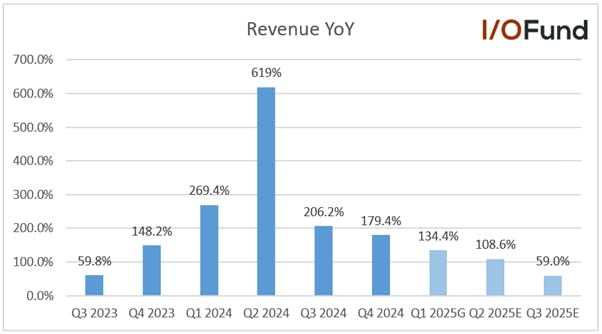
The company’s Q4 revenue grew by 179.4% YoY and 24.8% QoQ to $141.3 million, beating estimates by 10.3%, driven by strong AI demand.

The company experienced significant revenue growth in Q4 primarily due to strong sales of its Aries PCIe Retimer and Taurus Ethernet Smart Cable Module products. Leo and Scorpio's product momentum continued, with both products shipping in pre-production volumes during the fourth quarter.

Here is what management stated about the beat – most intriguing is the note that 2025 will be a “breakout year” and that the Scorpio products are slated to become the company’s largest product line (and yet did not drive the current outsized revenue growth and beat):

“Our revenue growth in 2024 was largely driven by Aries products, along with a strong ramp of Taurus in the fourth quarter. We expect 2025 to be a breakout year as we enter a new phase of growth driven by production revenue from all four of our product families to support a diverse set of customers and platforms. We expect 2025 to be a breakout year as we enter a new phase of growth driven by production revenue from all four of our product families to support a diverse set of customers and platforms. 

In 2025, our Aries and Taurus retirements are on track to continue their strong growth trajectory. Also, Astera Labs is poised to be a key enabler of CXL proliferation over the next several years with the volume ramp of our Leo family expected to start in second half of ‘25. 

Finally, our Scorpio smart fabric switches will begin ramping this year with new and broadening engagements for a scale up with our X series and scale out with our PCD switches. In time, we expect Scorpio Fabrics switches to become our largest product line, given the size and growth of the market opportunity for AI Fabrics.”to become our largest product line, given the size and growth of the market opportunity for AI Fabrics.”

  • Management Q1 revenue guide is $151 million to $155 million, representing a YoY growth of 134.4% and 8.4% QoQ at the midpoint, beating estimates by 14.2%.
  • Analysts expect revenue to grow 108.6% YoY and 5% QoQ to $160.58 million in Q2 and 59% YoY and 12% QoQ to $179.85 million in Q3.
Graph of Astera Labs revenue growth quarterly and forward estimates 2025
  • 2024 revenue grew by 242.3% YoY to $396.3 million, accelerating from 45% growth in 2023.
  • Looking further out, analysts expect revenue to grow 75% in 2025 and 25.8% in 2026.

Regarding 2025 being a breakout year, management stated it was partly due to increased dollar content per accelerator. We offer more in the Q&A section below, yet this was stated in the opening remarks: “As we look into 2025, we see strong secular trends across the industry, supported by higher CapEx spent by our customers, broadening deployment of AI infrastructure driven by more efficient AI models, and company-specific catalysts that should drive above market growth rates for Astera Labs.

Specifically, for 2025, we expect three key business drivers. One is the continued deployment of internally developed AI accelerator platforms that incorporate multiple Astera Labs product families, including Aries, Taurus and Scorpio. As a result, we will continue to benefit from increased dollar content per accelerator in these next-generation AI infrastructure systems.”

The total addressable market of $12 billion was further reiterated by saying, “We estimate our portfolio of hardware and software solutions across retimers, controller and fabric switches will address a $12 billion market by 2028.”

Gross Margin Contracts 330 Basis Points YoY

The company’s bottom line is growing at a remarkable pace. However, the margins will trend lower in the coming quarters due to the expected higher mix of hardware revenue. Notably, stock-based compensation is high yet the company has strong GAAP profitability potential as SBC becomes a lower percentage in the coming quarters/years.

Table of Astera Labs quarterly gross margins, operating and net margins

The CFO answered an analyst question on margins for 2025. “Now, if you go into 2025, we still see good contribution from Taurus and Aries SCM modules. But as we make it through the year, the Aries board and chips as well as Leo and Scorpio are a positive for us as well. So, we think Q1 and Q2, we should have a consistent margin profile of around 74%. And as we highlighted, margins will be trending down closer to the longer term model of 70%, but it all depends on the mix of our hardware versus silicon.”

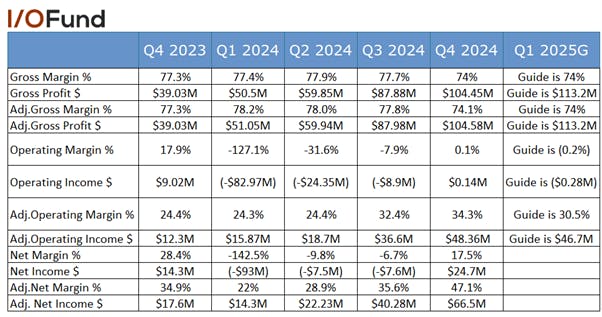
  • Gross profit grew by 167.6% YoY to $104.5 million or 74% of revenue compared to 77.3% in the same period last year.
  • Adjusted gross margin was 74.1% compared to 77.3% in the same period last year. The gross margin was below the management guide of 75% due to the higher mix of hardware revenue. Management guide for the next quarter is 74%.
  • Operating margin was 0.1% compared to 17.9% in the same period last year.
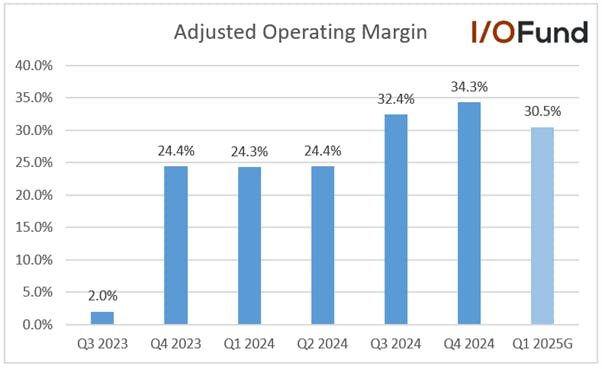
  • Adjusted operating margin was 34.3% compared to 24.4% in the same period last year; it was better than the guide of 32.4%, helped by operating leverage. However, operating expenses were higher than the management expectation as it continued to invest in R&D to support the strong growth and they closed a small acquisition in the quarter that also contributed to higher spending in the quarter.
  • Management Q1 adjusted operating margin guide is 30.5%. The CFO said in the earnings call, “Operating expenses will grow in Q1 is largely driven by three factors, one, continued momentum in expanding our R&D resource pool across headcount and intellectual property. Two, seasonal labor, expense step ups associated with annual performance merit increases and payroll tax resets, and three, a full quarter contribution of the strategic acquisition we executed in the latter part of Q4.”
  • Net income grew by 72.7% YoY to $24.7 million or 17.5% of revenue compared to 28.4% in the same period last year. Adjusted net income grew by 277.8% YoY to $66.5 million or 47.1% compared to 34.9% in the same period last year. The company benefited from a one-time tax benefit of $7.6 million in Q4.
  • The vast difference between GAAP and non-GAAP net income was due to the stock-based compensation of $48.2 million or 34.2% of revenue in Q4. Once SBC naturally levels out, this company has strong enough margins to become GAAP profitable.
Chart of Astera Labs quarterly adjusted oeprating margin

Strong EPS growth

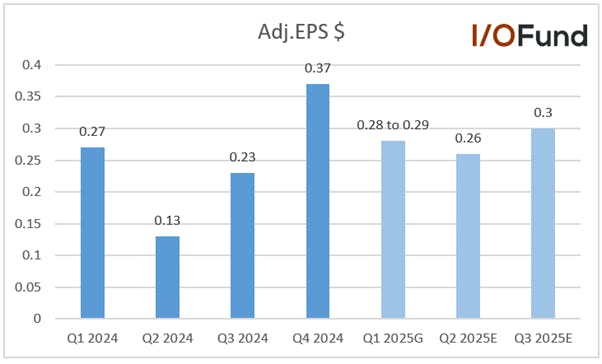
Adjusted EPS grew by 208.3% YoY to $0.37 and 150% YoY to $0.30 after excluding one-time tax benefits, beating estimates by 15.8%, driven by strong operating leverage.

  • Q1 adjusted EPS guide is $0.28 to $0.29, beating estimates by 14%.
  • Analysts expect adjusted EPS to grow 38.5% YoY to $1.16 in 2025 and 52.6% YoY to $1.77 in 2026.
Graph of Astera Labs quarterly adjusted EPS

Cash Flows and Balance Sheet

The company’s cash flows are growing, helped by higher revenues.

  • Q4 operating cash flow grew by 175.7% YoY to $39.7 million or 28.1% of revenue compared to 28.5% in the same period last year.
  • Q4 free cash flow grew by 15.4% YoY to $15.45 million or 17.2% of revenue compared to 26.5% in the same period last year.
  • Cash and marketable securities were $914.3 million compared to $886.8 million at the end of Q3 with no debt.
  • Inventories increased to $43.2 million from $24.4 million at the end of Q3. Management clarified in the earnings call Q&A that they will be maintaining the current levels to support growth and the strong growth in Q3 led to the company draw down significant inventories in Q3, which led to the sequential increase in Q4.

Harlan Sur (Analyst):

Appreciate that. And on the balance sheet, inventories are up almost 80% sequentially in the December quarter. That's an all-time high for the team. I think it’s up 60% versus the average inventory level over the past four quarters. Is the significant step-up reflective of a strong multi-quarter shipment profile across the overall portfolio? Or maybe reflective of a step up in more of your board level solutions? Or is it a kind of a combination of both?

A: Jitendra Mohan (CEO and Co-Founder)

Well, if you remember, in Q3, our revenues were very strong. We were up 47% sequentially. A lot of that strength developed during the quarter. So we drew down our inventories pretty significantly in Q3. Now in Q4, we had time to build back to our more normalized level. So this this level of inventory is actually where we feel much comfortable.

We always want to be in a position to support upsize from our customers and – because most of our programs are sole sourced. But this level reflects the growth in our business now.”

Table of Astera Labs quarterly cash flows, margins and balance sheet

Earnings Call:

Aries PCIe6 Forecasts Potential Delay on Nvidia’s GB200s

Astera stated they are shipping pre-production quantities for its Scorpio P Series and Aries PCIe Gen 6 solutions to maximize GPU throughput. The company stated: “These programs are driving higher dollar content opportunities for Astera Labs on a full rack and full accelerator basis and we expect volume deployments to begin in the second half of this year.”

What this comment implies is both the Scorpio P Series and PCIe Gen 6 will deploy in H2, yet originally, PCIe 6.0 was expected to ramp with support initially offered in the GB200s. Back in March, Astera demo’ed PCIe 6.0 for a wide range of Blackwell products.

There was also indication back in the August call that Gen 6 was confirmed to be used in Blackwell’s GB200, and there were initial shipments: “We have started shipping initial quantities of preproduction orders of our PCIe Gen 6 solution, Aries 6. We ship and support our hyperscaler customers initial program developments that are based on Nvidia's Blackwell platform, including GB200.”

There was further confirmation in the November call that preproduction volumes were shipping: “At the recent 2024 OCP Global Summit, we demonstrated the industry's first PCIe Gen 6 fabric switch, which is currently shipping in preproduction volumes for AI platforms.”

As Nvidia investors, we keep a close eye on these suppliers as they often can flag any issues with unparalleled accuracy. Given we are nose-down on many earnings reports over the past year regarding Nvidia’s AI systems specifically, there’s a notable change in tone for Astera to go from preproduction volumes to now shipping in volume in H2. We’ve noticed this change in other earnings reports, and will detail this more fully for you later today.

To stay on the topic of Astera, the following was discussed in the Q&A section:

“Now, if you look into 2025, we see both contributing growth. The first half of the year will be more predominantly the AI – internal AI accelerator programs. But if you get into the back half of the year, the transition on the merchant GPUs will also be very strong for us. This is where you'll see the custom rack configurations start to deploy and that’s where we see a big dollar increase in our contemporary GPU with Scorpio starting to ramp.”

On one hand this is a positive, but on the other hand, it raises questions as to why merchant GPUs (Nvidia) will be stronger in the back half of the year as this does not match the anticipated timing originally described by Nvidia’s management team with the CEO stating, “Blackwell production is in full steam. I think we're in great shape with respect to the Blackwell ramp at this point.”

There could be an argument made it’s unique to Astera Labs, yet we have seen something similar echoed across a few management teams in the last 4 business days, thus, it’s important to inform investors of this change in tone.

Thomas O'Malley   Barclays Bank

Super helpful. And then my follow-up was just — I think it was Mike's commentary on one of the first questions here on the call. You talked about kind of the year 2025 on the Aries side, talking about how in the first half of the year, you would see more internal AI efforts followed by the second half of the year being more merchant GPU. That comment was a bit surprising to me given we're going through a big product transition now at the large customer of yours. So is there any change in the way that you see the ramp of 2025 versus where you did before? I would have anticipated maybe the merchant GPU being a bit stronger earlier in the year. Just any reason behind those comments that caught me a little off guard.

Michael Tate   CFO

Sure. Yes, so the — first of all, the merchant GPU drives both Scorpio and Aries. So the big incremental piece of the merchant GPUs is the score field content which is all new for us. The designs that we have are complex in nature, they're all new. So the — to get them — to productize and ramp we're looking at that to start off in the back half of the year. Right now, in the first half of the year's preproduction. These are all for custom configuration. So the customization adds a little bit of lead time to the volume rates.

Aries, Taurus Driving the Beat; Scorpio is Ramping Quickly

We covered Astera Lab’s product offerings in our deep dive here. The company offers a few key products that are enabling larger and faster AI clusters. For data center AI accelerators, the company was first to offer PCIe 5 switches and retimers. Growth will likely continue due to next-generation PCIe 6 products with higher average sales prices that will be released in 2025 and ramp in 2026. On PCIe6, Astera will compete against Broadcom but this is less of a concern for merchant GPUs from Nvidia, and meanwhile, Astera has indicated it’s custom silicon programs are healthy.

Increased average sales prices are being driven by CPUs, GPUs and ASICs all moving to the new PCIe 5.0 standards. Arista Labs’ Aries Retimers and PCIe 5.0 components is driving the current growth, and the company is unchallenged in this new generation of PCIe, which came to market for AI accelerators only recently with Nvidia’s H200s.

Scorpio is a new product that is expected to expand the TAM to more than $12B by 2028: Astera Labs is releasing a PCIe Gen 6 fabric switch custom designed for AI data flows with high performance per watt compared to incumbents. Rather than building a large switch, the company built a smaller device that is more efficient for high-speed signals. With Scorpio, Astera Labs is defending its dominance in PCIe5 by doubling the bandwidth at lower power requirements than the 5th generation of PCIe.

Aries products drove the company’s strong growth in 2024, along with the ramp of Taurus products in Q4. Management expects Scorpio product revenue to grow sequentially in Q1 and comprise at least 10% of total revenue for 2025.

Mike Tate, CFO, said in the earnings call, “During the quarter, we enjoyed strong revenue growth of both our Aries and Taurus Smart Cable Module products supporting both scale up and scale out PCIe and Ethernet connectivity for AI rack level configurations. For Leo CXL, and Scorpio Smart Fabric Switches, we shipped pre-production volumes as our customers work to qualify their products for production deployments later in 2025.”

Scorpio is especially promising with one analyst stating it was apparent Scorpio will drive more than 10% of revenue with ASPs being “significantly higher” than other products:

Here is what management explained: “So I think to add some color to that, again, the ASP profile of a retimer class device and a switch device tends to be very different, meaning on the switch side, we do get a significantly higher ASP. And if you look at least for the customized AI racks that are being deployed, we are essentially adding a Scorpio socket to go along with the retimer socket. And given that attach rate configuration, what we also see is that the dollar content per GPU will go up. But in general, the switch is a much bigger TAM out there. And then we get to play both in the front end with the P-Series and the back end. Back end tends to be obviously a lot more fertile in many ways because we have many GPUs talking to each other. And we benefit from having a high ASP device like the X-Series switches and them being deployed in a scale that's much more significant compared to any other products that we have released so far.”

China and Tariffs

We have covered in our editorial that semiconductor stocks face geopolitical risks from tariff threats and a possible US-China trade war in 2025, but they will also face a tougher selling climate in China as the country pushes for more domestic production towards its goal for 70% semiconductor self-sufficiency by the end of 2025. Astera Labs has 15% exposure in China, which is less of a concern for this stock.

Conclusion:

Astera is likely to see volatile price action if a Blackwell delay were to be confirmed. Its important investors have a plan and a strategy since there is an unprecedented amount of capital pointed straight at these particular AI systems (GB200s). Our plan, as it stands today, is to embrace the volatility as part of investing, hedge at times, and keep dry powder on hand with plans to buy lower. Should Blackwell ship on time (although I cannot find a component supplier who has reported yet confirming this), then we will, of course, still participate.

For the H2 vision on Astera, here is the thesis in a nutshell from our last write-up:

The products are enabling faster data speeds with PCIe5 and also increased back-end networking with PCIe6 for large AI clusters, and thus management’s commentary that this is a new growth phase holds weight. We certainly know the future for AI clusters is going to exponentially increase from 10s of thousands for AI clusters to eventually millions of AI accelerators per cluster. This is not only a GPU opportunity but also a custom silicon opportunity, as Astera Labs exclusively offered PCIe5 switches and retimers, and will now compete against Broadcom on PCIe6.

Astera Labs is technically in the lead and Broadcom is the follower in this case; but where it gets even more interesting is with the new product Scorpio. It is expected to increase the TAM by $5.0 billion with a total TAM of over $12B over the next 3 years. If we assume Astera captures 50% of the total TAM, then what we have is a stock that will remain in hypergrowth territory. If you do the math, that’s a potential 12X increase in revenue by 2028 from the $500M run rate Astera has today.

Note: Astera’s fiscal year revenue will be $676M for closer to a 10X increase, should the assumptions stated above play out.

Royston Roche, Equity Analyst at the I/O Fund, contributed to this article.

Please note: The I/O Fund conducts research and draws conclusions for the Fund’s positions. We then share that information with our readers. This is not a guarantee of a stock’s performance. Please consult your personal financial advisor before buying any stock in the companies mentioned in this analysis.

Recommended Reading:

Palantir Stock Sets Path Towards 40% Growth

Palantir’s Q4 report was nothing short of exceptional, propelling shares past the $100 milestone on a huge beat and raise with many strong growth metrics. AIP’s release just six quarters ago has proven to be a redefining moment for the company, as it has helped drive a nearly 23 percentage point revenue acceleration in such a short period of time.

Palantir is in a league of its own – not only is it demonstrating significant growth contributions from AI offerings, but its valuation is now well beyond what’s typically viewed as ‘high’ in the software sector. As we had discussed in our October analysis, This Stock Is Crushing Salesforce, MongoDB And Snowflake In AI Revenue, Palantir is continuing to crush other leading AI favorites such as Snowflake or MongoDB when it comes to AI-driven growth.

Palantir’s Q4 Smashes Expectations

If beating its own guidance by nearly $60 million with revenue growth coming in 10 points ahead of said guidance isn’t enough proof of how strong this quarter was, there are many other metrics that display that strength.

Palantir reported $827.5 million in revenue for Q4, coming in far ahead of management’s $769 million guide and $781 million consensus estimates. This represented growth of 36% YoY, versus 26.4% guided and 28.4% expected. It also marked a 6 point sequential acceleration and a significant inflection in Palantir’s growth trajectory from the 12.7% growth reported in Q2 2023 when AIP was released.

Graph of Palantir stock quarterly revenue growth reaccelerating to 36% following launch of AIP in Q2 2023.

 Palantir’s revenue growth accelerated to 36% in Q4.

Q1’s guide was also impressive, with Palantir guiding for $858 to $862 million in revenue, or growth of 35.6%. Analysts were only estimating $799.3 million in revenue, or 26.0% growth, for the quarter. What’s important is that this guide sets the coveted 40% growth in sights: all it would take is a $30 million beat versus guidance for Palantir to report 40% growth for Q1. This was all but written off heading into Q4’s report, with both Q4 and Q1 expected to see ~26% growth – and Palantir smashed that out of the ballpark.

Fiscal 2025’s guide was also quite strong, with Palantir guiding for nearly 31% YoY growth to $3.749 billion at midpoint, a 2 point acceleration from the 28.8% growth reported for fiscal 2024. Analyst estimates were calling for just 25.6% growth to $3.53 billion in revenue in 2025, as management cited “unrelenting demand” for driving its “impressive outperformance.”

US Commercial Growth Wows in Q4

It’s not news that AIP continues to drive strong results for Palantir’s US commercial segment – management said each quarter in 2024 that the segment is “seeing unprecedented demand with AIP driving both new customer conversions and existing customer expansions.” If anything, I would argue that Q4 was the most deserving of high praise of any quarter this year.

Here are some of the top metrics from the quarter for US commercial:

  • Record TCV closed of $803 million, up 134% YoY and 170% QoQ, beating the previous record by almost $400 million
  • Record net new customers of 61, beating the previous high of 41; total customer count up 73% YoY and 19% QoQ to 382
  • Remaining deal value (RDV) of $1.79 billion, up 99% YoY and 47% QoQ, and accounting for roughly 33% of total RDV

Palantir’s sales cycle has raised some concerns, with management acknowledging hiccups in its execution, saying at the start of 2024 that they are still “at the way early days of figuring out how to actually get customers to buy [AIP]” and “not flawlessly executing on our sales motion.” That friction had appeared through Q3 with a deceleration in net new customers for US commercial, though Q4 all but reversed that with a surge in new customers and blazing triple-digit growth in TCV.

Graph of Palantir stock quarterly net new customer additions in US commercial segment, showing record high in Q4 2024.

Net customer additions reached a record at 61 in Q4 for the US commercial segment.

Management shared some TCV highlights, noting that a pharmaceutical company recently signed a $67 million TCV engagement shortly after a pilot, while a telecom firm signed a $40 million TCV expansion. Highlighting another customer success story, management said that “Panasonic Energy North America is seeing the effects of its AIP expansion as they've created a maintenance assistant to help 350 technicians in making 5.5 million batteries per day, resulting in reduced machine downtime, greater throughput, and rapid onboarding of new technicians.”

At the top-line, US commercial revenue rose 64% YoY and 20% QoQ to $214 million in Q4, on top of an already high 70% YoY comp from last year. For 2024, US commercial revenue rose 54% YoY to $702 million, exceeding Palantir’s guide for 50% growth.

Graph of Palantir stock quarterly US commercial revenue and growth rate, showing acceleration after AIP launch

US commercial revenue increased 64% YoY in Q4.

If 54% YoY growth for the segment wasn’t already strong enough, Palantir set the bar even higher for 2025 and guided for another 54% growth to at least $1.079 billion for the segment. Compare this to 2024 – Palantir initially guided for at least 40% growth for US commercial revenue, ending the year 14 points higher. For 2025, the pressure is on to deliver to these high expectations, starting where it left off in Q4.

International commercial has been a weaker spot, with revenue rising 3% YoY in both Q4 and Q3. Management shared that while they are working to “capitalize on targeted growth opportunities in Asia, the Middle East, and beyond,” Europe is lagging, contributing 13% of revenue with just 4% growth over the past year.

The I/O Fund recently made 5 different purchases in AI stocks at the end of January, while adding to multiple core positions. Advanced members received real-time trade alerts for each trade. Take advantage of our limited-time promotion for $50 off monthly Advanced plans – learn more here.herehere.

Government Leads the Way for Palantir’s Growth

While Palantir’s success in the commercial sector is quite clear by now, the government sector remains Palantir’s bread and butter. Interestingly, government outpaced commercial growth for the second quarter in a row, at 40% YoY versus 31% YoY.

In Q4, government revenue accelerated 7 points to 40% YoY to $455 million, accounting for 55% of total revenue. Within that, US government revenue increased 45% YoY to $343 million, up from 40% growth in Q3, and international government revenue rose 28% YoY and 26% QoQ to $112 million, benefiting from Palantir’s work with the NHS.

Palantir noted that customers like Anduril in the first Warp Speed cohort were already benefiting from the software in manufacturing – Anduril CIO Tom Bosco said that with the software, “we've seen up to 200x efficiency gain in our ability to anticipate and respond to supply shortages.”

Management also spoke confidently on FedStart, saying the offering “hit a major milestone with the approval of our FedRAMP High Environment for FedStart customers,” which is a “radical acceleration, both in reduction of time and costs of market access for software companies in the federal space.” Management added that CJADC2 (Combined Joint All Domain Command and Control) investments are continuing to deliver results while MAVEN is seeing significant adoption.

For the full year, government revenue rose 28% YoY, doubling 2023’s 14% growth rate. This was driven by 30% growth in US government revenue for the year, fueled by “continued execution in existing programs and new awards reflecting the growing demand for AI in our government software offerings.”

Palantir’s Margins, Cash Flows are Crazy

If accelerating revenue growth by more than 16 points in one year is considered impressive, Palantir’s margins and cash flows have been even better.

Adjusted operating margin has consistently expanded over the past two years, reaching 45% in Q4, up from the mid- to high-30% range over the past four quarters. For 2024, adjusted net margin was 39%, up from 28% in 2023.

Graph of Palantir stock quarterly adjusted operating margin expansion

Palantir’s adjusted operating margin expanded to 45% in Q4, with Q1 expected to be 41.4%.

If there was anything to nitpick, it would be that Q4’s adjusted operating margin could be overinflated – adjusted operating income came in at $372 million, $70 million ahead of guidance. This was due to a sharp increase in employer payroll taxes related to SBC – this rose 4x QoQ to $79.7 million.

Stripping out the SARs impact ($115 million SBC, $15 million payroll taxes) would leave employer payroll taxes at $64 million, or ~3x higher than Q3 and more than 6x higher than Q4 2023 – this is much higher than the typical trajectory for Palantir. If you normalize this to ~$20 million plus the SARs impact, adjusted operating income would instead be ~$328 million, or 40%.

For Q1 and for 2025, Palantir provided strong adjusted operating income guidance, suggesting that Q1 comes in at 41.4% and the full year at 41.6%. It is quite impressive to eye further margin expansion to the 40%+ range consistently given that Palantir is guiding for a minimum of 30% growth for the year. However, management added that expenses are expected to see a “more significant increase” in 2025 due to higher investments in technical hires and its AI product pipeline.

Sign up for I/O Fund's free newsletter with gains of up to 2600% because of Nvidia's epic run – Click here Sign up for I/O Fund's free newsletter with gains of up to 2600% because of Nvidia's epic run – Click here Click here

Additionally, cash flow margins are ridiculously strong, with operating and adjusted free cash flow margins both above 50% for the second quarter in a row. Q4’s operating cash flow was $460 million for a 56% margin, with adjusted free cash flow of $513 million, for a 63% margin. For 2024, operating cash flow was $1.15 billion for a 40% margin, with adjusted FCF of $1.25 billion for a 44% margin (well ahead of guidance for FCF to exceed $1 billion).

For 2025, management is eyeing cash flow generation to remain strong, forecasting adjusted free cash flow between $1.5 billion and $1.7 billion, or a nearly 43% margin at midpoint. Again, to be putting up these cash flow margins while accelerating revenue growth and expanding operating margins puts Palantir in rare territory.

Palantir’s Other Strong Key Metrics

There were a handful of other key metrics that came in quite strong in Q4, and suggested that underlying business momentum remains robust heading into 2025. These include:

  • 2x sequential growth in deals >$10M to 32
  • Rule of 40 of 81% (revenue growth + adjusted operating margin), increasing from 68% last quarter and 54% last year
  • Net retention rate expanding 2 points to 120%, reaching the highest level since Q1 2022 (seen below)
  • RPO increased 40% YoY to $1.73 billion, although this marked a deceleration from 59% YoY growth in Q3. RPO’s growth will be important to watch –RPO growth decelerating below the revenue growth rate has foreshadowed significant revenue decelerations for Snowflake in late fiscal 2023 and early fiscal 2024.

AIP’s impact on net retention is clear – NRR bottomed the quarter following its release at 107%, and has consistently ticked higher since then, reaching 120% in Q4. Management continues to stress that NRR has “not yet fully captured the acceleration and velocity in our U.S. business over the past year,” so tracking its trajectory through 2025 will show to what degree the 150+ customers added in 2024 are expanding spend on the platform.

Graph of Palantir stock quarterly net retention rate reaccelerating following launch of AIP in Q2 2023.

In Q4, Palantir’s net retention rate reached the highest level since early 2022 at 120%.

Palantir Executives Comment on DeepSeek

As concerns swirl over the state of the AI landscape following the recent release of DeepSeek’s R1 model at the end of January, Palantir’s management was questioned about what they believe the impacts are.

CTO Shyam Sankar explained that Palantir has said for two years that “models across both open and closed source are becoming more similar and performance will converge, all while the cost per token for inference continues to drop substantially,” DeepSeek’s R1 has taken that from “a contrarian position to consensus. It's now blindingly obvious to everyone,” adding that “AIP was built for this reality.”

Sankar added that models are “commoditizing” as the “price of inference is dropping like a rock. But I think the real lesson, the more profound one is that we are at war with China. We are in an AI arms race.”

This is something I agree with, as I shared my thoughts about AI spending on Fox Business News with Charles Payne during the market’s bloodbath of AI stocks on January 27. I explained that AI spending goes up in times of war, and that this “will cause the United States and Big Tech companies to spend more,” with Big Tech, startups, and other countries all battling on AI.

A Note on Palantir’s Valuation

To many investors on social media, Palantir’s valuation remains a hot topic, with it blowing past norms and reaching the upper echelons of the stratosphere for what is considered ‘typical’ for SaaS stocks. Put it this way — how often do you see a software company re-accelerate revenue from the teens to close in on 40% in six quarters organically and sustainably, while both increasing profitability and posting cash flow margins in excess of >50%?

Palantir is now trading at nearly 87x TTM revenue, making other best-of-breed cloud names such as CrowdStrike and Cloudflare look cheap at 28x and 31x TTM revenue. Down the line, Palantir is trading alongside Snowflake and Cloudflare at 170-190x forward adjusted EPS.

Graph of Palantir, CrowdStrike, Cloudflare, Snowflake and DataDog stock forward price-to-sales ratio.

Source: YCharts

Analysts share similar hesitations about Palantir’s valuation as it passed $100 per share:

  • Mizuho said that the “valuation cannot and should not be irrelevant, and we find it exceedingly difficult to justify PLTR's multiple that in our view already discounts significant further acceleration and upside versus consensus expectations.”
  • Jefferies cautioned that Palantir “would need to accelerate growth to 50% for four years and trade at 18-times 2028 revenue estimates ‘just to hold its stock price’.”

Palantir is fast approaching the 2021 peaks of Snowflake and Cloudflare at 115x trailing revenue, begging the question — could Palantir extend this run and go higher to match those valuations? Anything is possible, but I would caution that these levels tend to be volatile and tend not to hold well in the long term – Snowflake is still down 60% from its 2021 peak despite revenue rising 4x.

Conclusion

Palantir has since gone on a tremendous run driven by unwavering AI-driven momentum, and a significant revenue reacceleration driving strong profitability growth. Given the outsized valuation, the I/O Fund is looking for a lower entry in Palantir while we are continuing to purchase other small and mid-cap AI beneficiaries. Advanced members will receive real-time trade alerts for any trade on PLTR and other AI stocks – take advantage of our limited-time monthly promo! Learn more here.

Please note: The I/O Fund conducts research and draws conclusions for the Fund’s positions. We then share that information with our readers. This is not a guarantee of a stock’s performance. Please consult your personal financial advisor before buying any stock in the companies mentioned in this analysis.

Recommended Reading:

AOSL Q2: Potential B300 Supplier; Margins Disappoint

Alpha and Omega is openly being considered as a supplier for Nvidia’s B300 systems, expected to ship mid-year. Given its tiny revenue of $173.2 million, and our ability to combine technicals with fundamentals, we feel it’s a shot worth taking. Should AOSL be confirmed as the supplier over Monolithic Power Systems, then the company would theoretically surge. Should they not be confirmed, the stock would theoretically plummet. It’s not for the faint of heart, yet we continue to like the risk/reward the stock offers.

AOSL supplies the PMICs and MOSFETs powering each GPU, and for the upcoming platform of this customer (widely known to be Nvidia), AOSL will additionally sell the total solution controller and the multiphase controller. The number of PMICs/MOSFETs is expected to triple from 9 to 16 up to 50 MOSFETs per GPU.

With that introduction, the earnings report this quarter matters very little — what matters is if AOSL becomes a confirmed supplier. That announcement, or any supply chain whispers, will likely happen outside of an earnings report as we approach CY Q1-Q2.

For example, this week, a new write-up caused AOSL’s stock to rise 11%, stating AOS’s new power-management IC (PMIC) controller and DrMOS chips helps to “significantly cut transient power demands by several hundred watts during the brief periods when the SoC draws peak power” and was available in production quantities with a lead time of 12 to 16 weeks.

However, last month, there was a third-party analyst that stated AOS was seeing thermal management issues, causing over-heating. The same analyst also indicated AOSL would be a GB200 supplier, yet management is pointing toward the B300s (and associated systems) as the main design they will participate in.

Regardless of the factual accuracy of any single analyst, AOS is certainly in the middle of the action when it comes to qualification testing for the outsized power requirements of Nvidia’s road map. With this small of market cap and revenue base, the news and rumors can quickly change the stock price in either direction. 

Below, we do our due diligence on the earnings report, including what management is saying about their AI systems partner, the weak margins that drove some of the weak price action this quarter, and an idea on timing for when the stock will (or will not) show a sizable impact from being the chosen PMIC and controller supplier for the new server design.

Revenue

Alpha and Omega reported a slight revenue beat in Q2, but that was unfortunately overshadowed by lingering margin weakness.

Looking ahead, management hinted that Q3 would be the bottom for the year, signaling that revenue and margins are expected to recover “beyond the March quarter with incremental growth likely from smartphones, graphic cards and AI.” Management also hinted at increasing contributions from next-gen GPU platforms beginning in the middle of the calendar year.

Q2 revenue increased 4.8% YoY to $173.2 million, accelerating from 0.7% growth last quarter. Management said the results came in ahead of expectations and confirmed that inventory corrections are complete.

For Q3, revenue was guided at $158 million, +/- $10 million, for YoY growth of 5.3%. This was below expectations for $161 million, with management seeing some pricing pressures from a more “subdued” market environment. However, the low guide was also partially due to the wind down of licensing and engineering revenue with the 24-month contract expiring this month – for reference, licensing revenue was $5.4 million in Q4.

Management reiterated on a lack of visibility into 2025, though they did explain that they “expect both revenue and margin to recover beyond the March quarter.”

As stated in the introduction, this all comes down to whether AOS is chosen as the supplier over Monolithic Power, and if they are chosen, to what extent

Margins

This was the weakest part of the report, with margins coming in at the low end of the guided ranges and forecast to contract again across the board. Gross margin is now approaching the low-20% range, while operating margin was guided to drop to the lowest level in two years.

Given Q2’s margins came in low across the board, management is forecasting further contraction in a seasonally slower Q3, partially impacted by the wind down of licensing revenue as the 24-month contract expires this month

  • Gross margin contracted to 23.1% in Q2, coming in at the low end of the 24%, +/- 1% guide. The QoQ decline was once again attributed to “ASP erosion and mix changes.” On a YoY basis, gross margin is down 3.5 points.
  • For Q3, management guided for gross margin to contract further to 21.5%, +/- 1%, with some impacts from the phase-out of licensing and engineering revenue in the quarter.
  • Operating was contracted to (3.4%) in Q2, down from (0.1%) last quarter. The contraction stemmed from R&D expenses coming in slightly above expectations combined with the weaker gross margin.
  • For Q3, operating margin is expected to contract further to (7.9%), with operating loss more than doubling sequentially to ($12.5 million).
  • Net margin declined to ($3.8 million) in Q3.

EPS

Adjusted EPS came in just ahead of estimates, though GAAP EPS missed the mark.

  • Adjusted EPS was $0.09 in Q2, beating estimates for $0.08. GAAP EPS was  ($0.29), missing estimates for ($0.23).

Adjusted EPS estimates have come down significantly due to the recent margin weakness, and likely will come down further given Q3’s weak margin guide. Last quarter, AOSL was expected to report $0.35 in adjusted EPS in the second half of the fiscal year — $0.14 in Q3 and $0.21 in Q4 – though that was seen at just $0.08 combined heading into Q2’s report.

Cash and Balance Sheet

Despite the margin shortfall, operating and free cash flow both improved sequentially.

  • Operating cash flow was $14.1 million in Q2, up from $11.0 million in Q1. OCF margin improved from 6.1% to 8.1% in Q2.
  • Free cash flow was $6.7 million in Q2, up from $4.3 million in Q1. FCF margin improved from 2.4% to 3.9% in Q2.
  • Capex was $7.4 million in Q2, and guided to be $7 million to $9 million for Q3, a slight sequential increase at midpoint.
  • Inventory decreased $1.2 million sequentially to $183.7 million.
  • Cash and equivalents totaled $182.6 million.
  • Debt totaled $32.6 million.

Key Segments

Computing

Computing revenue increased 6.0% YoY but decreased (0.5%) QoQ to ~$76.0 million. This decelerated further from 8.6% growth last quarter. Management said that the segment’s results were slightly better than typical seasonality, though they were “slightly worse than our original expectation for slight sequential growth.”

During the quarter, PC and graphics card strength was offset by seasonal declines in notebooks and tablets. Servers and AI GPUs were “softer as the industry prepares for the next platform transition.” 

Management added in the prepared remarks: “Within AI for large data centers, we are a contender in the middle stages of the design-in phase and we see potential for these products to contribute to revenue in the middle of the calendar year. On graphics cards, the next generation platform is ramping up to mass production. With this new platform, we expect BOM content to increase as more power stage ICs, paired with our controller, are being used to power the GPU.”

For Q3, management said Computing revenue will “will likely decline due to seasonality,” with PCs expected to be flat as “tariff uncertainty is leading to demand pull-in with PC makers.”

Consumer

Consumer revenue declined (3.9%) YoY and (28.8%) QoQ to ~$22.5 million, in line with management’s expectations due to seasonality in gaming and appliances, with wearables normalizing after reaching a record level last quarter.

Management added that they do not expect “gaming to return to meaningful growth until the customer transitions to the next platform.” For Q3, revenue is forecast to see a low-single digit decline QoQ due to continued seasonality for gaming and TVs, with some softness in home appliances.

Communications

Communications revenue rose 14.2% YoY but declined (6.4%) QoQ to $33.3 million. Management explained that this was ahead of expectations for a double-digit QoQ decline as US and China smartphone demand only moderated slightly, with Korea increasing in preparation for product launches.

Management added that the “better-than-expected results are due to combination of market share gains, a mix-shift to higher end phones in China, and generally higher charging currents driving increased BOM content.”

Looking ahead to Q3, management expects a low-teens QoQ decline due to seasonality.

Power Supply and Industrial

Power Supply and Industrial revenue was flat YoY and up 9.6% QoQ to $34.9 million, driven by strength in quick chargers and power tools, with steady demand for e-mobility and AC-DC power supplies. Management said that they see opportunities ahead in 2025 for “quick chargers due to increased BOM content driven by higher charging currents,” while they are working on “leveraging relationships in Taiwan to partner on DC fans for server racks.”

For Q3, management forecast a low-teens QoQ decline due to seasonal declines in quick chargers, offset by e-mobility and AC-DC power supplies.

Earnings Call

AOSL’s Commentary about Being a Potential B300 Supplier

Reading between the lines suggests that AOSL is stating they are in the qualification stages for Nvidia’s upcoming B300s, due mid-year this year, as the company is quite explicit in stating they are currently in the design phase for a release mid-year. The B200s are well beyond their design phase, and beginning to ship.

Here is what management stated: “The second category of projects that we are targeting is the AI data center portion. And this is where our solutions are being used on board to power GPUs and these go into their server solutions.

And this is something that we are very excited to take part in, to be able to design into. We are right now still in the middle of that designing phase and we're closely working with that customer in bringing up boards and working with them. And I'm not going to go into details about the design but we did already indicate that this is something targeting mid-year for the launch.”

When pressed again on where they are in terms of timing and content share, the response was the following – indicating the potential for promising things for AOS over the next few months.

“Yes, we certainly think the potential for our business in data centers to be much bigger than that of the graphics portion simply because the usage goes up much more. As you can imagine in these data centers, the power levels are significantly bigger, so it simply requires more power stages to power each of these GPUs.

I don't want to quantify that at the moment, but basically it is something that is multiples bigger, you can say, in terms of the total attempt that we can go after. We know that we're not the only one players going after this, so the share is still to be determined. The final design, everything is still to be finalized as well, too. So we're working closely with the customer. Again, at this point, we can say that we're targeting for a mid-year launch.”

Notably, the company was asked about thermal issues but politely declined responding, stating they would not discuss the designs of their partner or any rumors. They simply reiterated they are “one of the main contenders.”

Margins:

At one point an analyst asked about the long-term target of $1 billion in revenue with a 30% margin, which was stated previously at an analyst day. The CFO corrected him and answered it was their medium-term target, which is incremental positive.

“Yes, our midterm target model is revenue reaches $1 billion. And then at that time, we expect non-GAAP gross margin to be around about 30% range. So that's our midterm target.”

Bill of Materials (BOM) will go up in any AI-design related wins. We’ve covered this in the past here. Additionally, the margins are expected to bottom next quarter with improvement as AOS goes into the June quarter – below is what the CFO stated.

“Sure. I mean, generally, I mean, yes, for the next 12 to 18 months, I would expect that the product mix probably will improve from this March quarter low point of the margin. I would expect probably in the June quarter, we can expect the gross margin on a non-GAAP basis to get back to the December quarter level. So the March quarter was mainly some product there and also the decrease in license and engineering service revenue, and along with the Lunar New Year period, which is not going to help on the margin side. So then, I mean, I would expect that, yes, we can bounce back and recover from there.”

Average sales prices (ASPs) are currently seeing some erosion, yet management pointed toward the new product line being a way to counter this: “Okay, sure. Yes, I mean, for the whole year, ASP erosion was in the range of mid-to-high single digit range on the same product basis. So going forward for this calendar year 2025, we continue to expect the mid to single digit — mid single digit type of ASP erosion. What we do here is we will accelerate our new product rollout to counter the ASP erosion. So with some good opportunities designed in here, yes, we expect beyond March quarter that all of gross margin can bounce back and recover.”

Conclusion:

AOSL sold off following the report as AI-related design wins are not appearing in the financials yet, and meanwhile, the company is seeing headwinds to its margins. Whether we buy more AOSL or sell AOSL will not be determined by this earnings report, it is nearly meaningless until we get more indication of how the design qualification is going for the B300s.

Fortunately, we use technicals to guide our high beta stocks, which can often show strength long before the fundamentals – especially in the case of supply chain whispers (or leaks). Therefore, we will continue following our plan for AOSL while adhering to our stops, yet also being generous with those stops to make sure the volatility does not prevent us from participating in the upside. Should we get the announcement we are seeking, the upside could be sizable. We want to hang in there and see how this plays out.

Please note: The I/O Fund conducts research and draws conclusions for the Fund’s positions. We then share that information with our readers. This is not a guarantee of a stock’s performance. Please consult your personal financial advisor before buying any stock in the companies mentioned in this analysis.

Recommended Reading:

Coherent FQ2: Networking Segment up 56% YoY, Keep an Eye on Co-Optics for H2

Coherent saw positive price action following its FQ2 earnings report with record revenue that beat consensus and EPS growth of 256% YoY. The top line revenue growth of 26.8% does not tell the full AI story, with the company’s AI-related networking segment up 56% YoY and 7% QoQ. When breaking it down by end markets, Datacom within Communications grew 79% YoY and was up 4% QoQ. There are additional AI-related components helping to drive sequential growth in the telecom segment, which was up sequentially for two quarters at 16% YoY growth and 11% QoQ growth.

To refresh your memory, Coherent supplies components for datacom transceivers and for optical interconnects. Transceivers and optical interconnects convert electrical signals into optical signals for fiber optic networks within the data center. Traditionally, optical links have been used for compute and storage servers, yet AI/ML servers are driving an increase in demand for the optical interconnects and transceivers that Coherent supplies.

As we look at larger AI systems ramping this year, there is some evidence that issues around single-rack Blackwell systems have been resolved yet multi-rack interconnects continue to see issues with overheating. Even though Nvidia has stated they are on schedule with Blackwell, the B300s and next generation Rubin will very likely require more fine-tuning.

Co-packaged optics (CPOs) are gaining widespread attention as a possible solution with rumors Nvidia will announce a CPO switch at the upcoming GTC conference. Although a bit early still, Coherent would be a strong contender in partnering on co-packaged optics. We take a look at this and the company’s strong financial performance in the report below.

Revenue Hits a New Record in FQ2

Coherent refined its methodology to report non-GAAP means starting in FQ2 2025 and recast the prior quarter’s non-GAAP numbers. The updated figures were used in this analysis.

FQ2 revenue grew by 26.8% YoY and 6.4% QoQ to a record $1.44 billion, beating consensus estimates for $1.37 billion by 5.11. Revenue strength was attributed to robust AI-related data center demand and growth in its telecom business, which offset weakness in its industrial segment.

  • Management FQ3 guide is $1.39B to $1.48B, representing YoY growth of 18.7% and flat QoQ, beating estimates by 2.9%. Management FQ3 adjusted EPS guide is $0.85 at the midpoint, representing 123.7% YoY growth and beating estimates by 11.8%.
  • Last quarter, revenue growth was up 28% YoY and up 3% QoQ to $1.35 billion. This beat consensus estimates for $1.32 billion by 2.4%.

When asked about the flat QoQ revenue on the call, the CEO stated it was not due to the AI-related segments: “It's pretty straightforward. We expect datacom and telecom to be up sequentially. And we expect the rest of our industrial related businesses to be down sequentially. And that net at the midpoint to be flat.”

Margins Expands for Fourth Consecutive Quarter

Disciplined operating expense management helped to drive strong improvement in operating margin.

  • FQ2 Non-GAAP gross margin rose 363 bps YoY to 38.2%, compared to 34.6% in the same period last year. Non-GAAP gross profit rose for the fifth consecutive quarter to $548 million.
  • Management guided FQ3 non-GAAP gross margin between 37% to 39%, mid-point of 38%, on non-GAAP gross profit of $545.3 million.
  • Non-GAAP operating margin was 18.5%, up from 13.5% in FQ2 2024 with FQ2 marking the fourth consecutive quarter of expanding margins.
  • The non-GAAP operating margin guide for the next quarter is 17.4%. Management is making progress towards its goal of achieving above 40% non-GAAP gross margin, driven by pricing optimization and product cost improvements.

The goal is to see 40% gross margin as pointed out in our Coherent writeup, and was reiterated in the opening remarks:

“And if you recall back when we — several quarters ago, when we put out our long-term gross margin targets of greater than 40%, we talked about our gross margin expansion strategy and the elements that comprise that. Product cost or cost reductions rather are part of that, but also pricing optimization. And so, you know, those areas continue to be, you know, areas of focus for us as we drive toward the long-term model of greater than 40%. And so pleased to see the results in Q2 and, you know, and we'll continue to focus on that going forward.”

Non-GAAP EPS Grows 256% YoY, Newly GAAP Profitable

FQ2 non-GAAP EPS rose 256% YoY to $0.96, beating consensus estimates for $0.67 by 41.8%. Coherent also generated its first GAAP profit of $0.44 in five quarters.

Management FQ3 adjusted EPS guide is $0.85 at the midpoint, representing 123.7% YoY growth and beating estimates by 11.8%.

Our previous analysis pointed out that Jeffries believes by driving more efficiencies, that Coherent can double adjusted EPS from about $3.00 to $6.40 annual EPS as soon as 2026.

Steady Cash Flow Growth and Chipping Away Debt  

FQ2’s operating cash flow hit a five-quarter high of $187.42 million as the operating cash flow percentage rose steadily for the fifth consecutive quarter to 13.10%.

Free cash hit its highest levels for the fifth straight quarter at $81.7 million, and the free cash flow percentage also improved for the fifth consecutive quarter, hitting a high of 5.7%.

Cash flow growth has been consistent. Coherent closed the quarter with $917.8 million in cash and cash equivalents. Debt has been consistently shrinking for the fifth consecutive quarter as the company has paid down $132 million to $3.86 billion.

Please note, Coherent is looking to divest or shut-down non-strategic product lines and assets, which will help margins and to help reduce debt. Read more here.more here.

Key Metrics/Segments

The data center and communications market has grown 58% YoY and now comprises 57% of total revenues, which offsets the softer industrial market which was flat YoY and accounts for 31% of total revenues. Instrumentation at 7% and electronics round out the smallest market at 5%.

Coherent has three key revenue segments.

Networking segment revenues rose 56% YoY and 7% QoQ to $815.9 million, compared to 61% YoY and 12%QoQ growth to $763 million in the previous quarter. Ongoing AI data center demand and continued recovery in telecom were the key drivers. This segment generates 49% of total revenue.

Lasers segment revenues rose 6% YoY and 8% QoQ to $375.3 million, compared to 4% YoY growth and (2%) QoQ drop to $348 million in the previous quarter. Excimer annealing lasers in the display capital equipment business were the main driver. This segment generates 29% of total revenue.

Materials segment revenues fell (4%) YoY and grew 3% QoQ to $243.5 million, compared to (15%) YoY and (3% ) QoQ drop to $237 million in the previous quarter. The weak automotive and market demand was responsible for the drop. This segment generates 22% of total revenue.

End Markets:

Communications – Datacom:

Communications across both datacom and telecom had growth of 58% YoY and 6% QoQ to $823M. Per the opening remarks: “The sequential and year-over-year increases were driven by another strong quarter of growth in our datacom revenue and a second quarter of sequential growth in our telecom revenue.“

CEO Jim Anderson noted Coherent’s record FQ2 datacom revenue rose 79% YoY and 4% sequentially, driven by ongoing strong data center demand. Management continues to see an expanding number of customers adopting and ramping up its 800G transceivers, and 400G and below transceivers remain strong. Coherent remains on track to ramp up sales in 2025 of its 1.6T datacom transceivers as customer engagements continue to expand. They are developing 3.2T transceivers and have the deepest portfolio of photonic technologies.

Communications – Telecom:

Telecom revenue grew 11% YoY and 16% QoQ, driven by data center interconnect, with some improvement in the traditional transport market, too. Continued ramp of new products, including 100G, 400G and 800G ZR and  ZR+ Coherent transceivers, are expected to continue to ramp in the coming quarters.

CEO Anderson stated they are moving from cautious to cautiously optimistic, with their telecom market up 16% QoQ and 11% YoY in FQ2, marking its second consecutive quarter of growth, “And we are expecting the telecom revenue to be up again sequentially in our fiscal Q3. So given all of that, we are cautiously optimistic that we've moved beyond the bottom of the valley in terms of the telecom recovery and demand, and we're on the upslope within that market.” New products and 100G, 400G, and 800G ZR/ZR+ Coherent transceivers drove growth.

Industrial:

Industrial end markets was up 7% YoY and up 3% QoQ to $437M, including display capital equipment and Excimer lasers for OLED screen manufacturing. Expanding OLED adoption in smartphones and adoption in larger format devices like laptops, tablets and computers is driving display strength.

Instrumentation and Electronics were both down YoY but up nominally QoQ. These are small segments >$100 million in revenue.

Valuation

Coherent trades at forward price-earnings (P/E) of 29.86.

The price/sales (P/S) ratio is 2.75, forward P/S is 2.51.

Earnings Call:

AI Datacom Transceivers and Co-Packaged Optics (CPO):

Coherent offers a range of datacom transceivers, and this is one of the company’s key advantages as AI networking is in flux, and Coherent can serve any request whereas other competitors specialize in only one transceiver technology. These transceiver technologies include VSCELs, EMLs, and CW lasers for silicon photonics.

Along the lines of what we’ve been discussing in our Q1 webinar, Coherent is in agreement that the importance of key networking technologies is going to increase as AI clusters grow in size.

Here is what was stated on the call:

“And we believe pluggable transceivers will continue to grow especially in the scale out domain over the coming years. And so we believe we're well positioned to grow not just, because the TAM is expanding, but because we believe we're well positioned for share gain as well.”

Looking beyond traditional pluggable optics, there is an increasing amount of discussion around co-packaged optics (CPOs), which places the optical transceivers directly on the chip package, rather than using separate optical modules. This results in faster data transmission, reduced latency and higher bandwidth. This may be the best of both worlds: the performance of optical yet with reduced power consumption. Tracking this is especially important as since we last covered copper/Semtech, there have been reports that copper is “causing concurrent issues with overheating and glitching” with rumors Nvidia will launch a CPO switch at the upcoming GTC. That could mean Coherent will be a lead supplier for the anticipated CPO switch – we will be monitoring this closely.

Here is what was stated on the call:

“But the second effect that we think that we're expecting, and this is kind of where CPO plays into, is we're expecting there to be a greater proportion of those interconnects between the computing nodes that switch from what are today electrical connections towards optical connections moving forward. And so think about it as the proportion of electrical versus optical, the proportion of optical connections, we believe increases over the coming years.

And the reason for that is if you look at the bandwidth that's required to support the connections between these computing nodes, and those computing nodes could be GPUs, CPUs, or XPUs, some sort of accelerators, the bandwidth is ramping up significantly. And optical connections can provide a much higher level of bandwidth than an electrical connection. And we think CPO is one of those enabling technologies. There'll be other enabling technologies that help enable the TAM expansion or the replacement of electrical connections with optical connections. And we see this CPO primarily, we believe the biggest sort of area of application for it over the long-term is in scale up. So within the rack or within the box connections between the computing nodes is where we believe we'll see the most prevalence over the long-term. And so the net is we believe CPO is a net accelerator of the overall TAM for optical networking and the data center. “

Here was another quote regarding the importance of CPOs and how Coherent will participate:

“But the second effect that we think that we're expecting, and this is kind of where CPO plays into, is we're expecting there to be a greater proportion of those interconnects between the computing nodes that switch from what are today electrical connections towards optical connections moving forward. And so think about it as the proportion of electrical versus optical, the proportion of optical connections, we believe increases over the coming years.”

Optical Switch Platform

The new data center Optical Circuit Switch (OCS) platform is progressing well, and Coherent has secured its first customer order in FQ2, significantly expanding its addressable market in data centers. Unlike other mechanical MEMS-based solutions, their platform uses field-proven digital liquid crystal technology that provides tremendous advantages for customers. Initial OCS revenue is expected in the calendar of 2025, yet will not be a significant contributor until 2026/2027.

“On the revenue ramp, we remain, our view remains that the revenue, we should start to see first revenue in this current calendar year. We'll probably get better, you know, quantification of that as we move throughout the year, but I think given that we would start to see revenue this year would be more of a contributor in calendar ‘26 and ‘27 and beyond”

Indium Phosphide Capacity Triples

Coherent emphasizes its ability to build many of its components yet also source when needed. They reiterate their supply chain resiliency on earnings calls to stand out against competitors who run into sourcing issues. FQ2 indium phosphide production grew 300% YoY, enabling rapid YoY growth of its 800G transceivers, as it’s the key technology behind EML (electro-absorption modulated laser) and CW (continuous wave) lasers. The U.S. CHIPS Act funding will help the expansion of the in-house indium phosphide platform at the Sherman, Texas facility.  

Coherent is one of the few photonics companies with significant vertical integration. The Company grows its crystals and has had an in-house indium phosphide platform for two decades, which it is expanding.

Semiconductor capital equipment saw healthy sequential YoY growth where Coherent’s lasers and advanced materials are critical enabling technologies.

According to management, there were no significant impacts are expected from tariffs in FQ3, and the guidance already factors in any anticipated effects. Additionally, the company's robust and resilient supply chain further supports its ability to mitigate potential tariff challenges. There wasn’t and pull forward of demand from customers to stockpile ahead of tariffs.

Conclusion:

As you know, we’ve covered big tech capex for four years now to help us cement our AI positions. Although in years past, we positioned with the larger design companies, we are keen to position for the smaller networking component suppliers this year.

Our Members should note that this is all in a state of flux, so we will keep you informed as we go along, yet our goal at the I/O Fund is to strategically participate in Nvidia’s AI dominance throughout 2025. You can expect our portfolio to remain agile as we track these twists and turns. According to Trend Force, co-packaged optics could ship in “mass production” as soon as August. In the meantime, Coherent is putting up strong AI-related growth at exactly the right time, and we will not hesitate to buy more of this quality company with a management team that tripled EPS, has plans to reduce debt, and has transparent discussions on their plans increase their margins.

Jea Yu, Equity Analyst at the I/O Fund, contributed to this article.

Please note: The I/O Fund conducts research and draws conclusions for the Fund’s positions. We then share that information with our readers. This is not a guarantee of a stock’s performance. Please consult your personal financial advisor before buying any stock in the companies mentioned in this analysis.

Recommended Reading:

Himax Technologies: A Future Key Player in Silicon Photonics

  • Himax Technologies produces display imaging processing solutions, including display driver chips, timing controllers, CMOS image sensors, microdisplays and WiseEye AI chips and modules.
  • Himax Technologies is a leading provider of endpoint AI solutions, particularly through its ultra-low-power WiseEye ASIC AI processors and modules.
  • Himax Technologies could be a major player in silicon photonics, a revolutionary semiconductor technology that uses light (photons) instead of electricity (electrons) to transmit data within and between computer chips.
  • Silicon photonics enables faster, more efficient data transfer using less power, generating less heat with more data capacity, which is crucial for AI and HPC applications.
  • Taiwan Semiconductor Manufacturing Company is a leading innovator in silicon photonics with its COUPE (compact optical engine) technology enabling high-bandwidth and low-latency communications between chips, and Himax is rumored to be an exclusive key supplier of micro-lens arrays.

Himax Technologies (NASDAQ: HIMX) is a Taiwan-based semiconductor company specializing in display imaging processing technologies. The fabless company’s product portfolio encompasses display driver integrated circuits (DDIC), touch display driver integrated circuits (TDDI), timing controllers (Tcon), liquid crystal on silicon (LCoS) microdisplays and complementary metal-oxide semiconductors (CMOS) image sensors. Its products cater to a range of applications in laptops, tablets, TVs, monitors, smartphones, automobiles and augmented reality (AR) and virtual reality (VR) devices. 

Their main business is supplying display driver chips (DDIC and TDDI) to original equipment manufacturers (OEMs). DDICs are required in almost every electronic device with a screen and TDDI is required for every device that has a touch screen. Himax has a 50% market share of TDDI in the global automotive market. Himax’s end-user products are primarily used by consumers, which lends to the cyclical nature of its business.

WiseEye Ultralow Power AI Sensing and Applications

Himax’s WiseEye AI sensing technology brings computer vision AI to endpoint devices. Its CMOS image sensors include near-infrared (NIR) and RGB and ultralow power always-on sensor (AoS). Himax’s AI is tailored for endpoint devices. Endpoint AI is not to be mistaken for edge AI:

  • Endpoint AI focuses on implementing AI directly on end-user devices, such as smartphones, tablets, laptops, smart home devices, and wearables. It aims to enhance user interaction and provide personalized, localized experiences. In other words, AI models run on these devices, enabling features like voice assistants, facial recognition or smart recommendations without relying on cloud processing.
  • Edge AI, on the other hand, refers to AI that processes data on devices located near the data source in a network. These devices are typically at the "edge" of the network, such as sensors or cameras. The key idea is that data is processed locally on these devices without needing to be it to the cloud for analysis, which reduces latency and bandwidth usage.

Endpoint AI is designed for local image and AI smart sensing. These are used in devices like smart doorbells, smart home cameras, smart glasses, and fitness trackers for motion sensing, object recognition, activity tracking and gesture base controls. It’s also used in smartphones and tablets for facial recognition, gesture control and augmented reality. Its WiseEye AI chips enable real-time monitoring and image-based decision-making as AI tasks are performed locally and directly on the device.

Rather Than Diversification, Himax is Exposed to Consumers

While Himax's products span across many industries and applications, their diversification is limited because of their product's end-user, consumers. Unlike Amphenol, with balanced end market exposure and true diversification in short cycles (IT datacom, mobile devices, mobile networks) and longer cycle end markets like industrials, commercial aviation and defense, Himax's business is cyclical.

Endpoint AI is targeted at consumers, typically on personal devices. Edge AI is targeted at industries and enterprises, used in applications like automation, industrial systems and smart cities. It’s this end-user component that has made its results volatile, lumpy and cyclical. A weak consumer lends to weak results for Himax. Additionally, 75% of its revenues are derived from China, and a significant portion of its products are manufactured in China. However, there could be a major catalyst to offset the cyclicality of its business; which is silicon photonics.

The Next Frontier of AI Chip Development: Silicon Photonics

Silicon Photonics is a revolutionary technology that uses light (photons) instead of electricity (electrons) to transmit data within and between computer chips. This enables much faster and more efficient data transfer with less power, generating less heat. This technology is ideally suited for AI and high-performance computing (HPC) applications. There are many advantages to photonics, including:

  • Higher Bandwidth: Light can carry much more data than electrical signals thereby enabling faster transmission of data.
  • Lower Latency: There is reduced delay in the data transfers, which is crucial for real-time applications.
  • Improved Power Efficiency: Optical communications can be much more energy-efficient than electrical connections, especially over long distances (IE, optical fiber).
  • Smaller Size: Integrating optical components on silicon chips allows for smaller and even more compact devices.
  • Less Heat: Light doesn’t generate much heat compared to electricity.

Taiwan Semi and Nvidia Team Up on Silicon Photonics

TSMC is a leader in silicon photonics with its COUPE (Compact Universal Optical Photonics Engine) technology. COUPE combines optical interconnects with advanced packaging techniques, such as CoWoS (Chip-on-Wafer-on-Substrate), to facilitate high-bandwidth, low-latency communication between chips. Speculation is that TSMC has been working with Nvidia to develop a silicon photonic-based chip prototype. It’s rumored they’ve created one at the end of 2024. They are also working on optical packaging technologies to improve AI performance and usher in a new packaging architecture for optoelectronic chip integration.

Here’s How Himax May Become a Key Player in Silicon Photonics

What Does This Have to Do with Himax? According to TF International Securities analyst Ming-Chi Kuo, Himax exclusively supplies their micro-lens arrays to TSMC for the first and second generations of COUPE FAUs. Himax exclusively supplies their micro-lens arrays to TSMC for the first and second generations of COUPE FAUs. FAUs are fiber array units, which are essential components of optical engines, helping them to focus and direct light for efficient data transmission. Since their components are vital for advanced packaging technology to enable high-performance computing for AI, they are a key upstream player in the AI ecosystem. 

Ming-Chi Kuo said via X, "Himax Emerging as a Key AI Upstream Winner in TSMC's COUPE (Silicon Photonics), Significantly Boosting Growth Visibility for 2026-2028." He further stated, "I previously shared my prediction that Himax might be a potential supplier for TSMC. My latest supply chain survey indicates that TSMC's COUPE (silicon photonics) development and ecosystem visibility have improved markedly. Furthermore, it's confirmed that Himax is the exclusive supplier of micro-lens arrays for the first and second generations of COUPE FAUs).” 

Kuo estimates Himax revenue will reach $1.16 billion vs consensus estimates of $1.11 billion in 2026, $1.42 billion in 2027 and $2.4 billion in 2028. Kuo estimates EPS of $1.00 vs consensus estimates of $0.80 for 2026, $1.60 in 2027 and $3.40 in 2028. Kuo also states that the first generation of COUPE is fully developed with mass production validation on the way and receiving the highest priority among TSMC’s developing technologies. Second-gen mass production validation is expected in the first half of 2026. Kuo believes Nvidia's Rubin GPUs could use COUPE upon mass production.

Himax’s WLO Technology is Key to Developing Silicon Photonics

Himax is involved with silicon photonics through its strategic partner Fiber Optic Communications Inc. (FOCI), a leading provider of optical communications solutions, which also owns a 5.3% equity stake. WLO technology is essential for manufacturing the miniature and precise optical components needed for silicon photonics like waveguides, diffraction gratings and lenses.

Wafer-level optics (WLO) is a key technology from Himax that’s being used in collaboration with FOCI to leverage their involvement in co-packaged optics (CPO), which involves packaging optical components directly onto semiconductors like CPUs and GPUs, reducing the distance that data needs to travel, improving bandwidth, latency and power efficiency. They also collaborate to develop laser-packaged optics (LPO), which uses lasers for even faster transmission. Himax and FOCI are collaborating to develop and manufacture CPO and LPO solutions, combining Himax's WLO expertise with FOCI's optical interconnect technology.

Himax, with its partnership with FOCI, could also be a key supplier of WLO components for TSMC's COUPE platform. These components would be essential for enabling the optical interconnects within CPO-based chips.

In its Q3 2024 earnings presentation, Himax listed WLO as a growth opportunity and noted, “Collaborating with the world's leading AI semiconductor and foundry partner in LPO/CPO, incorporating FOCI's proprietary LPO/CPO connector technology with Himax's nano-scale WLO to create an industry-leading optical transmission solution for Generative AI and HPC” The “foundry partner” is referring to TSMC.

Himax’s Three Subsidiaries

The Company operates three subsidiaries under the Himax umbrella. While each division operates with some degree of independence, they aren’t completely separate entities, and the Company doesn’t report revenues by division. These subsidiaries are:

  • Himax Technologies LTD: This is the main division that produces its display driver integrated circuits (DDIC), for which they have an 8% global market share. They produce thin-film transistor liquid crystal display (TFT-LCD), electrophoretic display (EPD), organic light-emitting diode (OLED), and LED display drivers. It provides technologies for touch sensor displays, including pure in-cell touch TDDI as well as 3D decoder processors, ASIC service and IP licensing, wafer level optics (WLO), power management chips, WiseEye AI processors and modules. They have in-house WLO fabs and color filter fabs. End markets include 4K/8K TVs, gaming monitors, smartphones, tablets, smart speakers and automobile infotainment systems.
  • Himax Display Inc.: This division focuses on microdisplay products. They produce the liquid crystal on display (LCoS) modules for head-mounted display, heads-up display (HUD) and pico projector applications. They have in-house LC and module display facilities.
  • Himax Imaging LTD: This division specializes in CMOS image sensors and ultralow power always-on sensors (AoS) CMOS image sensors. CMOS image sensors record light data to capture images and video, which are often used in digital cameras, webcams and scanners. Its end-user applications include monitors, smart TVs, ADAS, smart home devices, augmented reality (AR)/virtual reality (VR) headsets, digital cameras, webcams, facial recognition and advanced driver assistance systems (ADAS). This division also produces their micro-lens arrays.

Financials: Cyclical, But Still Beat Top and Bottom-Line Consensus

A weak consumer base, especially in China, and an inventory glut caused YoY sales to decline. Q3 2024 QoQ sales also declined due to the stronger Q2 2024 ramp-up from consumer shopping holidays in China. A surge in Q2 also comes from the highly publicized, overhyped run-up to the Chinese government’s stimulus efforts to bolster its fledging economy. Markets were propped up in anticipation of a major stimulus package, which was released at the end of September 2024 with monetary easing through interest rate cuts and easing of the reserve requirement ratio (RRR) for banks to inject liquidity into the economy.

While there was a short-term boost to China's stock market and some economic indicators, the longer-term effectiveness remains to be seen. Himax’s revenues are highly dependent on the Chinese economy as they derive 75% of their revenues from China. The recovery of their automotive market was a boon for their earnings as their higher margin automotive TDDI and in-cell touch displays got a boost, and its latest technology went into mass production in Q3. 

Himax reported Q3 2024 EPS of $0.07, beating the consensus estimate of $.06 by a penny. Revenues fell 6.75% YoY to $221.41 million but still beat the consensus analyst estimates for $219.96 by 1.11%.

Revenue Fell in Q3 Due to Softer Consumer Market

Q3 revenue fell (6.75%) YoY and (7.18%) QoQ to $222.41, beating consensus analyst estimates for $219.96 million by $2.45 million of 1.11%. The YoY revenue decline was attributed to the softer Chinese economy, but order momentum was strong in automotive, tablet and Tcon products.

Three Categories of Revenue Reported in Q3 2024  

While Himax has three subsidiaries, as mentioned earlier, they only report revenue based on three specific categories:

Large-sized display drivers: $30.7 million in revenues, down 21.2% QoQ due to weaker monitor and TV IC sales attributed to customers' de-stocking amid challenging market conditions following substantial Q2 replenishment for shopping festivals. 

Small and Medium-sized display drivers: $155.4 million in revenues, down 2.2% but beating guidance of being down in the low-teens attributed to stronger-than-expected automotive and tablets markets. Automotive drive sales, including TDDI and DDIC, had mid-single digit declines, which beat estimates of decline in the high teens.

Non-driver products: $36.3 million in revenues was a 13.1% QoQ decline, primarily from the double-digit sequential decline in Tcon sales. Again, due to customers pulling forward inventory purchases in the prior quarter in anticipation of strong sales during the shopping festivals.

This better-than-expected result was primarily fueled by rush orders from Chinese panel customers shortly after Himax's last earnings call on the backdrop of the Chinese government's renewed trade-in stimulus announcement made in mid-August as part of their efforts to boost automobile consumption further. Himax's automotive business, comprising drivers, Tcon, and OLED 3 sales, remained the largest revenue contributor in the third quarter, representing nearly half of total sales.

The small and medium-sized driver IC segment accounted for 69.9% of total sales for the quarter, compared to 66.3% in the previous quarter and 67.6% a year ago. Sequential declines were due to customers pulling forward their inventory purchases in the prior quarter, anticipating strong sales during shopping festivals.

EPS: Q3 EPS Beats After a Lumpy Pull-In Q2

Himax reported Q3 EPS of $0.07 vs $0.06 consensus estimates, a penny beat. The Company guided Q4 EPS between $0.93 to $0.11, mid-point $0.10. Q2 2024 had an unusual high EPS of $0.17 due to the extra inventory customers ordered in anticipation of Chinese shopping holidays including the “520 Festival” and “618 Shopping Festival”.

Margins: Consistent Gross Margins and Annual Bonuses Drop Operating Margins in Q3

Himax remained consistent on its gross margin, reporting 30% for Q3 2024. The operating margin dropped to 2.6% due to the annual spike in operating expenses. Operating expenses rose 28.4% QoQ to $60.8 million, again primarily due to employee awards and bonuses, which are paid out at the end of September each year. Himax grants annual bonuses at the end of September every year.

Cash and Debt Levels Drop Sequentially From Annual Bonuses

The sequential drop in cash from $253.8 million in Q2 to $205.5 million in Q3 2024 was primarily due to $50.7 million paid in annual dividends. The ($1.3 million) in operating cash flow was primarily due to the $30.1 million paid out in employee bonuses. Himax had $36 million in debt, of which $6 million was the current portion.

Conference Call: More Hints on Himax’s Future WLO Prospects

CEO Jordan Wu stated that the macro environment remains challenging. Their panel customers are reducing production to stabilize panel prices in response to current market conditions. End brands are simultaneously taking a cautious approach to procuring panels and are maintaining lower inventories. These factors have compressed chip demand, causing Himax to take a conservative outlook for Q4. The global economy is still uncertain, but they are confident in its business outlook for automotive, AI, wafer level optics (WLO) and organic light emitting diode (OLED), which are its key growth drivers. 

  • The automotive display market is its primary revenue contributor and continues to expand. New and cutting-edge technologies LCD, TDDI, OLEN and Tcon will continue to provide sustainable long-term growth. There have been significant fluctuations in the automotive market demand in the Chinese market, which accounts for over 30% of global vehicle sales.
  • WiseEye PalmVein provides high security and reliability with low false acceptance and rejection rates, using unique internal vein patterns to prevent replication or spoofing. With local identification processing to enhance privacy, Himax anticipates strong sales growth and expanding applications for the WiseEye PalmVein module starting next year.
  • Large-panel display driver chips are expected to have double-digit sales decreases in Q4 due to soft holiday shopping demand expectations and ongoing customer de-stocking since Q2. Panel makers are strategically reducing production.
  • CEO Wu commented on presumably TSMC and its WLO business, “Moreover, Himax and FOCI, along with world-leading AI semiconductor companies and foundry partners, have begun new technology development for future generation products. We believe this will create new revenue streams for Himax and make a significant contribution to our total revenue and profit in the coming years.”
  • AI PCs are prompting display upgrades for notebooks. Wu commented, “In the third quarter, our newly introduced in-cell touch TDDI successfully entered mass production for a prominent brand’s first AI PC. Several projects are also in progress with other brands for their upcoming notebook models.”
  • Himax, in collaboration with FOCI, is advancing through the small-scale production phase of their first-generation solution for laser-packaged optics (LPO) architecture and has begun developing next-generation technologies for more complex co-packaged optics (CPO) architectures. WLO and CPO revenue is not expected in Q4.
  • Himax has created nano-scale precision optical systems for LPO/CPO designed to meet the demands of high-speed computing and are key to the success of LPO/CPO optical solutions. Additionally, Himax's WLO expertise is gaining recognition, with increasing engineering collaborations in AR/VR and other applications, positioning WLO to contribute significantly to future revenue and profit.

CEO Wu provided more elaboration on their technology roadmap with WLO. The company is working on next-generation technologies focused on increasing the number of optical fiber lines in advanced multi-chip modules to boost data transmission rates significantly. By bundling multiple chipsets into a single module, the goal is to improve bandwidth, utilizing optical fibers to replace traditional metal wiring for high-speed data transfer.

The Company is focused on packing more optical fiber lines into limited space to achieve higher bandwidth. It requires advancements in optical design and manufacturing, such as improved waveform integrity and precise coupling with photonic ICs. While the timeline is challenging, there is strong customer demand to accelerate the migration from first-generation LPO to more advanced CPO and prepare next-generation products to meet increasing data transmission needs.

CEO Wu concluded the Q&A with, “Without specifics, we believe the same existing capacity will generate substantially more revenue and profit for us as the products for LPO/CPO demand much more sophisticated optical design and manufacturing, compared to those used for our earlier products, which, as I mentioned, is for consumer electronics. So, I hope all address your questions regarding this WLO business.”

Conclusion: Himax has a stable yet cyclical business with its optical display driver chips and various products used by consumers. The Company has been consistent with its gross margins despite falling YoY revenues stemming from an uncertain macroeconomic climate, especially in China. The potential for its future WLO and silicon photonics business is what’s been keeping shares elevated.

Silicon photonics could be the next-generation technology essential for advancing semiconductors and continuing the progress of Moore's Law, particularly for AI and high-performance computing (HPC) applications. This could be the true growth driver that Himax needs to offset lumpiness with the rest of its business, which is overly concentrated in China.

They derive 75% of revenues from China and are highly dependent on their consumers. This poses geopolitical risks also especially with Trump's tariff threats, which are expected to start at 10% on Chinese imports to the U.S. on February 1, 2025. This could further hurt demand for Himax products. While most of their customer base is concentrated in China, a significant number of their OEMs are in China and presumably export their products to the United States.

The speculation that Himax is the exclusive supplier of micro-lens arrays to TSMC for their COUPE platform has added a 30% premium to shares, as it was trading around $6.50 before the December 12, 2024, TF International Securities analyst Ming-Cho Kuos’ blog post.

As for the future of the technology, CEO Wu stated, “We are certainly very excited about the prospect because, you know, if we look at our partners or customers’ projected capacity expansion as well as their projected growth of such high-end 2.5D modules or XPUs, even if we to fully utilize our existing capacity, we can only meet a small fraction of their projected demand.” Wu also clarified that WLO revenues would not be seen in Q4 2024.

The Company is profitable and has $206.5 million in cash with very little debt at $36 million. While cash flow has been decelerating, Q4 would have been the turning point at $27 million or 12% of revenue if backing out the annual worker’s bonus payouts. The stock trades at 10.99X forward earnings and has a 3% annual dividend yield. If the TSMC rumor turns out to be valid, then it may be the magic bullet to smooth out the cyclical nature of its current business model.

Welcome to the I/O Fund’s new Discovery Tier, where we cover a new stock idea on a weekly or bi-monthly basis. We are excited to bring you more coverage from the I/O Fund team geared toward new idea generation only.

I/O Fund Equity Analyst, Jea Yu, contributed to this analysis

Please note: The I/O Fund conducts research and draws conclusions for the Fund’s positions. We then share that information with our readers. This is not a guarantee of a stock’s performance. Please consult your personal financial advisor before buying any stock in the companies mentioned in this analysis.

 Recommended Reading: Recommended Reading:

AMD Q4 Earnings: Q1 Decline in Data Center, Mgmt Drops AI Guidance
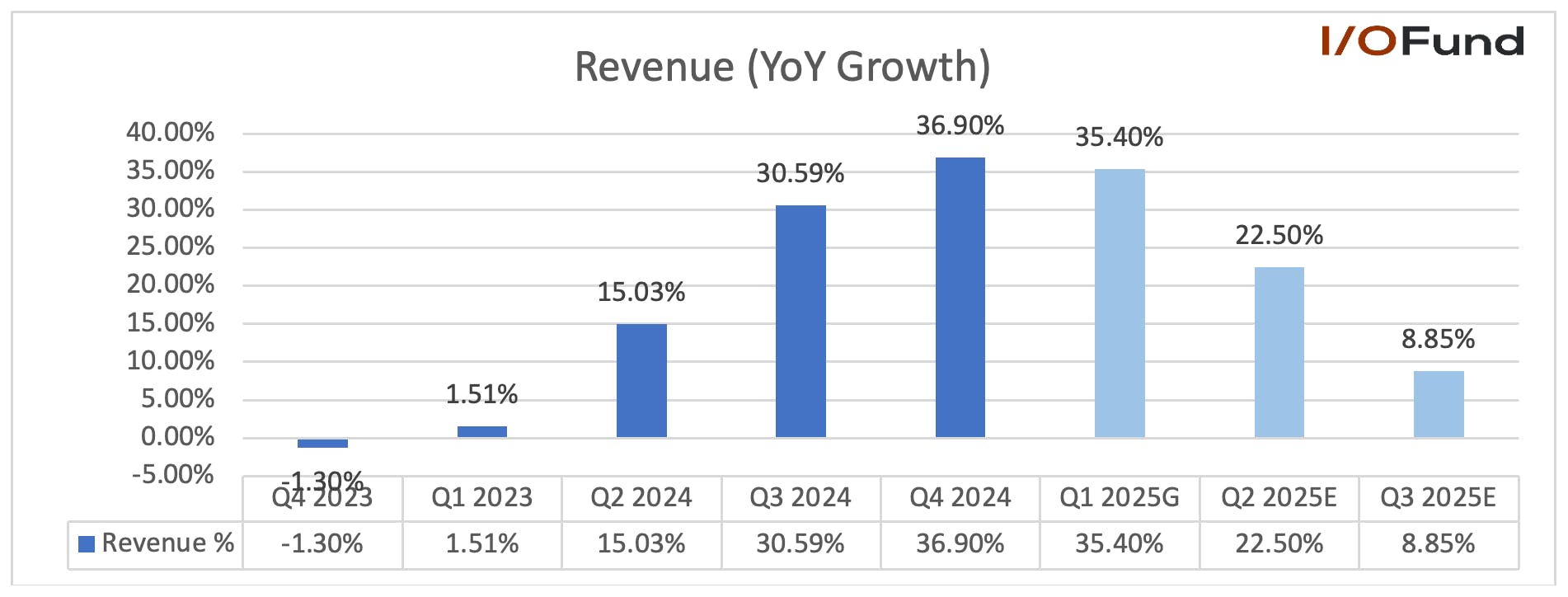
AMD is seeing weak price action for two reasons. First, the company is guiding for a decline QoQ from Q4 to Q1 across most segments, including the data center. Management also implied H1 of 2025 will be flat compared to H2 of 2024 in the data center. The market’s reaction is saying, “this isn’t exactly Nvidia

Second, management is dropping AI guidance from their commentary. If you’ve been following along, then you’re aware that AMD provides guidance around their expectations for AI-related GPU sales. For example, they stated this year GPUs would “exceed $5 billion” yet we started the year with commentary that GPUs would be in the range of $2 billion.
In response to AMD’s qualitative guidance, analysts would raise estimates, making it impossible for AMD to provide a surprise beat. It was a tough situation, and fairly rare to have analysts always doubling what a management had stated (on a forward basis). Therefore, I don’t disagree with what management is doing, which is creating immediate-term pain for a more equal playing field as they go ship the better architecture in the second half of 2025.

The Street thinks dropping AI guidance is hiding an issue, and communicating that there must be more weakness ahead. Almost-always, when a management team drops a key metric, it means it’s too weak to continue reporting this key metric. I believe it’s the opposite, that AMD is setting up the equal playing field before the MI350 and MI400 architecture arrive, as it’s been generally understood to be the moment when AMD can close the gap with Nvidia on some workloads.
The topic of “some workloads” is where the market will continue to get the AI story wrong, in my opinion. There is not one perfect chip, or AI system, for every single workload. It’s true that to train the trillion+ parameter models coming out of OpenAI that Nvidia’s NVL systems will be needed. However, it’s my contention that as some Big Tech workloads and enterprises seek lighter models at a reduced cost, that AMD’s new GPU architecture (coming in H2 2025) will be a strong choice.

Lastly, AMD is in pole position for edge computing, which they collectively refer to as mobile processors. Similar to data center GPUs, Nvidia will bring its sheer might and compute power as evidenced by Project Digits (the $3,000 supercomputer), yet you will you hear me continue to recognize AMD as an AI PC leader, and for lighter AI workloads at the edge (and those not looking to blow the bank), this is unlikely to change anytime soon as it’s what AMD does best.

Regarding the weak price action, overall, our firm has done quite well on this stock over the years and even recent quarters. It’s understandable if some investors are growing frustrated, yet this is not a stock we hold at a loss. We think we may be identifying a bottom, and this is key to understanding why we decide to continue to hold a stock, at times. Knox can fill you in more on Thursday on what he is seeing. If we think the stock has bottomed, then you’ll likely see us tough this one out as we are overweight Nvidia in both its stock ticker and its suppliers. We are strategically preparing for the days of “cheaper AI” which has been a thesis of ours for years; I’ve stated on Fox recently that Nvidia’s biggest threat is its gluttonous pricing power.

On the topic of custom silicon, AMD hinted its hat is in the ring. As is Nvidia. As is Broadcom, of course. As is Marvell, of course. As are a few startups. Due to the sensitive nature of IP, I foresee a scenario where each hyperscaler uses a different design company as it could expose their IP to go to one source for custom designs. We will track this as we go along.

Data Center Revenue falls short of estimates

AMD beat the revenue and EPS estimates. The company’s Q4 revenue grew by 24.1% YoY to $7.66 billion, beating estimates by 1.8%. The adjusted EPS grew by 41.6% YoY to $1.09, beating the estimates by a modest 0.4%. The revenue guidance for Q1 is $7.1 billion, representing YoY growth of 29.7% at the midpoint and beating the estimates by 1.6%.
The company’s revenue growth was led by record quarterly data center and client segment revenue. Data center revenue grew by 69% YoY and 9% QoQ to $3.86 billion. However, the revenue fell short of estimates of $4.14 billion. AI revenue exceeded $5 billion for the year 2024. Management expects strong AI and data center revenue growth in 2025. However, the earnings call lacked visibility on when AI revenue would ramp up, and guidance was missing in the earnings call.
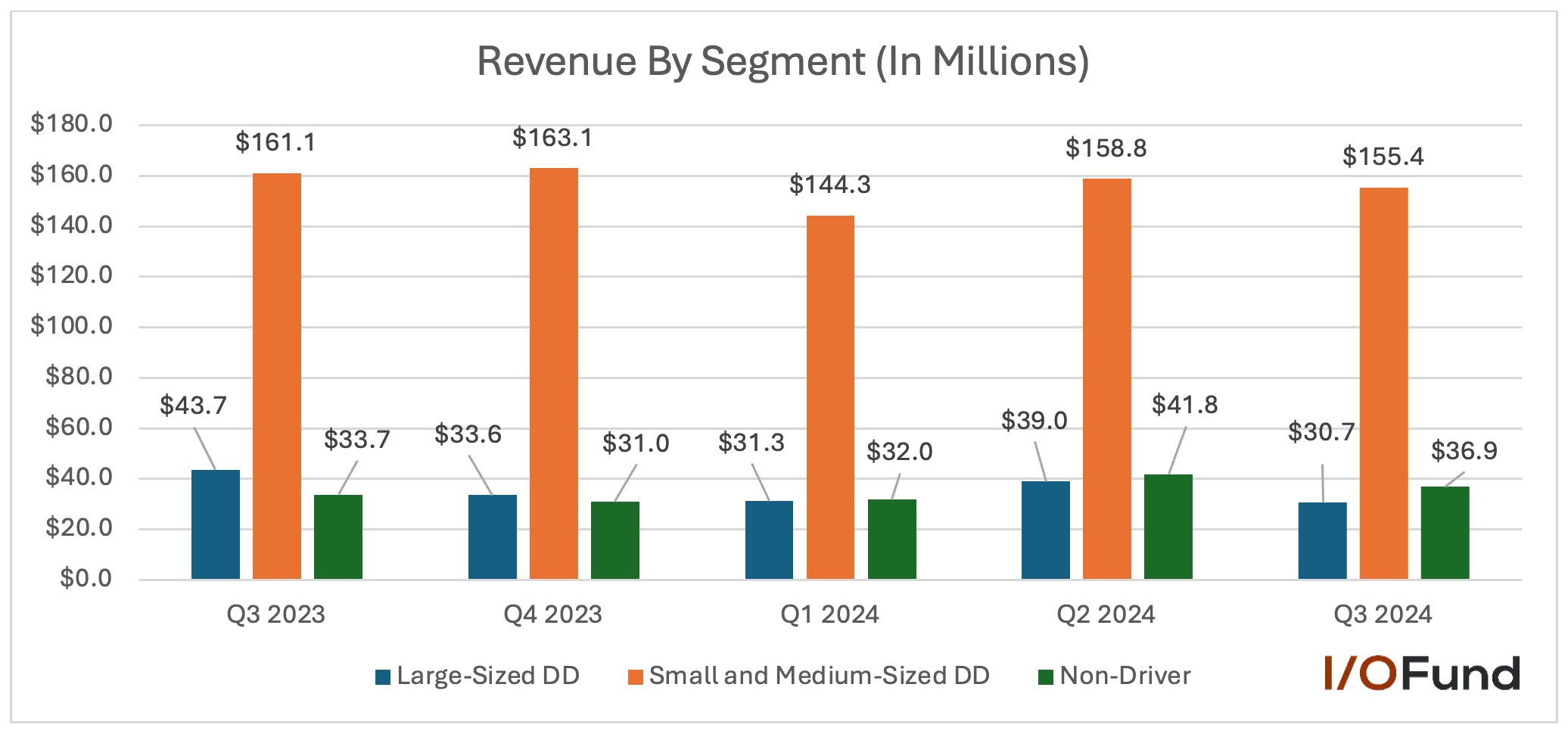
The company’s launch of MI350 chips in mid-2025 should be a significant catalyst as the management believes that the MI350 chips have the largest generational increase in AI performance they have ever produced.
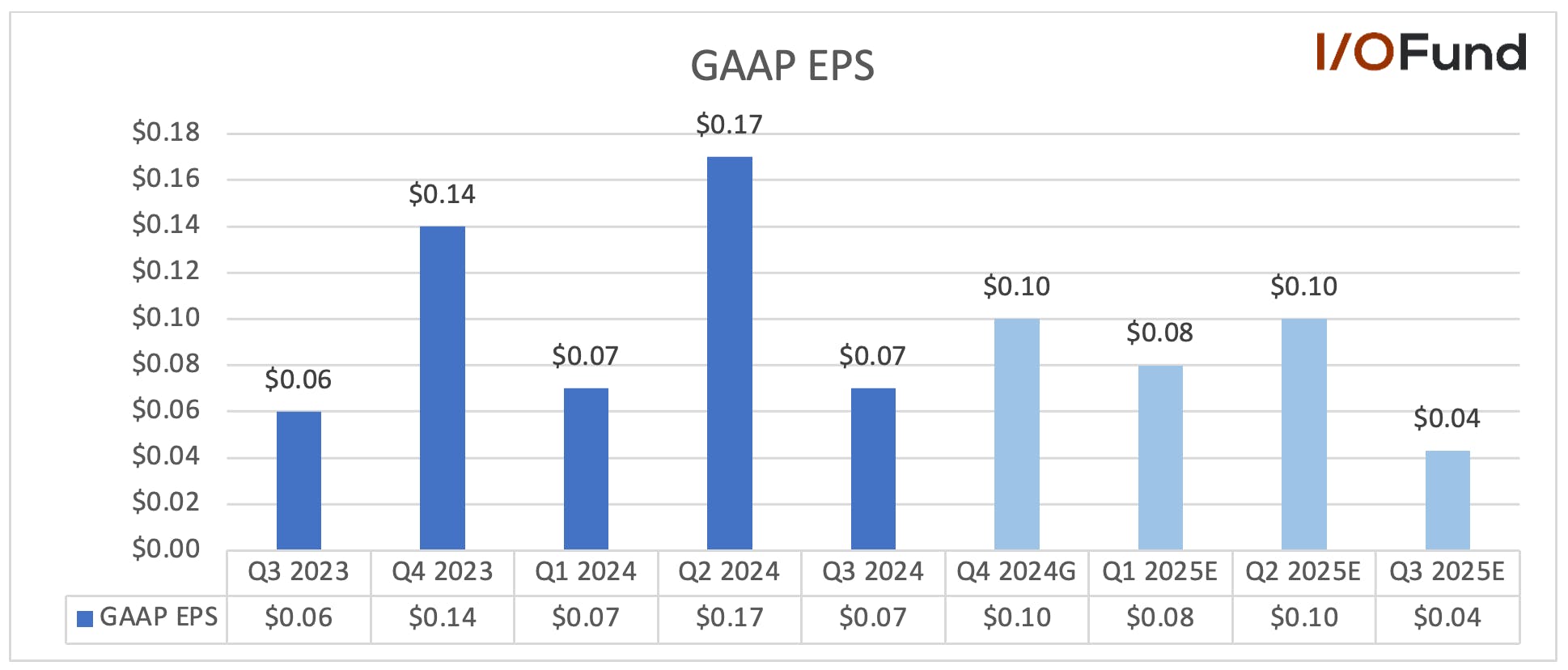
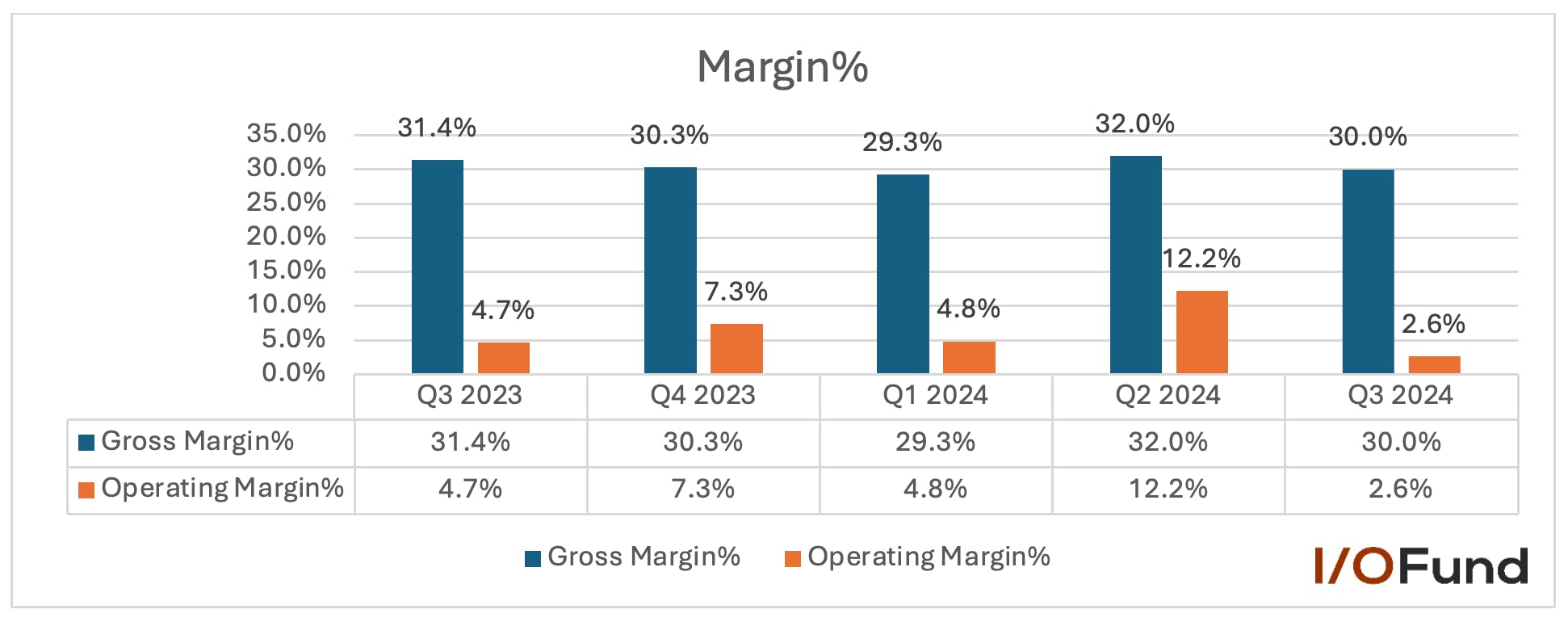
Revenue

The company’s Q4 revenue grew by 24.1% YoY to $7.66 billion, beating estimates by 1.8%. The company’s revenue growth was led by record quarterly data center and client segment revenue, partially offset by lower embedded revenue.

  • Management revenue guidance for Q1 is $7.1 billion, representing YoY growth of 29.7% at the midpoint and beating the estimates by 1.6%. Management mentioned that the revenue will be down (-7%) sequentially due to seasonality.
  • Analysts expect 28% growth in Q2 and 23.2% growth in Q3.
  • The full-year revenue grew by 13.7% YoY to $25.8 billion.
  • Looking further out, analysts expect revenue to grow 23.9% YoY in 2025 and 23.3% in 2026.
  • Management expects double digit revenue and EPS growth driven by strong AI demand. The second half revenue is expected to higher than the first half due to the MI350 launch in mid-2025.

Segments

Data Center

Data Center revenue grew by 69% YoY and 9% QoQ to a record $3.86 billion. However, the data center revenue fell short of estimates of $4.14 billion and also decelerated from 122% growth in Q3. Management highlighted during the earnings call that 2024 was a significant year for the server business driven by the ramp-up of fifth-gen EYPC Turin and strong double-digit YoY growth in fourth-gen EPYC sales.

Data Center segment operating income was $1.2 billion or 30% of revenue compared to $666 million or 29% a year ago.

During the Q&A, there was a discussion that GPUs could be about $2 billion (an analyst’s words, not management – but they did not deny this number). Yet, the sticking point (as discussed) is that H1 will be flat compared to H2. Here was a response to his question as to whether the $2 billion will grow in H1: “I think you should assume that the first half of 2025 data center segment will be consistent with the second half of '24. And that's true for both businesses on the server side as well as the data center GPU side.”

Client Segment

Client segment revenue grew by 58% YoY and 23% QoQ to $2.31 billion, driven by strong demand for Ryzen desktop and mobile processors. 

Client segment operating income was $446 million or 19% of revenue compared to operating income of $55 million or 4% of revenue a year ago, driven primarily by operating leverage.

Per management, they are not concerned that inventory is building with these knockout numbers. “We don't believe there is some substantial inventory build up. We actually think that what we're seeing is very strong adoption of our new products. So on the desktop side, we saw our highest sell-out in many years, as we went through the holiday season, launching our new gaming CPUs, frankly, they have been constrained in the market, and we've continued shipping very strongly through the month of January as we are catching up with some demand there.”

Gaming Segment

Gaming segment revenue was $563 million, down (-59%) YoY, primarily due to a decrease in semi customer revenue. However, was up 22% sequentially. Gaming segment operating income was $50 million or 9% of revenue compared to $224 million or 16% a year ago.

Looking forward, management believes channel inventories have now normalized and semi-custom sales are expected to return to more historical patterns in 2025.

Embedded Segment

Embedded segment revenue was $923 million down (-13%) YoY and flat sequentially due to the slower recover in the end market. Embedded segment operating income was $362 million or 39% of revenue compared to $461 million or 44% a year ago.

Margins

The company’s margins are improving with higher data center revenue mix. Going into 2025, management expects margins to be better in the second half of the year due to higher contribution from the data center revenue and it was clarified during the earnings call Q&A. The client business expansion will be a headwind in the first half due to the higher concentration of consumer business, which has margins below the corporate average.

Toshiya Hari (Analyst)

“That's great. And then as a quick follow-up, maybe one for Jean. So you're guiding gross margin to 54% in the first quarter. I'm curious what some of the major puts and takes are and those are the things that we should be cognizant of going into Q2 and more importantly, the second half. Given your data center commentary skewed more to the second half, I would expect margins to improve in the second half. But yes, if you can kind of run through the pluses and minuses, that would be really helpful. Thank you.

Jean Hu (CFO)

Yes. Thanks for the question. You are right. Our gross margin is primarily driven by our revenue mix, I think when you look at looking to 2025, Q1 guide, not only data center continued to grow significantly year-over-year. At the same time, client business is also growing year-over-year. So overall, the revenue mix is quite consistent with the Q4. So the gross margin guide is 54%. I think for the first half, if the revenue mix is at this level, we do feel the gross margin will be consistent with 54%. But going into second half, we do believe the data center is our fastest growth driver for the company and that will drive the gross margin to step up in second half.”

  • Q4 gross margin was 51% compared to 47% in the same period last year. Adjusted gross margin improved 300 bps YoY to 54% due to favourable shift of higher mix of data center and client revenues, lower gaming revenue and partially offset by lower embedded revenue. Management guide for Q1 is 54% due to the similar revenue mix as Q4.
  • Operating margin was 11% compared to 6% in the same period last year. Adjusted operating margin was 26% compared to 23% in the same period last year. Operating expenses increased 23% YoY to $2.1 billion as the company invested due to the expected strong growth in AI. Management expects adjusted operating margin to be 24% in the next quarter.
  • Net margin was 6% compared to 11% in the same period last year. Adjusted net margin was 23% compared to 19% in the same period last year.

EPS

The adjusted EPS grew by 41.6% YoY to $1.09, beating the estimates by a modest 0.4%. The strong growth was driven by higher data center revenue.

  • Analysts expect adjusted EPS to grow 52.2% YoY in Q1 and 55.7% in Q2
  • Looking further out, analysts expect adjusted EPS to grow 41.5% YoY to $4.68 in 2025 and 46.3% YoY to $6.85 in 2026.

Cash Flows and Balance Sheet

The company’s cash flows are improving driven by higher profits.

  • Q4 operating cash flow grew by 241% YoY to $1.3 billion or 17% of revenue compared to 6% in the same period last year driven by higher data center revenue.
  • Q4 free cash flow grew by 351% YoY to a record $1.1 billion or 14% of revenue compared to 4% in the same period last year.
  • Cash and short-term investments were $5.13 billion and debt of $1.72 billion compared to $4.54 billion and $1.72 billion at the end of Q3.
  • The company repurchased shares worth $256 million in Q4.

Earnings Call:

Dropping AI Revenue Guidance:

AI revenue exceeded $5 billion for the year 2024. Despite the change in tone and dropping AI guidance, there was one exchange in particular where management reiterated it will grow “strong double digits” in 2025. The details can appear confusing, as on one hand, you have H1 2025 as flat, but on the other hand, you have the growth being “strong double digits.” For anyone who follows AMD closely, it’s assumed they are referring to a strong MI350 launch in what appears to be between May-July time frame (that’s my take on the timing, considering what management has described – typically it would have been August for AMD’s cadence).

This question cut to the chase of what was on everyone’s minds – which is how management is thinking about the impact of MI350s coming given a flat H1 2025 had been discussed.

Stacy Rasgon

Got it. Thanks. And I guess for my follow-up, maybe to follow on there, do you think your exit rate on GPUs in '25 is higher than your exit rate in '24. Are you willing to commit to that?

Lisa Su 

Absolutely. But yes, of course. It would be hard to grow strong double digits otherwise, right?”

As stated in the opening remarks, the launch of MI350 chips in mid-2025 should be a significant catalyst as the management believes the chips have the largest generational increase in AI performance they have ever produced. There was additional information provided:

“So as it relates to how data center — so the overall data center business will grow strong double digits certainly, both the server product line as well as the data center GPU product line will grow strong double digits. And from the shape of the revenue you would expect that the second half would be stronger than the first half, just given MI350 will be a catalyst for the data center GPU business. But overall, I think we are very pleased with the trajectory of the data center business in both 2024 and then going into full year 2025.”

Q1 Data Center Weakness:

Although Q4 beat on revenue, Q1 is expected to be soft with a 7% sequential decline. According to management, data center will be down just above the (-7%) total revenue sequential decline and in line with the corporate average, client and the embedded business to be down more than the total revenue decline, gaming to be down less than the total revenue decline.

The moment the stock went from being down 3% to being down 8% was when more color was provided that data center would be participating in this decline. Client is expected to be weak from Q4 to Q1, as device sales are always lower in Q1 for all consumer-device related companies (i.e., Apple, etc). Yet, seeing Gaming having stronger QoQ growth than data center is not ideal.

Here was the conversation that caused the stock to see steeper losses:

Q: Aaron Rakers (Analyst)

Yes. Thank you very much. And as a quick follow-up, just thinking about the guidance overall relative to that down 7% sequential I know you mentioned seasonality across the business segments. Are you assuming that you are down sequentially in data center in total in 1Q? And how do I frame that relative to seasonality? Thank you.

A: Lisa Su (CEO)

Yes, sure, Aaron. So let me give you some more color on the Q1 guide. So Q1 guide was down 7% sequentially, as Jean mentioned. And the way that breaks out in each of the segments assume that data center would be down just about that average, so the corporate average. We would expect the client business and the embedded business to be down more than that. Just given where seasonality is for those businesses. And then we would expect gaming business will be down a little less than that. And that's a little atypical from a seasonality standpoint, but we are coming-off of a year when there was a lot of let’s call it, inventory normalization. And now that inventory has normalized, we would expect that, that would be down a little bit less than the corporate average.”

MI350s Shipping Sooner than Expected

As with all underdogs, AMD has only a few chances to make its mark. We’ve been reporting for some time that this would be the CDNA-4 architecture with the MI350s (shipping in volume H2 2025), and if successful, then the CNDA-NEXT with the MI400s will be another opportunity (probably about a year later, H2 2026).

Here is what I’ve stated in the past:

“We will match that timeline and say we hope to see AMD be a leader in the market and in our portfolio by 2027-2028. CDNA 4 architecture is due out in 2025-2026, and is the most likely catalyst that I see today to narrow the product road map with Nvidia.”

This is what management stated about the upcoming architecture: “CDNA 4 will deliver the biggest generational leap in AI performance in our history, with a 35 times increase in AI compute performance compared to CDNA 3. The silicon has come up really well. We were running large-scale LLMs within 24 hours of receiving first silicon and validation work is progressing ahead of schedule.”

The silver lining to the earnings report is that it looks like investors will get a guide that includes some of the MI350s in the next earnings report as AMD is moving up their shipping expectations. Previously, this would have been about two quarters out. From Lisa Su: “Based on early silicon progress and the strong customer interest in the MI350 series, we now plan to sample lead customers this quarter and are on track to accelerate production shipments to mid-year.”

There were additional comments in the Q&A on this timing:

“And then the big news is on the MI350 series. So we had previously stated that we thought we would launch that in the second half of the year. And frankly, that bring-up has come up better than we expected, and there is very strong customer demand for that. So we are actually going to pull that production ramp into the middle of the year, which improves our relative competitiveness.”

By relative competitiveness, what AMD’s goal is put it into plain words, is that while Blackwell is greatly supply constrained due to the massive NVL systems, and already sold-out next year, AMD will aim to release a competitive architecture that serves the outsized demand for the B200s.

Quick Note on Custom Silicon:

There are many competitors on custom silicon, and AMD made it clear in the earnings call that they are one of them:

“And I just want to reiterate on the ASIC side, look, I think ASICs are a part of the solution, but there — I want to remind everyone, they are also a very strong part of the AMD sort of toolbox.

So we've done semi-custom solutions for a long-time. We are very involved in a number of ASIC discussions with our customers as well. And what they like to do is, they'd like to take our baseline IP and really innovate on top of that. And that's what I think differentiates our capability is that we do have all of the building blocks of CPUs, GPUs, as well as all of the networking technologies that you would need to put the solutions together.”

Conclusion:

What will get us to close our position? Price, first and foremost – which is why we sizably trimmed the position a few months ago. From what I’m hearing on the technicals side, price is doing what was expected, but you will know if this changes via our real-time trade alerts. Secondly, if the MI350s are too weak to take the overflow in capex that Blackwell supply cannot fulfill. If consumer and tariffs create more impact than currently priced in. We always have a plan.

With that said, I will be watching with keen interest the launch of the MI350s. If this release benchmarks “close enough” to the B200s then AMD investors will be rewarded. If the benchmarks are too far apart, the proverbial David (Lisa Su and team) will have missed a critical window for striking with her slingshot. Despite what benchmarks say, we only have to watch how Big Tech capex funnels to truly know how AI accelerators are being received; this is a proxy and substantial (unprecedented) flow of capital that overwhelmingly matters more than what analysts, industry experts, or even management teams say or predict. Big Tech companies are at the forefront and they will make the ultimate decision.

Right now, that capex is pointed directly at Nvidia, which was the basis of our Q1 webinar. We will see come late Spring/early Summer if AMD can pry some of the roughly $300 billion loose. The market is giving up, but that sometimes becomes precisely the moment when a stock bottoms.

Before I conclude, keep an eye on the Client segment as it’s abundantly clear who is in the lead with AI PCs. Nvidia will do quite well here too, but AMD’s numbers are communicating something very important about their lead in edge AI.

Royston Roche, Equity Analyst for the I/O Fund, contributed to this analysis.

Please note: The I/O Fund conducts research and draws conclusions for the company’s portfolio. We then share that information with our readers and offer real-time trade notifications. This is not a guarantee of a stock’s performance and it is not financial advice. Please consult your personal financial advisor before buying any stock in the companies mentioned in this analysis. Beth Kindig and the I/O Fund own shares in AMD at the time of writing and may own stocks pictured in the charts.

Recommended Reading: