NVIDIA’s groundbreaking hardware technologies and AI are unlocking unprecedented computational power. At the NVIDIA GTC 2025, NVIDIA unveiled its Blackwell Ultra GPU designed for the “Age of Reasoning” at its 2025 GPU Technology Conference (GTC). AI accelerators like GPUs are well suited for AI training and inference due to parallel processing, which allows for many calculations to be performed simultaneously. Only 30% of the top 500 supercomputers relied on accelerated computing; today, 80% do. The Green 500 ranking of supercomputers by energy efficiency shows an even more pronounced trend.
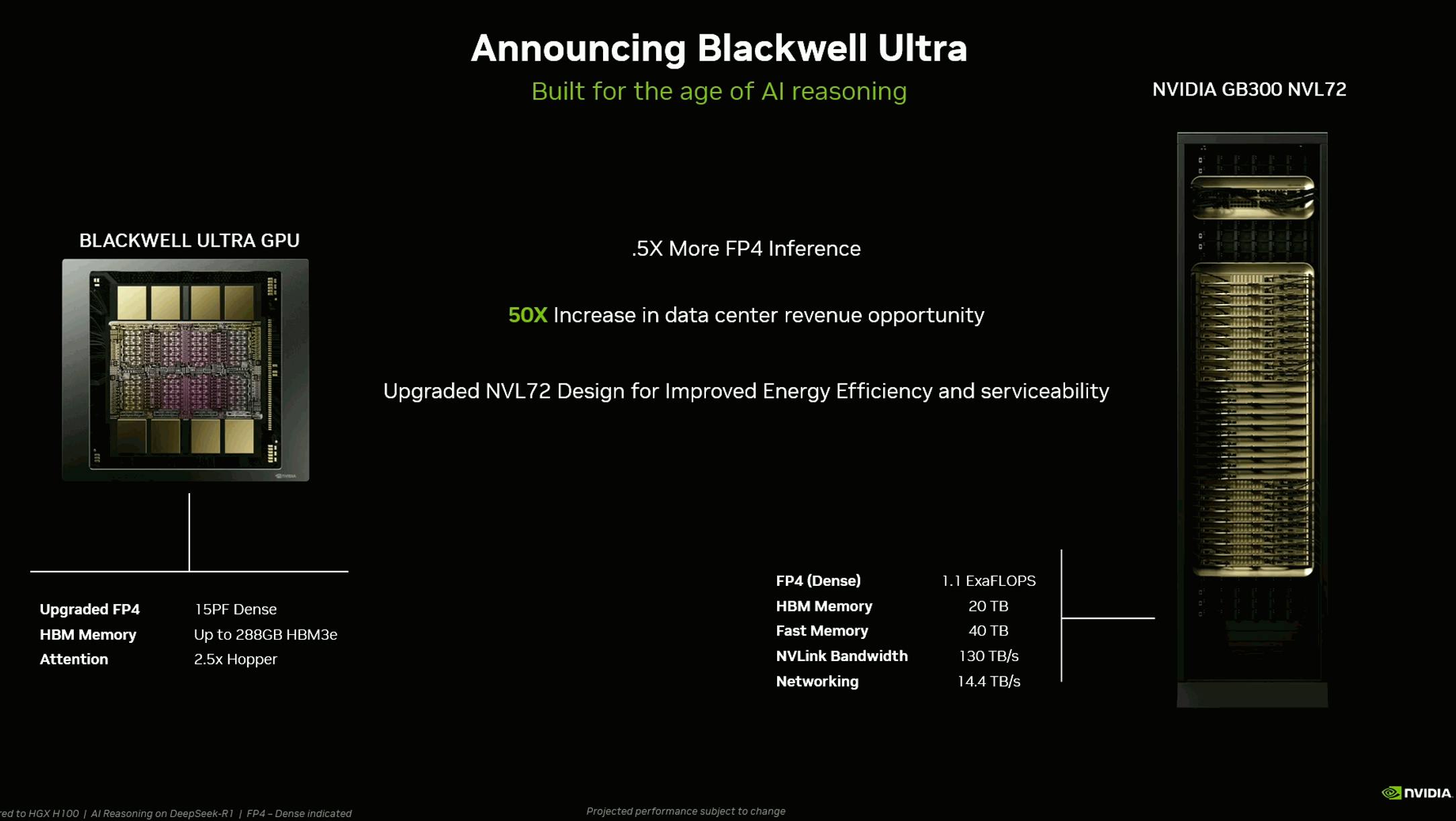
NVIDIA Blackwell Ultra GPU and GB300 NVL72 server key specifications included.
AI reasoning models emulate how the brain thinks to render a conclusion, popularized by OpenAI’s o1, Google’s Gemini 2.0 Flash Thinking and DeepSeek’s R1 A1 models. Reasoning models improve responses to queries and more powerful GPUs improve the performance of these models. Blackwell Ultra GPUs are the next generation of the evolution of the GB200 bolstered by more inference power horsepower, packing 50% FLOPS at 1.1 exaFLOPS of FP dense compute.
At the NVIDIA GTC 2025,NVIDIA GTC 2025, in his March 18 presentation titled, “The Next Frontier of AI Supercomputing: Efficiency With Unprecedented Capability”, NVIDIA’s Vice President of Hyperscale and HPC Computing, Ian Buck, stated, “Blackwell Ultra takes GB200’s 40x data center revenue opportunity to 50x”, citing faster token serving and higher throughput ideal for post-training for models like DeepSeek, which chomp through 100 trillion tokens.
NVIDIA GB300 NVL72 Unleashes Inference Horsepower
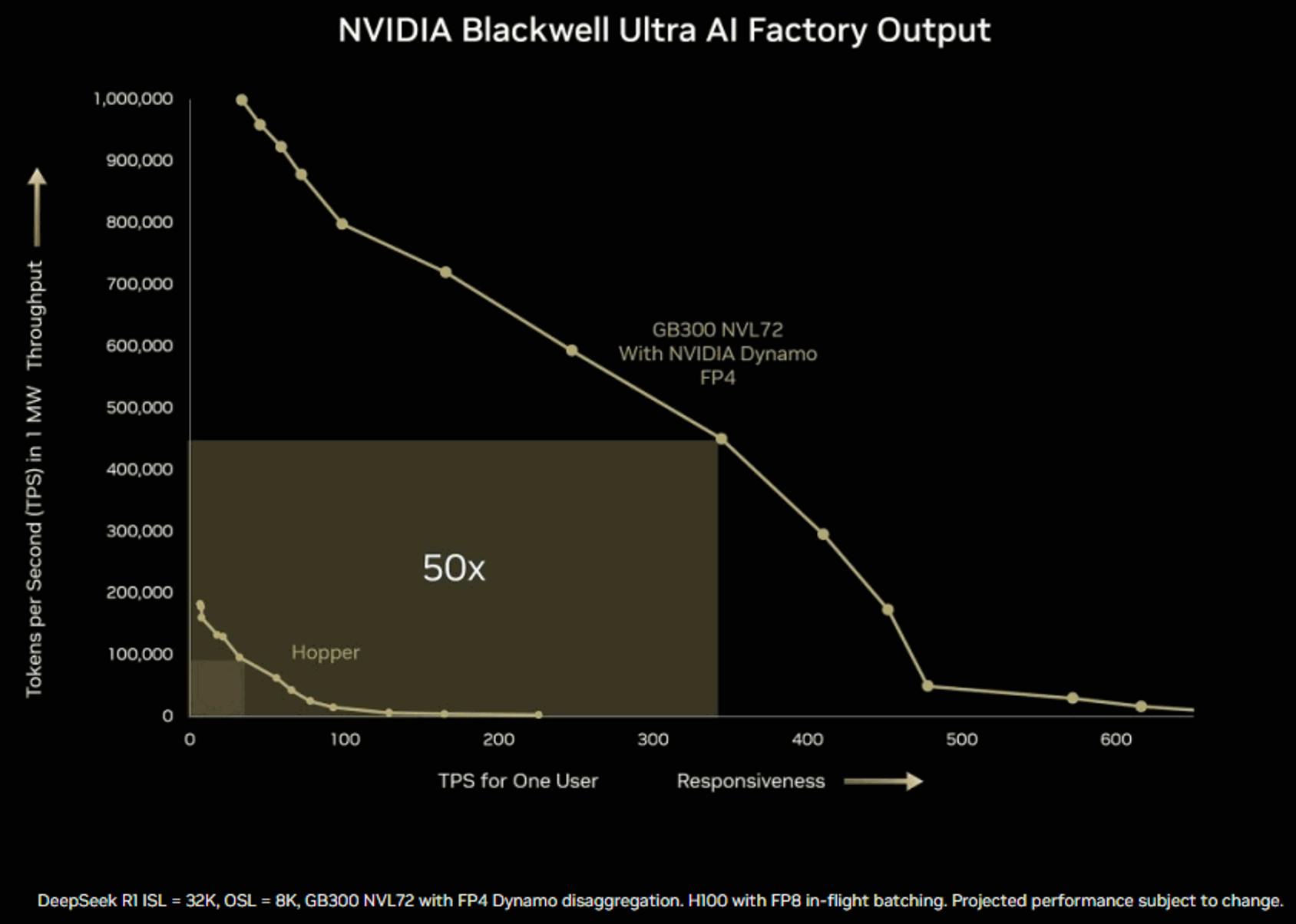
NVIDIA’s GB300 superchip combines two Blackwell Ultra GPUs with one Grace CPU. Blackwell Ultra GPUs can be used in the NVL72 rack server, which integrates 72 Blackwell Ultra GPUs and 36 Grace CPUs. The NVIDIA GB300 NVL72 has a fully liquid-cooled rack-scale design. AI factories achieve 50X higher output for reasoning model inference with the NVIDIA GB300 NVL72 compared to the NVIDIA Hopper platform when used with the NVIDIA Quantum-X800 InfiniBand or Spectrum-X Ethernet paired with ConnectX-8 SuperNICS.
Blackwell Ultra’s Silicon Photonics Slashes Power Consumption by Up to 77%
NVIDIA’s Blackwell Ultra GPUs use co-packaged optics with silicon photonics, which integrates optical and silicon components onto a single substrate. This reduces power consumption by eliminating the need for external lasers and pluggable transceivers to achieve a significant reduction in power from 39 watts to 9 watts. Buck said that silicon photonics "… gives you that benefit from going from 30 watts of power down to only 9 watts of power for the same number of ports, and that's huge. It doesn't sound like 39 sounds a lot. But if you get 400,000 GPUs in an AI supercomputer, there's like 24 megawatts of lasers like so that's a lot of laser light that could be optimized and made more efficient.”
Join thousands of investors who trust I/O Fund’s expert stock analysis on AI, semiconductors, cryptocurrency, and adtech — sign up for free! Click here!Join thousands of investors who trust I/O Fund’s expert stock analysis on AI, semiconductors, cryptocurrency, and adtech — sign up for free!Click here!Click here!
Beth Kindig, Lead Analyst at the IO Fund, pointed out in her “AI Power Consumption: Rapidly Becoming Mission-Critical”AI Power Consumption: Rapidly Becoming Mission-Critical” blog article that, "In my analysis last month on the Blackwell architecture, I made the argument these estimates are too low and that my firm expects we will see a $200 billion data center segment by end of CY2025 propelled forward by the B100, B200 and GB200, including the following points: “Taiwan Semi’s CoWos capacity, which is essential for Blackwell’s architecture, is estimated to rise to 40,000 units/month by the end of 2024, which is more than a 150% YoY increase from ~15,000 units/month at the end of 2023. Applied Materials has boosted its forecast for HBM packaging revenue from a prior view for 4X growth to 6X growth this year.””
The Next Generation CPU: Vera CPU: Grace’s Successor
NVIDIA’s next-generation CPU is Vera, a follow-on to Grace. With 88 cores (176 threads via spatial multithreading), Vera doubles Grace’s performance 2X, memory bandwidth by 5X per watt, and has a beefier chip-to-chip link for the upcoming Rubin GPU. “Every core talks to every other core,” Buck stressed, contrasting x86’s front-end focus. Vera’s 12-thread memory saturation trounces traditional CPUs, feeding GPUs for AI and HPC back-end tasks. Vera Rubin will launch in 2026. Vera Rubin NVL 144 will launch in the second half of 2026. FYI, Vera Rubin was an American astronomer who discovered dark matter. Rubin will mark the shift from HBM3/HBM3e to HBM4 and HBM4e for Rubin Ultra.
The Next Generation GPU Architecture: Rubin Ultra
NVIDIA will be launching Vera Rubin NVL 576 in the second half of 2027, which will have 14X the performance of GB300 NVL72. Rubin will have 1.2 ExaFLOPS of FP8 training compared to just 0.36 ExaFLOPS for B300, resulting in 3.3X compute performance. Bandwidth will improve from 8 TB/s to 13 TB/s. It will have 576 Rubin GPUs in a rack. Compute density is boosted by featuring four dies per package. Rubin Ultra NVL576 will have 365 TB of memory. The inference compute with FP4 rises to 15 ExaFLOPS with 5 ExaFLOPS of FP8 training compute. NVIDIA hinted the next-generation architecture after astronomer Vera Rubin will be named after theoretical physicist Richard Feynman.
The I/O Fund recently entered five new small and mid-cap positions that we believe will be beneficiaries of this AI spending war. We discuss entries, exits, and what to expect from the broad market every Thursday at 4:30 p.m. in our 1-hour webinar. For a limited time, get $110 off an Annual Pro plan with code PRO110OFF [Learn more here.]get $110 off an Annual Pro plan with code PRO110OFF [Learn more here.]
Please note: The I/O Fund conducts research and draws conclusions for the company’s portfolio. We then share that information with our readers and offer real-time trade notifications. This is not a guarantee of a stock’s performance and it is not financial advice. Please consult your personal financial advisor before buying any stock in the companies mentioned in this analysis. Beth Kindig and the I/O Fund own shares in NVDA at the time of writing and may own stocks pictured in the charts.
Supercomputers and cutting-edge AI data centers are fueling the artificial intelligence (AI) revolution. Large-scale systems need comprehensive builds that are increasingly integrated to meet the evolving demands of complex workloads. As AI applications become more sophisticated, the need for infrastructure that's not only incredibly powerful but also energy-efficient is growing exponentially. Innovations like NVIDIA’s GB200 are designed to deliver the scalability needed for next-generation AI superclusters.
At the 2025 NVIDIA GPU Technology Conference2025 NVIDIA GPU Technology Conference (GTC), VP and Chief Architect of Systems, Mike Houston, and Senior Director of Applied Systems Engineering, Julie Bernauer, discussed large-scale systems design principles in their May 18 presentation, “Next-generation at Scale Compute in the Data Center.”
NVIDIA’s First Rack-Scale Product is the GB200 Superchip
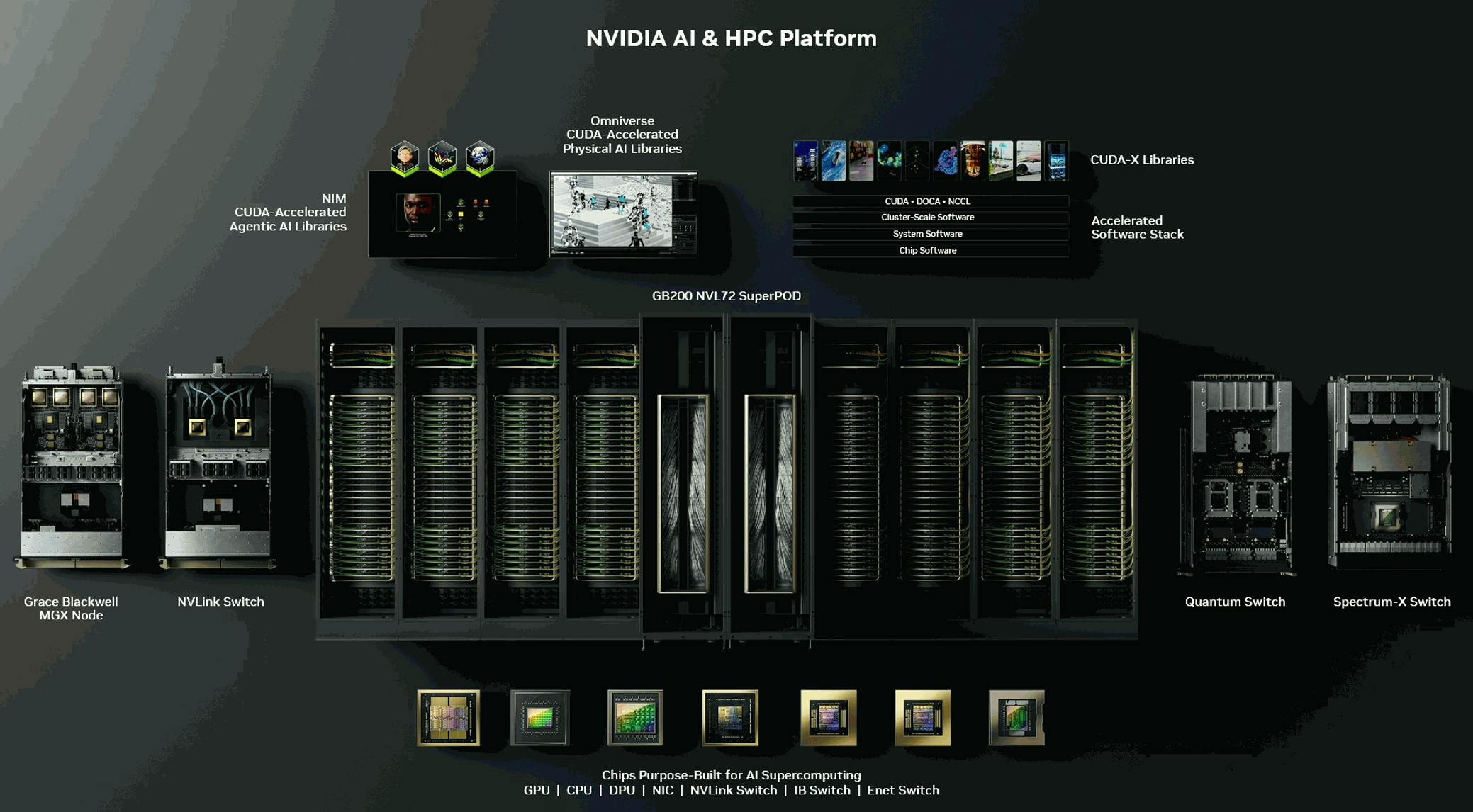
The NVIDIA Grace Blackwell 200 (GB200) Superchip combines two Blackwell GPUs and one Grace CPU. It’s NVIDIA’s first rack-scale product. The NVIDIA GB200 NVL72 is a configuration and rack-scale, liquid-cooled AI computing platform, which is purpose-built for AI training and inferencing, handling up to 27 trillion parameters for generative AI models. The GB200 includes base components like Grace Hopper compute trays, NVLink switches (a connector in the middle of the rack linking all GPUs) and cable cartridges (literally miles of cables in the back to tie everything together). The design includes quantum switches for InfiniBand (a high-speed network for linking clusters) and spectrum switches for Ethernet.
AI 101: What are Clusters and Superclusters?
Clusters 101: are a network of independent computers (called nodes) connected by a high-speed network. A cluster serves as a unified resource, as they are separate machines configured to work together to act as a single powerful computing system. They are often used for parallel processing, which breaks down a large task into smaller parts distributed across the nodes, enabling faster processing than just a single computer could do. A key benefit of a node is high availability, meaning if one node (computer) fails, the other nodes can take over its workload, ensuring that the system remains operational. High-performance compute (HPC) clusters are used for tasks like research, scientific simulations and AI training.
Join thousands of investors who trust I/O Fund’s expert stock analysis on AI, semiconductors, cryptocurrency, and adtech — sign up for free! Click here!Join thousands of investors who trust I/O Fund’s expert stock analysis on AI, semiconductors, cryptocurrency, and adtech — sign up for free!Click here!Click here!
Superclusters 101: are very large clusters that may be comprised of hundreds to thousands of GPUs through many data centers. For example, Elon Musk’s xAI supercomputer Colossus, powered by 100,000 NVIDIA GPUs, is definitely a supercluster.
DGX started as single machines for AI but evolved into clusters for AI training. Pre-training can involve superclusters, but post-training can still involve 16,000 GPUs with smaller setups for fine-tuning and inference using trained AI to answer questions.
Optimizing the Benefits of Rack-Scale Architecture with GB200
NVIDIA’s GB200 NVL72 is a rack-scale system. Rack-scale designs a whole rack as one big, coordinated unit, not just random machines stuck together. Rack scale refers to integrating and compressing systems that may span across multiple servers, storage and networking devices onto a single server rack. GB200 can replace or consolidate a large number of GPU compute servers. This provides many benefits, including:
Improved GPU Density: The GB200 NVL72 contains 72 Blackwell GPUs, and 36 Grace CPUs interconnected with NVLink, NVIDIA’s proprietary high-speed (130 TB/s) signaling interconnect that enables all 72 GPUs and 36 CPUs to act as a single massive GPU. It's designed to offer exceptional performance in AI training and inference for large language models (LLMs).
Performance: The GB200 delivers up to 720 petaFLOPs for AI training and 1.4 exaFLOPs for inference. Since all components are within proximity in a single rack, communication between components has much lower latency, which is especially beneficial in data-intensive tasks, reducing bottlenecks and improving data throughput.
Increased Efficiency: Rack-scale architecture allows for better utilization of hardware by pooling resources to optimize performance. Consolidating resources within a single rack reduces the need for separate units, saving space and power in the data center.
Easier Management: Centralized management of the entire rack's resources simplifies setup and maintenance, also enabling automation tools for scaling, provisioning and monitoring to reduce manual interventions.
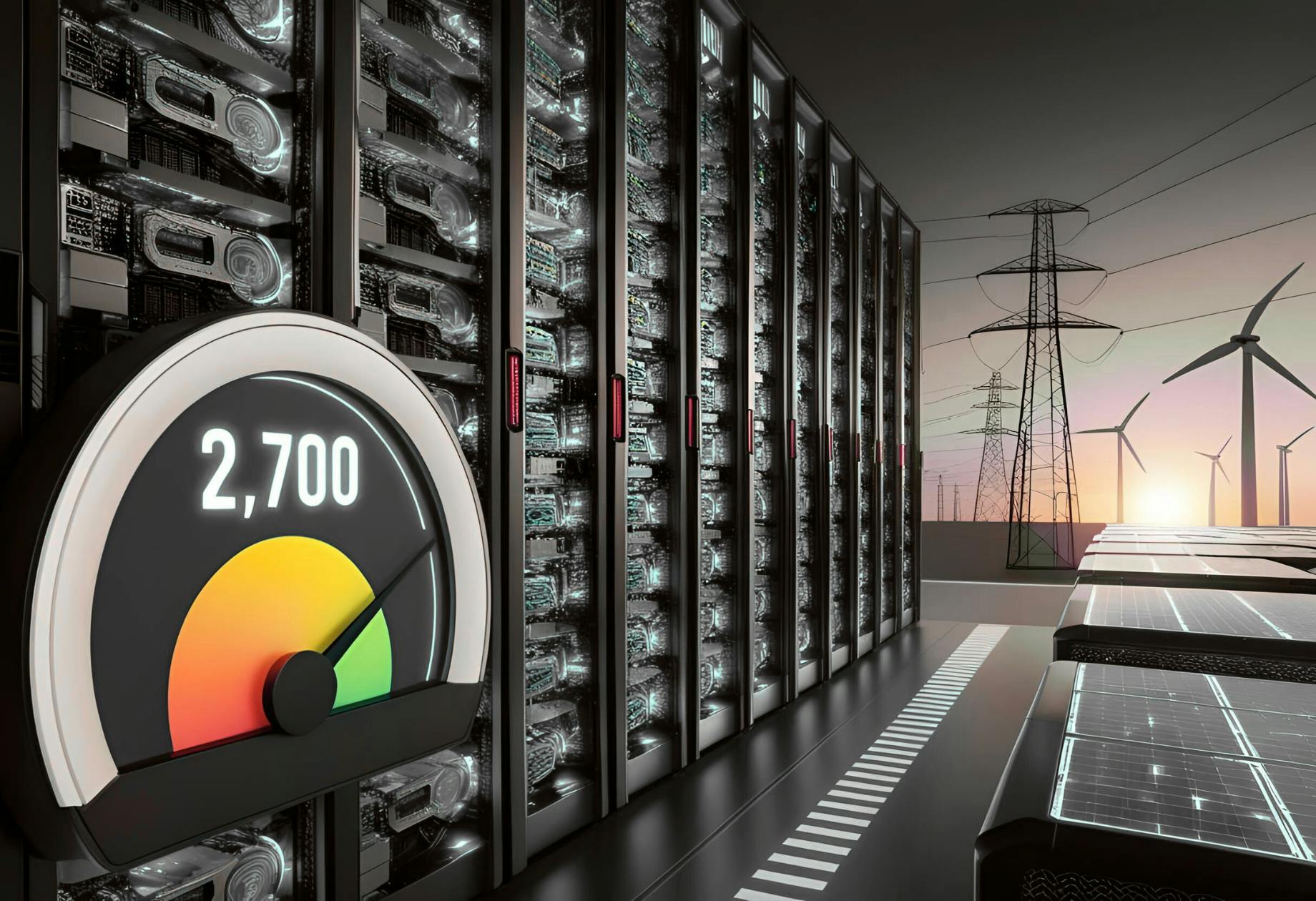
Cost Efficient: Fewer servers, storage, networking equipment, physical space, cooling, and energy usage save money. As IO Fund discussed in its article “AI Power Consumption: Rapidly Becoming Mission-CriticalAI Power Consumption: Rapidly Becoming Mission-Critical," the GB200 is “expected to consume 2,700W”, which can add dramatically to operating expenses, especially without rack-scale architecture.
Future Proofing: Rack-scale architecture enables the integration of evolving technologies as components can be switched out, repaired and upgraded, enabling more adaptability for future growth.
Unified Power and Cooling: Housing multiple components within a single rack reduces the complexity of cooling systems and improves energy efficiency to lower operational costs.
Scaling Up AI Factories with DGX SuperPOD, Reference Architecture and Fabric
At the 2025 NVIDIA GPU Technology Conference (GTC), NVIDIA unveiled its next-generation DGX SuperPOD AI infrastructure. In the “Next-generation at Scale Compute in the Data Center” presentation, VP and Chief Architect of Systems, Mike Houston, and Senior Director of Applied Systems Engineering, Julie Bernauer, spoke about
The SuperPOD is NVIDIA’s all-in-one HPC solution designed to handle the massive computational needs of AI models and simulations. Grace Blackwell nodes are the building blocks of the SuperPOD. When scaling up clusters and superclusters, there are three factors to consider. Reference architecture is comprised of pre-tested system designs that serve as a blueprint for new data center deployments to ensure optimal installation and performance, accelerating time to the first token.
Fabric refers to the data center’s network infrastructure that connects all the servers and devices enabling them to seamlessly communicate with each other to reduce latency between components, especially GPUs. Cooling is critical in large data centers. Liquid cooling is preferred to manage the heat produced by thousands of GPUs as it is much more efficient for high-density platforms. Future GPU architectures aim for higher density and more efficient connectivity to push the limits of AI computation.
The I/O Fund recently entered five new small and mid-cap positions that we believe will be beneficiaries of this AI spending war. We discuss entries, exits, and what to expect from the broad market every Thursday at 4:30 p.m. in our 1-hour webinar. For a limited time, get $110 off an Annual Pro plan with code PRO110OFF [Learn more here.]get $110 off an Annual Pro plan with code PRO110OFF [Learn more here.]
Please note: The I/O Fund conducts research and draws conclusions for the Fund’s positions. We then share that information with our readers. This is not a guarantee of a stock’s performance. Please consult your personal financial advisor before buying any stock in the companies mentioned in this analysis.
Nvidia has traversed choppy waters so far in 2025 as concerns have mounted about how the company plans to sustain its historic levels of demand. It began with DeepSeek in late January, was furthered by suppliers providing mixed signals on the timing of its premiere Blackwell NVL systems, then saw rumors of data center cancellations from a major customer in February.
What better place to address these issues than the GPU Technology Conference (GTC) in San Jose, now dubbed the Super Bowl of AI. In the keynote held on Tuesday, Jensen Huang threw cold water on many of Wall Street’s assumptions, helping to alleviate concerns that demand for Nvidia GPUs will slow. In addition, I appeared on Fox News during the keynote to discuss why valuation is the great equalizer for this stock – along with my prediction for which quarter this year Nvidia will likely explode higher.
Nvidia Explains Why Cheaper Models Will Not Result in Less Compute
CEO Jensen Huang kicked the conference off with a wild remark about the current pace of progress in AI and the need for compute: “the scaling law of AI is more resilient, and in fact, hyper-accelerated, and the amount of computation we need at this point, as a result of agentic AI and reasoning, is easily 100x more than we thought we’d need at this time last year.”
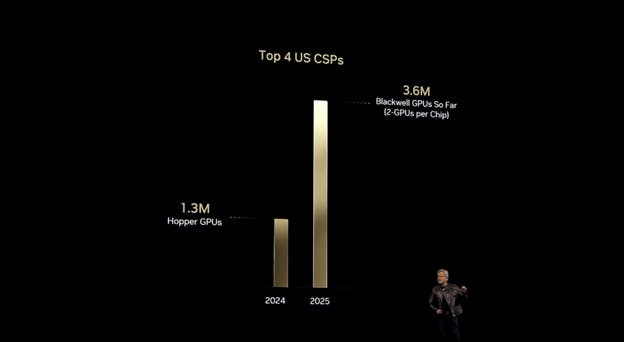
The proof of this is easily seen as Blackwell chip sales have significantly outperformed Hopper year-over-year, with 3.6 million GPUs ordered so far in 2025 by the top 4 CSPs, versus a peak of 1.3 million Hopper GPUs in 2024. And this is just sales to the 4 largest CSPs, not including CoreWeave, Meta, xAI, Tesla, Nebius and many others that will be acquiring the chips. Huang added that “demand is much greater than that, obviously” — with the readthrough being this is what they’re able to ship, with demand that exceeds current capacity.
Nvidia’s Blackwell chip sales so far in 2025 have far exceeded Hopper’s peak. Source: NvidiaNvidia
Huang further illustrated that due to AI being able to reason beyond pretrained data, it now generates more tokens at 10X for a complex model, yet compute has to be 10X faster, resulting in 100X more computation.
“Well, it could generate 100x more tokens and you can see that happening, as I explained previously, or the model is more complex, it generates 10x more tokens. And in order for us to keep the model responsive, interactive so that we don't lose our patience waiting for it to think, we now have to compute 10x faster. And so 10x tokens, 10x faster, the amount of computation we have to do is 100x more easily. “
Models will need to generate more tokens, more quickly; meaning, AI remains a hardware problem that Nvidia is uniquely positioned to solve. The amount of computation required for inference is significantly higher than previously estimated – and it’s this demand that Nvidia’s future generations of GPUs will aim to meet.
Huang Forecasts Capex to Grow more than 300% in 3 Years
Nvidia has been a massive beneficiary of big tech capex budgets. Our firm has been tracking Big Tech capex as a proxy for AI spending since 2022, when I publicly stated in my newsletter: “However, it has been our stance for some time that Big Tech capex is the true leading indicator for AI semiconductor companies. Despite an enormous increase in Big Tech capex primarily driven by data centers, this line item does not get the attention it deserves in terms of follow-through to the semiconductor industry.”
We’ve continuously reminded our readers that data center capex provides visible read-throughs for Nvidia as it captures a lion’s share of that spend, and GTC provided another clear signal that not only is capex not slowingnot slowing as analysts fear, but is accelerating ahead of expectations.
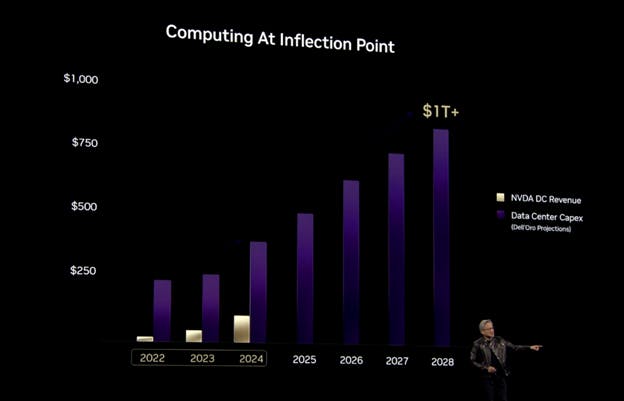
At GTC, Huang pulled forward his view for $1 trillion in data center buildouts, saying he now sees the $1 trillion mark being reached as soon as 2028, ahead of prior expectations for 2030, representing an expansion of Nvidia’s addressable market.
Huang explained that he was confident that the industry would reach that figure “very soon” due to two dynamics – the majority of this growth accelerating as the world undergoes a platform shift to AI (the inflection point for accelerated computing), and an increase in awareness from the world’s largest companies that software’s future requires capital investments.
Nvidia CEO Jensen Huang predicts data center capex may reach $1 trillion as soon as 2028 as AI drives an inflection in computing. Source: NvidiaNvidia
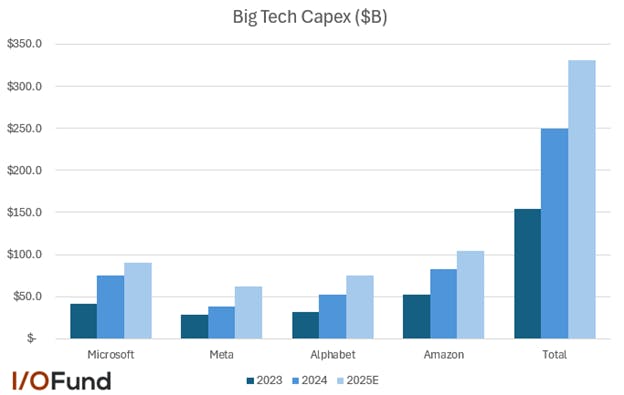
Not only did Big Tech hit the $250 billion threshold in 2024, but these companies are on track to significantly exceed that in 2025, with Microsoft, Meta, Alphabet and Amazon likely to spend close to $330 billion on capex this year. This is easily more than double what was spent in 2023, and as whole, that represents 33% YoY growth for the four purchasing Blackwell en masse.
Based on Huang’s prediction that data center expenditures could reach $1 trillion by 2028, that’s 3x growth in 3 years, and Big Tech alone (not even including Oracle and others) is already at one-third of that this year.
Big Tech’s capex is on track to approach $330 billion in 2025, up 33% YoY and more than double what was spent in 2023. Should Huang’s prediction prove true, it will represent 300% growth in the AI DC infrastructure market in three brief years.
China’s tech firms are also quickly raising capex to remain competitive in the global AI war, with Alibaba signaling capex of $52 billion over the next three years, more than what it has spent over the past decade, while Tencent outlined faster capex growth as it purchases more AI chips. I have said previously on Fox Business News that AI spending goes up in times of war – and neither China nor the US will want to lose to the other when it comes to AI dominance.
The I/O Fund specializes in covering lesser-known AI stocks on our research site with trade alerts and weekly webinars. Learn more here.The I/O Fund specializes in covering lesser-known AI stocks on our research site with trade alerts and weekly webinars. Learn more here.here.
Huang Explains Why Nvidia’s GPUs will Remain in High Demand
The breakthroughs we’ve seen in recent months and the rapid progression to complex problem solving and reasoning are increasing token usage by 100x and resulting in 10x faster computing power required to power the next stages of AI.
Tokens are the core factor going into the economics of an AI model – tokens for training represent the core part of the model costs, while tokens for inference generate revenue and thus profit. In a demo at GTC, Nvidia showed that for a complex problem with multiple constraints, a reasoning model like DeepSeek’s R1 would reason through the possibilities and answer with 20x more tokens using 150x more compute than a traditional model like Meta’s Llama 3.3-70B.
Translating this to the data center shows why Blackwell is in such high demand, to the tune that it has sold more than 2.5x as many GPUs already in 2025 versus Hopper’s peak. With Blackwell, which delivers up to 30x faster performance on inference versus the HGX H100, at 116 tokens per second per GPU versus 3.5 tokens per second, with 25x better energy efficiency. For a reasoning model, Huang explained that with Nvidia’s new Dynamo inference serving library, Blackwell can deliver up to 40x performance for reasoning models.
Here's why this is important. We explained last week in a brief writeup Unlocking the Future of AI Data Centers: Which Fuel Source Reigns Supreme in Efficiency? that power was the core chokepoint and the key enabler for AI’s future, as AI cannot exist without new sources of electricity to power its applications. Huang highlighted this at GTC, explaining that data centers are power limited, meaning revenues are power limited, hence why customers are looking for the most energy efficient chips they can get.
A 100MW data center (which is becoming more commonplace for hyperscalers) could house 1,400 H100 NVL8 racks and produce a maximum of 300 million tokens per second. With Blackwell, the same data center could house 600 racks but produce a maximum of 12 billion tokens per second, in theory a 40x increase. Increased inference performance leading to higher token outputs both lowers costs and increases revenue potential – Nvidia pointed out that DeepSeek-R1 based software optimizations improved token output and revenue generation by 25x and lowered inference costs by 20x.
While these maximums are theoretical in nature, the underlying notion that a data center can serve substantially more tokens at a lower cost supports Blackwell’s high demand, from a superior TCO profile and increased revenue generating ability.
Larger (and more) data centers expand the opportunity ahead for Nvidia – in the follow-up analyst call at GTC, Huang explained that “every gigawatt [of data center] is about $40 billion, $50 billion to Nvidia.”
According to CBRE, approximately 9.5 GW of data centers have gone under construction since the start of 2023. given an average construction timeline of 18 to 36 months (depending on constraints such as power supply), Huang’s comments imply a $380 billion to $475 billion revenue opportunity over the next 1 to 3 years just from that existing footprint under construction since 2023. We’ve already seen large data center announcements in 2025, with construction on the first $100 billion data center for Stargate commencing and Crusoe securing 4.5GW in natural gas for future data centers.
Upcoming GPU Roadmap Positions Nvidia to Capture $1T Data Center Spend
Nvidia is continuing to move at a break-neck pace when it comes to upgrading its GPU lineup, and maintaining this rapid release cycle is allowing it to continually pry away Big Tech’s capex year after year due to the performance, energy and TCO advantages each generation offers over the last.
At GTC, Huang unveiled Blackwell Ultra, the GB300 lineup, Vera Rubin and Vera Rubin Ultra, Blackwell’s successors, and an initial view at Feynman, Rubin’s successor.
GB300 NVL72 Delivers 1.5x Performance Upgrade
Notably, Nvidia provided little mention of the GB200 NVL72 during the keynote and offered no concrete evidence of shipping timelines for the superchip, opting to discuss Blackwell Ultra instead.
Blackwell Ultra, the GB300 NVL72, is due in the second half of 2025, with Huang expecting a smooth transition to the upgraded platform. The GB300 NVL72 provides up to a 1.5x performance boost versus the GB200 and delivers 50% more FP4 dense compute with a 50% boost to memory capacity, both of which will increase inference throughput.
Rubin Offers 3.3x Boost to GB300
Nvidia’s Vera Rubin NVL144 is scheduled for release in the second half of 2026, a year after the GB300 NVL72. Rubin is expected to be “drop-in compatible” to existing Blackwell infrastructure and offers up to a 3.3x boost to FP4 inference performance versus the GB300, with 3.6 exaFLOPs compared to 1.1 exaFLOPs.
Per chip, Rubin offers 50 petaFLOPs of FP4, up 2.5x from 20 petaFLOPs for Blackwell. Rubin also marks a shift to HBM4 memory, while remaining at 288 GB capacity.
Rubin Ultra Sees up to a 14X Increase in Inference Performance
Perhaps the largest boost in performance comes with Rubin Ultra NVL576, set to be released in the second half of 2027. Nvidia says the upcoming platform will offer up to 15 exaFLOPs of FP4 inference performance, a more than 4x increase from Rubin and nearly 14x increase from the GB300 in just two years.
While this leaves much for the supply chain to address in a short period of time (as we know Nvidia likes to break the limits of what’s possible), Nvidia is proving that it remains committed to the two things that matter most as AI continues to scale past generative AI to agentic AI and physical AI – it will continue to significantly boost inference performance via hardware improvements and software optimizations and reduce costs and thus TCO for its customers.
Put simply, data centers can handle more inference requests, process more tokens, and make more in revenue with each upgrade with the same power requirements.
Nvidia’s Valuation is the Equalizer
The major takeaway from GTC is that we’re only on the very brink of what AI can ultimately achieve. The need for compute will continue to rise as the industry progresses from generative AI to advanced reasoning models, to comprehensive AI agents, to autonomous vehicles and robotics where real-time inference is an absolute necessity for split-second decision making.
I spoke with Charles Payne on Fox Business News live during GTC to explain why I believe that the event’s major takeaway is that GPU demand is secular, not cyclical. I explained that Huang is “answering for investors why Nvidia’s GPUs will remain in demand. It does not matter if cheaper models are run on a single GPU, because ultimately, for these advancements to continue, we need to see that 10x in [faster] computing power, and we all know which company will serve that demand.”
Huang put it quite simply: “every single company only has so much power. And within that power, you have to maximize your revenues, not just your cost.”
While a lack of clarity and little mention of the GB200 NVL72’s timing during the keynote was likely a factor behind the muted stock price reaction, I would argue that Nvidia’s stock is absurdly cheap ahead of Q3 and Q4’s volume ramp.
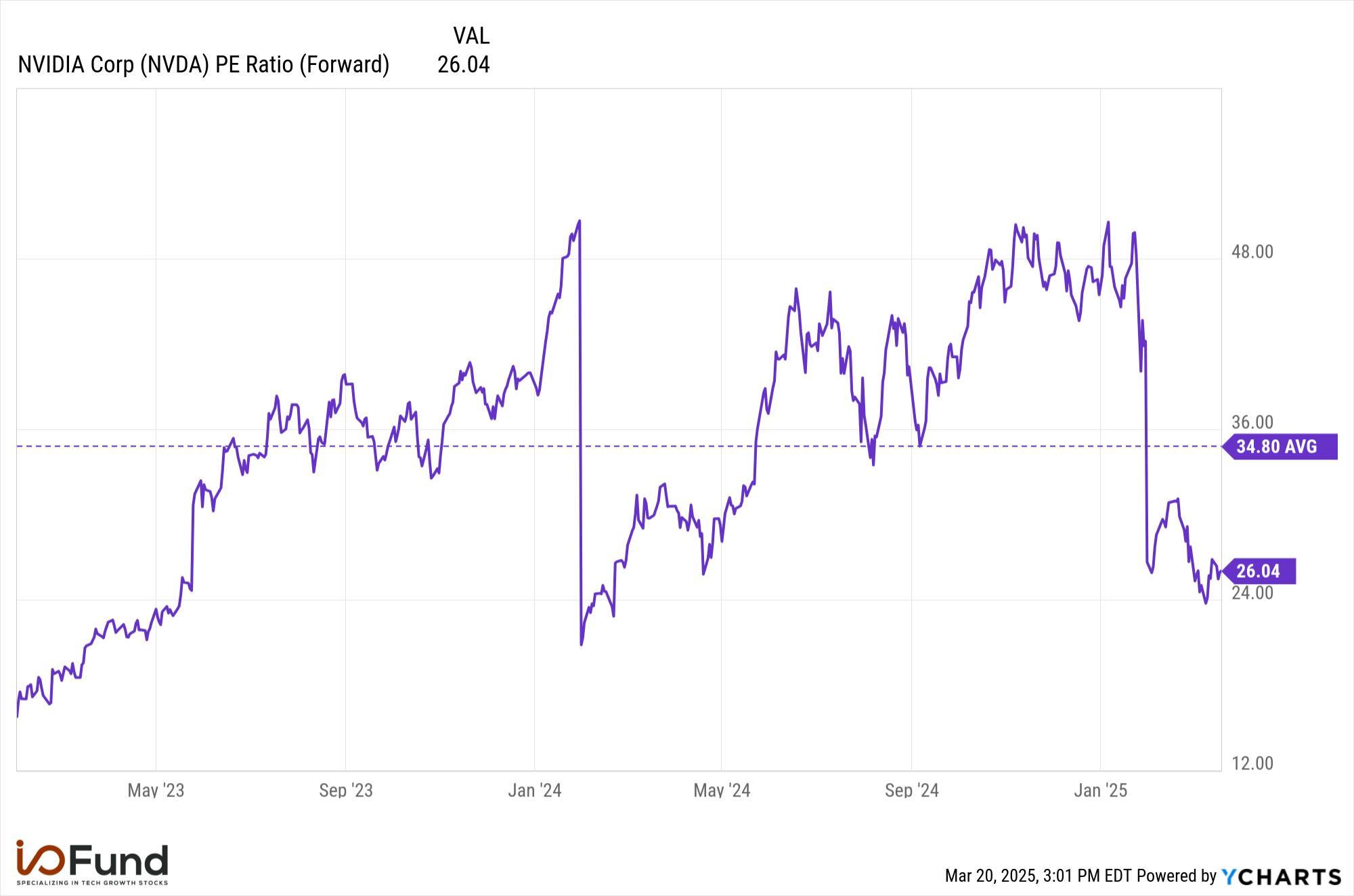
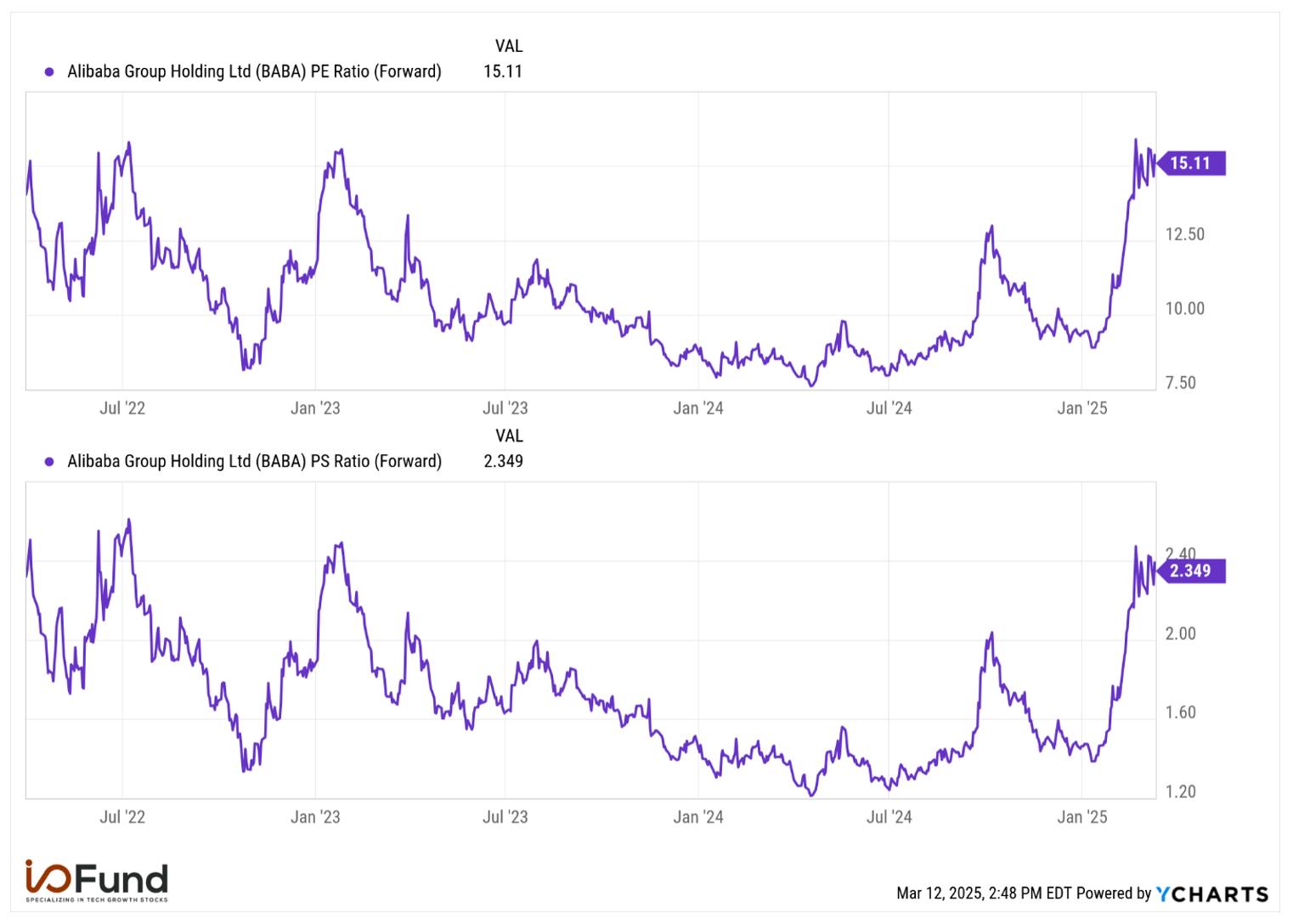
Nvidia is trading at 26.5x forward earnings with growth of over 51% expected this year. Source: YChartsYCharts
Nvidia is currently trading at 26x this fiscal year’s earnings with earnings growth forecast to be 51.5% to $4.53, and at 20x next year's with 27% growth to $5.76. That 26x multiple is nearly a 25% discount to Nvidia’s average forward PE ratio over the past two years, and the same multiple it commanded before May 2023’s Hopper-driven breakout quarter.
Conclusion
Although there are many details from Nvidia’s GTC conference keynote worthy of discussion — Big Tech capex is the single most important point for investors as the sheer amount of capital pointed at data center infrastructure from a handful of companies is truly unparalleled in the history of the markets.
We’ve continuously reminded our readers that data center capex provides visible read-throughs for Nvidia as it captures a lion’s share of that spend, and GTC provided another clear signal that not only is capex not slowingnot slowing as analysts feared but is accelerating ahead of expectations.
In the more immediate term, we have mixed signals from suppliers on the exact timing of Blackwell’s GB200 NVL72s. The premiere SKU was originally expected to ship in volume in Q1 and that did not happen. Going into the February earnings report, I stated my spidey senses were up in the article “Nvidia Suppliers Send Mixed Signals for Delays on GB200 Systems – What It Means for NVDA Stock and cautioned the earnings report was unlikely to offer the blowout that investors have become accustomed to. This was despite Wall Street growing exuberant into the print and aggressively raising price targets.
Later, I/O Fund Portfolio Manager Knox Ridley stated that if Nvidia breaks $123-$119, the stock would likely find support between $102 and $83. This scenario remains a possibility given the weakness we have seen in the broad market. With that said, we see any dips on Nvidia as a buying opportunity as the stars are aligning for Q3-Q4 in terms of volume shipments on the Blackwell and Blackwell Ultra GPUs.
The I/O Fund has a strong track record on this stock, discussing every twist and turn publicly for our free stock newsletter readers with documented gains of up to 4,100% as far back as 2018 based on a very-early AI thesis. The I/O Fund sends real-time trade alerts for every entry and exit, and our research members will be notified via text when we deem the risk/reward favorable and resume buying Nvidia. Learn more here.
Disclaimer: The I/O Fund conducts research and draws conclusions for the company’s portfolio. We then share that information with our readers and offer real-time trade notifications. This is not a guarantee of a stock’s performance and it is not financial advice. Please consult your personal financial advisor before buying any stock in the companies mentioned in this analysis. Beth Kindig and the I/O Fund own shares in NVDA at the time of writing and may own stocks pictured in the charts.
Core Scientific is a major Bitcoin miner leading the transition to high-performance compute (HPC) data centers with 1.3 GW of contracted powered infrastructure.
The Company signed 12-year hosting deals with AI Hyperscaler CoreWeave to provide 590 MW of HPC infrastructure valued at up to $10.2 billion.
CoreWeave will front the $750+ million in capex funds to modify Core Scientific’s data centers as an anchor client.
Core Scientific’s HPC hosting revenues could surge 21X per quarter when the full 590 MW of critical load go online in 2027.
ROTH MKM expects Core Scientific to reach a $1.58 billion run rate by 2027.
The I/O Fund will be holding a very tight stop on any position we initiate, and the stock would be for Advanced Market Signals only, indicating it qualifies for more advanced investors who are comfortable trading daily/weekly.
Core Scientific (NASDAQ: CORZ) is a digital infrastructure company that operates bitcoin mining and hosting services, and high-performance compute (HPC) hosting services through its nine purpose-built data centers. As one of the largest Bitcoin miners in North America, operating 171,000 mining rigs (164,000 owned), the Company is positioning itself for significant growth in the AI space.
Its strategic shift to high-performance computing (HPC) hosting is particularly compelling, allowing it to mitigate Bitcoin’s volatility while capitalizing on the surging demand for AI data centers. By securing high-margin HPC hosting contracts, the company is poised to tap into one of the most lucrative and rapidly growing markets in technology. While other Bitcoin miners are starting to catch on, attempting to transition to AI data centers, Core Scientific has a clear first mover advantage reinforced by lucrative multi-billion dollar 12-year contracts with upside revenue potential of $10.2 billion with AI hyperscaler CoreWeave with a trajectory aimed at generating 21X HPC hosting revenue growth in 2027.
Core Scientific’s Value Proposition for HPC Hosting Customers
Core Scientific provides many attractive value propositions to hyperscalers:
Specialized Power Infrastructure: HPC customers require more power than conventional data centers can offer. AI and HPC workloads require 6 to 10 times more electricity to operate. Traditional data centers are accustomed to single racks consuming 10 to 15 kW of power. Current AI racks push 80 KW as they will soon draw 120 kW to 150 kW in the next generations, with 200 kW within several years. Core Scientific has the existing infrastructure with nearly 900 MW of capacity for HPC hosting in addition to the 400 MW for Bitcoin mining capacity. , with 200 kW within several years. Core Scientific has the existing infrastructure with nearly 900 MW of capacity for HPC hosting in addition to the 400 MW for Bitcoin mining capacity.
Scalable HPC Infrastructure: They are actively transitioning their facilities to cater specifically to AI workloads with infrastructure optimized for machine learning and deep learning applications. Its Denton, Texas, facility is undergoing a $6.1 billion expansion, boosting its MW capacity by 97 MW to 394 MW with 47 more acres to 78 acres to host one of North America's largest GPU supercomputers for AI computing. It's being converted entirely for HPC hosting.
Location: Core Scientific operates 9 Application Specific Data Centers strategically located near major internet hubs in Georgia, Kentucky, North Dakota, North Carolina, Oklahoma, Alabama and three in Texas. Its new leased (with an option to buy) site in Alabama offers 11 MW of critical IT load and is scalable up to 66 MW of critical IT load, which Core Scientific is in discussions with potential new clients to contract for HPC hosting. They are developing a state-of-the-art 100 MW data center in Muskogee, Oklahoma.
Maintenance and Repair: Offering 24/7 around-the-clock monitoring, support and maintenance, Core Scientific is one of the largest application-specific integrated chips (ASIC) repair centers in North America, servicing their own and customer’s fleet of 171,000 bitcoin mining rigs. Parlaying from ASICs, they plan on using their expertise and manpower to replicate it and expand their offering on the GPU side.
CoreWeave: An Early Believer in the Core Logic’s HPC Transition
CoreWeave is an NVIDIA-backed AI Hyperscaler, providing AI cloud services by offering GPU clusters for HPC and AI workloads. CoreWeave is a specialized cloud provider offering an optimized platform for GPU-intensive tasks. They build and operate their own data centers equipped with a massive scale of over 300,000 Nvidia GPUs. They currently have 28 operational data centers and plan to open 10 new data centers in 2025, leasing a significant portion of their capacity with Core Scientific.
On March 6, 2024, Core Scientific announced an initial long-term deal with anchor customer CoreWeave to provide up to 16 MW of data center infrastructure for their HPC and AI workloads at their tier 3 data center in Austin, Texas. This helps to substantiate the pivot from Bitcoin mining to offering AI/HPC infrastructure, stating a “strategy shift” to AI may be good for a temporary stock price spike, but actually signing up customers is another story.
CoreWeave was already a GPU hosting client from 2019 to 2022, hosting thousands of GPUs. Despite the potential value of the March 6 deal being worth up to $100 million, it didn’t move the needle much for the stock price, which still traded under $4.00, selling off to $2.95 the following week.
CoreWeave Ups the Ante and Fronts the Capex Funds in $3.5 Billion Deal
Core Scientific was successful in delivering 16 MW of capacity more than 30 days ahead of schedule at its Austin, Texas, data center. This prompted more deals. On June 3, 2024, CoreWeave signed several 12-year contract deals securing 200 MW of infrastructure to host CoreWeave’s NVDA GPUs. Additionally, CoreWeave will fully fund (not pay for) the capital investments (capex), estimated around $300 million, required to modify Core Scientific’s “existing infrastructure into cutting-edge application-specific data centers customized for dense HPC." CoreWeave will put up the capital for the modifications and Core Scientific will credit them 50% of their hosting fees until it’s paid back fully.
Regarding CoreWeave paying for the capex, here is what was stated on the call:
“Yes. Thanks, Brett. I mean really, the difference in the CoreWeave deal is 100% funding of the CapEx. They were able to significantly buy down their rates. And I think as we look forward, what we're seeing for 2025 is frankly rather unique. If you're able to deliver capacity in 2025 and 2026 right now — we're definitely seeing those lease rates be much higher than we expected, especially given that many of these folks are willing to cover some portion of the CapEx of the build-out. So we're excited about where lease rates are going, and we believe we'll be able to extract a significant amount of value from the demand that we're currently seeing over the next few years.”
CoreWeave Contracts a Total of 502 MW Generating $8.7 Billion Over 12 Years
Once the 200 MW of HPC is operational Core Scientific estimates they’ll receive around $290 million annually or more than $3.5 billion during the initial 12-years terms of the contracts. CoreWeave exercised its options and signed for an additional 70 MW on June 25, 2024, and $105 million of capex funding, equating to an additional $1.23 billion for Core Scientific during its 12-year term. In August 2024, CoreWeave signed another 112 MW contract beginning in 2026.
In October 2024, CoreWeave exercised the rest of its options and signed another 120 MW hosting contract for 12 years for a total of a full 502 MW of critical IT load with a total revenue potential of $8.7 billion over the 12-year terms of its contracts. The average annual run rate is $725 million. HPC hosting revenues are expected to start flowing in 2025 with 200 MW delivered by the end of 1H 2025, up to 270 MW delivered by the end of 2H 2025, up to 382 MW by the end of 1H 2026 and up to 500 MW by the end of 2H 2026. CoreWeave is expected to fund capex costs of $750 million, which Core Scientific will credit 50% of the hosting fees until fully repaid.
CoreWeave: Providing 250,000+ NVIDIA GPU-powered AI Infrastructure For Lease
As Core Scientific’s largest anchor customer, it’s important to take a look into this client. Core Scientific is a direct benefactor of CoreWeave’s success. What’s good for CoreWeave is also good for Core Scientific.
CoreWeave is an AI hyperscaler that has evolved from a crypto miner that leased space and power (NVIDIA GPUs) from Core Scientific to an AI hyperscaler powerhouse with a roster of high profile clients including Microsoft, Meta Platforms, IBM, Cohere, NVIDIA and OpenAI. CoreWeave is a specialized cloud provider focused on offering scalable AI cloud infrastructure including access to over 250,000 NVIDIA GPUs, low-latency networking and high-bandwidth storage optimized for the massive computational workloads of AI training and inference and ML. The company stands out, as NVIDIA stated, “… CoreWeave has launched NVIDIA GB200 NVL72-based instances, becoming the first cloud service provider to make the NVIDIA Blackwell platform generally available.”
CoreWeave builds infrastructure that can scale at a moment’s notice that can go from zero GPUS to 10,000 GPU working on the same job within a minute.
In 2024, Microsoft accounted for nearly 62% of CoreWeave’s revenue (with Meta accounting for 15% according to H.C. Wainwright), which surged 737% YoY from $229 million to $1.9 billion. Customer concentration concerns were eased a bit with the signing of a $11.9 billion deal with OpenAI, who will also become an investor owning $350 million of stock. NVIDIA holds a 5% minority stake in CoreWeave, which will be going public in 2025.
Core Scientific Gets a Game Changer Deal with CoreWeave
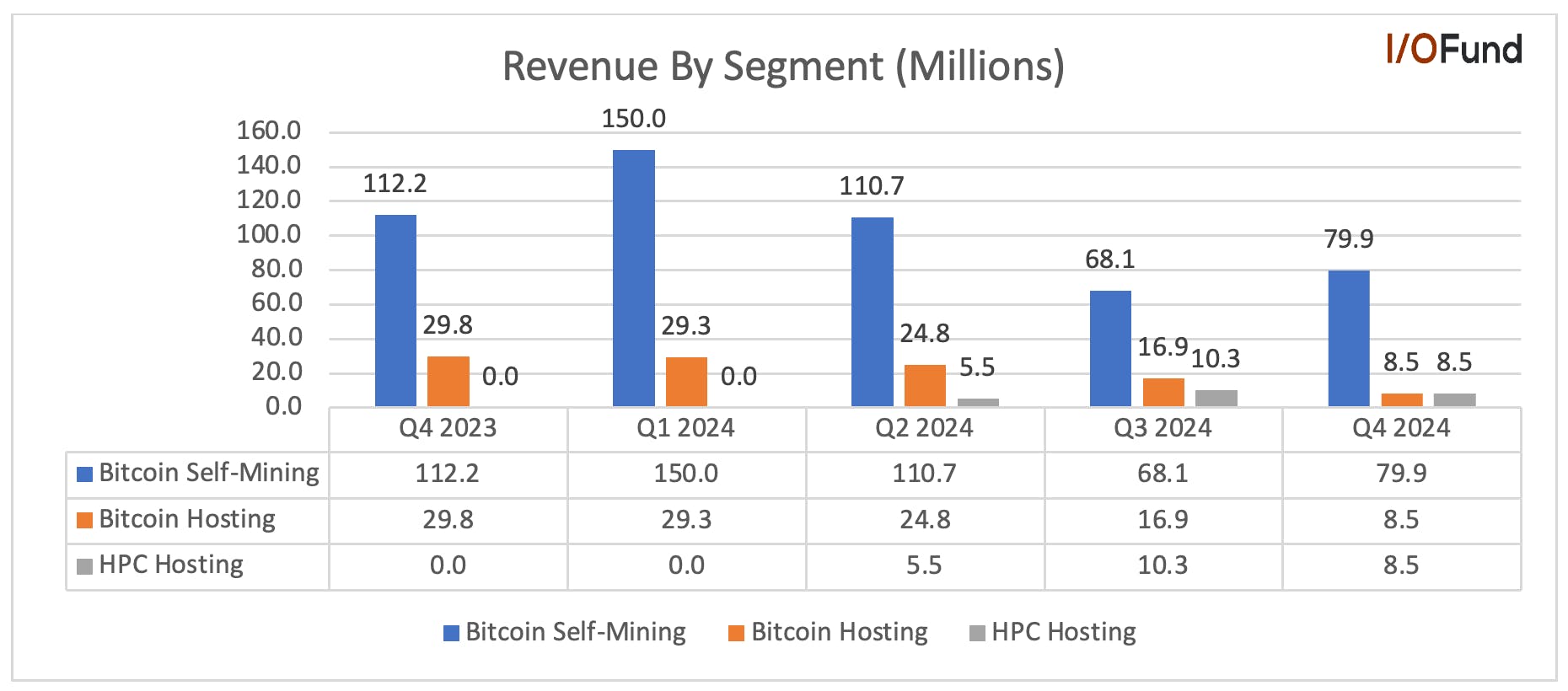
The revenue potential of CoreWeave’s contracts is $8.7 billion over their 12-year terms, equivalent to $725 million annually once fully online. That equates to $181.25 million of quarterly HPC revenue, up from $8.5 million in Q4 or 21X potential, by early 2027. When compared to overall revenue, this is 2X growth on a quarterly basis.
The 21X growth in HPC and 2X growth in overall revenue is before the additional 70 MW $1.2 billion expansion deal announced at its Denton, Texas facility in its Q4 earnings release, resulting in the cumulative revenue potential of over $10 billion from CoreWeave, with 75 to 80% cash gross profit margins according to the Company. The full 590MW contracted to CoreWeave is expected to come online in 2027. This would be up from 250 MW expected in 2025.
CoreWeave Announces $1.2 Billion Expansion at Denton, Texas Facility
On Feb 26, 2025, coinciding with its Q4 2024 earnings release, Core Scientific announced a $1.2 billion 70 MW expansion at the Denton, TX site, for CoreWeave. The 70 MW of additional contracted power at the Denton site increases the full critical IT load to approximately 260 MW. The agreement increases CoreWeave's total contracted HPC infrastructure with Core Scientific to approximately 590 MW across six sites.
Under the terms of our Agreement with CoreWeave with respect to this additional 70MW, Core Scientific is responsible for funding $104 million of the additional required capex ($1.5M per MW), with CoreWeave responsible for the additional capex associated with the expansion. The company also retains the option for two additional five-year renewal terms.
“Looking ahead, we now expect to have delivered approximately 250 megawatts of HPC capacity to CoreWeave by the end of this year, with the full 590 megawatts coming online in early 2027. This represents a shift from our previous timeline and reflects both the size and complexity of the project, particularly the addition of an incremental 70 megawatts of critical IT load.“
Adam Sullivan also added this, “So from what we're seeing on CoreWeave's demand side is significantly stronger than what we saw in 2024. There's a lot of things going on in the market today that we're seeing that's actually driving continued demand and flow into CoreWeave. And so we're excited about continuing to expand with them at Denton. And Denton is going to be one of the largest supercomputers in the United States, and it's going to be a flagship asset for CoreWeave.“
One note of caution: Core Scientific has all the makings of a hypergrowth stock and this includes immense risk. The company is recently out of Chapter 11 Bankruptcy and has to raise cash to fund operations, which means taking on debt. The I/O Fund will be holding a very tight stop on any position we initiate, and the stock would be for Advanced Market Signals only, indicating it qualifies for more advanced investors who are comfortable trading daily/weekly.
Looking Beyond the Q4 2024 Headline Numbers
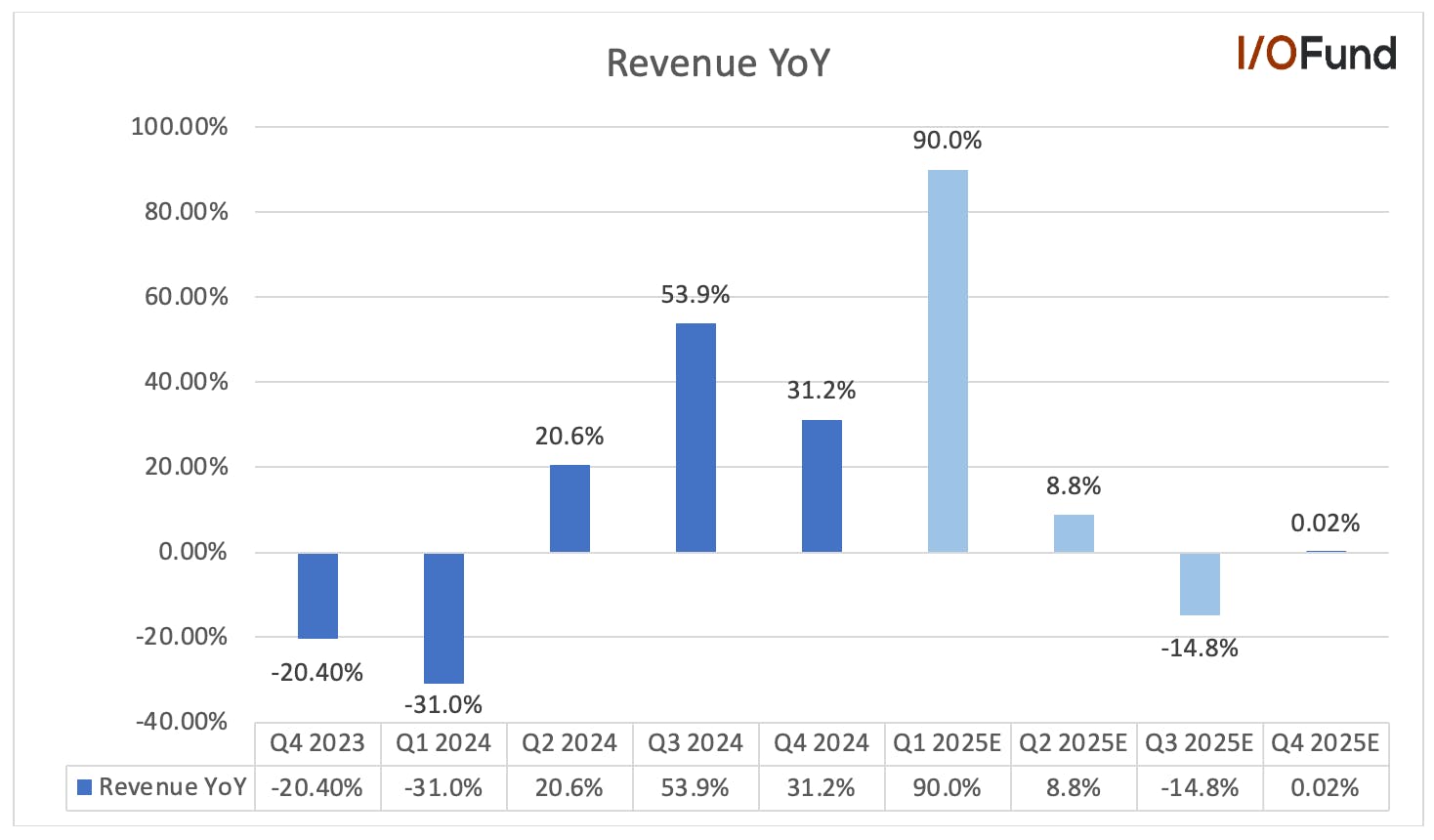
Core Scientific reported disastrous-looking Q4 2024 earnings results based on headline numbers, with an EPS loss of ($0.60), missing consensus estimates for a loss of ($0.09) by ($0.51). Revenues fell 33.1% YoY to $94.93 million, missing consensus estimates by ($2.14 million). Yet, the stock gapped over 10% following its release.
The reason is that just beneath the surface, Core Scientific is setting up to solve one of the biggest issues the United States and the AI market face: power supply. The company is going through a transition period as it moves into the AI/HPC data center markets supported by AI hyperscaler CoreWeave, who just signed a five-year $11.9 billion deal with OpenAI.
$224.7 Million Mark-to-Market Adjustment Shouldn’t Spook Investors
The initial sting of the reported ($265.5 million) GAAP loss in Q4 2024 may sound like bad news, but $224.7 million of it is a non-cash mark-to-market adjustment on warrants; just accounting noise. The “actual” Q4 net loss was ($31.8 million), not ($265.5 million).
Core Scientific issued warrants, which are considered liabilities under GAAP accounting rules since the Company has to deliver stock at the exercise price. If the stock rises in value, the Company has to post a larger liability, but it doesn’t mean they are taking any actual losses. The Company issued two tranches of warrants at $6.81 x 98.3M shares for Tranche 1 (CORZW) exp. January 23, 2027, and $0.01 x 81.9M shares for Tranche 2 (CORZZ) exp. January 23, 2029, as part of its plan to emerge from Chapter 11 bankruptcy in January 2024.
The Company still receives the funds when the warrants convert as they issue the required shares. There are no real losses. In fact, it’s relatively good news since the higher the stock price rises, the deeper the “paper losses” appear until the warrants are all exercised or expired and taken off the books. However, that presents a dilution issue of an additional 180.2 million additional common shares.
The 116 Million Shares from Warrants Remaining Might Spook Investors
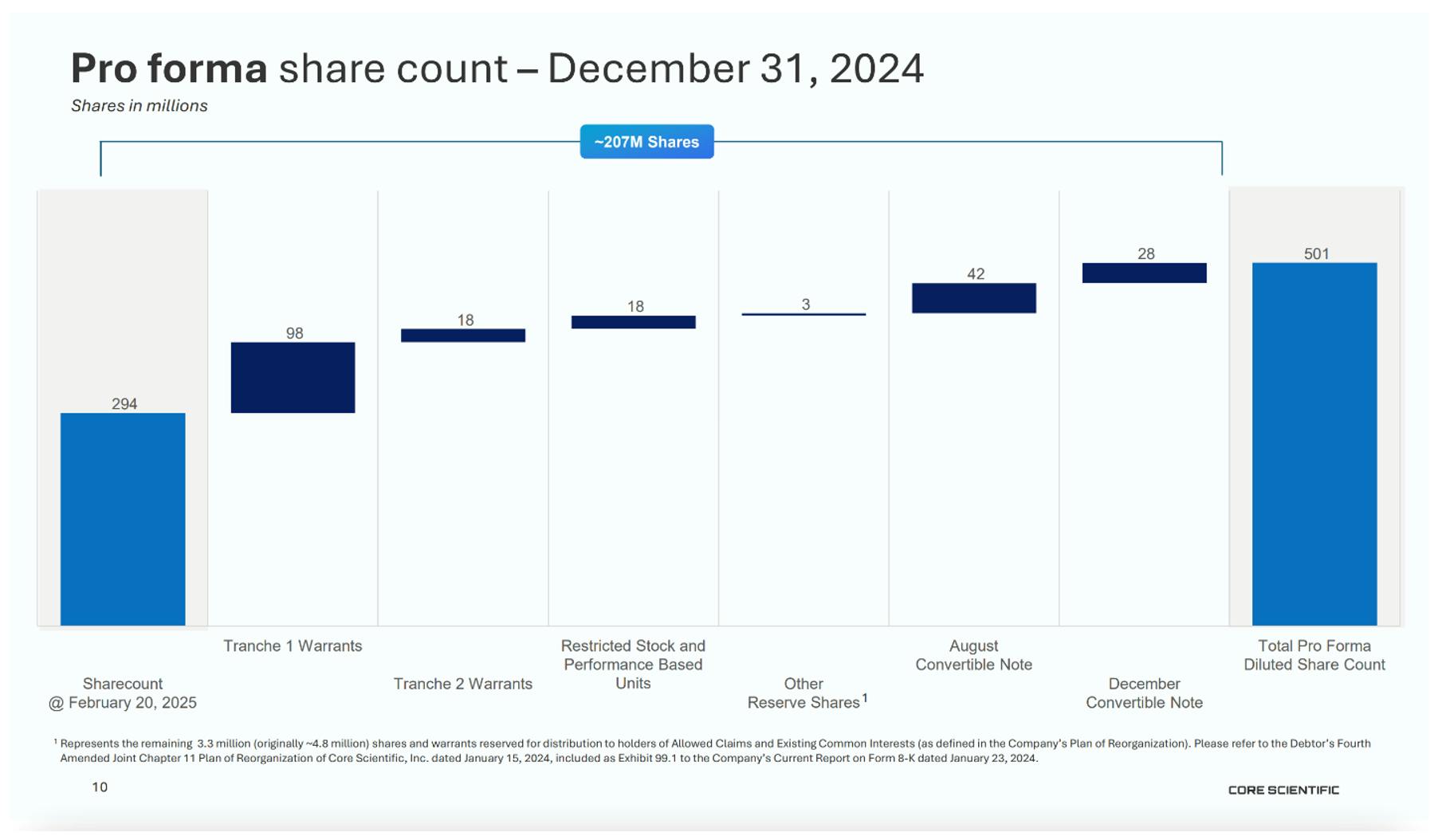
During 2024, Core Scientific received $4.4 million in proceeds from 646,109 shares of Tranche 1 warrants being exercised. On December 24, 2024, 60.9 million Tranche 2 warrants were exercised for $600,000. This leaves 116 million warrant-related shares remaining of potential dilution on the remaining warrants. Core Scientific has 294 million shares outstanding as of February 20, 2025.
As of February 20, 2025, the pro forma diluted share count is 501 million shares. This includes the current 294 million shares outstanding along with 207 million additional unissued shares that include Tranche 1 and Tranche 2 warrants of 116 million remaining, convertible notes of 70 million shares and 21 million shares of restricted stock and reserve shares.
Revenues Sink as Company Converts Bitcoin Data Centers to HPC Data Centers
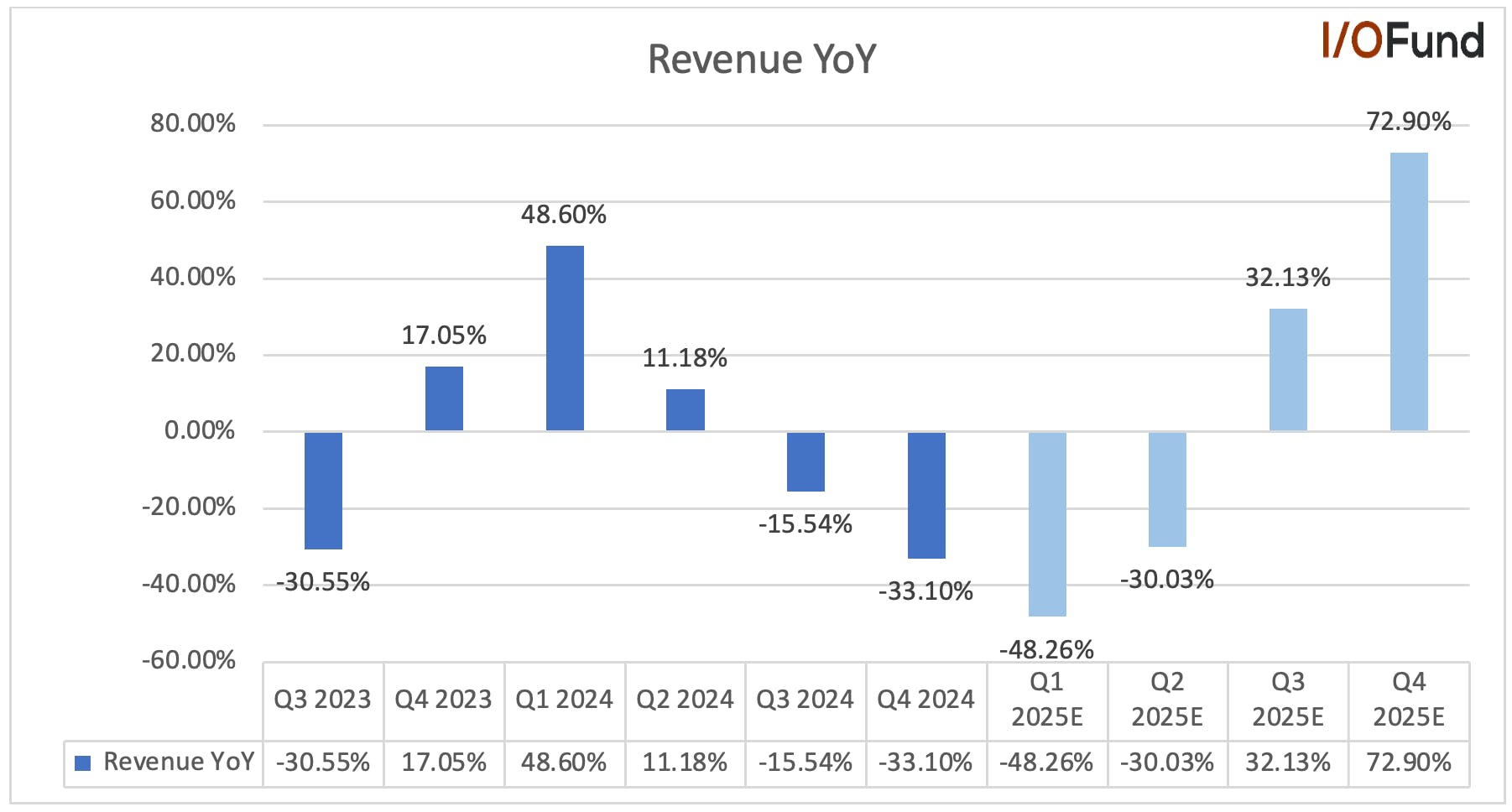
The company’s Q4 revenue fell by (33.1%) YoY and (0.44%) QoQ to $94.93 million, primarily due to the decline in self-mined Bitcoin to 974, down from 3,042 in the year ago period. The Company has been converting some of its Bitcoin mining data centers to HPC data centers and actively “sunsetting” Bitcoin hosting contracts as it transitions to HPC hosting. The Bitcoin halving event also occurred in April of Q2 2024, thereby causing Bitcoin revenue to shrink on a YoY basis further magnifying the deceleration. Revenue fell short of estimates by (2.2%).
Analyst expect revenue to fall (48.26%) YoY to $92.77 million in Q1 2025, and fall (30.03%) YoY to $98.73 million in Q2 2025.
Full-year 2024 revenues rose 1.6% to $510.7 million.
Analysts expect FY2025 revenue to fall (3.71%) YoY to $491.75 million.
Revenue Segments: Bitcoin Revenues Drop in Preparation for HPC Revenue Acceleration
As Core Scientific transitions from Bitcoin self-mining and hosting to HPC hosting, the revenue segments can be expected to drop in the Bitcoin segments and rise in the HPC hosting segment. The quarters may look predominantly worse until the Core Scientific HPC revenues start to ramp up as they go online. Based on analyst estimates, Q1 2025 may be the final “kitchen sink” quarter before revenues reaccelerate.
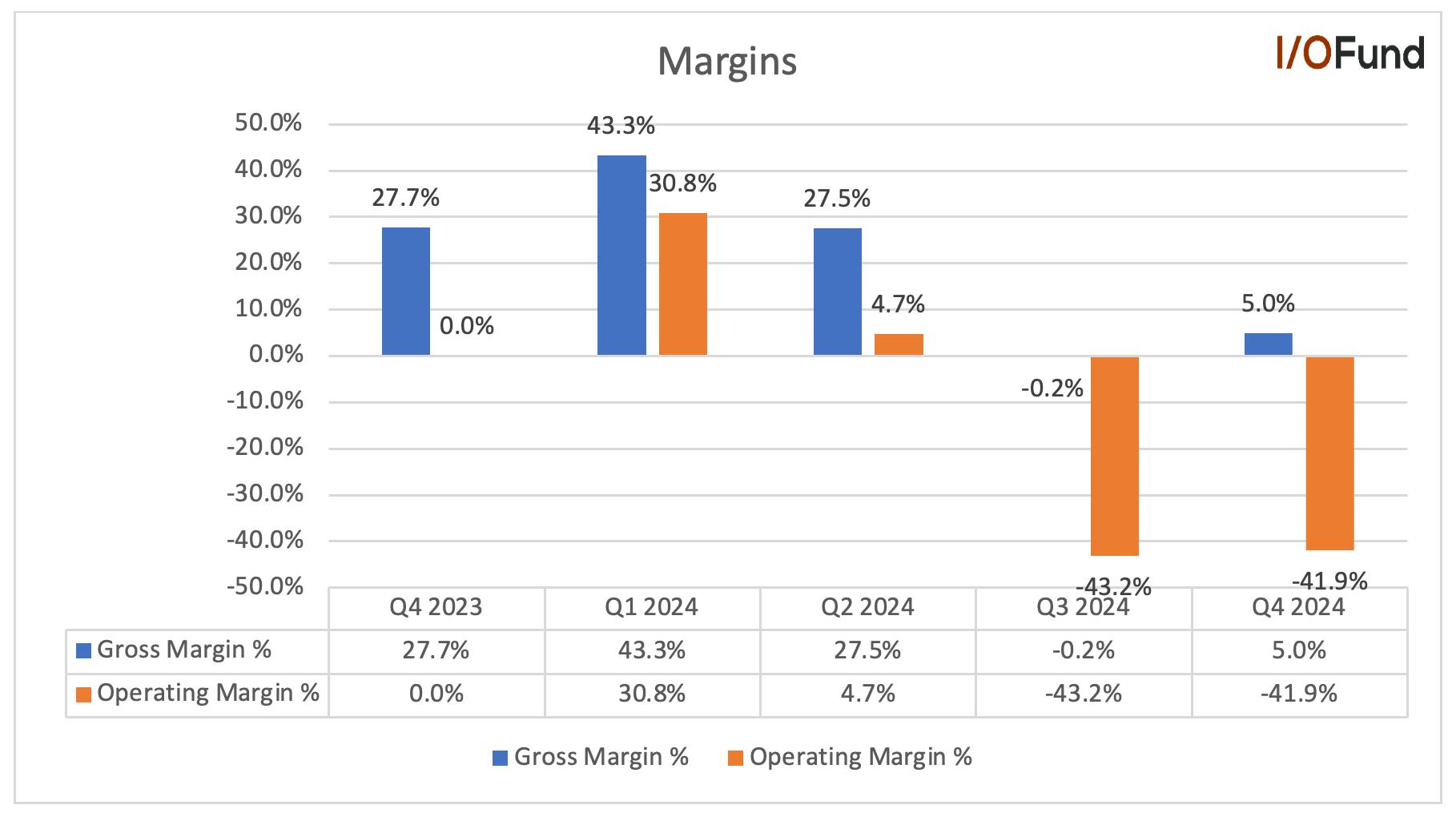
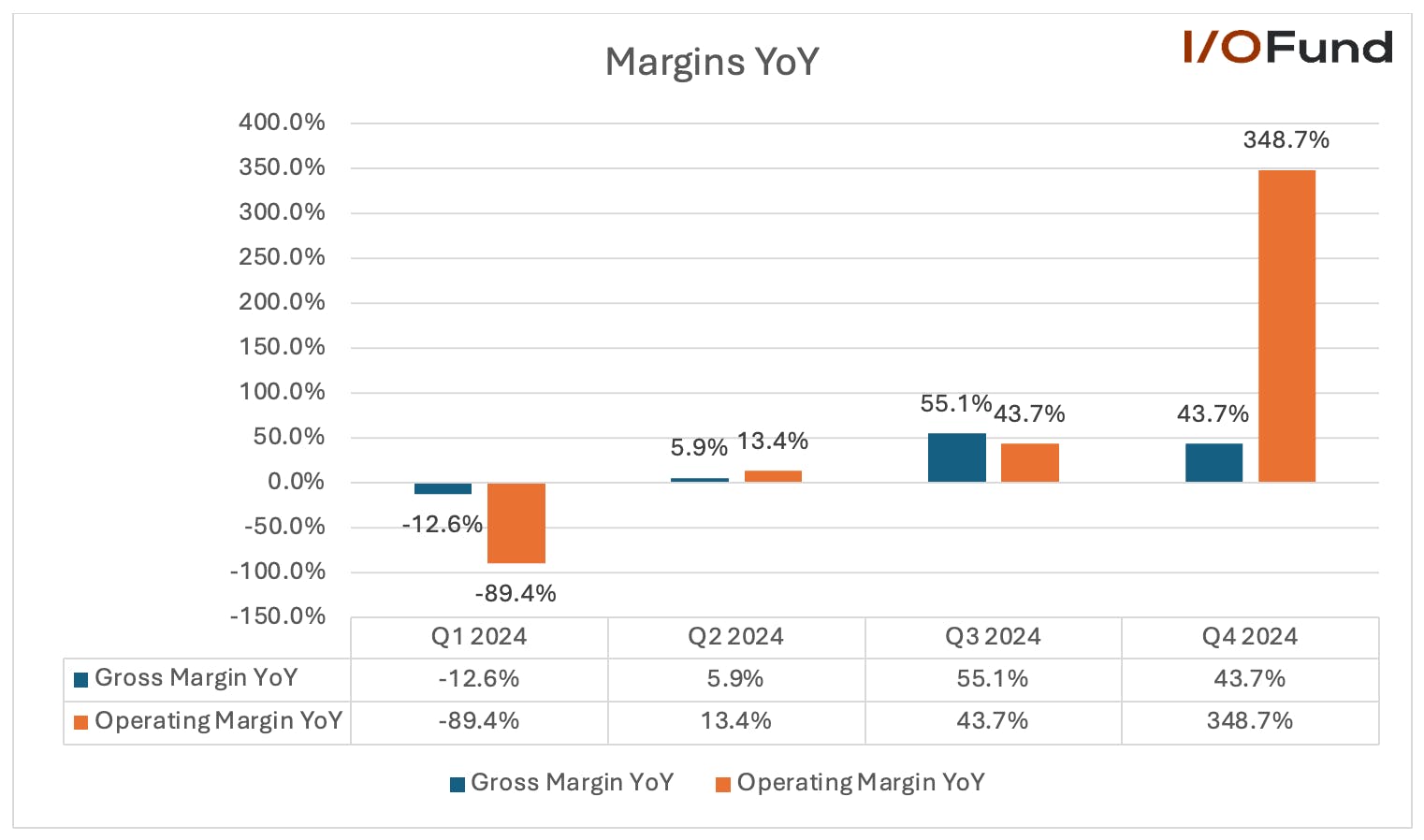
Margins Consistently Expand Through 2024
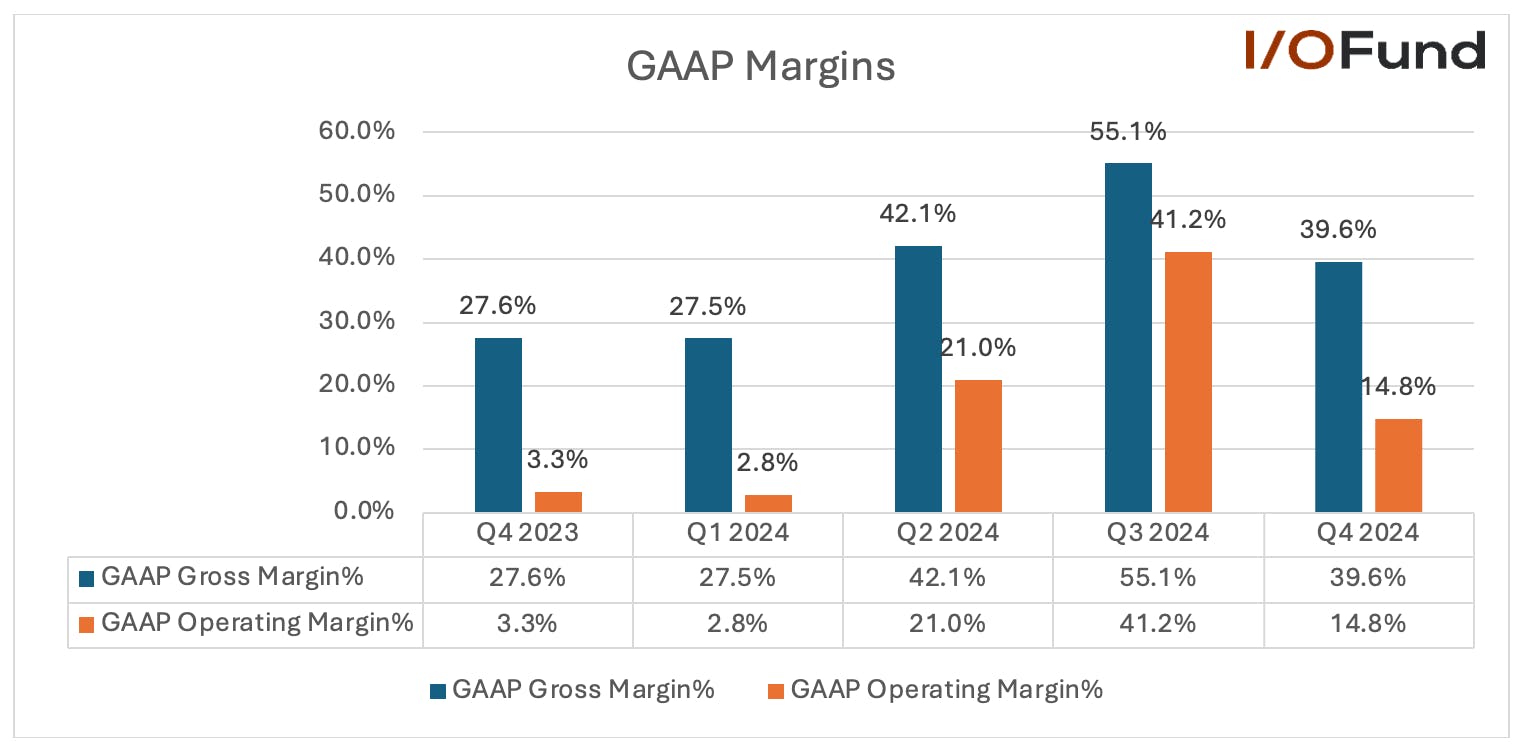
Q4 gross margin was 5%, compared to 27.7% in the same period last year.
Q4 operating margin was (41.9%), compared to 2.8% in the same period last year. However, EPS is showing a rebound on the horizon as higher margin HPC hosting revenues increase.
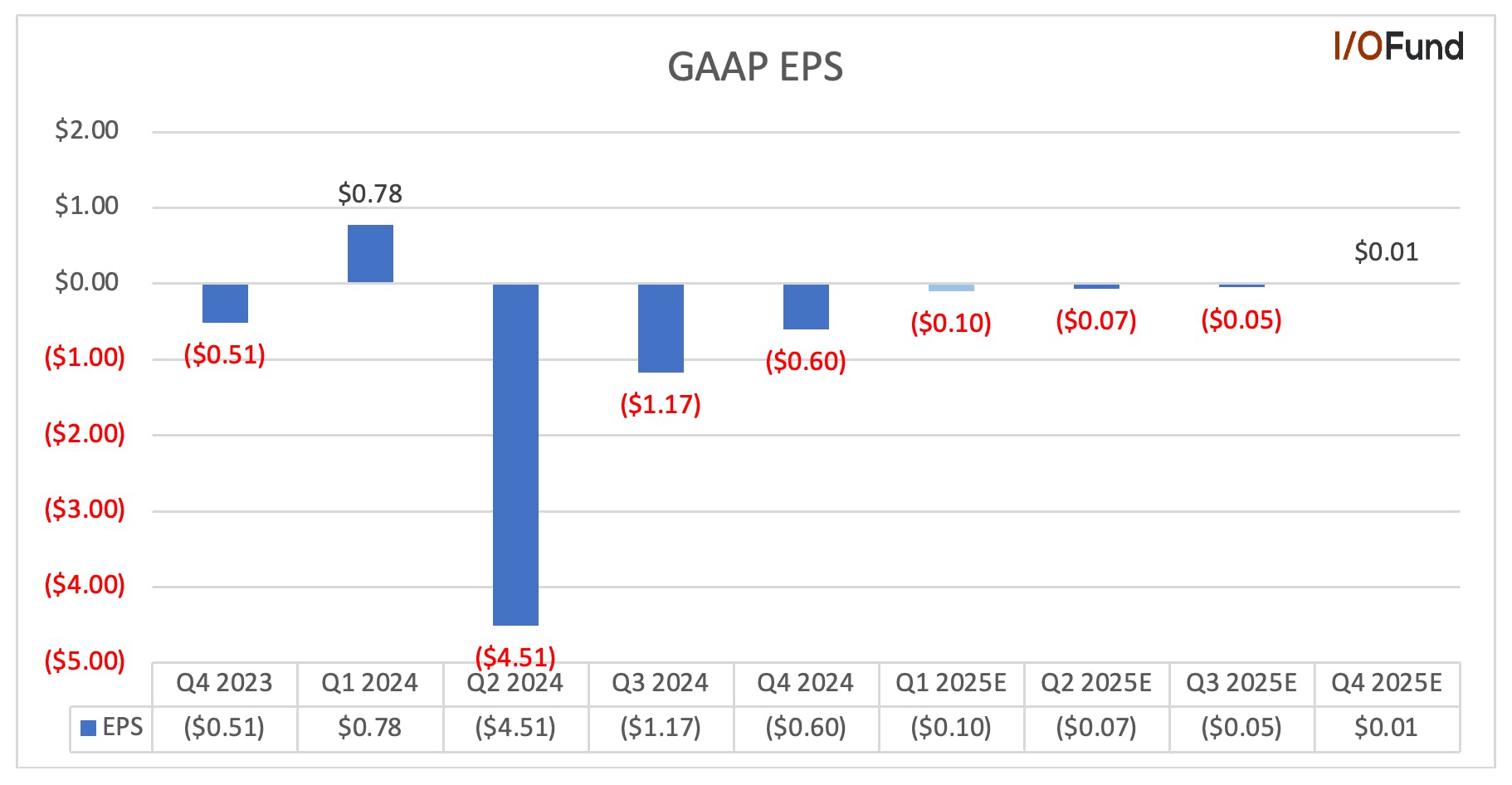
GAAP EPS Trending Towards Positive After Mark-to-Market Adjustments on Warrants
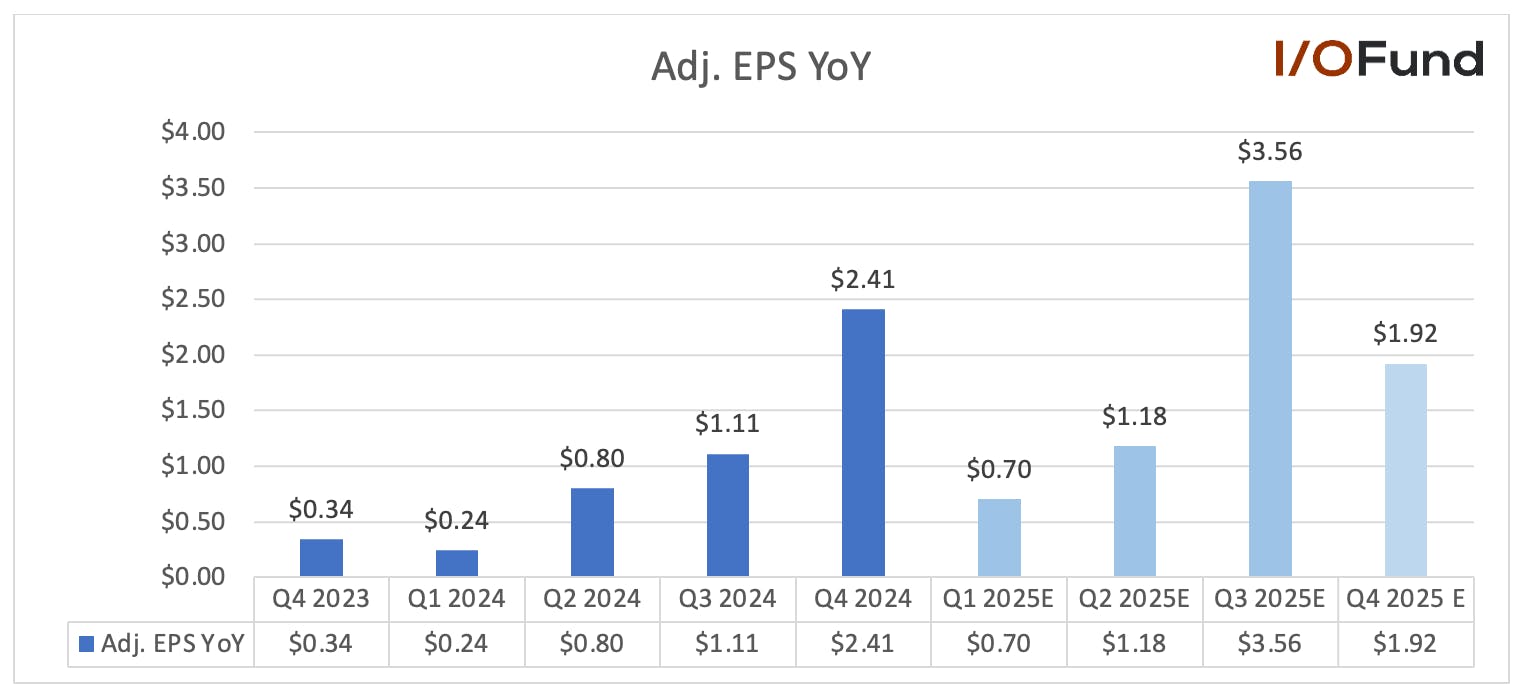
Q4 GAAP EPS was ($0.60) compared to ($0.11) in the same period last year. The EPS miss was primarily due to the $244.7 million non-cash market-to-market (MTM) adjusted on the warrants.
Analysts expect GAAP Q1 2025 EPS to improve to ($0.10).
Analysts expect GAAP Q2 2025 EPS to improve to ($0.07).
Analysts expect GAAP Q3 2025 EPS to improve to ($0.05).
Analysts expect GAAP Q4 2025 EPS to improve to $0.01 as CoreWeave's data centers come online.
Full year 2024 GAAP EPS was ($4.39) compared to ($0.65) last year.
Analysts expect full year 2025 GAAP EPS to improve to ($0.24).
Analysts expect full year 2026 GAAP EPS to improve to $0.40 as more of CoreWeave’s data centers come online.
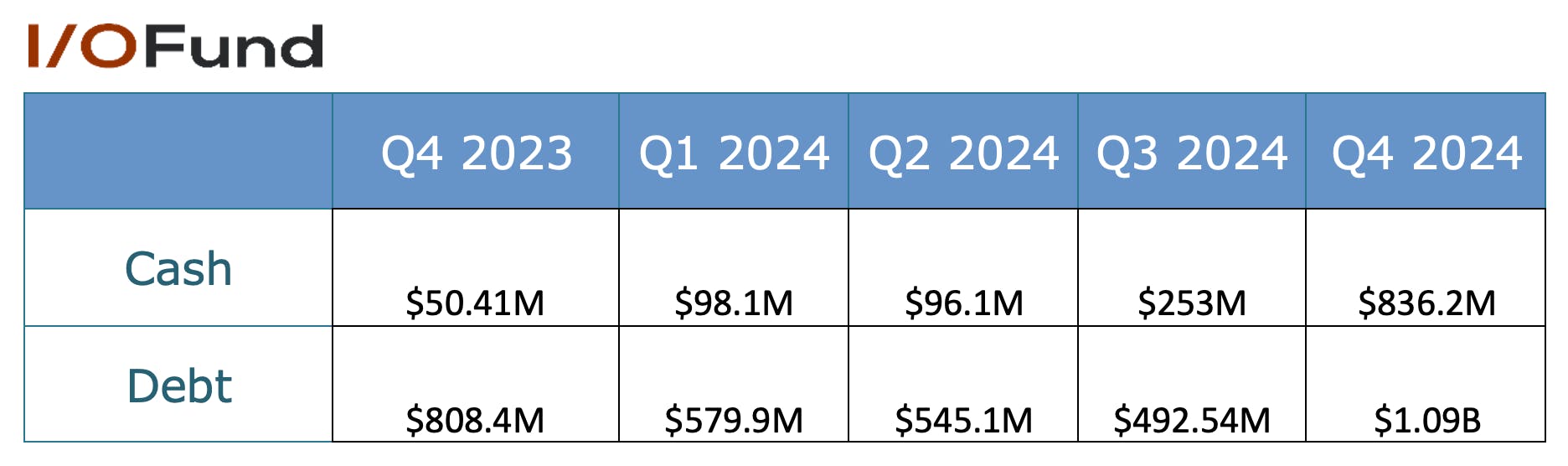
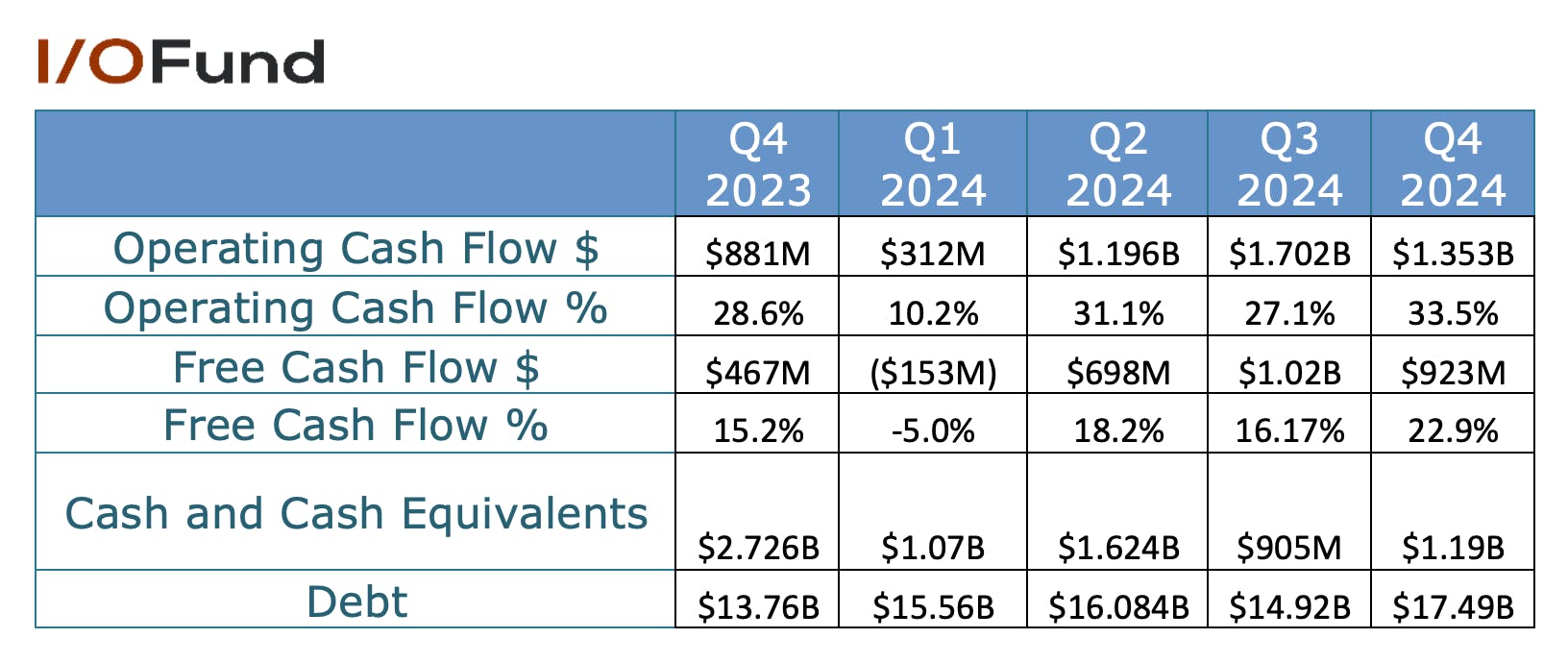
Cash Grows as Core Scientific Issues $1.09 Billion in Convertible Senior Notes
Core Scientific closed Q4 with $836.2 million in cash and $1.09 billion in debt. The debt is comprised of two convertible notes. In August 2024, The Company issued $460 million in convertible notes due 2029, which enabled the Company to refinance its debt from a 12% interest rate to 3% while increasing its cash position and removing covenants to allow the Company to accumulate Bitcoin. The conversion price is $11.00 at a rate of 90.9256 shares per $1,000 in principal, which brings a total 41.82 million shares issued upon conversion.
In December 2024, Core Scientific priced an upsized $625 million convertible senior notes offering due 2031. The conversion price is $22.49 at a rate of 44.4587 shares per $1,000 in principal. This brings a total of 71.61 million additional common shares upon full conversion.
The Implications of Not Being Investment Grade
Its worth noting that there are implications of not being investment grade especially when needing to raise cash. Considering Core Scientific emerged from Chapter 11 bankruptcy in January 2024, this status alone shapes their cash-raising strategy. Being non-investment grade tends to mean higher borrowing costs, but Core Scientific was able to cut their interest rate from 12% to 3% by swapping out the debt with convertible notes.
It’s worth noting that Core Scientific’s 3% interest rate is impressive for a company just out of bankruptcy implying the institution(s) are very confident in Core Scientific’s strategy. However, that route also comes with its potential share of dilution (41.82 million new shares) if shares are converted at $11.00 per share. Core Scientific has the option to redeem early if the stock trades 130% above the conversion price for 20-30 trading days ($14.30) after the initial non-call period August 2027.
The additional $625 million convertible also comes with dilution (27.79 million new shares) but at a higher conversion price of $22.49 and no interest rate. However, Core Scientific achieved this funding with 0% interest implying very high confidence that Core Scientific will either redeem the notes at maturity or that the shares will surge above the conversion price enabling them to convert shares for a profit before then. Both convertibles are senior unsecured obligations, therefore in the event of bankruptcy or default, unsecured creditors rank below secured lenders.
Valuation
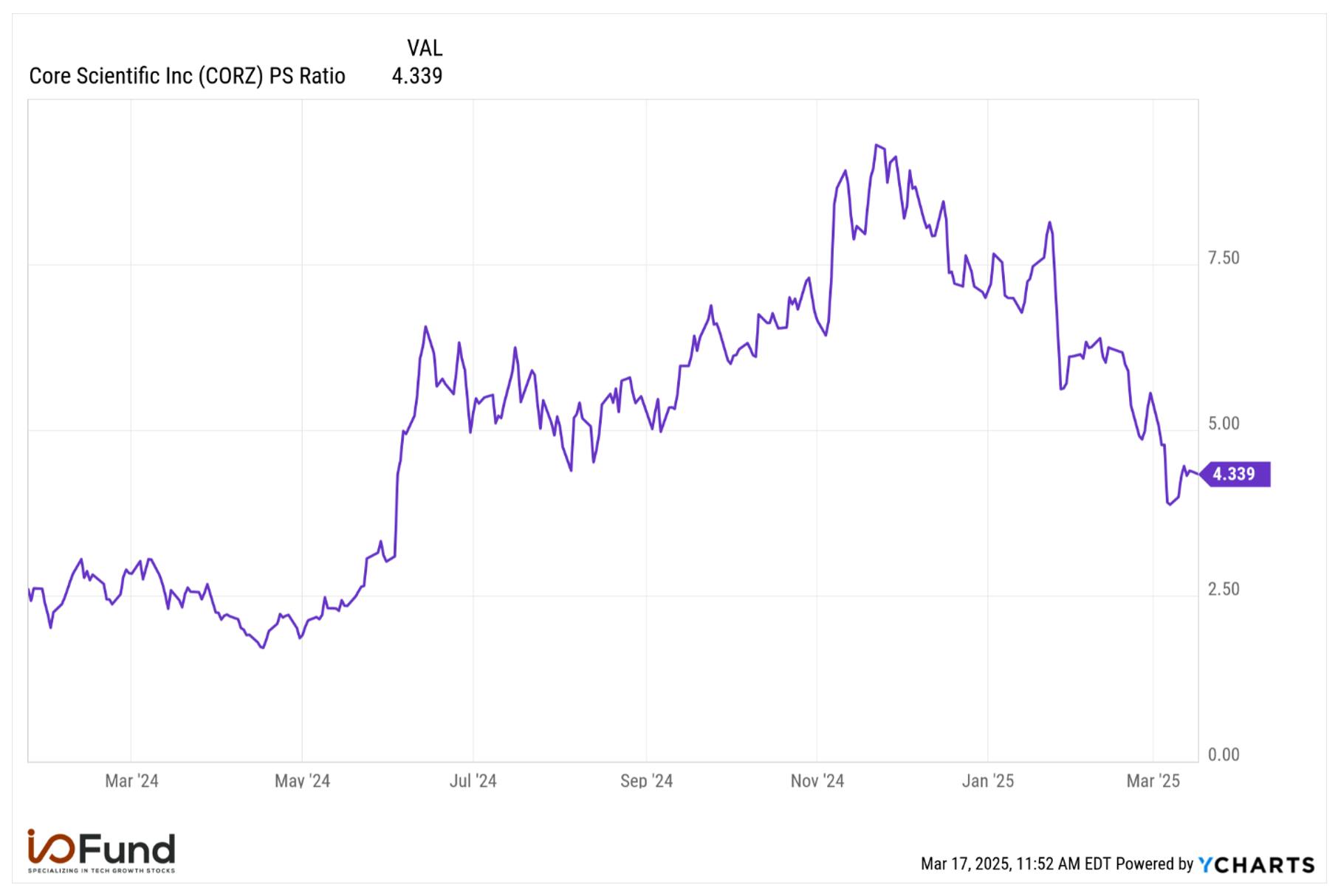
The Company trades at a forward P/E ratio of 12.27. The trailing twelve month (TTM) P/S ratio is 4.34 and forward P/S is 12.27. The five-year average P/S ratio is 5.08. The P/S ratio peaked at 9.3 in November 2024.
Management highlighted their strategic pivot from Bitcoin mining to HPC hosting. The Company delivered 500MW of capacity through 12-year agreements worth $8.7 billion, expanding its HPC infrastructure to over 1.3GW of contracted power. Its key initiatives include accelerating capacity expansion and targeting significant new site acquisitions, including projects in Auburn, Alabama, and Denton, Texas.
In Q4, the Company secured approval to expand its gross capacity at its site in Denton, Texas, by nearly 100MW, which equates to nearly 70MW of critical IT load. Denton is on track to host one of the largest GPU supercomputers in North America. The Auburn, Alabama, site currently has 11MW of critical IT load, and the Company is actively working with Alabama Power to secure a much larger power agreement. They are deferring significant capital deployment until they finalize negotiations with prospective customers.
CEO Adam Sullivan said this.
“Today, we announced a significant expansion of our relationship with CoreWeave at our Denton facility, which will bring that site to full capacity. This new agreement adds approximately 70 megawatts of critical IT load and represents approximately $1.2 billion in additional contracted revenue over a 12-year term. With this latest expansion, our total contracted value with CoreWeave now exceeds $10 billion, an amount that includes our Austin, Texas agreement, and covers roughly 590 megawatts of critical IT load once fully online. Of that total, just over 570 megawatts reflect the capacity we're converting at existing sites to HPC, where we expect 75% to 80% cash gross profit margins.”
However, Core Scientific will put up the CapEx to receive full HPC rental payments rather than 50% payments, with the other 50% being a CapEx credit for the upfront CapEx spent by CoreWeave. Sullivan said this.
“Under this newest agreement for the additional 70 megawatts, we will fund $1.5 million in capital expenditures per megawatt, whereas in prior agreements, CoreWeave covered those costs. In return, we will benefit from full rental payments during the first two years of the contract because there will be no CapEx credit associated with this new agreement.”
It’s worth noting that analysts may be considering 2027 full delivery as too ambitious considering as evidenced by the lowering of revisions. There are execution risks that may be out of their hands including grid delays and securing power with utilities (IE: working with Alabama Power to secure more power to the Auburn site), funding capex or negative developments with CoreWeave.
Prioritizing Customer Diversification and CoreWeave Timeline to Come Online Fully
Diversifying its customer base is a key priority as it aims to reduce CoreWeave's share of revenues to under 50% of critical IT load by 2028. The Company is in active discussions and remains confident in its ability to diversify its HPC customer base. The Company exited the year with 15MW of critical IT load. New block ASIC chips are expected in 2H 2025, which will refresh some of its Bitcoin mining fleet. Otherwise, there are no plans for any further CapEx spending in 2025 for its Bitcoin mining business.
CEO Adam Sullivan reiterated their top priority of diversifying new customers.
“We are in active discussions with dozens of new customers, including the vast majority of hyperscale providers in several large enterprise companies. Demand remains strong, but we're seeing considerably more due diligence compared to the first half of 2024. This heightened scrutiny reflects the influx of new market entrants who make ambitious capacity promises yet lack the tangible power agreements to back them up, much like the recent situation where a hyperscaler canceled contracts with companies that overstated their available power.”
The Company expects to have nearly 250MW of HPC capacity to CoreWeave delivered by the end of 2025. The full 590MW is coming online in early 2027. Core Scientific believes they can add another 300MW of capacity across existing sites by the end of 2027.
Earnings Call Q&A:
The Goal of Reducing CoreWeave’s Concentration of Revenue under 50%
Core Scientific is actively trying to diversify their concentration of revenue from CoreWeave.
Jeffries analyst John Peterson:
“Okay. And then I appreciate the goal of wanting to bring CoreWeave down to less than 50% of revenue by the end of 2028. I think that would require you to procure a lot more power this year in addition to signing on additional customers. So maybe just talk through the milestones that you need to hit throughout this year to be on track to do that.”
Adam Sullivan:
“We talk about the ability to continue to expand at existing sites. And that's a competitive process because we are getting direction in terms of how much additional power we're going to be able to achieve at some of our existing sites and then some of our new sites as well. Very attractive locations. Our focus today is on building blue-chip assets. And we want to have those blue-chip assets with blue-chip clients. And so that's where our focus is today. And we're going to continue to execute and acquire more sites to bring more capacity online to secure more contracts and achieve our goal of getting them below 50% by 2028.”
At 75% to 80% margins, 590 MW would yield $637.5 to $680 million, with a midpoint of $658.75 million after 2027 (assuming all 590 MW comes online). If CoreWeave is 50% of critical load by 2028, total HPC capacity needs to double to 1,180 MW from producing more power and acquiring more sites. It would require Core Scientific to assume more hyperscalers sign under similar 12-year terms to CoreWeave. Sullivan stated how diversifying its customer base was a top priority, “Starting with diversifying our customer base, this is the top priority for the company this year, and the goal is to sign enough contracts so that CoreWeave represents less than 50% of critical IT load by the end of 2028.” Sullivan mentioned 700 MW was available.
Nick Giles:
“So, appreciate your target that CoreWeave represents less than 50% of critical IT, but that implies that you sign at least the same amount with other customers, but you do have 700 megawatts that you've outlined between existing and new sites by 2027. So, should we assume that the delta would be new customers as well, or could that kind of 130 be split between a new customer and maybe one more tranche with CoreWeave?”
Adam Sullivan:
“Yes. So, we've outlined the 300 and the 400 number that's critical IT load megawatts, so about 700 megawatts. As we look forward if we have 590 of CoreWeave contracts the 700 available to us is really where our focus is going to be on executing new clients. So that's part of our goal to get them below 50%, to have enough capacity available and saleable for us to be able to bring them down to that level.”
How the Deep Seek News Only Made People Want to Move Faster
The Deep Seek news was a head fake as actual demand increased, and it only made people want to move faster.
Adam Sullivan:
“We've seen much more specific requests around locations in terms of developments and where they would like to build. But overall, the Deep Seek news for hitting the public markets rather hard from everything that we've seen on the actual demand side, demand continues to increase, and those conversations continue to progress very well.”
Diversifying the Customer Base Beyond Hyperscalers
While Core Scientific makes headlines when deals are made with name-brand hyperscalers, enterprise customers could also fill in pieces of the void to improve diversification.
Greg Lewis:
“Could you talk a little bit about you mentioned enterprise customers potentially. It's something that seems to be we're hearing more about beyond just the hyperscalers. As maybe you broaden out the customer base beyond just the hyperscalers, which it seems that latency is a big issue for them. Maybe scalability is a big issue for them. As you kind of look at potential enterprise customers, does that open up sites maybe in your portfolio and elsewhere that maybe under hyperscaler footprint wouldn’t work but through enterprise it might?”
Adam Sullivan:
“And so, we're looking at having hyperscale at the very least as anchor, potentially a single tenant. And if they're serving as an anchor, being able to fill out the rest of the capacity with enterprise clients as well. So, the demand, does it open up more sites with enterprise? Absolutely. But we're focused on blue chip assets with blue chip clients, which includes both of those groups.”
Delivery Times and Securing Power Agreements is a Competitive Advantage
Sullivan pointed out that many while demand remains strong, they are seeing considerably more due diligence compared to the first half of 2024 due to the influx of new market entrants that make “ambitious capacity promises” but actually lack the “tangible power agreements to back them up.” Sullivan referenced what may have been the rumored Microsoft cancellation of commitments with CoreWeave due to “delivery issues and missed deadlines.” Microsoft outright denied the cancellations.
Adam Sullivan:
“This heightened scrutiny reflects the influx of new market entrants who make ambitious capacity promises yet lack the tangible power agreements to back them up, much like the recent situation where a hyperscaler canceled contracts with companies that overstated their available power. Our proven track record and secured power agreements set us apart in this environment, and we won't be expanding our footprint unless we have a high degree of confidence in our ability to deliver for additional customers.”
When pressed about the rumor of Microsoft cancelling capacity with CoreWeave, Sullivan responded.
“I can't comment specifically on any relationship between CoreWeave and Microsoft other than what they've spoken about publicly. But, I mean, CoreWeave's continuing to expand. You're seeing it not only with Core Scientific, but really across the globe and internationally. So, from what we're seeing on CoreWeave's demand side is significantly stronger than what we saw in 2024. There's a lot of things going on in the market today that we're seeing that's actually driving continued demand and flow into CoreWeave. And so, we're excited about continuing to expand with them at Denton.”
Is Core Scientific in Discussions with Other Hyperscalers?
Needham analyst John Todaro inquired about discussions with other hyperscalers and CoreWeave. Sullivan noted they are in talks with a majority of hyperscalers in conversations with large enterprises. The customer conversations are continuing to evolve throughout the early part of 2025. Sullivan was asked if he saw any demand changes across inference and training workloads on the back of Deep Seek headlines.
Adam Sullivan:
“Denton was a site that we were really slating for CoreWeave. We did have conversations with some other hyperscalers and other clients on those megawatts. As we talked about the 300 megawatts potential at other existing sites, we're in conversations today with other potential customers around that. There's really no guarantee that anything like that would go to CoreWeave, because what we do want to do now is really focus on continuing to diversify our client base, and our existing sites are great campuses for us to do that.”
Elaboration on the Delays
Sullivan mentioned there were some delays from changing some of the designs to fit for the equipment further impacted by the constrained supply chains going out into 2026.
Adam Sullivan:
“And one of the things that we wanted to ensure that we achieved was that we had the right equipment on the right schedules for the site plans that we had. And so, that required us to change some of the designs to fit for the equipment that was available to deliver on the timelines that we set forward. And so, there was just some incremental delays there. But overall, we have high confidence in where the delivery schedules that we've put forward today. And we believe we're going to be able to hit those timelines.”
Management now expects critical IT load to be 250 MW, including the 16.5 MW, down from 270 MW plus 16.5 MW.
Brett Knoblauch:
“Thanks, guys. Really appreciate it. Maybe just quickly on the delays, if you will, or the pushback in timing. Just want to make sure I heard you right. You're now expecting critical IT load this year to be 250 megawatts. Does that include the 16.5? And before, you guys were expecting, I think, 270 plus the 16.5.”
Adam Sullivan:
“Yes, thanks, Brett. Yes, that's correct. That's really a push out of just one 40-megawatt building out into early 2026. And you're absolutely right. That number does include the 16.5 megawatts.”
Core Scientific Implements a Utility First Process For Evaluating Expansion Sites
For data center site selection, there is a shift away from large remote training sites towards locations that are closer to major metropolitan areas. This has been driven by demand and the need for proximity as the Company expands into new markets, which include the East Coast. However, prioritization is based on reliable utility partnerships.
Rosemarie Sison:
“Just to follow up on that comment that you made, Adam, about proximity to major metro areas. Would that mean that you're potentially looking at expanding out of the markets that you're in right now possibly into the East Coast or the West Coast as those opportunities present themselves?”
Adam Sullivan:
“Yes, absolutely. Thank you for the question, Rosemarie. I mean, we are building one of the larger data centers on the East Coast right now. And so, we have a lot of confidence in our ability to continue to expand in new markets. This is something where we're going to be one of the larger providers in the Dallas market. We believe something similar in the Atlanta market as well. So, we're definitely looking at continuing to enter into new cities. But albeit that looks a little bit different because we might have less familiarity with the utilities in that location. A point on that is we currently operate with seven utilities. We're continuing to expand our relationships across that base. And so, we're taking a very diligent process, a utility-first process, when we're evaluating entering new locations to ensure that we have a strong partnership and relationship with that utility so that we know that we have that firm power available when we go take them to a client.”
Conclusion: Solid Gameplan, Execution is the Key
Other Bitcoin mining companies are adopting Core Scientific's pivot to HPC hosting. However, Core Scientific's game-changing contracts amounting to over $10 billion in revenues over 12-year terms with CoreWeave give them a first-to-market advantage fortified by $10.2 billion in revenue potential from an AI disruptor.
CoreWeave, backed by NVIDIA as an investor and customer, is likely the leading hyperscaler in the market, positioning itself as a first mover in the AI data center space. Given NVIDIA’s potential preferential treatment toward CoreWeave, especially compared to competitors like Amazon who are building with custom silicon, CoreWeave is primed to lead the way in scaling AI infrastructure.
Hyperscalers will likely follow in CoreWeave's footsteps. This dynamic reinforces the notion that Core Scientific's strategic pivot to HPC hosting could be bolstered by CoreWeave's leadership in the hyperscaler space, further underscoring that what’s good for CoreWeave is also good for Core Scientific.
CoreWeave was initially interested in acquiring Core Scientific for $1.02 billion or $5.75 per share in June 2024, but was rejected and they decided to back them as they expanded their data center footprint. The downside to this relationship is the very limited customer concentration, as CoreWeave is their largest HPC hosting client. Core Scientific’s near-term future lies with CoreWeave. CoreWeave is expected to generate $10 billion from Microsoft as a client by the end of the decade.
As a potential lottery ticket element for investors, CoreWeave could revisit another acquisition attempt for Core Scientific after its IPO, where it would have additional cash and stock to use as currency. The initial acquisition attempt in June 2024 was for $1.02 billion in cash or $5.75 per share, which Core Scientific rejected stating that the offer “significantly undervalues the Company.” With an estimated $35 billion valuation, CoreWeave could make a much more attractive acquisition offer for less than it would be paying Core Scientific over its 12-year term leases.
Core Scientific has a solid game plan to accelerate its quarterly HPC hosting revenue by at least 21X in two years. As with any great game plan, the flaw always lies in the execution. Analyst estimates forecast one more kitchen sink quarter to go before revenues turn back up as HPC hosting revenues start to ramp up. The potential for more than doubling the outstanding shares to 501 million shares upon full conversion and vesting of restricted stock is concern down the road, but for now the game plan looks solid; the execution is the key.
Welcome to the I/O Fund’s new Discovery Tier, where we cover a new stock idea on a weekly or bi-monthly basis. We are excited to bring you more coverage from the I/O Fund team geared toward new idea generation only.
Jea Yu, Equity Analyst at the I/O Fund, contributed to this article.
Please note: The I/O Fund conducts research and draws conclusions for the Fund’s positions. We then share that information with our readers. This is not a guarantee of a stock’s performance. Please consult your personal financial advisor before buying any stock in the companies mentioned in this analysis.
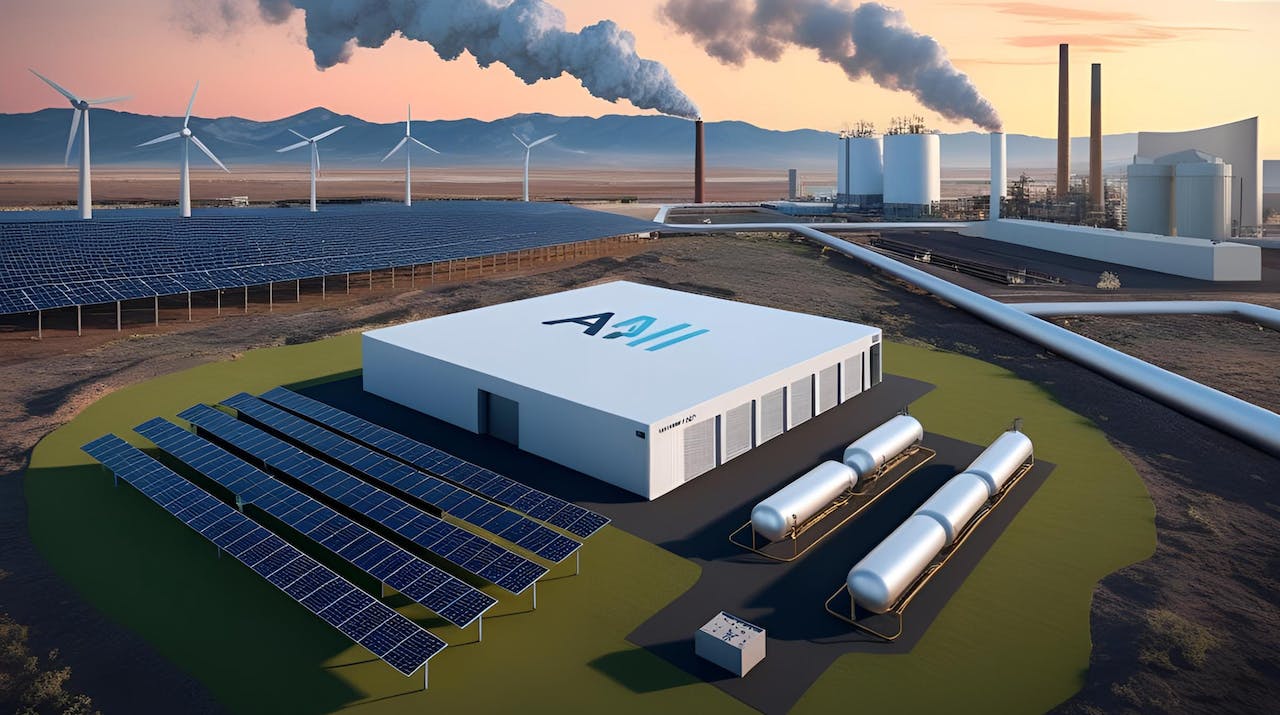
While traditional brown energy remains a significant energy source for AI data centers, clean and renewable energy continues to grow in capacity.
Goldman Sachs believes 40% of new data center capacity will be from renewables.
Hyperscalers and data centers are adopting a mixed energy portfolio, combining brown, clean, and renewable energy to balance emissions while ensuring 24/7 reliability.
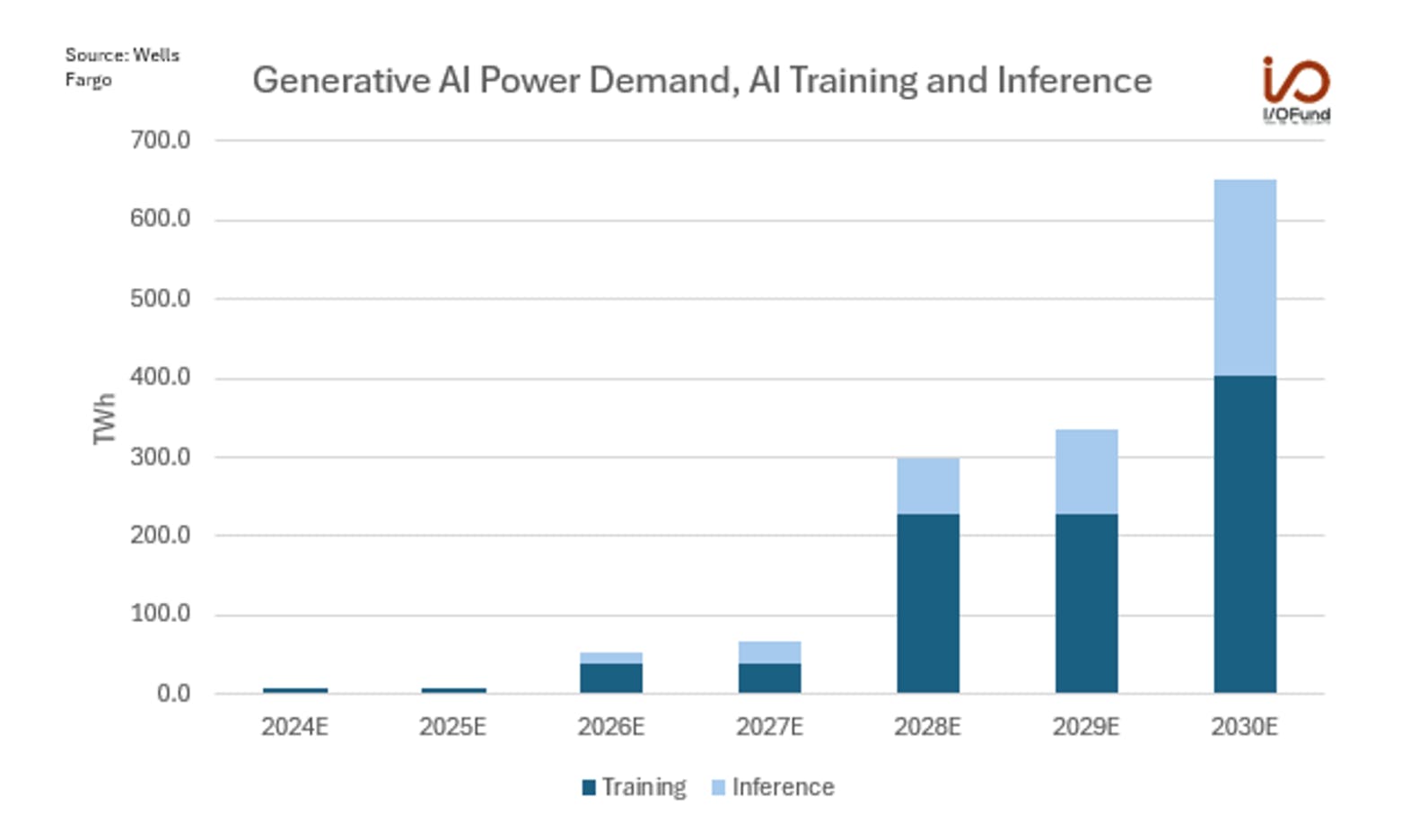
As the artificial intelligence (AI) revolution drives the growth of AI data centers, the topic of energy continues to gain prominence. AI data centers cannot function without energy sources, and how that power is generated seems just as important as how reliable the power is. Energy sources are commonly labeled brown, clean or renewable. Goldman Sachs says AI data center power consumption demand is expected to grow by more than 160% by 2030 from 2023 levels. Let’s take a look at each of these sources and how efficient and reliable they can be for AI data centers.
What is Brown Energy?
For decades, the world has relied heavily on brown energy from fossil fuels like oil, coal and natural gas. These dominant fuels powered the Industrial Revolution and remain the primary sources of electricity for the grid today, with coal and natural gas generating nearly 60%.
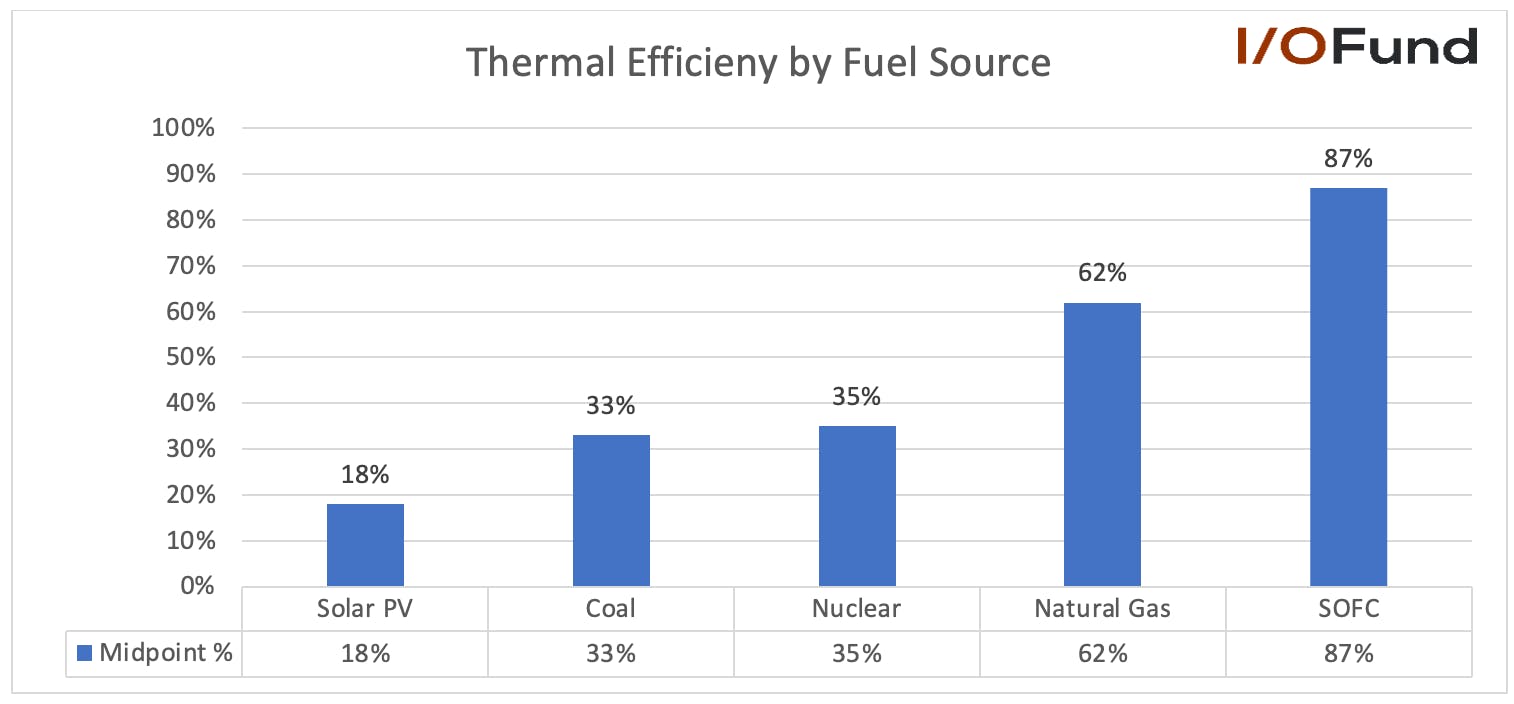
Coal-fired power plants are some of the worst offenders as they release enormous amounts of carbon dioxide and greenhouse gases into the atmosphere. Thermal efficiency (TE) measures how effectively a fuel’s heat is converted into electricity. Coal has some of the lowest TE efficiency, around 33%.
Natural gas is the top fuel source for powering the electric grid at 43% and is cleaner than coal but still contributes carbon emissions when it's burned. TE is between 35% to 42% on a simple cycle gas turbine and up to 62% when using combined cycle gas turbines (CCGT), which use the exhaust heat to boil water in a steam turbine, adding the extra 20% to 25% TE.
Join thousands of investors who trust I/O Fund’s expert stock analysis on AI, semiconductors, cryptocurrency, and adtech — sign up for free! Click here!Join thousands of investors who trust I/O Fund’s expert stock analysis on AI, semiconductors, cryptocurrency, and adtech — sign up for free!Click here!
The environmental impact of burning fossil fuels has paved the way for the clean energy and decarbonization movement. The combustion process produces carbon emissions, which contribute to air pollution and climate change. As AI data centers consume massive amounts of electricity, they’re also trying to meet clean energy initiatives.
What is Clean Energy?
Clean energy has much less environmental impact, producing low to zero greenhouse gas emissions. It also generates less pollution and leaves a smaller carbon footprint. Some examples of clean energy are:
Solar power generates electricity using sunlight and photovoltaic panels with TE between 15% to 22%.
Wind power generates electricity by harnessing kinetic energy from the wind with turbines with mechanical efficiency (ME) between 35% to 50%; since they don’t operate on thermal cycles, there isn’t heat conversion.
Hydropower generates electricity from water flowing through turbines, again no thermal cycle but the ME is 85% to 95% since the momentum of the water converts to power with almost no loss.
Geothermal power uses the heat emanating from the earth’s core with a low TE ranging from 10% to 23%
Nuclear energy generates power through fission, heating water to create steam that drives turbines, with TE averaging between 33% to 37%.
For AI data centers, the most practical clean energy sources come from nuclear, solar and wind power. While the efficiency of hydropower is exceptionally high, it isn’t practical for data centers due to factors like heavy capex to build dams and reservoirs, environmental impacts and geographical limitations. Clean energy enables data centers to lower their carbon footprint and enhance their environmental reputation.
What is Renewable Energy?
Renewable energy comes from natural processes that are replenished at a faster rate than consumed, such as solar, wind, and hydropower. While renewable energy is typically clean, meaning it generates low carbon emissions, not all clean energy sources are renewable. For example, nuclear power is considered clean but not renewable.
While solar and wind power are renewable and clean energy, they aren’t available 24/7. They would require a battery (storage) system to match the 24/7 reliability of nuclear and natural gas. As for supply costs, renewable energy sources are actually cheaper than generating electricity from natural gas. According to a report by Goldman Sachs, solar energy costs $25 per megawatt-hour (MWh) compared to CCGT natural gas at $37/MWh. But there's a reason natural gas costs more: reliability.
“In practice, though, utility-scale solar plants only run around 6 hours per day on average, while wind plants run for an average of 9 hours per day. There is also day-to-day volatility in the capacity of these sources, depending on the radiance of the sun and the strength of the wind.” Solar is not effective during cloudy and overcast days, whereas nuclear and natural gas plants can run around the clock every day regardless of weather. Goldman Sachs believes that 40% of the new capacity built to support data center power demands will be renewables.
The Mixed Energy Sources Portfolio Approach
Many hyperscalers and data centers have adopted a mixed energy portfolio approach utilizing brown energy and clean or renewable energy to balance the emissions and maintain a green stance.
Goldman Sachs Infrastructure analyst Jim Schneider commented, “Our conversations with renewable developers indicate that wind and solar could serve roughly 80% of a data center's power demand if paired with storage, but some sort of baseload generation is needed to meet the 24/7 demand.” While the baseload power preference is nuclear, building them is just too difficult, which makes natural gas and renewables the most practical solution short-term.
The I/O Fund recently entered five new small and mid-cap positions that we believe will be beneficiaries of this AI spending war. We discuss entries, exits, and what to expect from the broad market every Thursday at 4:30 p.m. in our 1-hour webinar. For a limited time, get $20 off a Monthly Pro plan with code PRO20OFFget $20 off a Monthly Pro plan with code PRO20OFF[Learn more here.]Learn more here.]
Please note: The I/O Fund conducts research and draws conclusions for the Fund’s positions. We then share that information with our readers. This is not a guarantee of a stock’s performance. Please consult your personal financial advisor before buying any stock in the companies mentioned in this analysis.
AI data centers could need up to 6 billion cubic feet of natural gas per day by 2030 to meet the industry’s rabid energy demand, up from near zero today.
Natural gas is the top fuel used to generate electricity in the United States.
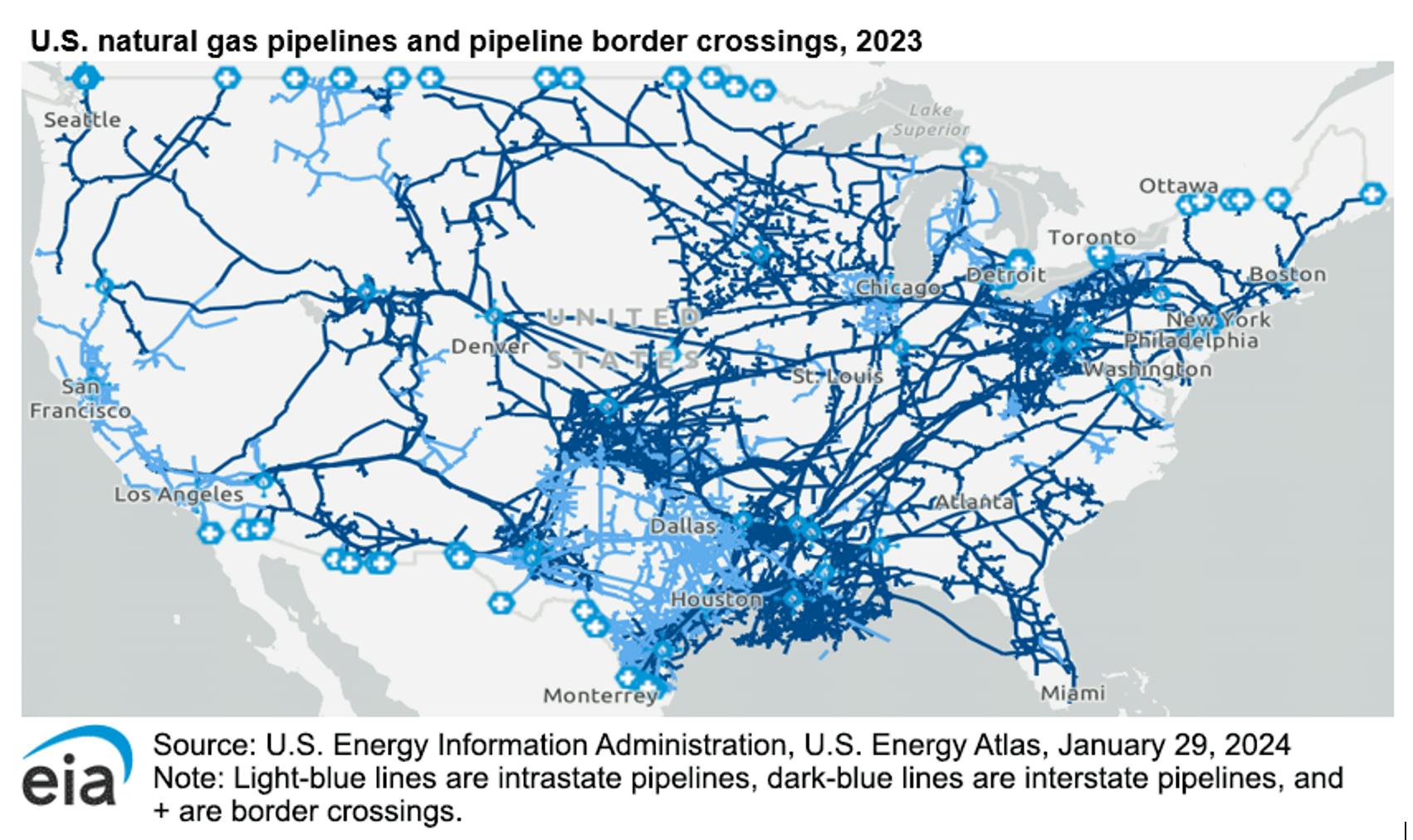
Some of the largest AI data center projects are located in regions with the densest gas pipelines, like Texas and Louisiana.
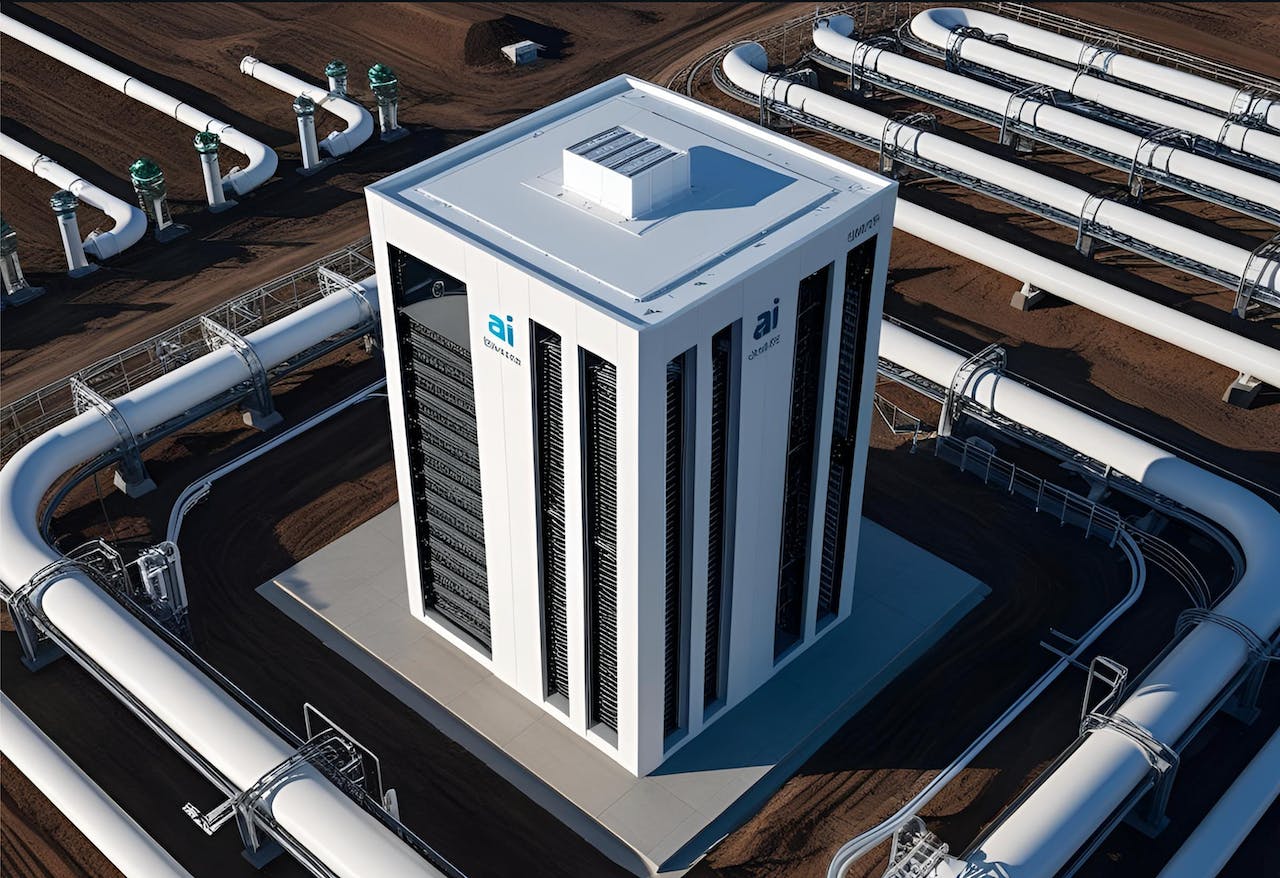
Artificial intelligence (AI) data centers are thirsting to feed their growing electricity demands. While there have been a lot of headlines regarding hyperscalers choosing to go with nuclear, new buildouts are still years away. When AI data centers need power now, they are left with the obvious choice of using the electrical grid or setting up co-location deals powered by the nation’s most abundant fuel, natural gas. Natural gas is the top fuel source for powering the electrical grid, accounting for 43% of the power in 2023. However, that fuel has to reach the data centers and that involves pipelines, lots of natural gas pipelines. For this reason, natural gas pipelines are the unsung heroes of AI data center expansion.
AI Data Centers Will Need 3 to 6 Billion Cubic Feet of Natural Gas Per Day by 2030
An October 2024 report from S&P Global found that the additional demand for natural gas to support data centers could reach three to six billion cubic feet per day (bcf/d) by 2030 as the industry struggles to find power for AI data center buildouts. The shocking part is that this figure starts from nearly zero bcf/d today, rising to upwards of 6 bcf/d by 2030.
The Three Types of Natural Gas Pipelines Need for AI Data Centers
Between early 2023 and mid-2024, the U.S. natural gas pipeline infrastructure saw a slight growth across all 3 types of pipelines:
Gathering Pipelines are used to transport the natural gas (or crude oil) collected from the wellheads at production sites to a central collection point like a storage facility, a processing plant or a transmission pipeline. Gathering pipelines are the smallest in diameter and operate at low pressure and flow. Gathering pipelines increased 0.97% between 2023 and mid-2024 from 496,051 miles to 500,854 miles.
Transmission Pipelines are the larger pipelines that move high volumes of natural gas from the production and processing plants, storage facilities, and distribution centers. These pipelines operate at pressures up to 1,000 pounds per square inch (PSI) and range from a hundred feet to hundreds of miles. Transmission pipelines increased 0.58% between 2023 and mid-2024 from 361,945 miles to 364,030 miles.
Distribution Pipelines are the smaller pipelines that deliver natural gas to end-users like individual homes, businesses and facilities. These operate at low pressure and can be made of plastic pipe instead of steel as underground pipes to smaller service lines connecting to properties. These are regulated by the local distribution companies (LDCs) that use them. Distribution pipelines grew 1.14% between 2023 to mid-2024 from 103,897 miles to 105,082 miles.
Join thousands of investors who trust I/O Fund’s expert stock analysis on AI, semiconductors, cryptocurrency, and adtech — sign up for free! Click here!Join thousands of investors who trust I/O Fund’s expert stock analysis on AI, semiconductors, cryptocurrency, and adtech — sign up for free!Click here!
Location, Location, Location of Gas Pipelines is Key
AI data center construction tends to be concentrated in regions where gas pipeline infrastructure is densest. Here’s a breakdown of the top regions with dense and bountiful gas pipeline infrastructure:
Texas leads with over 58,500 miles of natural gas transmission pipelines. It’s the epicenter of the Permian Basin and connects to Gulf Coast liquefied natural gas (LNG) export terminals and petrochemical hubs. Project Stargate is the $500 billion joint venture investment by Oracle, Softbank and OpenAI to grow America’s AI infrastructure by 2029. Its first AI data center is under construction in Abilene, Texas. Oracle CEO Larry Ellison stated. “the data centers are already under construction here in Texas. Each building is half a million square feet. There are 10 buildings currently being built, but that will expand to 20 other locations beyond the Abilene location, which is our first location.”
Louisiana has over 18,900 miles of natural gas transmission pipelines. Meta Platforms announced it will be constructing a 2GW+ AI data center located in Richland Parish, Louisiana. The $10 billion project will be built on 2,250 acres, housing 4 million sq ft with nine buildings slated to be almost the size of Manhattan. Entergy will spend $3.2 billion to build a 1.5GW gas plant on Franklin Farms as part of a co-location deal and another build or acquire another 1.5GW of solar power elsewhere to offset the carbon emissions. Bitcoin miner Hut 8 is planning on building a $2.5 billion data center campus with two 450,000 sq ft facilities and investments up to $12 billion from future tenants. Initial deployment will be 300 MW at the West Feliciana Parish, Louisiana location.
Oklahoma has over 18,500 miles of natural gas transmission pipelines. Core Scientific and AI hyperscaler CoreWeave are building a 100MW facility in Muskogee, Oklahoma. Google has invested over $4.8 billion into its Mayes County, Oklahoma, data center campus, expanding it three times since 2007. DAMAC Properties is planning on investing $20 billion in data centers in the U.S., including in Oklahoma.
Fewer Pipelines in the Northeast Relative to the Southwest, But Not to Be Counted Out
The Southwest region dominates, with the top three states having the most gas pipelines. However, that doesn’t mean the Northeast region is deprived of data centers. Virginia is home to 70% of the world’s data centers and hosts 35% of the global hyperscalers. In fact, Northern Virginia is often cited as the “data center capital of the world," with over 300 data centers located throughout Fairfax, Loudoun and Prince William Countries. More than 70% of the world’s internet traffic passes through Northern Virginia's interconnection and co-locations infrastructure. Amazon, Google, Microsoft and Meta all have a significant data center presence in the region.
Natural Gas for AI Data Centers is Here to Stay
As AI data centers continue to scale, natural gas will remain a critical component in providing reliable power. Gas pipelines crisscrossing places like Texas, Louisiana, and Oklahoma, where the infrastructure is thickest, are quietly doing the heavy lifting to fuel these AI hotspots. As the demand for AI-driven services continues to rise, natural gas will remain a key player in supporting the growth of the data center industry, making natural gas pipelines the unsung heroes of the digital economy.
The I/O Fund recently entered five new small and mid-cap positions that we believe will be beneficiaries of this AI spending war. We discuss entries, exits, and what to expect from the broad market every Thursday at 4:30 p.m. in our 1-hour webinar. For a limited time, get $110 off an Annual Pro plan with code PRO110OFF [Learn more here.]get $110 off an Annual Pro plan with code PRO110OFF [Learn more here.]
Please note: The I/O Fund conducts research and draws conclusions for the Fund’s positions. We then share that information with our readers. This is not a guarantee of a stock’s performance. Please consult your personal financial advisor before buying any stock in the companies mentioned in this analysis.
Vistra is an independent power product (IPP) with 41 GW capacity, operating the second-largest fleet of nuclear plants in the United States.
Vistra has closed power purchase agreements (PPAs) to supply Amazon with 200 MW and Microsoft with 405 MW of renewable energy for their data centers in Texas and Illinois, respectively.
The Company is in talks with two unnamed hyperscalers for natural gas plants co-located with their data centers.
Co-location involves building data centers or power plants on-site to provide electricity directly to the data center, bypassing the electrical grid. This is known as "behind the meter."
Regulations on co-location builds are materializing as hyperscalers await the precedent-setting decision on Talen Energy/Amazon co-location reliability solution vs FERC/AEP/Exelon push for cost equity as a major catalyst.
Vistra has said they are in talks with hyperscalers and data center developers for nuclear power but hasn’t announced any deals yet.
Vistra Corp. (NYSE: VST) is the largest competitive power generation and retail electric company in the United States. It’s an integrated independent power producer (IPP) based out of Irving, Texas, serving five million customers across 20 states and Washington, D.C., with a power generation capacity of 41 GW (41,000 MW). It has the second-largest competitive nuclear fleet in the country, behind Constellation Energy. Texas is a hotspot for data centers and chip manufacturers.
The company has power purchase agreements (PPA) with Amazon and Microsoft and is actively “speaking with all the major hyperscalers” and actively engaged with the major data center developers, according to Vistra CEO Jim Burke during their Q4 conference call. As of March 1, 2025, Vistra energy has 41 GW capacity, comprised of 27 GW for natural gas, 6.4 GW for nuclear, 6 GW for coal and 2 GW for renewable and battery/energy storage (1 GW), which includes solar assets with 350 MW already online.
The Energy Harbor Acquisition Bolstered Vistra’s Nuclear Footprint
On March 1, 2024, Vistra completed the acquisition of Energy Harbor Corp., adding an additional 4 GW of 24/7 nuclear generation and 1 million retail customers. The Company paid $3 billion in cash and a 15% equity stake in a new subsidiary comprised of all of its nuclear fleet (6.4GW) called Vistra Vision. The transaction closing followed receipt of all required regulatory approvals, including the from the Federal Energy Regulatory Commission (FERC) in February 2024.
In Q3 2024, the Company bought back the remaining 15% minority interest stake in Vistra Vision for approximately $3.248 billion from affiliates of Nuveen and Avenue Capital Management LLC. The buyback increased its nuclear ownership stake to the full 6.4GW capacity, not to be mistaken with adding any more capacity or increasing its licensed output (uprate). This results in keeping all the proceeds they were distributing to the minority stakeholders in Vistra Vision, which will result in a bump up in net income moving forward, however, they still have to pay $3.248 billion for it.
Vista expects to pay in five installments of $1.18 billion on December 31, 2024, $114 million on June 30, 2025, $1.0 billion on December 31, 2025, $54 million on June 30, 2026, and $900 million on December 31, 2026. The net present value of the purchase price as of December 31, 2024, discounted at a 6% interest rate, is $3.085 billion.
Complying with the Electrical Grid Operators and FERC
Here’s a quick summary of the many acronym organizations in the electricity market. As an IPP, Vistra actively deals with the electrical grid operators where they sell their electricity. Vistra sells wholesale electricity to markets managed by the PJM Interconnection (Pennsylvania, New Jersey, Maryland), which covers 13 states. PJM is an independent system operation (ISO) and regional transmission organization (RTO). They run the wholesale electricity markets for the regions, balancing the needs of market participants and ensuring grid reliability. They coordinate the flow of electricity from the power generators to local utilities.
ERCOT (Electric Reliability Council of Texas) performs the same ISO and RTO functions in Texas, managing high-voltage transmission grids. Texas is the only state that owns its power grid. ERCOT was the first ISO in the United States. Vistra also owns power plants and sells electricity to markets managed by ERCOT. The ISOs and RTOs are regulated by the Federal Energy Regulatory Commission (FERC).
Co-Location and BTM are Growth Drivers for Vistra
Front of the meter (FTM) refers to power produced by the power plants that flow to the electrical grid and then to the data center or customer. Behind the meter (BTM) refers to electricity that’s generated and directly delivered to the data center, bypassing the grid. Co-location deals where utilities like Vistra install gas power plants on-premise for the hyperscalers are BTM, as the power is generated on-site and delivered directly to the data center. Vistra can repurpose existing gas plants or construct new builds. BTM and co-location are Vistra’s AI hyperscaler growth strategy, but so far, there haven’t been any deals announced yet.
The time to power depends on the type of gas plant, whether it's repurposing an existing gas plant or constructing a new gas plant. Repurposing an existing gas plant can take six to 24 months, using spare capacity. New builds can take three to five years due to gas infrastructure, permits, construction and commissioning (IE, Building up to 860 MW of new gas plants in West Texas).
Vistra is a Nuclear Energy Powerhouse Primed for AI Data Centers
As of March 5, 2025, Vistra operates four active nuclear plants with a combined power capacity of over 6.4 GW, which is enough zero-carbon baseload capacity to power 3.2 million homes across PRJM and ERCOT markets. These include:
Camanche Peak Nuclear Power Plant located in Texas, comprised of two units with 2,400 MW total capacity, with licenses extended to 2050 and 2053, approved by the Nuclear Regulatory Commission (NRC) in July 2024.
Beaver Valley Nuclear Power Plant in Pennsylvania is comprised of two units with a 1,800 MW total capacity. NRC licenses expire in 2036 and 2047.
Perry Nuclear Power Plant in Ohio is comprised of one unit with a 1,300 MW capacity. NRC license expires in 2046.
Davis-Nesse Nuclear Power Plant in Ohio is comprised of one unit with 894 MW capacity. NRC license expires in 2037.
Beaver Valley, Perry and David-Neese Nuclear Plants were acquired from Energy Harbor for $3.4 billion in March 2024. The nuclear plants are operated under Vistra Vision, and the fossil fuel segment operates under Vistra Tradition. Nuclear energy comprises just over 15% of its total energy production. Vistra Energy’s nuclear fleet operates at 92% of its maximum capacity (aka capacity factor) in Q4.
Nuclear Energy and Gas Power Plants Talks with Hyperscalers
Vistra signed a 200 MW power purchase agreement (PPA) with Amazon for a Texas solar facility in October 2024. Vistra signed a 405 MW PPA with Microsoft for a solar project in Illinois during Q3 2024. Incidentally, Vistra hasn’t announced any major nuclear power purchase agreements (PPA) with major hyperscalers yet. However, the Company is in early discussions with some hyperscalers about nuclear uprates and some new builds as well.
Co-location is the trend of building data centers or power plants near data centers to alleviate pressure on the electrical grid and reduce transmission loss to ensure maximum efficiency.
Vistra is in discussions with two unidentified hyperscalers to build new natural gas power plants co-located with data centers. During its Q3 2024 conference call, Vistra's Head of Strategy, Stacey Dore, said this.
“There's a lot of interest, obviously, in the nuclear side. However, we have ongoing conversations with several different development companies about a handful of our gas sites, both in PJM and in ERCOT. And we're in early discussions with some of the hyperscalers about nuclear uprates, and some new build as well as Jim mentioned. And then, finally, we're in discussions with two particular large companies about building new gas plants to support a data center project.”
Diore also cautioned that these talks aren’t an overnight decision, “As we've said before, the diligence process for these deals takes a long time. It's an intense effort because these are very long-term commitments to purchasing power.” The announcement if and when these two hyperscalers closed the deal should be a catalyst for the stock.
How Natural Gas is Used to Generate Electricity
Vistra generates 66% or 27 GW of its energy capacity from natural gas using gas-fired power plants. The primary method for large-scale natural gas generation (1MW or more) is combined-cycle gas turbines (CCGT), which connect a gas turbine with a steam turbine. The natural gas is burned in a combustion chamber with compressed air to spin the turbine connected to a generator producing electricity. The exhaust heat can climb up to 1,000 degrees Fahrenheit, which is used to boil water to generate steam, driving a second turbine to generation addition electricity.
Simple-cycle turbines operate with just the natural gas turbines, without the steam turbines. Natural gas combustion turbines generate 35% to 42% of direct electricity. The steam turbines add another 20% to 25%, yielding total thermal efficiencies between 55% to 67%, which is the energy output vs fuel input. As natural gas is delivered through pipelines, around 92% is actually delivered, as 8% energy loss is common. Coal plants yield around 33% thermal efficiency. Nuclear plants yield 33% to 37% thermal efficiency, similar to or slightly better than coal. The main difference is the carbon emissions, which are virtually none, making nuclear the cleanest option of the three.
On a smaller scale (325 KW), we wrote about how Bloom Energy Servers (BES) can reach 85% to 90% thermal efficiency through its non-combustion, electrochemical reaction method using solid oxide fuel cells and heat capture.
“BES is designed to work with existing carbon capture utilization and storage (CCUS) and combined heat and power (CHP) technologies. CCUS mitigates emissions from natural gas as BES generates a pure stream of CO2 that can be used or sequestered. CHP allows the exhaust heat generated by BES (operating at a core temperature of 1,500 degrees Fahrenheit or 800 degrees Celsius) to be channeled and made available for use, further increasing the efficiency of the system.“
AI Applications are Driving AI Data Center Power Needs
AI applications require much more electricity to operate, depending on the applications. AI training and inferencing drive power demand, “Wells Fargo is projecting AI power demand to surge 550% by 2026, from 8 TWh in 2024 to 52 TWh, before rising another 1,150% to 652 TWh by 2030. This is a remarkable 8,050% growth from their 2024 projected level. AI training is expected to drive the bulk of this demand, at 40 TWh in 2026 and 402 TWh by 2030, with inference’s power demand accelerating at the end of the decade. In this model, the 652 TWh projection is more than 16% of the current total electricity demand in the US.”
As IO Fund pointed out, “The Electric Power Research Institute forecasts that data centers may see their electricity consumption more than double by 2030, reaching 9% of total electricity demand in the US. The IEA is projecting global electricity demand from AI, data centers and crypto to rise to 800 TWh in 2026 in its base case scenario, a nearly 75% increase from 460 TWh in 2022. The agency’s high case scenario calls for demand to more than double to 1,050 TWh.”
Vistra Leverages Clean Energy Tax Credits and Incentives
Vistra currently does and could leverage many forms of energy credits to help squeeze every bit of margin. Its customers can also benefit from tax credits under these programs. Here are some of the most lucrative credits:
The Inflation Reduction Act (IRS) of 2022 introduced a Nuclear Production Tax Credit (PTC) of up to $25 per megawatt-hour (MWh), which runs for 10 years through 2032 for facilities in service prior to January 1, 2023. The PTC kicks in went prices are below set limits. Vistra recognized a $545 million benefit from the nuclear PTC in Q4 2024.
The Investment Tax Credit (ITC) was extended by the IRA through to December 31, 2024, under section 48, offering a 30% credit for projects started prior to then with up to four years to go online. New projects starting on January 1, 2025, and after shifts to section 48E, the Clean Electricity Production Credit, which applies to zero-emission projects through 2033
The Clean Electricity Production Tax Credit (PTC) under section 48E replaced the traditional PTC with technology-neutral clean electricity PTC, which offers up to 2.75 cents per kilowatt-hour (kWh). Projects that begin construction before 2033 and meet wage/apprenticeship rules can receive the credit. Vistra can receive PTC for any upgrades (capacity increases) or new builds after 2025. It could have the potential for up to $50 million annually in solar and scaling higher with new projects. Vistra’s solar projects with Amazon (200 MW PPA) and Microsoft (405 MW PPA) are likely claiming the ITC of 30%, which covers installation costs. It’s 600 MW planned battery story planned in Texas also qualifies. Nuclear uprates could also apply if started post-2025.
The Energy Community Tax Credit Bonus adds a 10% tax credit (10% points) to the existing ITC for projects in energy communities and areas with close coal plants/mines. Vistra operates in many former coal mining regions in Ohio, Pennsylvania and Texas.
The Trump administration has mentioned it plans to rollback many IRA provisions, which could cap or limit tax credits and incentives moving forward.
Financials: MTM Caused a Non-Cash Surge to Financial Metrics
Note that Q3 2024 shows a surge in net income to $3.465 billion, up 159% YoY from $1.335 billion in Q3 2023, driven primarily by unrealized mark-to-market (MTM) gains on derivative positions and the addition of Energy Harbor. This jolted various metrics, including gross and operating margins, GAAP EPS and gross profits. Still, since most of it was a non-cash gain, the operating cash flow didn’t surge proportionally. The mark-to-market gains were non-cash, but the addition of Energy Harbor gains were cash and are here to stay moving forward. Vistra expected $700 million in contributions from the Energy Harbor business for 10 months. The adjusted EBITDA excludes the impact of unrealized gains or losses on derivatives, which makes for a better measure of operating performance. CFO Moldovan clarified this in the Q4 conference call.
“Including the nuclear production tax credit, our adjusted EBITDA was more than $850 million above the midpoint and more than $600 million above the top end. Notably, the 10-month contribution from Energy Harbor, including the nuclear PTC, exceeded our $700 million expectation by approximately $200 million.”
Revenue is Lumpy, But The Energy Harbor Acquisition is Accretive
Q4 revenue rose 31.16% YoY but fell (35.8%) QoQ to $4.04 billion, beating the single analyst estimate by 3.2% or $124 million, driven primarily by the inclusion of results from the Energy Harbor acquisition and an increase in revenues due to the estimated nuclear PTC recorded in the quarter. The negative QoQ was primarily due to the surge in Q3 "driven primarily by unrealized mark-to-market gains on derivative positions."
Adjusted EBITDA from Ongoing Operations: Bypassing the MTM Noise
Due to the MTM unrealized gains on derivatives, the adjusted EBITDA from the ongoing operations metric provides a more accurate picture of the operations. Q4 adjusted EBITDA from ongoing operations was $1.985 billion, up 104.2% YoY and 37.85% YoY. This was an improvement from Q3 adjusted EBITDA of $1.44 billion, down (10.73%) YoY and up 1.84% QoQ.
Net income for the full year 2024 increased by $1.32 billion, driven primarily by unrealized MTM gains on derivative positions, the addition of Energy Harbor and an increase in revenues due to estimated nuclear PTC recorded in Q4. Ongoing adjusted EBITDA for the full year 2025 increased $1.516 billion YoY primarily due to the inclusion of results from the Energy Harbor acquisition and estimated nuclear PTC recorded in Q4 2024. Full year 2025 adjusted EBITDA from ongoing operations was $5.656 billion. Management guided full year 2025 ongoing operations adjusted EBITDA of $5.5 billion to $6.1 billion, with the midpoint of $5.8 billion. Management has "high confidence" in an adjusted EBITDA midpoint opportunity above $6 billion in the full year 2026, as its hedge ratio has increased from 64% to 80% since Q3.
The hedge ratio is the percentage of future (2026) expected electricity generation in megawatt hours (MWh) that is already locked in at a fixed price (IE, 80% is locked in at a fixed price) through derivatives like futures, options or swaps. The unhedged portion (IE: 20%) is exposed to market prices, which may rise, thereby raising EBITDA or potential fall and sinking EBITDA.
Margins: MTM and PTC Surge Q4 Improvement by 348.7%
Q4 gross margin was 39.6%, up 348.7% YoY and down (28.14%) QoQ, largely due to the MTM unrealized gains on derivatives, as mentioned earlier. The large YoY surge was due to the near doubling of gross profit to $1.6 billion in Q4 2024 compared to $850 million in Q4 2023, partially driven by the $545 million nuclear production tax credit (PTC), which reflects the full-year credit and the inclusion of results from the Energy Harbor acquisition. However, the jump was primarily based on a non-cash event, which investors shouldn't mistake for organic growth.
Lumpy Cash Flow as Debt Reaches Highest Level of 2024
Q4 cash flow reached $1.353B as operating cash flow rose to its highest level of five quarters at 33.5%. However, cash flow has been lumpy, ranging from $312 million in Q1 to a peak of $1.702B in Q3. Free cash flow closed Q4 at $923 million but was just as lumpy at ($153 million) in Q1, peaking at $1.017 billion in Q3 2024. Vistra closed Q4 2024 with $1.19 billion in cash and cash equivalents. The debt reached its highest level in five quarters, closing the year at $17.49 billion. Net debt to adjusted EBITDA is 2.9X. The Company plans on executing $2 billion in stock buybacks in 2025 and 2026.
Conference Call: Potential 10% Nuclear Capacity Increase by 2030
CEO Jim Burke reviewed 2024 events, including acquiring three nuclear sites and 1 million retail customers. They also completed a 20-year license renewal for the Camanche Plant nuclear power plant and secured Amazon and Microsoft PPA agreements with its renewables pipeline. The pre-Q&A can be summed up with the following:
Vista is in the early stages of the development of two natural gas peakers, power plants using natural gas during high demand periods, "peak times," totaling up to 860 MW of capacity. They are targeting mid-2028 for commercial operations.
Vistra continues to execute its zero-carbon growth strategy by leveraging existing land and interconnections to develop solar and energy storage projects opportunistically. They brought two solar and energy storage facilities online at its Coffeen and Baldwin, Illinois, sites. These facilities are part of the Illinois coal-to-solar and energy storage initiative. Vistra has begun construction of its Oak Hill, Texas, site for its contract with Amazon and the Pulaski, Illinois, site for its contract with Microsoft. Once they go online, it will add more than 600 MW of renewable capacity to Vistra’s portfolio.
Vistra has engineering studies in process with initial estimates indicating the potential uprates across their nuclear fleet of nearly 10%. Uprates increase a nuclear plant's power output without having to build new reactors. This can be performed with technology upgrades and improved turbines. It means they have the potential to add an extra 640 MW of additional capacity to their portfolio by the early 2030s when they expect to go online. This could equate to an extra $258 million a year at $50/MWh x 5.16 TWh, and even higher towards $361 million annually, with hyperscaler PPAs paying a premium of $70/MWh.
Texas policymakers are concerned about grid reliability and the challenges of accommodating rapidly growing energy demand, particularly from AI data centers. Despite these concerns, market reforms to incentivize new generations have been limited, raising worries among both generators and large-load customers, including data centers. While it's unclear if data center customers will alter their decisions during ongoing legislative discussions, there are potential solutions.
Vistra plans to spend $700 million on solar and energy storage products in 2025, which includes solar projects for Amazon and Microsoft.
Q&A: Gas Power Plants and Nuclear Plants for Data Centers
Analysts had tunnel vision during the Q&A; data centers. Right off the bat, Management was asked about the primary impediment to getting the deal done with the hyperscalers. CEO Burke responded that it’s not as easy as just signing a contract. The “flavor of the deal” matters.
Burke assured, “So you can assume that we're speaking to all the major hyperscalers and that we're actively engaged with them and the major data center developers. But there are flavors of complexity. So, the virtual PPA, which would be a front-ended leader, would be a relatively straightforward deal to execute. We have a number of discussions going on with those. Those do not offer, we think, the same margin potential as the more complicated deals, which do involve co-location, whether it's with existing assets or new assets.”
Burke further elaborated on co-location deals (colo-deals), which include risk-sharing for 10 to 20 years.
“And you've seen not many deals have been announced that have actually been co-location related. We think colo-deals offer a lot of benefits for not only the data center customer and our fleet but the market overall — the overall customer base because it not only provides speed to market for the customer but can also result in more transmission build-out that the grid absorbs today.”
Front-of-the-meter (FTM) power purchasing agreements (PPAs) with data centers are a lower-margin product. Burke elaborated that the highest margins come for co-lo deals offering speed to market using an existing resource. Burke noted that the sweet spot is understanding their value proposition.
The complexity of these deals has sparked elevated discussions in regulatory and policymaking circles, with FERC and Texas recently addressing co-location issues. As customers seek clarity on the rules, the timing of any announcements will depend on the resolution of these regulatory discussions in PJM and Texas. Although front-of-the-meter virtual PPAs are still a possibility, co-location deals—where the load and generation asset are close—remain the ideal. The company is actively engaging in these discussions and is optimistic about progress, though further clarity is needed before any deals are finalized. Burke said the Comanche Peak opportunity is considered the most attractive and fastest to execute in its portfolio.
Status of Gas Power Plants for Co-Located Data Centers
Morgan Stanley analyst David Arcaro asked about the prospects of potential gas co-location. Vistra Head of Strategy Stacey Dore started by saying they are seeing interest in their existing gas sites from data center developers at this point. Since a grid connection is typically needed at a gas power plant, the regulatory approval process applies even for a front-of-the-meter interconnection, which adds more time and complexity, especially when adding batteries and other backup generators to replicate reliability. Their gas lines don’t have as much land associated with them as a nuclear site, so the challenge of where to build the data center exists but continued to say:
“Having said that, we're progressing on a lot of those conversations on a handful of our sites in detail, working on agreements to bring those projects to fruition. And in addition to that, we are in a number of conversations about building new gas for data centers as well. So we have a number of conversations going on that are at the papering stage. And as Jim referenced earlier, those agreements can be complex, but we are optimistic about our ability to bring those projects to a close.”
CEO Burke believes a cap and floor and likely to be approved in the next two auctions. While some worry about the grid doubling by 2030, Vistra anticipates a more moderate peak demand growth in the 3% to 5% range rather than double-digit increases.
Talen/Amazon Deal will Set Tone for AI Data Centers and Colocation
The Talen and Amazon deal highlights the resource adequacy issue, sparking a conversation about whether co-location or transmission charges should be addressed. While co-location helps minimize strain on the electrical grid as electricity is funneled directly to the data center bypassing the grid, critics argue it actually deprives consumers of capacity while shifting transmission costs to them unfairly. American Electric Power (AEP) and Exelon made the case that Amazon was getting a “free ride” by co-locating adjacent to Talen’s Susquehanna Nuclear Power Plant and shifting up to $170 million in grid costs to their customers, while depriving them of electric capacity.
Vistra supports efforts to require customers larger than 75 MW to shed load during critical peak hours, and the customers they’re talking to are preparing their designs for this. But when the talk of remote disconnect switches arises, it's unusual and only would exist for these customers, which gives them pause.
Are Microgrids and Off-Grid Energy Servers the Solution?
Shedding loads during critical peak hours could be done through micro-grids. As IO Fund wrote in Bloom Energy: Fuel Cells for the Booming AI Data Center Trend Bloom Energy: Fuel Cells for the Booming AI Data Center Trend in the Discovery Tier, Bloom energy servers (BES) can be stacked. “The 325 kW base blocks can be duplicated and scaled up to multiple MWs for any project. They can also be used as the primary power source. They can be used off-grid or parallel as a microgrid. BES has a high density of 100 MW per acre.” The ideal has gained traction as evidenced by the game changer deal made with Bloom Energy and American Electric Power (AEP) to procure up to 1GW of Bloom’s solid-oxide-fuel-cells (SOFCs) for their hyperscaler customers.
Customers Waiting on Transmission Charges
Burke insists customers need clarity on transmission charges, which was a big choking point with Amazon and Talen. Amazon claims they shouldn’t have to pay transmission fees since their data center is co-located adjacent to Talen Energy’s Susquehanna nuclear plant. The data center would be powered behind the meter directly from the nuclear plant, bypassing the grid. However, FERC rejected the amended interconnection service agreement (ISA) to increase to 480 MW with a potential up to 960 MW. American Electric Power (AEP) and Exelon argued that diverting that much power would reduce the electricity available to the 65 million residents in the regional PHM grid, which could destabilize the grid, and shift up to $140 million in costs onto other ratepayers, essentially giving Amazon a "free ride." The case could set a precedent with co-location agreements around the country. Burke said this:
“They just want to know, are they going to get something that's commensurate with the transmission and grid utilization. These are revisiting potentially of the four coincident peak methodology. That probably does need revisiting because some customers are able to either reduce their load or turn on back up and minimize their transmission exposure, which means those costs go to other customers, including potentially residential customers. And since we serve nearly 5 million customers, we're sensitive to that as well.”
Seaport analyst Angie Storozynski bluntly asked management why they hadn't heard of any gas deals. Dore stated the co-location deals with existing assets are waiting on regulatory clarity as well. Whether gas or nuclear, regulatory clarity is what customers are waiting on.
“I mean the same uncertainty that is applying to behind-the-meter or co-located deals in PJM, for example, with the FERC proceedings, would apply whether the asset is nuclear or gas. Because the question really that's being asked is, what is the transmission charge, if any, that has to be paid on those deals.”
Vistra Expects FERC Clarity in the Second Half of the Year
Dore explained that Vistra isn’t waiting for full clarity from FERC or Texas before announcing deals, but ongoing legal proceedings (Amazon/Talon) are raising questions around risks like changing laws. The company is continuing work on projects like Beaver Valley and Comanche Peak, progressing without pause despite regulatory complexities. Jim Burke added that while co-locating load with plants raises concerns about grid adequacy, the company believes that co-location can benefit the grid by reducing transmission build-out and enhancing efficiency. Customers want to be seen as contributors to economic development, and co-location offers a faster market entry.
Despite regulatory delays, the company remains committed to advancing these discussions. Dore further noted that FERC's recent order sets a positive timeline for co-location and recognizes that there is no resource adequacy difference between front-of-the-meter and behind-the-meter loads. The challenge lies in balancing the customers' desire for fast deployment with policymakers' concerns about grid stability. The company hopes for clarity from FERC within the next 5-6 months to move co-location projects forward.
Conclusion:
Vistra is technically a utility company. Historically, these stocks have been considered defensive income plays due to their stagnant growth and consistent dividend yields. The AI boom has triggered interest in utility company stocks on a convincing thesis that power consumption is the chokepoint with AI. Utility companies will make more money with the explosion of power consumption driven by AI driven by data centers.
For utility companies, there are a number of ways to grow: acquisition (IE: Energy Harbor), rising energy prices (rate hikes), increasing capacity (uprates), increasing customers (IE: Energy Harbor = one million new customers), regulatory incentives (PTC, ITC, CEPTC, ECTC), cost reductions and new service offerings (co-lo). Co-location is the highest margin option with hyperscalers, but they are waiting on the Amazon/Talen FERC ruling in 2H 2025 to set a precedent on transmission fees and whether co-located data centers have to pay their share for grid maintenance and upgrades even without using the grid.
Vistra confirmed they are in talks with hyperscalers for co-location and new builds. However, they haven’t announced any nuclear PPAs so far or named the two hyperscalers getting gas plants. Announcements with hyperscalers will be a catalyst for the stock. Despite the stock being up 87% on a trailing twelve-month basis, the P/E is reasonable at 15.56.
Vistra was just a normal utility company until its announced the completion of the Energy Harbor acquisition on March 1, 2024, adding three nuclear plants and one million additional customers, this sent the stock surging from the $54.69 level gaining momentum on the AI data center “halo” as the markets turned to power producers as the next growth segment. Vistra announced Q2 earnings on August 8, 2024, revealing the two long-term PPA with Amazon and Microsoft, which were the first major hyperscalers they contracted. This sent VST stock on an upward trajectory from $80.46 to a peak of $199.84 on Jan. 23, 2025, just before the Q4 2024 earnings results, which triggered the downward trajectory as the Company only has two hyperscaler under contract (AMZN, MSFT), but are in talks with two hyperscalers for co-located gas plants. Investors put the cart in front of the horse, but shares are pulling back in time for the reveal of some more hyperscaler PPA news.
Investors should see how the stock reacts to announcements with hyperscalers, as it will either put in a new floor on the stock price or trigger a sell the news reaction as the AI “halo” dissolves. For now, it’s a waiting game for announcements and regulatory decisions.
Welcome to the I/O Fund’s new Discovery Tier, where we cover a new stock idea on a weekly or bi-monthly basis. We are excited to bring you more coverage from the I/O Fund team geared toward new idea generation only.
Jea Yu, Equity Analyst at the I/O Fund, contributed to this article.
Please note: The I/O Fund conducts research and draws conclusions for the Fund’s positions. We then share that information with our readers. This is not a guarantee of a stock’s performance. Please consult your personal financial advisor before buying any stock in the companies mentioned in this analysis.
Alibaba is one of the hottest AI stocks in the market in 2025, with shares up more than 60% year-to-date. The surge in price is due to Q3 results showing Cloud revenue accelerated with AI revenue up triple-digits for a sixth quarter in a row. Notably, the triple digit growth is on much lower revenue than what United States Big Tech companies are reporting, with leader Microsoft at 13X higher AI revenue. AI is also not meaningfully contributing to revenue nor earnings despite six consecutive quarters of triple digit growth.
Despite the advancements that Alibaba is making in AI and tens of billions it is committing to invest in AI infrastructure, AI remains but a small portion of Cloud revenue, far below the scale of US-based peers. An ultra-competitive Chinese AI market engaging in a pricing war likely is hindering the country’s AI growth potential, as Alibaba is touting tens of thousands of users and millions of downloads with small dollar growth to show for it. I break this down and more below.
Alibaba has Made Visible AI Advancements
Alibaba remains committed to its dual-prong strategy of e-commerce and AI + cloud. The company has recently highlighted multiple advancements on the AI front, with a handful of its models showing “industry-leading” performance. Shares rose again on Tuesday as Alibaba struck a partnership with Manus AI to roll out a Chinese version of Manus’ rapidly popular AI agent.
China’s AI market is rapidly heating up with fierce competition from Alibaba, DeepSeek, Baidu, Tencent and Bytedance, among others. Alibaba is aiming to take a leading position in the AI market and announced recently that its Qwen2.5-Max mixture-of-experts model outperforms DeepSeek’s V3, Meta’s Llama 3.1 and OpenAI’s GPT-4o. In Q3’s earnings call, Alibaba teased the release of a new deep reasoning model built on Qwen 2.5 Max.
Alibaba says its Qwen model outperforms DeepSeek’s V3 and Llama 3.1-405B across major benchmarks.
Last week, Alibaba announced a new 32 billion parameter reasoning model, QwQ-32B, that it says outperforms DeepSeek’s R1 reasoning model, with 1/20th the parameters. QwQ-32B is the latest iteration of QwQ, which was first launched in November 2024 and “designed to enhance logical reasoning and planning by reviewing and refining its own responses during inference,” which a report from VentureBeat says allowed it to outperform OpenAI’s o1 on math benchmarks AIME and MATH, and scientific reasoning tasks.
Alibaba is committed to expanding access to its AI models and tools, with its Qwen-2.5 series of models available via APIs as well as its genAI development platform Model Studio. Developers also can access Alibaba’s family of multimodal models – its vision understanding model Qwen-VL, its visual generation model Wanx2.1, its audio language model Qwen-Audio, and its coding assistance model Qwen-2.5coder.
In Q3’s earnings call, Alibaba’s management highlighted that this approach is paying off, with more than 90,000 Qwen-based derivative models developed globally at the end of January, which made Qwen “the most popular among developers across the major model families.” Management added that more than 290,000 companies and developers accessed Qwen APIs through Alibaba Cloud's Bailian platform.
Alibaba Outlines Significant Capex Outlay to Support AI
To support its growth in AI and become a competitive global player, Alibaba outlined a plan to “aggressively invest in AI infrastructure,” with planned capex over the next three years exceeding what it has spent over the last decade. Management’s plan calls for spending of 380 billion yuan, or ~$52.4 billion, over the next three years predominantly for AI.
Management first discussed increasing capex in the June 2024 quarter, when expenditures nearly doubled YoY to ~12 billion yuan, or $1.6 billion. Management noted in the June quarter that confidence in this level of investment was driven by strong demand, and expected to stay around this level for the next few quarters.
However, capex quickly accelerated — in the September 2024 quarter, capex rose more than 310% YoY to 16.9 billion yuan, or $2.4 billion, and in the December 2024 quarter, capex rose 330% YoY to 31.4 billion yuan, or $4.3 billion. For the nine months of this fiscal year, capex totaled 60.3 billion yuan, or $8.3 billion, rising more than 246% YoY.
Capex Plans Well Below US Big Tech
This 30 billion yuan/quarter rate is a bare minimum of what’s needed to come close to management’s spending targets, signaling heightened capex will continue for the foreseeable future. However, at $52.4 billion over the next three years, Alibaba is spending only a fraction of what US Big Tech firms are spending, which could impact its competitive positioning.
For 2025, Amazon, Microsoft, Meta and Alphabet outlined plans for approximately $320 billion in capex, predominantly for AI, which is 6x more than what Alibaba is spending. Of the four, Meta has earmarked the least towards capex, at $60-65 billion, but even at the low end, Meta’s one-year spending is more than 15% higher than Alibaba’s 3-year plan.
In 2024 and 2025, Big Tech is on track to spend more than $550 billion in capex, or more than 10x higher than Alibaba’s plan in just two years as opposed to three. So while Alibaba’s AI spending commitment looks high compared to its historical investments, it’s spending just a mere fraction of what Big Tech is. The US is not likely to back down when it comes to AI dominance, which we covered in the article “DeepSeek Creates Buying Opportunity for Nvidia Stock.”
Alibaba Remaining Competitive on AI Pricing
China’s AI market is engaged in much fiercer competition than in the US, and this is evident within the pricing structures of AI models. Alibaba and rivals are pricing models at mere fractions of the cost of US-based competitors, in an effort to win over customers from each other and remain ahead in the broader global AI race.
China’s AI market has been in a pricing war since early 2024 – Alibaba had cut prices by up to 97% in May 2024. ByteDance further intensified the price war in December 2024, when it slashed prices for its new Doubao model with vision understanding capabilities to $0.00041 per 1,000 tokens, 85% lower than the industry average. Alibaba mirrored this move within two weeks, matching Doubao’s $0.00041 price for its Qwen-VL Max model.
Alibaba’s Qwen models are priced much cheaper than leading models from OpenAI and Anthropic as China engages in an AI pricing war.
Alibaba’s Qwen2.5 Max is priced at $0.0016 per 1,000 input tokens and $0.0064 per 1,000 output tokens, while its Qwen Plus is offered at $0.0004 per 1,000 input tokens and $0.0012 per 1,000 output tokens. Qwen Turbo is priced at $0.00005 per 1,000 input tokens and $0.0002 per 1,000 output tokens.
For comparison, ByteDance’s Doubao 1.5 Pro is priced at $0.00011 per 1,000 input tokens and $0.00028 per 1,000 output tokens. DeepSeek’s V3 model is priced $0.00014 per 1,000 input tokens and $0.00029 per 1,000 output tokens, while its R1 models is priced higher at $0.00057 per 1,000 input tokens and $0.00227 per 1,000 output tokens. Baidu recently announced that it is aiming to make Ernie free for all users by the start of April this year.
This pricing structure is allowing Alibaba to remain quite competitive in the Chinese AI market and more so on the global market, as China’s models are significantly cheaper than OpenAI, Anthropic and others, with Meta and Mistral two of the lower-cost competitors.
OpenAI’s GPT 4.5 is currently one of the most expensive models available, at $0.075 per 1,000 input tokens and $0.15 per 1,000 output tokens – that’s up to almost 50x more expensive that Qwen2.5 Max. OpenAI’s o1 is priced at $0.0015 per 1,000 input tokens and $0.06 per 1,000 output tokens, while the much smaller GPT 4o mini is priced comparatively to Chinese rivals.
Pricing is Alibaba Stock’s Achilles Heel for AI
However, it is this pricing structure and ongoing price war in China’s AI model market that is Alibaba’s Achilles heel. While the low-cost structure is enabling Alibaba to remain extremely competitive in the face of rising competition both domestically and globally, it’s serving as a bit of a hindrance to growth, with AI revenue likely still quite below the $1 billion mark, where US tech giants are touting multi-billion dollar AI revenue streams.
Alibaba first outlined the growing demand for AI model training and AI infrastructure services in its June 2023 quarter. The following quarter in September 2023, Alibaba laid out a two-pronged strategy for driving AI growth in the cloud.
Management said that they will aim to “build the most open cloud in the AI era, providing stable and efficient AI infrastructure for all industries and enabling all sectors to go intelligent,” and “build an open and prosperous AI ecosystem.” This was underscored by its Qwen family of models, its model application development platform Bailian, and its open-source platform ModelScope. The September quarter saw ModelScope’s cumulative downloads more than double sequentially, from 45 million in July 2023 to 100 million, attracting more than 2.8 million developers.
Discussing the March 2024 quarter results, CEO Eddie Wu explained that AI is serving as a primary driver for the revenue growth that is being seen in the broader Cloud segment:
“If you look at the overall revenue growth of the Cloud business today, most of that is already being driven, I would say by AI and AI-related new products. So going forward a lot of the incremental growth we can expect to see in the Cloud business will be related to investments the customers are making in AI. But also there is a complementary effect because the more that customers invest in and make use of AI the more demand they will also have for other of our various cloud offerings.”
For the December 2024 quarter, Cloud Intelligence revenue accelerated 6 points sequentially to 13% YoY to ¥31,742 million, or $4.35 billion, up from 7% growth in the September quarter. This marks the steepest sequential increase in what has been a rather gradual acceleration from 2% YoY growth in the September 2023 quarter.
Alibaba stock’s Cloud revenue growth accelerated to 13% YoY in the December quarter, aided by AI.
In its December 2024 quarter results, Alibaba noted that AI product revenue “maintained triple-digit year-over-year growth for the sixth consecutive quarter,” starting in the September 2023 quarter. AI helped drive an acceleration to the double-digits for Cloud Intelligence revenue growth.
There are a handful of stats that support increasing adoption of Alibaba’s AI products – more than 90,000 Qwen-based derivative models had been developed globally at the end of January, while more than 290,000 companies and developers have accessed Qwen APIs through Alibaba Cloud's Bailian platform. Qwen’s models have been downloaded more than 7 million times, and ModelScope has attracted more than 4,000 AI models and 5 million developers.
The I/O Fund specializes in covering lesser-known AI stocks on our research site with trade alerts and weekly webinars. Learn more here.The I/O Fund specializes in covering lesser-known AI stocks on our research site with trade alerts and weekly webinars. Learn more here.Learn more here.
Yet despite this and six quarters of triple-digit growth, Cloud revenue is only growing in the low-double digits, implying that AI’s contribution to revenue remains quite small. A rough estimate places AI’s contribution in the mid-single digit percentage of Cloud revenue, with revenue possibly around the $200-275 million range as of the December quarter. This would put Alibaba’s AI run rate between $800 million to $1 billion.
Compare this to Microsoft, where its AI run rate on Azure surpassed $13 billion last quarter, up 175% YoY. Microsoft is also showing rapid growth for AI platforms and tools – the number of Azure OpenAI apps running on Azure databases more than doubled YoY last quarter, while Azure AI Foundry reached 200,000 MAUs within two months. Microsoft’s Phi family of small language models have been downloaded more than 20 million times, nearly 3x more than Qwen. 160,000 organizations have used Microsoft’s Copilot Studio, creating 400,000 custom agents last quarter, up 2x QoQ.
AI’s Impact on Alibaba’s Cloud Margins
Alibaba noted last quarter that a shift to higher-margin cloud products, including AI, has aided EBITA growth in its Cloud segment. For the December quarter, adjusted EBITA rose 33% YoY to ¥3,138 million, or $430 million, decelerating dramatically from 89% YoY and 155% YoY growth in the prior two quarters.
Adjusted EBITA margin was 9.9% in the December quarter, up from 9% in the prior quarter. It’s hard to argue against the beneficial impact of AI on EBITA margin for Cloud, with margins beginning to expand significantly as AI embarked on its six-quarter stretch of triple digit growth in the September 2023 quarter, aside from a hiccup in the March 2024 quarter. Since that point, margin have risen nearly 5 points and are knocking on the double-digit range.
Alibaba stock’s Cloud adjusted EBITA margins have expanded as AI drives a shift to higher-margin products.
Despite the margin expansion and strong EBITA growth from a shift in product mix towards higher-margin cloud offerings and AI products, Cloud’s share of consolidated adjusted EBITA is still quite small. For the last four quarters, Cloud’s share has hovered between 5% to 6.6% of consolidated adjusted EBITA. While this was an improvement from 0.9% in the June 2023 quarter and 3.3% to 4.5% in the second half of 2023, segment adjusted EBITA growth has decelerated sharply to the lowest level in the past seven quarters, suggesting EBITA contribution may follow and plateau.
Alibaba’s Cloud Intelligence adjusted EBITA growth has decelerated more than 120 points in two quarters to 33% YoY.
What this means is that despite the six-quarter string of triple-digit growth for AI revenue, there’s minimal impact to the bottom line from this AI revenue surge at the moment. Earnings estimates for this fiscal year and next were relatively unchanged through much of the second half of 2024, within a 3% range, only rising in February following a 10% earnings beat in the December quarter.
Alibaba’s EPS estimates for this fiscal year and next were relatively unchanged through most of 2024 despite AI growth. Source: YCharts
AI revenue is not yet at the scale where it is meaningfully contributing to revenue or earnings, though Alibaba’s commitment to spend significantly on AI after witnessing six quarter of triple-digit growth is more positive for the long-term rather than the short term.
Valuation Reaching a Peak
Because AI is not driving the revenue scale or profits that we are seeing here with US Big Tech, Alibaba’s valuation is getting pricey, trading at peak levels from the past three years. Alibaba not only is facing tough competition from Big Tech but also from within domestic peers, with Tencent and Baidu both reporting strong AI growth.
Alibaba is trading at peak valuation levels from the past three years. Source: YCharts
Alibaba is currently trading at 15.1x forward earnings and 2.35x forward revenue, both at or just below peak valuations since early 2022. This rapid rerating has likely been driven predominantly by AI enthusiasm, given that a majority of the multiple expansion occurred following DeepSeek’s rout in late January.
For comparison, Baidu trades at a 40% discount to Alibaba on both metrics, at 9x forward earnings and 1.7x forward revenue, with its AI Cloud revenue rising 26% YoY, double the rate of Alibaba’s. Baidu’s Ernie handled 1.65 billion daily API calls in December 2024, with external API calls up 178% QoQ. Baidu’s Wenku platform reached 94 million MAUs, up 216% YoY and 83% QoQ.
There’s also risk that China remains behind the US when it comes to AI and monetization, with Tencent VP Martin Lau laying out three reasons why it lags behind US peers despite AI revenue reaching 10% of Cloud revenue. He explained that China does not have nearly as large as an enterprise market as the US, and within that, the SaaS ecosystem “is not really that vibrant in China.” He added that fewer AI startups in China are purchasing less compute, another reason the US leads. These three reasons are why Lau believes that AI revenue is starting to scale, but not exploding as it is in US.
Conclusion
Alibaba is one of AI’s top winners so far in 2025 with shares rising more than 60% YTD on AI enthusiasm as the giant has released highly-competitive Qwen models and struck partnerships with leading Chinese AI firms. However, the rally is likely front-running AI revenue to a significant degree, as Cloud’s low growth and management’s comments about AI revenue imply that AI is still growing off quite a small base.
Alibaba is quickly ramping AI investments to better compete on the global scale, but its AI run rate far lags that of US peers, with Microsoft recently reporting 175% YoY growth to a $13 billion AI run rate and Amazon and Google both reporting in the multi-billion dollars. Alibaba has a lot of ground to cover to get into the same realm as Big Tech on AI, as its AI run rate is still likely below the $1 billion mark.
The I/O Fund has recently added five new small and mid-cap positions poised to benefit from the ongoing AI spending war. Join us every Thursday at 4:30 p.m. for our exclusive 1-hour webinar, where we cover market entries, exits, and key insights on the broader market. Take advantage of our limited time monthly promotion for up to $110 off Pro. Learn more here.The I/O Fund has recently added five new small and mid-cap positions poised to benefit from the ongoing AI spending war. Join us every Thursday at 4:30 p.m. for our exclusive 1-hour webinar, where we cover market entries, exits, and key insights on the broader market. Take advantage of our limited time monthly promotion for up to $110 off Pro. Learn more here.here.
Please note: The I/O Fund conducts research and draws conclusions for the Fund’s positions. We then share that information with our readers. This is not a guarantee of a stock’s performance. Please consult your personal financial advisor before buying any stock in the companies mentioned in this analysis.
AI data centers are expected to consume up to 9% of all electricity generated in the United States by 2030.
AI GPUs have already tripled their power consumption, with Nvidia Blackwell raising the bar as the GB200 is expected to use up to 2,700 watts of power, up from 250 watts for the earlier A100.
Power consumption is the chokepoint for AI data centers that are desperate to lock in power purchase agreements (PPAs) to procure long-term power.
The artificial intelligence (AI) revolution is driving an intensely competitive race across various facets, from GPUs and ASICs to CPUs, storage, LLM models, and beyond. However, one critical component stands out as the key enabler for AI's future: power.
Simply put, AI cannot exist without the electricity that powers its applications, making energy the chokepoint for AI data centers. Electricity must be generated to keep these data centers running at full capacity, and there are five primary types of fuel sources: coal, natural gas, solar, nuclear and fuel cells.
AI and Data Centers Are Driving Up Power Consumption:
Power consumption is rising with each generation of GPUs. Nvidia’s A100 max power consumption was 250W. Its H100 GPU consumes 350 to 350W and up to 700W with SXM. IO Fund wrote, “Nvidia’s upcoming Blackwell generation boosts power consumption even further, with the B200 consuming up to 1,200W, and the GB200 (which combines two B200 GPUs and one Grace CPU) expected to consume 2,700W. This represents up to a 300% increase in power consumption across one generation of GPUs with AI systems increasing power consumption at a higher rate.”
Join thousands of investors who trust I/O Fund’s expert stock analysis on AI, semiconductors, cryptocurrency, and adtech — sign up for free! Click here!Join thousands of investors who trust I/O Fund’s expert stock analysis on AI, semiconductors, cryptocurrency, and adtech — sign up for free!Click here!
AI data centers need to meet this power demand, which is expected to surge with each generation of GPUs, which are now expected to roll out annually (rather than bi-annually). A single rack is used to consume 10 to 15 kilowatts (KW) of power, but current AI racks are now averaging 80 KW. The next generation is expected to draw 120 KW to 150 KW towards 200 KW within the next few years. This will drive data center consumption by 160% by 2030, where data centers could draw 9% of all the electricity produced in the United States.
Using Thermal Efficiency to Rank Fuel Sources
AI data centers are actively trying to secure long-term power purchase agreements (PPA) and are even exploring nuclear energy options, as evidenced by the 20-year PPA Microsoft signed with Constellation Energy. Hyperscalers are also co-locating data centers near power sources to ensure reliable electricity.
To ensure reliable power, hyperscalers are increasingly seeking long-term power purchase agreements (PPA) and exploring various energy options, including nuclear power. This was underscored by the 20-year PPA that Microsoft signed with Constellation Energy marking the largest-ever PPA in its history. Constellation Energy will launch the Crane Clean Energy Center, restoring the Three Mile Island Unit 1 nuclear reactor, which will add 835 MW of carbon-free energy to the electrical grid.
While electricity is generated from various energy fuels, not all fuels produce the same amount of energy. Thermal efficiency measures how effectively a fuel is converted into electricity. For example, a thermal efficiency of 25% means that 75% of the fuel is lost as heat. Higher thermal efficiency means more energy is converted into electricity, while lower efficiency results in greater energy loss. Let’s see how the energy fuel sources size up.
Premium members receive real-time trade alerts on Nvidia (including 9 we sent under $20 in 2022), as well as deep-dive research on numerous AI stocks and crypto that we track closely. Learn more herehere
Sizing Up the Five Types of Energy Fuel
These are the five energy fuel sources and their general thermal efficiency. These are general thermal efficiencies, which can vary based on location, technology and method:
Solar PV: While solar photovoltaic (PV) panels produce renewable clean energy, they are also the least efficient, averaging 15% to 20%, or 17.5% midpoint. They generate electricity directly from the sunlight. Of course, sunlight is not available 24/7, and efficiencies can drop during overcast and precipitation.
Coal: The world has been phasing out burning coal due to the high levels of carbon emissions. Coal-fired plants burn coal in a boiler, producing steam which flows into a turbine, spinning a generator to produce electricity. The U.S. Energy Information Administration (EIA) suggests 16% of the electricity in the United States is powered by coal. Coal has a thermal efficiency of 33%.
Nuclear: The thermal efficiency of nuclear power plants ranges between 33% to 37%, with a midpoint of 35%. Interestingly, nuclear is not much more efficient than coal as it also uses steam from nuclear fission to spin turbines that generate electricity. However, nuclear plants don’t produce any carbon emissions, making them the cleanest energy option.
Natural Gas: Gas plants produce electricity through two methods. The simple cycle gas turbine works through combustion by burning the natural gas in a combustion chamber to spin a turbine connected to a generator that generates electricity. This alone has a thermal efficiency between 35% to 42%, with a midpoint of 39%. Many gas plants use combined cycle gas turbines (CCGT), which use the exhaust heat up to 1,000 degrees Fahrenheit to boil water in a steam turbine, which adds an extra 20% to 25%, midpoint of 23% efficiency for a total of 62% thermal efficiency. There are carbon emissions generated from burning the gas.
Solid Oxide Fuel Cells (SOFCs): SOFCs can use natural gas, biogas, propane or methane to generate electricity. Natural gas is the preferred method, which produces an electrochemical reaction to produce electricity facilitated by a solid ceramic electrolyte. The thermal efficiency is up to 65%. However, using a combined heat and power (CHP) system will use the exhaust heat of up to 1,500 degrees Fahrenheit to be channeled to a steam turbine, adding an extra 20% to 25% for a total efficiency midpoint of around 87%.
This is the Clear Winner in Thermal Efficiency
As depicted in the chart, SOFC has the highest thermal efficiency when used with heat capture to add an extra 20% to 25%. SOFCs emit carbon when using natural gas as a fuel source, but not as much as gas turbines since there is no combustion, just an electrochemical reaction. For zero carbon, hydrogen can be used as a fuel source. However, it takes electricity to make the hydrogen that will produce electricity, which defeats the purpose for now. Also, while hydroelectric power can have efficiencies as high as 90%, the problem is the location (need to be near large masses of water) and cost (dams are expensive). They don't generate enough electricity (from KWs to hundreds of MWs) to be cost-effective.
As the cost of hydrogen falls and the infrastructure supports it, then it may become a more readily used energy fuel. Natural gas already has the infrastructure and continues to penetrate as a preferred energy fuel. SOFCs are a cleaner way to generate electricity with higher thermal efficiency to boot using natural gas. Investing in the right energy infrastructure is essential to powering the next wave of AI innovation.
Stay on the leading edge of AI with I/O Fund’s high-performing tech portfolio, which had 7 positions outperform the Nasdaq-100 in 2023 for a cumulative return of 131% since inception. In 2024, the I/O Fund has 10 positions beat the indexes, many held at high allocations, and we are prepping for a strong 2025. Join our free newsletter here or subscribe to Advanced Market Signals for weekly webinars, entries, exits and real-time trade alerts.free newsletter here or subscribe to Advanced Market Signals for weekly webinars, entries, exits and real-time trade alerts.
Please note: The I/O Fund conducts research and draws conclusions for the Fund’s positions. We then share that information with our readers. This is not a guarantee of a stock’s performance. Please consult your personal financial advisor before buying any stock in the companies mentioned in this analysis.
TSMC released its monthly revenue for February on March 10th. Revenue grew by 43.1% YoY and down (-11.3%) MoM to NT$260.01 billion. February 2025 revenue was the new high for the month. In U.S. dollar terms revenue grew by 37.3% YoY to $7.93 billion using the average exchange rate of 1 US dollar to 32.78 NT dollars. This strong performance, coupled with Foxconn's impressive 56.4% year-over-year monthly revenue growth in February, suggests robust and sustained demand for AI.
A closer look at TSMC's monthly revenue reveals that month-over-month figures can be volatile. The February decline is likely attributable to seasonal factors, such as the Lunar New Year holidays and fewer working days. For context, February 2024 also saw a MoM revenue decrease of (-15.8%). This suggests that the recent month-over-month decline is not unusual and should be considered within the context of seasonal trends.
The management had provided an update last month that they expect the Q1 revenue to be near the lower end of the guidance range of $25 billion and $25.8 billion due to the Taiwan earthquake in January. Importantly, TSMC maintains its strong outlook for the full year 2025, anticipating revenue growth in the mid-20% range in US dollar terms, driven by robust AI demand.
Sustained sequential HPC growth
As the leading foundry for AI accelerators, TSMC is riding the enormous wave of demand from Big Tech. The chipmaker’s high-performance computing (HPC) revenues rose 19% QoQ to a record $14.25 billion and accounted for 53% of revenue in Q4, surpassing the 50% mark for the third time. The sequential HPC growth for the six consecutive quarters is a further testament that there is no AI demand slowdown and demonstrates sustained momentum in the AI sector. Management expects AI accelerators to be the strongest driver of the HPC platform growth in the next several years.
The above chart shows that TSMC’s HPC sequential revenue growth tells us that they're a few quarters ahead of Nvidia's bigger quarters like the 2022 sequential growth before the launch of Hopper Architecture.
TSMC is experiencing explosive growth in its AI segment, with revenue tripling in 2024. Management expects this remarkable growth to continue, projecting a further doubling of AI revenue in 2025.
Management expects AI accelerators to grow mid-40% CAGR for the next five years and expects AI accelerators to be the strongest driver of the HPC platform growth and the largest contributor in terms of the overall incremental revenue growth in the next several years.
The chart below further emphasizes the strength of TSMC's high-performance computing (HPC) segment, with revenue reaching a record $14.25 billion in the most recent quarter. This represents the largest sequential increase to date, surging by approximately $2.26 billion. This data underscores the significant growth trajectory of TSMC's HPC business, driven by robust demand for AI accelerators.
TSMC's Advanced Packaging in High Demand: NVIDIA Leads the Charge
TSMC also reported a surge in Advanced Packaging due to the strong demand for Nvidia’s Blackwell chips. NVIDIA has reportedly secured over 70% of TSMC's CoWoS-L capacity for 2025, with shipments expected to exceed 2 million units and grow by more than 20% each quarter, according to a report from Economic Daily News. The report also estimates that advanced packaging revenue accounted for approximately 8% of TSMC’s revenue in 2024 and is expected to exceed 10% in 2025.
TSMC, which is struggling to meet the strong demand for advanced packaging, plans to double production capacity this year to 75,000 wafers a month, according to a report from Taiwan Economic Daily. Furthermore, TSMC is projected to continue expanding CoWoS production in the coming year, reaching 90,000 wafers per month in 2026.
The I/O Fund has a live portfolio of 10 to 15 positions. This portfolio is the culmination of all analysis by a team of analysts led by the Lead Tech Analyst Beth Kindig, who frequently appears on all Tier-1 media. Our highest convictions can be found listed by percentage of allocation. To view our entire portfolio, upgrade to Advanced Market Signals. Learn more here.
Please note: The I/O Fund conducts research and draws conclusions for the Fund’s positions. We then share that information with our readers. This is not a guarantee of a stock’s performance. Please consult your personal financial advisor before buying any stock in the companies mentioned in this analysis.