CES 2019 – AI Assistants Are Multiplying, Are We Privacy-Ready?

To experience CES this year was to experience the sensation of exiting a large football stadium. You essentially walk in a continuous herd of over 180,000 people. There were many noteworthy displays and freebies, as long as you don’t mind standing in line for two hours or having hundreds of people blocking your view. (The only line I stood in was for Starbucks).

I’m also not one for flying taxis or the never-ending release of new television screens. At this point, if you buy an 8K television, it will take years for content producers to catch up to 8K content (which is why you won’t see me covering this as a trend). Although, standing under these curved OLED TVs from LG complete with a dramatic presentation was one of my favorite, personal highlights.

I’ve organized the stampede into a couple of important trends that will impact you as a consumer of technology and will also help to inform your tech stock portfolio. I’ll be covering the notable CES trends in a three-part series. These trends include the tipping point for AI-powered assistants, Level 2 vehicle automation and 5G (yes, it’s a big deal).

Note: I’m launching a podcast. Sign up for my newsletter for more information.

CES 2019 Becomes Tipping Point for AI-Assistants

You may have heard the shocking statistics regarding daily mobile phone usage. For instance, the average person spends over 4 hours per day looking at their phone. The idea of touching your mobile phone to an obsessive level, especially while driving, will become a long-forgotten concept as we transition to AI-powered voice assistants. Google was clear with CES attendees – AI-powered assistants are the next frontier in technology and Google wants to win.

One of the bigger attractions at CES was a theme park ride that took riders through a Disney-like experience designed to highlight Google Assistant. The characters and landscapes prompted daily tasks through Google Assistant, such as turning off lights, taking selfies, and ordering birthday cakes. It was a costly display that got a lot of media attention.

Man Taking A Picture at CES 2019

source: Mashable

Here is a brief overview of the Google assistant-powered announcements from last week.

  • Google expects Google Assistant to be on 1 billion devices by the end of the month, up from 400 million devices a year ago.
  • Google Assistant will be on Google Maps for both iOS and Android
  • Google Assistant will be integrated with Android lock screens, Sonos Speakers, Samsung TVs, Dish set-top-boxes, Lenovo alarm clocks, IKEA blinds (yes, you read that right), Anker and JBL to retrofit your car, and has partnered with United to check you in on flights with more airlines on the way.

Amazon Alexa had 80% of the market in early 2018. When new numbers are released, you can expect market share to decrease as Google was growing at 483% growth compared to Amazon’s 8% growth. Here are a few of Amazon’s announcements from CES:

  • Alexa, in a partnership with JLB speakers, can be installed into your ceiling through a LED downlight.
  • Razer plans to integrate Alexa into its gaming platform
  • Amazon announced partnerships with Telenav and HERE technologies, which are both big players in the connected car space. Telenav is a connected car and location-based services provider and HERE sells and licenses mapping and location data, and works with companies such as BMW, Oracle, Facebook and Yahoo! Maps.
  • Echo Auto now has over 1 million pre-orders, which is a dongle that plugs into a car’s infotainment system to provide hands-free driving.

Home is Where the Privacy Is

Apple should have an answer for this at WWDC in June, if not sooner.  Siri was the original AI powered assistant released four years before Alexa. The only news we got from Apple during the show came from partnership announcements with HomeKit and AirPlay 2 arriving on non-apple devices such as Samsung, LG, Vizio and Sony TVs. (Apple does not make announcements at CES, rather Apple makes announcements at its own, proprietary conferences).

My newsletter subscribers get this information first. Sign up here.My newsletter subscribers get this information first. Sign up here.here.

However, Apple did make one very bold statement at CES. The statement was in the form of a large ad that stated, “What happens on your iPhone, stays on your iPhone.” Apple is correct to bring up privacy at a time when tech companies will have more data and information than ever before from AI-powered speakers.
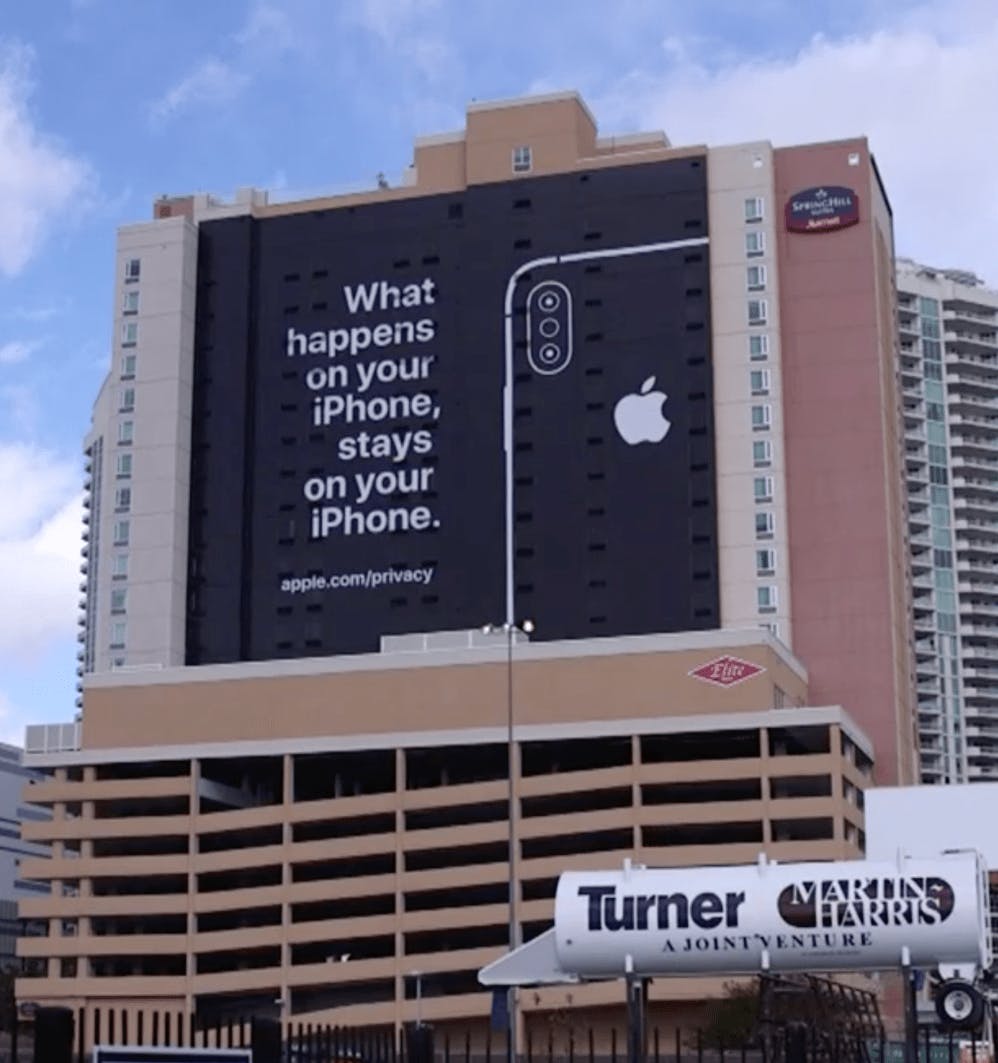
Apple Statement at CES 2019

Takeaway:

The time we spend touching our mobile phones will define this past decade as a “thing of the past.” The practice of typing everything we are thinking onto a small screen will slowly be replaced by voice activated technology. CES 2019 was a turning point with tech giants revealing AI assistants are the central focus in their strategy moving forward.  However, there are serious privacy implications to having a speaker in every room of the house. Google’s Android operating system leaks more data than Facebook, even on Facebook’s worst day. The bottom line is that there are still a lot of questions to be answered before these assistants are in your ceilings, on your blinds and in your bedroom via the alarm clock. I’ll be looking forward to Apple’s privacy-driven answer at WWDC in June.

Why Microsoft (Not Amazon) Will Win the Pentagon Contract

In 2019, the biggest cloud customer in the world will be the United States Department of Defense. The DoD is currently reviewing bids to award a single cloud provider a multi-year contract. Obviously, this isn’t your typical enterprise IT department, transferring from on-premise servers, or a startup who needs the flexibility of cloud infrastructure to scale. The program is called the Joint Enterprise Defense Initiative, or JEDI, and its purpose is to move the DoD’s massive computing systems into the cloud. This one contract is worth $10 billion, or 25% of the current market, which currently stands at $40 billion in annual revenue.

Many prognosticators and reporters unanimously believe the contract will go to Amazon Web Services. This belief is so strong that vendors, such as Oracle and IBM, made a rebuttal to Congress, believing the terms of the proposal favored Amazon. However, the majority of these forecasts overlook Microsoft’s strength in security and IT, and the alliances Microsoft has been forming with the DoD since Satya Nadella became CEO in 2014. Admittedly, guessing a company other than Amazon will win the Pentagon contract is a pure gamble, however, there are strong indicators for Microsoft that should not be overlooked

Also Read : Microsoft Earnings Likely to Prove Cloud Isn’t Slowing Down

Background on JEDI Contract

The Pentagon contract will move 3.4 million users and 4 million devices off private servers and into the cloud. The security risks of using servers outside the Pentagon’s domain are offset by physically separated government regions and hybrid solutions that extend on-premise servers by adding the cloud where necessary. The benefits of artificial intelligence, deep learning, and other technologies like virtual reality are essential for modern warfare as real-time data will inform missions when soldiers are in the field and also help to prepare them for combat.

“This program is truly about increasing the lethality of our department and providing the best resources to our men and women in uniform,” the Defense Department’s chief management officer, John H. Gibson II, told industry leaders and academics at a public event. Developing the system “will revolutionize how we fight and win wars.”

The DoD will not be the first to make a big move to the cloud. John Edwards, the CIO of the CIA, called moving to the cloud in 2013 ‘the best decision we’ve ever made.” According to Edwards, the 4,000 developers across the intelligence community work in the cloud environment, rather than individually provisioned workstations, which means the scalability does not come at the cost of the security. The Intelligence Community’s Cloud Services contract, called C2S for short, enhances security by not connecting to the internet. The results are better than expected as what used to take 180 days to provision a single server, improved to 60 days, and now takes a few minutes due to virtualization.

Also Read : Here’s Why Microsoft Stock Could Overtake Amazon on Cloud Infrastructure

JEDI Awarded to One Cloud Provider

One point of contention during the request for proposals, released on July 26th, was the stipulation that the contract be awarded to a single cloud provider. This provision caused a rebuttal to be sent to Congress as it narrows down who can compete on these terms. There are nine tech companies who have voiced opposition to the government awarding the JEDI contract to a single provider, including Oracle, Microsoft, IBM, Dell, Hewlett-Packard, Red Hat, and VM Ware.

While some cloud providers argue it will make the JEDI program less secure to be with one provider, this isn’t necessarily true as working with multiple providers introduces new vulnerabilities. One reason for this is that “managing security and data accessibility between clouds currently requires manual configuration that is prone to human error or resource limitation and therefore introduces potential security vulnerabilities,” as stated in the Pentagon’s response.

There are further disadvantages to storing data in separate silos across multiple vendors, which can weaken machine learning and artificial intelligence capabilities, reduce training performance and lower accuracy. The DoD is seeking to remove data silos as they move from their legacy systems, which are scattered across 500 individual cloud efforts.

The Case for Amazon

Amazon’s significant market share is one reason it is favored to win the contract. To put it simply, Amazon has the infrastructure and security clearances to meet the proposal’s guidelines while the majority of cloud contenders are too specialized to contend, such as Oracle with its flagship databases, or VM Ware with virtual machines. These limitations ultimately prevent these companies from meeting all of the proposal’s criteria.

Proponents for Amazon also point to the CIA contract that was awarded to AWS in 2013, which was a $600 million computing contract that services all 17 agencies in the intelligence community. Notably, for the last five years, Amazon has proven it can manage sensitive government information. Last April, Defense secretary Jim Mattis praised Amazon to lawmakers at a hearing when he said, “We’ve examined what CIA achieved in terms of availability of data” and “also security of their data, and it’s very impressive.”

Also Read : Microsoft Stock Price: Technical Analysis

The Case for Microsoft

The CIA contract was decided in 2013, but it wasn’t until 2014 that Satya Nadella started his tenure as CEO that the MS cloud platform Azure began its rise. Nadella worked his way up through the company over the course of nineteen years to president of the cloud business. At this point, Nadella who is not backing down with recent Level 6 security clearances anticipated in Q1 2019, which will put Azure on par with AWS with top-level security (more on this below).

There are many instances in the last four years where the DoD continued to choose Microsoft for software and operating systems. For instance, in May of 2018, the United States Intelligence Community extended its agreement to use MS products such as Azure Government, Office 365 for US Government, and Windows 10 in a joint licensing agreement with Dell. In this announcement, MS stated that over “10 million government customers from every federal cabinet level, including the Department of Defense” rely on MS’s Cloud for Government.

My newsletter subscribers get this information first. Sign up here.My newsletter subscribers get this information first. Sign up here.here.

In 2016, MS won a five-year contract to provide technical support to the Defense Information Systems Agency (DISA). In 2016, the original Windows 10 agreement that took effect in 2017 included 4 million laptops, desktops and mobile devices. More recently, in November of 2018, MS won a $480 million contract with the U.S. government to bring 100,000 augmented reality headsets into the military’s arsenal. The two-year contract will help soldiers prepare for combat training.

The question that remains is if the Pentagon will want to use Amazon for cloud infrastructure while using Microsoft for operating systems and software? If the Pentagon truly wants one provider, then Microsoft can offer an end-to-end solution for the DoD. This will be especially important as we see edge device computing built out, which Microsoft is preparing for with Azure Sphere.

We can also see from the timeline of MS’s press releases that the company is preparing to be a strong contender with Amazon on security:

  • In early 2017, Microsoft granted access to the Azure Government Department of Defense regions at Impact Level-5*, per their website.
  • In August of 2018, MS announced that Azure Stack, the hybrid solution, is available for government customers. This allows customers to maintain their own data centers while using cloud services for its advantages.
  • MS announced Azure Government Secret in October of 2017, which helps U.S. agencies handle classified data in areas such as energy research or law enforcement.
  • In October of 2018, when the Pentagon contract bids were due, MS posted on its blog that by the first quarter of 2019, Azure Government Secret will support “Secret U.S. classified data or Defense Information Systems Agency (DISA) level 6 workloads*.”

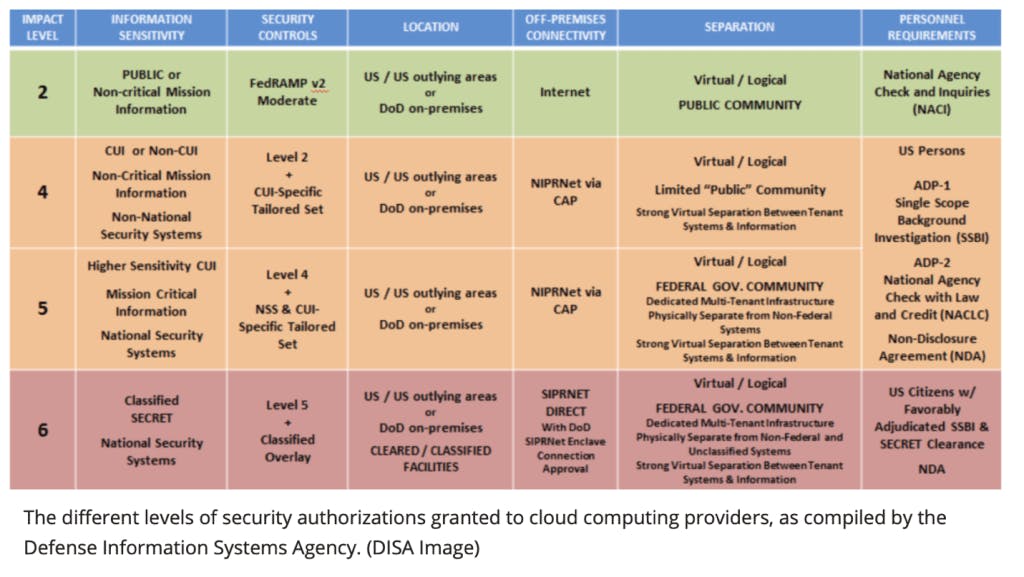
*Level 5 security is what Microsoft currently holds while Level 6 is what will be required by the Pentagon and is what Amazon currently holds. Microsoft will achieve Level 6 by Q1 2019. Here is a snapshot of the different levels of security authorizations (image source: Defense Information Systems Agency)

the different levels of security in cloud computing

Levels of Security Authorization Chart

Takeaway:

Microsoft has had a long relationship with the government that precedes the 2013 CIA contract. At the time of this contract, MS was not a cloud contender, but Satya Nadella was determined to change this.  MS will soon be an apples-to-apples contender with AWS on security, hybrid solutions and government cloud regions. Meanwhile, MS has secured the operating systems and software used by the Pentagon, through licensing with Dell. If the DoD were to choose Amazon, they’d still have to work with Microsoft on security, and would technically be working with two vendors. However, if the Pentagon wants one provider for end-to-end cloud computing, software, operating systems, and edge device computing software such as Azure Sphere, then Microsoft is the clear choice.

Here’s Why Microsoft Stock Could Overtake Amazon on Cloud Infrastructure

The cloud infrastructure market is expected to reach $83.5 billion by 2021, up from $40.8 billion in 2018. Amazon Web Services was launched in 2006, which means it took twelve years for the infrastructure-as-a-service (IaaS) market to reach $40 billion – but will take only three years for the next $40 billion to accumulate. Therefore, the investment window for cloud infrastructure stocks is far from over.

Microsoft Stock Overtake Amazon Cloud Infrastructure

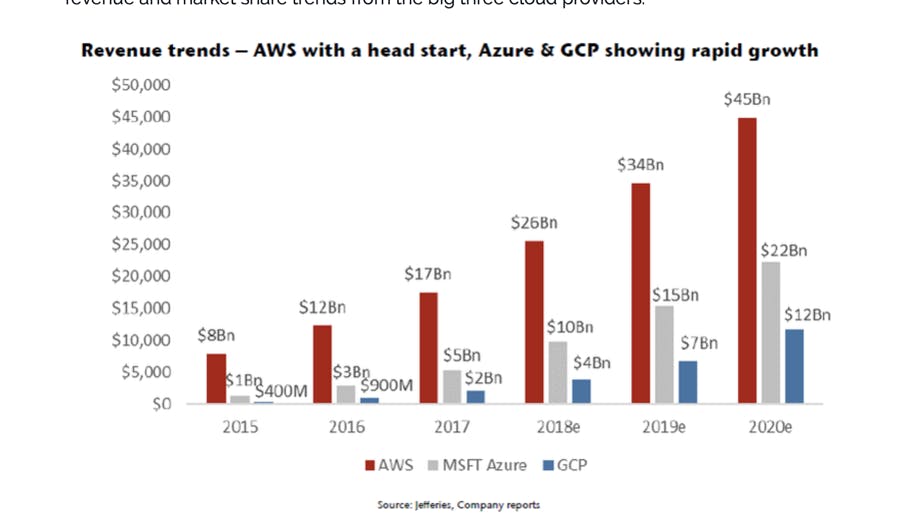
The IaaS segment is currently Amazon’s most profitable revenue stream comprising 55% of its quarterly operating profit, and is also the top growth-driver for Microsoft at 89%. Considering these are two of the three companies vying for most valuable company in the United States, it’s easy to see why IaaS could be the determining factor on who will remain in this position. AWS has a formidable lead in cloud infrastructure with estimates of $26 billion in sales last year compared to Microsoft’s $10 billion.

However, there was an important strategic acquisition Microsoft completed last month which will narrow its position in second place – and it’s my prediction that this specific acquisition will be a primary driver that will propel MS into first place in the next 2-3 years. Before I discuss the acquisition, I think it’s important to provide an overview of the IaaS segment.

Also Read : Why Microsoft (Not Amazon) Will Win the Pentagon Contract


Brief Overview of IaaS Cloud Stocks

Gartner analysis bumped Oracle and IBM from the leader quadrant this year, while placing Google Cloud in third behind AWS and Microsoft. For all intents and purposes, these are the three cloud infrastructure companies remaining for serious stock investors after a period of fierce consolidation. At one point, Amazon had more market share than the trailing 14 cloud infrastructure companies combined. It now has the market share of the trailing 5 companies combined. This reflects Microsoft and Google’s growth as the territory Amazon has forfeited was primarily gained by MS Azure and also Google Cloud Platform (GCP).

AWS, Microsoft and GCP Revenue Trends

AWS has an outstanding lead at 33% of the market, with Microsoft at 13% and Google at 5-6%. These margins are why Amazon posts 40% growth while Microsoft posts 98% growth – there is simply more territory that MS can gain as a second-place participant. GCP claims the most growth because its revenue is small enough to post these gains.

Suffice to say, current revenue is not a solid indicator of who will capture the $40 billion projected growth over the next three-year period. In fact, I believe AWS will have its hardest years ahead as Microsoft’s singular focus has been to grow Azure, and this strategy will be reflected in earnings between 2019-2022. AWS is the most mature provider in this category, but Microsoft has deeper experience with strategic IT dominance. The effort at which Microsoft is driving adoption to .NET CORE and Azure is, surprisingly, not something we see with AWS (more on this below).

To some extent, this reason could easily be explained by Amazon’s ever-expanding focus. The company may be too distracted with growing its e-commerce dominance, such as Prime deliveries and also Prime OTT streaming, plus the Whole Foods acquisition, as well as its plans to disrupt the healthcare industry and the connected home. It’s easy to see how Amazon might lack the focus in strategic investments that the competitive cloud infrastructure market will demand. Microsoft, on the other hand, is putting its entire weight behind IaaS, and the next couple of years will be interesting to see how this plays out.

Also Read : Microsoft Earnings Likely to Prove Cloud Isn’t Slowing Down


Microsoft’s Strategic Move to Acquire the World’s Largest Open Source Repository

Microsoft’s dedication to become the cloud infrastructure leader was demonstrated last month with the acquisition of Github for $7.5 billion, which is a repository for developers to upload projects and files. There are 28 million active developers collaborating on GitHub. In other words, every single developer in the world is on GitHub. In fact, GitHub’s user base is larger than the total number of developers globally, which is an impossibility the founder pointed out last year, proving the platform’s omnipresence.

“Git” refers to version control systems, which developer-talk for an open version of all the modifications made to projects (like writing code), that is stored in one central repository. Collaboration and sharing are at the essence of open-source software, and Github provides a social environment for this to occur. There is a ton of innovation which happens here, and almost every developer hosts their code and projects here for the world to see (or even for employers to review during job interviews). Developers can “fork’ a project, or split a project, by creating a new project off an existing one. Or they can issue a pull request to have the original developers of a project incorporate new code.

My newsletter subscribers get this information first. Sign up here.My newsletter subscribers get this information first. Sign up here.here.

Ironic is the best word to describe Microsoft’s venture into open source technologies and repositories. At one time, the company was loathed by the developer community for their closed standards, as the Founder Bill Gates adamantly believed software should be proprietary. In the late 90s, leaked documents showed Microsoft had attempted to contain the open source movement, and to prevent Linux from competing with Microsoft software by locking customers into proprietary protocols. (Linux is the free and open-sourced software operating system that launched in the early 90s and Android is built on today; Windows is the anti-thesis to this operating system).

Developers seek open source environments so they can learn from each other, and to support more innovation. Today, AWS excels when it comes to open source development due to being an early supporter of Linux. However, Microsoft is attempting a complete one-eighty by embracing the open-source community, and if MS succeeds, it will pay in dividends for Azure as it goes head to head with AWS.

This venture into open-source advocacy has been planned for some time. Over the last few years, Microsoft became the top contributor on Github with 2 million projects, which helps position Microsoft as an advocate while evangelizing the .NET framework and the .NET CORE that runs on Windows, MacOS, and Linux. Microsoft now claims that 40% of Azure’s virtual machines are running Linux.

Furthermore, MS acquired Xamarin two years ago, the leading mobile application development platform. The tools help developers navigate across the various programming languages required by different platforms, such as iOS and Android on native, web applications, or a mix of both with 75% of the code re-usable. This greatly reduces development time and resources, and also demonstrates that MS is ready to host and support competing operating systems in order to gain on cloud infrastructure.

Takeaway: Microsoft is courting developers because they are a primary decision maker as to which cloud service a company will use. MS Azure’s current customers are enterprise level, such as Fortune 500 companies.  Microsoft’s strength is that most businesses at this level have a significant investment in MS products, and it is easier to go with MS because it is what they know, and the transition is easy as the IT department won’t have to be trained on AWS or Google Cloud.

However, Microsoft’s blaring weakness is open source, and the some 28 million developers that are on smaller teams, and who socialize on Github, are decidedly open source. For $7.5 billion, Microsoft has done what every great company should do – acquire to address your weakness.

Both Xamarin and Github are highly strategic acquisitions. Microsoft paid 25 times the value of Github, which has revenue of about $300 million. Alphabet was also interested in purchasing Github, according to inside sources.

Also Read : Microsoft Stock Price: Technical Analysis

GM Stock Risky Due to Autonomous Vehicle Bubble

This week, General Motors Company cut more than 14,000 salaried staff and factory workers with plans to close seven factories worldwide in what Bloomberg calls a “sweeping realignment to prepare for a future of electric and self-driving vehicles.” Unfortunately for GM, and their employees, the future of autonomous vehicles is much farther off than what the company represents. Investors in GM stock should be cautious, and realistic, as to when new revenue streams will occur, as cutting costs, even to the tune of a net savings of $4.5 billion, might not be enough to wait out the innovation cycle.

In light of the recent layouts, there is $1.5 billion of reduced capex that the company will be saving by cutting the low-demand production lines and the anticipated plant closures (a drop in the bucket compared to the annual capex of $27.5 billion), however, the $1.5 billion capex is not being reinvested into electric vehicles or autonomous vehicle production at this time. The lack of reallocation conflicts with statements from the company CEO, Mary Barra, who promised the company would double investment in electric vehicles and self-driving technology during this week’s announcement.

The bottom line is that GM is correct to prepare for tough times, but they are not disclosing the true timeline for long-range electric vehicle and autonomous vehicle deployment and investors will have to wait years before they see any real profit from new production lines.

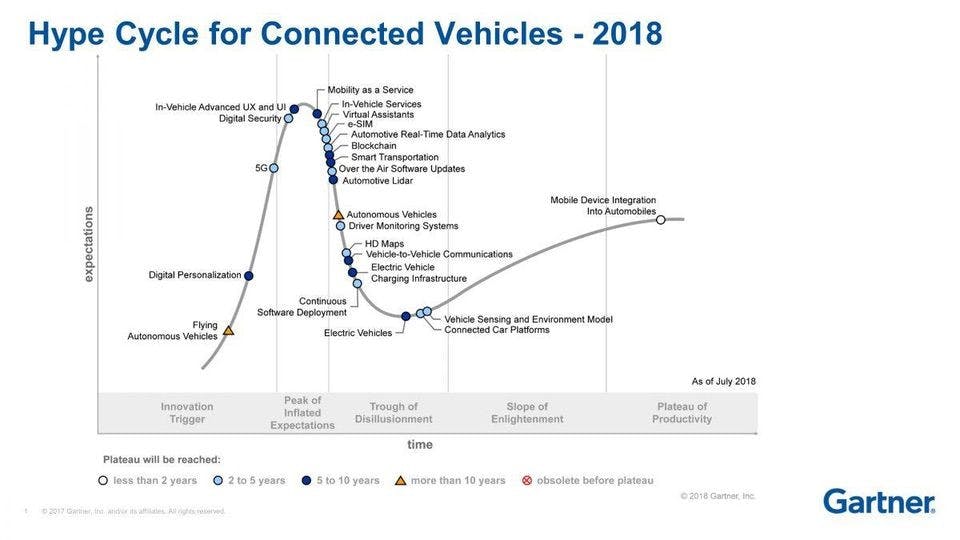
Three Words to Heed for GM Stock: Gartner’s “Trough of Disillusionment”

In September, Autonomous Vehicles fell into the “trough of disillusionment,” which is the downward slope published by the analyst firm, Gartner, to show the hype cycle for certain technologies. You can think of this as “winter is coming” for tech products – a time when all of the buzz and excitement finally meets reality (note: artificial intelligence winter is a well-documented thing).

ABI Research, an advisory firm that reports on market-foresight trends, predicts 8 million consumer vehicles with Level 3 to Level 5 autonomy will ship in 2025. Compare this to the 94.5 million vehicles sold in 2017 – which equates to 8.5% of sales. This is a small and fairly insignificant percentage of market share to be chasing 7-years ahead of deployment. Yet, investors have poured cash into auto manufacturers due to marketing campaigns that provide false hope for the near future.

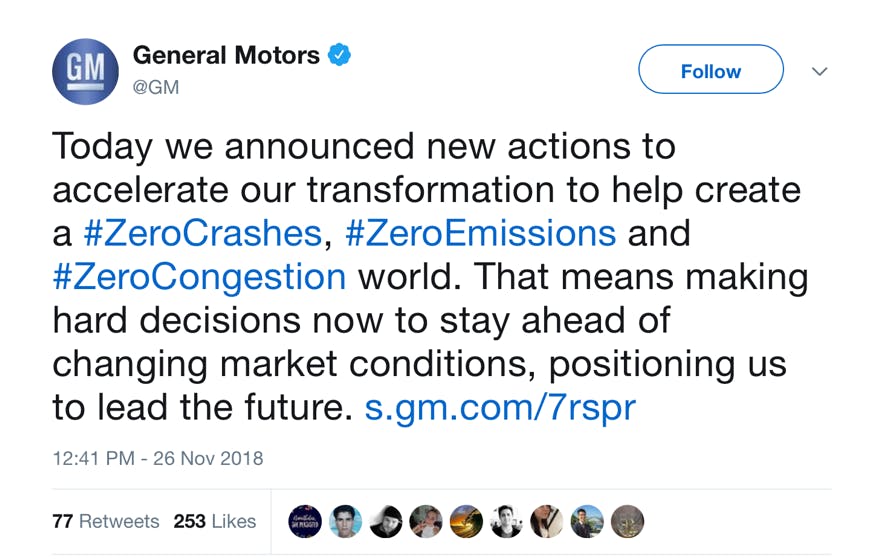
Twitter post

The reality for autonomous vehicles includes regulations, production cycles, and delays in implementation for what is an extraordinarily difficult problem to solve – how to get machines to respond like humans at crucial moments. This gap between investor expectations (perception) and commercial deployments (reality) has created an autonomous vehicle bubble.

Per statements from GM, long-range electric vehicles are a minimum of 8 years before they represent a slim 10% of GM’s current production. In 2017, the company committed to a volume production goal of “1 million units globally by 2026,” with the majority of EVs being sold in China. GM’s overall production was about 10 million units globally in 2016.

Brief Background on the 6 Levels of Autonomy

You can skip this section if you know the six levels of autonomous vehicles as published by SAE International. If not, this background is important to understand why the autonomous vehicle bubble formed, and why and when it will burst.

Level 0: No Automation. The driver performs all of the tasks.

Level 1: Driver Assistance. The driver handles all of the accelerating, braking, and monitoring of surrounding environment. An example of this level is when a car brakes for you in a critical moment.

Level 2: Partial Automation. The vehicle assists with steering and acceleration functions and allows the driver to disengage. Bubble formed here with investments pouring in, fueled by high hopes of Level 4 or Level 5 commercial deployment by 2020.

Level 3: Conditional Automation. The vehicle controls all monitoring of the environment using sensors. The driver’s attention is critical but the AV system runs the safety critical functions. This level does not require human attention under 37 miles per hour. Bubble will burst at this level as commercial deployments are delayed and reality sets in that AV investments will not see returns for many years.

Level 4: High Automation. Vehicle is capable of steering, braking, and accelerating, as well as responding to events and changing lanes. The system is switched into the mode under safe conditions, but the vehicle cannot determine dynamic instances like traffic jams or merging onto the highway. Most likely ETA 7-10 years.

Level 5: Complete Automation. No human attention required. No need for pedals, brakes, or a steering wheel. The AV controls all critical tasks, monitoring of the environment and identification of unique driving conditions like traffic jams. Most likely ETA 10-15 years.

Autonomous Vehicles – Stuck in Second Gear

Hurricane auto sales from last September helped GM stock, which rose 11.9% from the previous years, however the stock has retraced and is now trading at $35 per share. GM is no stranger to pushing the autonomous vehicle hype with executives commenting that Cruise Automation was making “rapid progress” back in October 2017, and in a blog post, the CEO stated, “in the coming months, we’ll take the next bold steps in testing our autonomous technology as we lead the way to fully self-driving vehicles without any human driver as a backup.” Those months have come and gone, of course.

Tesla is another example of a company that has made unfulfilled AV promises. In 2017, Tesla missed the deadline for a full rollout for self-driving cars. Since 2015, the company had been promising that every car made going forward would have the hardware necessary to facilitate full self-driving capabilities. In line with inflated expectations, Tesla announced it would officially stop promoting the “Full Self-Driving” option for its cars.

My newsletter subscribers get this information first. Sign up here.My newsletter subscribers get this information first. Sign up here.here.

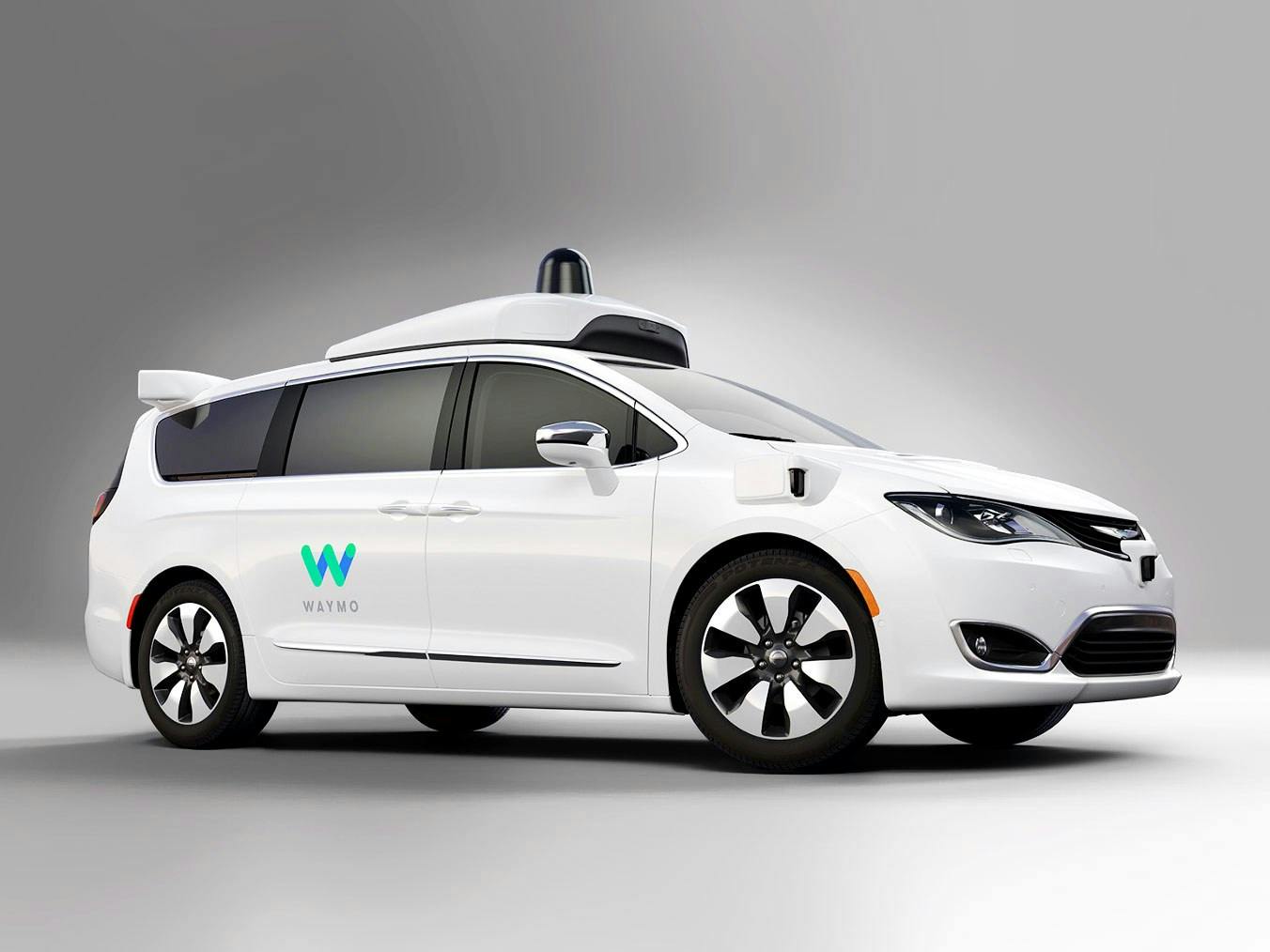
Waymo has been in testing since 2009 and has racked up more than 8 million miles on public roads and more than 5 billion miles in simulation. There are 600 self-driving Chrysler Pacifica Hybrid minivans on the road with goals of launching a commercial driverless transportation system later this year. This, and many other “near deployment” announcements have created massive expectations for the AV market, which is forecast to grow 10x from $54 billion in 2019 to $556 billion in 2026 at a growth rate of 39.47%.

The primary risk today for GM stock is that these forecasts assume commercial deployments will occur on time. As Mike Ramsey, a lead author on the Gartner report points out, even if GM and Waymo continue to debut driverless minivans or launch ride-hailing fleets, commercial deployments won’t be ready anytime soon. For example, the 2019 Audi A8 with Traffic Jam Assist with Level 3 partial automation, which has been anticipated for some time, has extended its release date another year due to foggy federal regulatory framework, infrastructural differences, and a lack of consumer understanding of self-driving technology.

More Evidence of the Autonomous Vehicle Bubble

In two side-by-side headlines we see Mary Barra of GM propagating a very different perception than what company insiders have reported. On November 1st, at the New Times conference moderated by Andrew Ross Sorkin, Barra stated the company is “on track” to roll out a ride sharing service in 2019 that would rely on autonomous vehicles, with the New York Times reporting Barra “added the company had a strategy to show how its vehicles are safer than human drivers.”

Dealbook

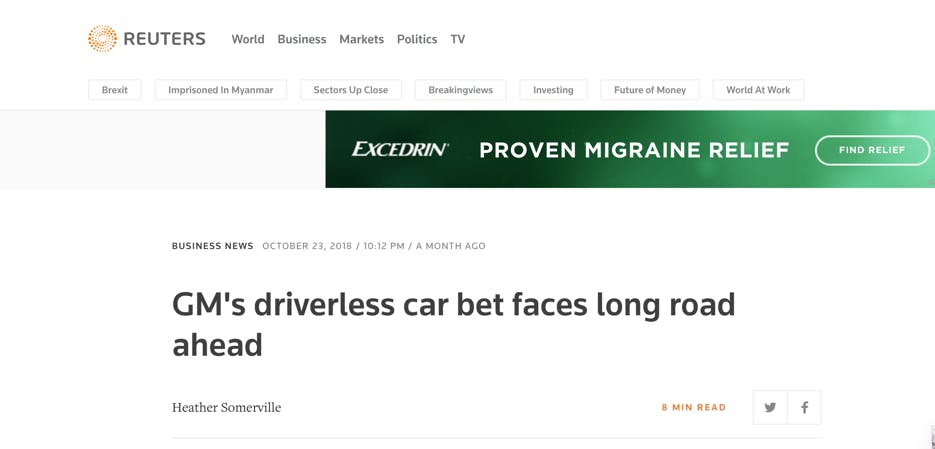
Meanwhile, on October 23rd, GM insiders told Reuters, “Nothing is on schedule,” citing unexpected technical challenges, such as Cruise cars not correctly identifying whether objects are in motion. Current employees and former employees also reported that Cruise software struggled to identify whether objects on the road are stationary or moving, failed to recognize pedestrians, and has mistakenly seen phantom bicycles.

Reuters

The regulation hurdles between Level 2 and Level 3, and delayed deployments, will put immense pressure on stocks, like GM, that are overvalued based on AV speculation. Press plays a large role in this. Headlines are a continual churn of autonomous vehicle “moments” – every partnership, every mile driven, every make and model that adds another feature. To be clear, we’ve only gone from a Level 1 to Level 2. We are not able to release Level 3 AV right now –that includes Waymo, GM, Audi, Mercedes, BMW, and yes – even Tesla.

Research studies have proven that consumers are very confused by the high profile promises, which Thatcham Research calls “dangerously confusing.” In a recent study, 71 percent of respondents around the world believe they can buy an autonomous vehicle today – yet there is not one autonomous vehicle on the market. The top three brands that consumers mistakenly believe distribute self-driving cars include Tesla (40%), BMW (27%), and Audi (21%). Of these, 11 percent say they would take a brief nap while using assist systems (hopefully, you’re not the person in the crosswalk when this happens).

GM Stock Investors Must Define “Future”

The company’s decision to lay off a sizeable work force seems sensible enough from a shareholders’ perspective (however unfortunate for the Midwest laborers). However, what is not sensible is having high expectations of when the future will deliver new revenue streams.

For value investors looking to buy GM’s high yield at depressed prices, don’t base the decision on GM’s PR push around electric vehicles and autonomous vehicles unless you’re comfortable not seeing profits in these production lines for many years to come.

Holding Nvidia Stock Will Pay Off Due to Two Impenetrable Moats

Tech stocks are getting slammed right now, and Nvidia may be one of Wall Street’s biggest losers in the sell-off that began last month and continued into this week. Nvidia’s stock has seen a 30-day high of $292 and a whiplash low of $176 – equaling a 40% plunge in the matter of four weeks. Today, it stands at $197.60.

Economic indicators and earnings from tech companies have not exactly warranted this reaction from the market. Fears the semi-conductor industry is slowing down based off Advanced Micro Devices earnings report were negated when Intel reported strong Q3 earnings. And while Apple may be on the precipice of a capped out $1 trillion-dollar market cap due to possible iPhone saturation, Nvidia’s outlook is quite the opposite in regards to public-company growth trajectory. The market may continue to have volatility, but Nvidia investors who are patient will be rewarded due to competitive advantages in GPU-powered cloud performance and developer adoption of Nvidia’s platform.

Brief Overview of Nvidia’s Revenue Segments

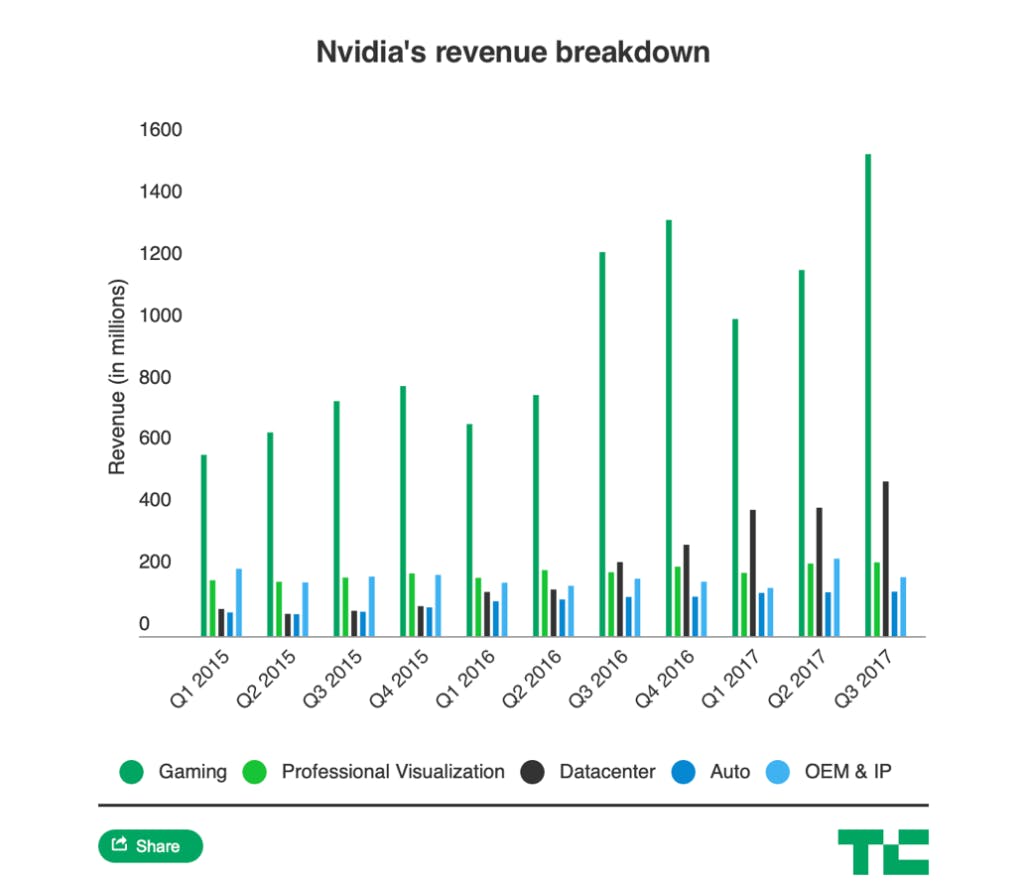
To summarize, gaming claims the majority of Nvidia’s revenue at $1.81 billion, up 52% YoY. Gaming will get a nice boost in 6-12 months from the new GeForce RTX 2070, RTX 2080 and 2080 Ti chips, which introduce the possibility of hybrid rendering through ray-tracing. In layman’s terms, ray-tracing mimics how light behaves in the real world by mapping out rays from 3D illumination sources. The imagery is much more realistic as a result. Electronic Arts released the first raytracing game today (November 14th) whereas 6 months ago, the gaming industry did not think raytracing would even be possible. Companies who have signed up for the new Turing architecture include Adobe, Pixar, Siemens, Black Magic, Weta Digital, Epic Games (maker of Fortnite) and Autodesk.

Data center revenue has been picking up speed at 83% YoY, or $760 million, as GPU chips are powering more of the cloud for machine learning and artificial intelligence applications. Data center revenue, once a small blip, claims 24% of the company’s total sales. This will continue to grow steadily into the near future due to the computing power and flexibility GPUs provide over CPUs, which is what Intel sells, or TPUs and FPGA, which are custom machine-learning chips by Google and used by Microsoft that are too specific to one platform for widespread adoption – more on these points below.

Source: TechCrunch

Smaller segments by Nvidia include professional visualization and automotive, which grew to $281 million and $161 million, respectively, up 20% and 13% year over year.

Two Impenetrable Moats: GPU-Cloud and Developer Adoption

Revenue segments are your typical Nvidia stock coverage. But can Nvidia take market share from Intel? Will Google, Microsoft, Facebook and Apple design their own custom chips to compete with Nvidia? This is what investors need to answer for themselves especially if we continue into correction territory.

Regarding Intel, the cloud is too competitive to forego the performance and efficiency that Nvidia delivers. Recently, the Turing T4 GPU became the fastest adopted server GPU of all time in just two short months of hitting the market. Prior to the release of the Turing T4 GPU, Nvidia’s data center growth was 3x compared to Intel. Intel posted 26% growth YoY whereas Nvidia posted 83% YoY. However, Nvidia’s data center revenue is 1/6th compared to Intel’s at $760 million vs. $6.1 billion. This revenue segment will continue to grow as the GPU-powered cloud is built out. Unfortunately for Intel, GPUs are the better choice for cloud customers as the usage pattern is constantly in flux, demanding a wide variety of models and different software frameworks. Intel’s CPU Xeon Processor cannot compete with the performance-per-watt of what Nvidia offers in the cloud. Per the announcement on September 13th, 2018, Microsoft, Google, Cisco, Dell EMC, Fujitsu, HPE, IBM, Oracle and Supermicro plan to release servers with Nvidia’s T4 GPU on board.

My newsletter subscribers get this information first. Sign up here.My newsletter subscribers get this information first. Sign up here.here.

Google and Microsoft have both made chips for their data centers. Microsoft adopted the field-programmable gate array (FPGA) which is used for AI apps. And Google has built a custom chip called the Tensor Processor Unit (TPU) for Google’s TensorFlow deep learning framework. Competing, customized chips will become the new norm as tech giants prefer to use proprietary tech. The biggest weakness that competing customized chips face like TPUs, from Google, and FPGA, used by Microsoft, is that they may be too specialized for developers to adopt. The drawbacks will continue to be price and difficulty, as programming for FPGA is an area not many engineers have expertise in. The same goes for Google Cloud Platform (GCP). They’ll have to get developers to adopt GCP and keep them locked into TensorFlow. Even so, there are alternate frameworks such as PyTorch from Facebook which add further to the fragmentation of developer frameworks. In addition, even if Google uses TPUs for inferencing, it may still use Nvidia’s GPU for training neural networks.

Let’s use mobile application development as an example. One of the reasons mobile is a duopoly between Android and iOS is that developers can only learn so many tools and development environments before the process becomes inefficient. In order to truly excel at a language, it has to be universal. For instance, Microsoft attempted to launch a Windows phone, which was met by resistance as developers did not care to learn a new operating system that could not prove itself with user adoption. In turn, mobile users did not buy the Windows phone because their favorite applications were not available to download. iPhone’s success was due to iOS developers who learned tools like XCode to create applications. Android became the competing universal language for the remaining manufacturers, such as Samsung, LG, Sony, Pixel, etcetera. The next wave of AI applications and machine learning inferences will follow the same path of limited competition due to development bandwidth. Developers will self-regulate the number of competitors for processing units due to a need for a universal platform that supports all frameworks.

Here’s a quote from Marc Andreessen of Andreessen-Horowitz, one of the most successful venture capitalists in Silicon Valley:

“We’ve been investing in a lot of startups applying deep learning to many areas, and every single one effectively comes in building on Nvidia’s platform. It’s like when people were all building on Windows in the ’90s or all building on the iPhone in the late 2000s.”

There is an even greater need to simplify artificial intelligence and machine learning than exists for mobile standards. There are thousands of variants emerging each year in AI as neural networks evolve and expand in depth, complexity and architecture. There are multiple frameworks supported by major industry players and Nvidia’s GPUs are flexible enough to accelerate all of these frameworks and workflows including Caffe2, Cognitive Toolkit, Kaldi, MXNet, PaddlePaddle, Pytorch and TensorFlow.

In addition, AI occurs beyond the cloud and Nvidia’s GPUs are available in what is called edge devices, such as self-driving cars, desktops, workstations, data centers and across all major cloud providers.

Conclusion

Nvidia is already the universal platform for development, but this won’t become obvious until innovation in artificial intelligence matures. Developers are programming the future of artificial intelligence applications on Nvidia because GPUs are easier and more flexible than customized TPU chips from Google or FGPA chips used by Microsoft. Meanwhile, Intel’s CPU chips will struggle to compete as artificial intelligence applications and machine learning inferencing move to the cloud. Intel is trying to catch-up but Nvidia continues to release more powerful GPUs – and cloud providers such as Amazon, Microsoft and Google cannot risk losing the competitive advantage that comes with Nvidia’s technology.

The Turing T4 GPU from Nvidia should start to show up in earnings soon, and the real-time ray-tracing RTX chips will keep gaming revenue strong when there is more adoption in 6-12 months. Nvidia is a company that has reported big earnings beats, with average upside potential of 33.35 percent to estimates in the last four quarters. Data center revenue stands at 24% and is rapidly growing. When artificial intelligence matures, you can expect data center revenue to be Nvidia’s top revenue segment. Despite the corrections we’ve seen in the technology sector, and with Nvidia stock specifically, investors who remain patient will have a sizeable return in the future.

Prediction: Here’s Why Roku Will Be The Next Tech Darling

Roku’s earnings report for Q3 is scheduled on a potentially volatile trading day depending on how the broader markets react to the mid-term elections. The uncertainty around this outcome, along with rising rates, geopolitical trade uncertainty, and a host of companies tempering their Q4 outlook has caused a style rotation, which has pummeled tech stocks. Regardless, Roku is a mid-cap growth stock in the tech sector that will continually prove itself against headwinds as the company is poised to become one of the most opportunistic growth stories in the market by 2023.

The reason for this is simple: connected TV advertising combines the high engagement of traditional television with the audience targeting capabilities of mobile. These previously two competing forces will combine to create the next advertising phenom, and Roku will emerge as the tech darling of this ever-important shift in ad dollars.

Pay TV Attrition is a Blood Bath

Pay TV has had better decades. The peak for Pay TV user growth in the United States occurred in 2011 when it began an inevitable erosion due to bloated, costly monthly packages, a lack of flexibility for on-demand, and advertising-stuffed programming choices. The following year, pay TV subscribers fell by 8,000 in 2012, which accelerated to 164,000 subscriber losses in 2014. Three years later, those losses grew 20x to a staggering 3 million subscribers (source: Leichtman). And by 2023, live-linear OTT video subscriptions will surpass traditional broadcast TV[1].

Cord-cutters have driven a formidable marketplace. In fact, the global OTT devices and services market will reach $165 billion in 2025 compared to $29 billion in 2015[2].

Also Read : Update on $ROKU – Will Roku Miss Earnings?

“All TV is now OTT” –ABI Research

Roku offers the most synonymous OTT business model with cable and satellite TV providers and can capitalize long-term on this massive subscriber loss by leveraging its advertising, audience development and content distribution services, which make up 89% of gross margins from the platform. As of Q2 2018, if Roku were a traditional cable TV company, the 22 million active subscriber base would rival Comcast as second largest distributor of content in the United States. Only AT&T has more with 47 million DirecTV subscribers. Compare this to Charter Communications, which has a $65 billion market cap and only 16 million users or Comcast with a $171 billion market cap with the aforementioned 22 million subscribers. Roku’s market cap is at $6 billion with shares priced at $56 with the same number of users as Comcast.

The Next Phenom in Tech is Connected TV Advertising

I’ve covered Roku extensively in previous analysis including strengths on how the company is vendor agnostic, player vs platform revenue and the company’s global potential. Connected TV advertising, however, is by far the most important piece for Roku’s trajectory.

Bear with me here as I talk about some of the problems and technicalities in the advertising industry, and why Roku is well positioned.

As Digiday puts it, “Two of the big trends in digital media aren’t compatible: The drive to enforce viewability standards and the shift to mobile, particularly apps.”

Viewability issues are a serious issue for big brands who are averse to mobile in-app advertising because it’s too challenging to track. In addition, many big brands do not need immediate purchases which is called “purchase intent” – which is mobile’s main value over television.

For instance, Coca-cola doesn’t expect you to buy a soda immediately after seeing an ad. Audi doesn’t expect you to buy a car immediately either. So, a lot of the benefits of mobile aren’t worth the downside to these big brands. Advertising budgets shifted to mobile because they had to find audiences, not because it’s a superior method to advertise.

Also Read : Roku Q3 Earnings: Choppy But Unshakeable Long-Term

Here’s how the two compare:

  • Pay TV has high completion rates as viewers are comfortable in their homes and better prepared to receive advertisements.
    undefinedundefined
  • Mobile offers audience data to better target viewers based on individual preferences.
    undefinedundefinedundefined

Connected TV advertising, which is Roku’s specialty, combines the best of both television and mobile. It offers 100% viewability and completion rates with the audience data and dynamic ad insertion found on mobile. Forbes covered this in a recent article which stated Ad Supported OTT is the future reporting OTT ads have a 97% completion rate and 100% viewability.

In a recent study by FreeWheel, 200 billion video starts found OTT ads had ballooned from 2% to 32% in a four-year period due to heavier investments from advertisers.

In the Q2 2018 Video Advertising benchmark study released by Extreme Reach, a tech platform for video ad campaigns, connected TV impressions overtook mobile, accounting for 38 percent of all video ad impressions down from 33 percent in Q1.

Here’s a quote from Extreme Reach:

“CTV is clearly on the path to becoming the dominant platform for media consumption, and premium inventory is the most sure-fire audience draw.”

– Mary Vestewig, Senior Director, Video Account Management at Extreme Reach.

AppNexus, the world’s leading independent advertising technology company, announced in July of 2018 that advertiser spend in its connected TV marketplace grew 748% year-over-year versus the second quarter of 2017 and 68% quarter-over-quarter. AppNexus currently sees 20 billion monthly connected TV impressions per month.

From an investment standpoint, the implications of attracting more advertising dollars than mobile is enormous. Big brand budgets have been looking for a solution to traditional television that isn’t confined to the attention span and limited screen size of mobile viewers. With Roku, that option is finally here.

Also Read : Roku’s Stock Price: Will There Be Another Pullback?

Subscriptions are Saturated

Subscription video-on-demand (SVOD) comprises 40 percent of the OTT market with the majority of the revenue coming from the United States. By 2022, SVOD penetration will be 132% of US TV households with many homes having more than one SVOD platform[1].

Total SVOD is expected to reach 171 million by 2022 – up from 59 million in 2016 reflecting a 53% increase.

Previously, viewing data and ratings on SVOD (subscription video on demand) such as Netflix (NFLX), Hulu Plus, and Amazon Prime and other OTT content was not disclosed even by Nielsen (NLSN). However, in a recent interview, Nielsen COO Steve Hasker revealed four previously undisclosed statistics about SVOD such as 89.5% of SVOD content is primarily viewed on the television glass whereas 11.5% is viewed on smartphones and tablets.

Of this time, 80% is spent on catalog programming whereas 20% is spent on original content. For definition purposes, Netflix is original content and something Roku or Amazon Prime offers is considered catalog programming.

Meanwhile, as competition increases, the costs for original programming are escalating with Netflix spending $8 billion in 2018 in order to remain competitive for a small piece of the pie (20% of how time is spent).

Roku has held firm on not creating original programming and the statistics support this. The costs for original programming are likely to escalate as HBO, Showtime, Apple, and now Disney developing its own channel for 2019, will continue to compete for this space.

In addition, subscribers pay for quite a few premium $8+ subscription channels, which will eventually lead to subscription fatigue – not to mention mitigate the reason cord-cutters leave pay TV services – which is to lower costs. For a subscriber with YouTube TV ($40) and three premium channels ($24-26), they are paying $65+ per month. This pricing will meet resistance by cord cutters and ad-supported OTT will continue to be a solid choice for viewers.

Conclusion:

Roku is executing on a market trend that will defy typical growth trajectories. Brand budgets are migrating towards Connected TV as a superior method of advertising over mobile. The Roku Channel launched in October 2017 and is already a top 5 channel by active account research. Investors should keep a close eye on platform revenue, which was up 96% YoY to $90.3 million in Q2. The trailing 12-month ARPU in Q2 increased 48% YoY to $16.60 and was “driven by strong growth in video advertising as we continue to capture more share of TV ad budgets,” as the company stated in their shareholder letter.  Due to connected TV advertising trajectories, I am long on Roku for the next 3-5 years.

Click here for more information on why Roku stock will reach $100 in the next two years.

All analysis contained herein should be appropriately credited to Beth Kindig.

Can Programmatic Ads Save Spotify?

Summary: According to Q3 earnings calls, Spotify may seek to broker user data in order to keep average revenue per user afloat. Known as programmatic advertising, this method of monetizing data to supplement music revenue may be Spotify’s only hope to stave off competitors who nip at the heels of the music-streaming app

Portions of this article were originally published September 27th, 2018 under 8 Reasons Spotify will be a Sell Recommendation by 2019 at $184 per share. This analysis has been updated to include the recent partnership with Google and programmatic offering Ad Studio.Spotify will be a Sell Recommendation by 2019 at $184 per share. This analysis has been updated to include the recent partnership with Google and programmatic offering Ad Studio.

Half Full or Half Empty? -6% ARPU in Q3 Compared to -12% ARPU in Q2

Spotify Technology met its Q3 forecast for paying subscribers and a few other metrics, but average revenue per user declined due to promotional accounts for families and students. Spotify ended the period with 87 million Premium subscribers worldwide, up 40% year-over-year. Spotify has 109 million monthly active users of its advertising-supported streaming service, up 8 million from Q2 or 20% YoY.

This quarter, Spotify’s average revenue per user percentage has improved but QoQ growth is still in the red. Average revenue per user declined to $5.50 in Q3 from $5.83 in Q2, or -6% following -12% the previous quarter.

Costly Partnership with Google

Spotify lacks the razor-razor blade Gillette analogy for tech companies, which in this case states you should have ownership of a device if you want to bank on the subscriptions. This is one reason I’ve been long on Roku since its IPO. Roku players are the cheap razors that will deliver the razor blades of ad-supported content in the OTT market. (You can read my analysis on Roku here). However, this lack of device ownership is causing trouble for Spotify. Smartphones dominated by Apple and Google are only part of the story. At home assistants such as Alexa are being designed and leveraged specifically for AI activated music services. To get a glimpse of Spotify’s future, consider that major record labels let Amazon offer a reduced Alexa version of the premium service at $3.99 per month and Apple is requiring users to sign in to Apple Music to power the HomePod – which completely shuts out devout Spotify users.

Spotify’s new strategy is to partner with Google to offer free Google Home Mini speakers to users who subscribe to the Family plan as part of a holiday season promotion. The partnership comes at a cost of approximately 50 basis points to the Gross Margin profile in Q4, the company noted. From Google’s standpoint, they get their entry level smart speaker into more homes, while Spotify benefits by having a partner for smart home infrastructure. Ultimately, this is one example of the lengths Spotify will have to go to in order to compete with Apple and Amazon on their home turf.

My newsletter subscribers get this information first. Sign up here.My newsletter subscribers get this information first. Sign up here.here.

Apple has Homefield Advantage

Most certainly, Apple won’t be beat in its own ecosystem. Apple revolutionized digital music with the iPod and iTunes. With smartphone penetration, the Beats acquisition, its Homepod ecosystem and a huge push into connected car infotainment, Apple can surround Spotify in nearly every direction. Keep in mind, that 66% of the world’s paying app users are iPhone users who trend towards higher incomes (vs. only 34% on Android), so Apple users are supremely important for Spotify’s $9.99 subscriptions.

In fact, the turf war has already receded Spotify’s market share. Record industry sources state Apple is adding paying subscribers at a rate of 5 percent in the U.S. versus 2 percent for Spotify, and that Apple Music may have already taken over Spotify as the number one streaming service in the United States.

In addition, Apple was cleared to complete the acquisition for UK-based music recognition app Shazam Entertainment for $400 million. Due to the threat this poses to Spotify and other smaller apps, regulators in seven countries contested the acquisition when Apple’s plans were first announced. Despite these efforts, the acquisition was approved in August of 2018. To date, Shazam has had well over 1 billion downloads, last reported in 2016, and owns a wealth of information on what music is trending with over 20 million searches per day.

Can Programmatic Ads Save Spotify?

Tim Cook is a chief critic on how applications and websites use private data to increase the accuracy of targeted advertising. Therefore, one area Apple clearly won’t compete is in the brokering of programmatic ads based on users’ music choices. Meanwhile, Spotify has every intention of letting advertisers target its users through Ad Studio.

Spotify would not be the first mobile application to supplement its core product with a programmatic offering. Facebook and Twitter owe at least 1/6thto 1/4thof their current revenue to programmatic proving it can substantially increase average revenue per user. Therefore, if Ad Studio is executed correctly, it may have the potential to limit stock losses even with stiff competition from Apple and Amazon.

Here’s a statement from Spotify’s press release:

“Last quarter we said that we expected our Programmatic and self-serve products to become a significant portion of our Ad-Supported revenue. If we’re successful in achieving this shift in revenue mix, then we also expect to achieve significant operating leverage in the ad sales business, increasing our operating margins. Last quarter we reported on our new automated self-serve platform, Ad Studio, which is live in the US, UK, Canada, and Australia. Ad Studio revenues are still quite small, but we’re seeing exponential growth, so expect to hear more about this product in future quarterly updates.”

Note About Tencent Music IPO:

Spotify owns Tencent Music Entertainment (TME) shares and it’s been stated in past financial reports that “a TME IPO would trigger a fair market value adjustment to the carrying value of our investment recognized in other comprehensive income. The gain could be significant.”  This one-time, non-recurring event would generate a Net income for Spotify with a Net loss returning in the following quarters. Spotify stock holders should be aware that this one-time wave may be worthwhile to hold on for, but that the long-term prospects of the company are still not proven.

Conclusion

Spotify is a small fish in deep waters. Q3 earnings prove music streaming is a tough business. The company is attempting to partner with device owners, like Google, but these partnerships will eat away at Gross Margins in future quarterly earnings. I’m forecasting that Spotify will be in sell status through 2019 unless they can prove themselves with a strong programmatic offering through Ad Studio. Note the Tencent Music IPO will generate a net income for Spotify in the current quarter.

You can access more analysis on Spotify here.

This article and previous Spotify analysis written by Beth Kindig has been published on Seeking Alpha. All original analysis contained herein should be appropriately credited to Beth Kindig.

What Everyone Should Know Before Facebook’s Q3 Earnings Call

Facebook’s earnings call today may be the most anticipated call of Q3. The stock has tumbled since the last quarterly earnings call from a high of $217 in July to a low of $142. Three months ago, Street analysts did not think this was possible – and many still have price targets at $200. I believe bullish financial analysts are distracted by Facebook’s security costs, news feed fatigue and Instagram while underestimating the most important number on Facebook’s earnings call tomorrow –user growth rate.

Background on Facebook’s User Growth Trajectory

Facebook’s rampant growth from 2004-2017 was due to a viral coefficient formula which is also known as the k-factor. The k-factor equation was taken from epidemiology, in which a virus that has a k-factor greater than 1 indicates exponential growth. The equation for virality for websites and applications describes the growth rate:

k = i * c

i = number of invites
C = conversion rate

When K is equal to one or greater, you have viral growth.

Facebook’s growth rate trajectory was exponential because people found the network more rewarding when more people they knew joined the network. The same will be true for Facebook’s deceleration, as well. As people start to spend less time on the social network, there will be viral deceleration.

To illustrate, a loss of 1 million users in the United States to Facebook is not a 1:1 loss, like it would be for Netflix or Google, where users are isolated from each other in a “silo.”

  • If I stop using Google, your search results are not affected.
  • If I stop using Netflix, your programming choices are not affected.
  • Even Twitter can withstand user loss as the platform is not based on a reciprocal following structure. This is why a celebrity can have 60 million followers, yet only follow 135 people in return.

If 1 million users close their Facebook accounts in the United States, however, it will be subject to a negative k-factor. These 1 million people who delete their accounts weaken the content on the platform for the 50 million-500 million people who were connected to them (assuming each user has at least 100 friends and some are inter-connected).

Now, if 2 million of the subsequent 50-500 million start to use Facebook less due to the impact the original 1 million had, then another 500 million to 1 billion will have a less enjoyable experience, which will reduce time on site. If 5 million from those 500 million find the platform less interesting because their favorite people have left the platform, the affects will continue to spiral.

My newsletter subscribers get this information first. Sign up here.My newsletter subscribers get this information first. Sign up here.here.

This is why Snap has been a popular short. Snapchat continues to lose daily active users on a quarter-over-quarter basis in North America and Europe. Only last May, Snap began to report a sinking growth rate of 2.13 percent – which was its slowest ever at the time compared to 5 percent in Q4 2017. See below for how Facebook’s user growth rate compares.

It should be noted that this was once Facebook’s strength and Twitter’s weakness. New users on Facebook had a low barrier to entry because total friend count grew relative to how much you reciprocate and follow back. Twitter, on the other hand, has had a tough time attracting new users because there is no reciprocation.

Facebook Reported Slowest-ever User Growth Rate in Q2 2018

The viral-coefficient-in-the-reverse explains why the most important metric for investors to pay attention to in Facebook’s earnings report is the user growth rate. Last quarter, Facebook’s monthly user count grew 1.54 percent compared to 3.14 last quarter. Daily active users grew even slower at 1.44 percent, compared to 3.42 percent last quarter. Previously, the slowest daily active user growth rate was 2.18 percent in Q4 2017. If this number becomes stagnant, the social media platform can decelerate very quickly. This is also why it’s possible for Facebook to report strong earnings and there still be a sell-off. If and when this number goes into the red, Facebook will have reached its peak as a social media platform –and profits will soon follow this trailing decline.

Disclosure: I shorted this stock in April of 2018 and have a put option on this stock as of October 2018 as I expect the user growth rates to continue to decline in the near future. Readers should also note these declines are more likely to occur in high average revenue per user markets (ARPU) such as the United States, Canada, and in Europe.

Read more analysis on how I predicted Facebook earnings prior to Q2 and analyzed Facebook would face GDPR trouble following Q1 2018 here.

I consult for financial firms. Inquire here.

The Level 2 Autonomous Vehicle Bubble – Tesla, GM, Audi, BMW, Waymo, Nvidia, and Intel

Last month, Autonomous Vehicles fell into the “trough of disillusionment,” which is the downward slope that analyst firm Gartner publishes to show the hype cycle for certain technologies. You can think of this as “winter is coming” for tech products – a time when all of the buzz and excitement finally meets reality (note: artificial intelligence winter is a well-documented thing). The reality for autonomous vehicles includes regulations, production cycles, and delays in implementation for what is an extraordinarily difficult problem to solve – how to get machines to respond like humans at crucial moments. This gap between investor expectations (perception) and commercial deployments (reality) has created an autonomous vehicle bubble that will pop in 2019 as the next level of autonomy continues to face delays.

Brief Background on the 6 Levels of Autonomy

You can skip this section if you know the six levels of autonomous vehicles as published by SAE International. If not, this background is important to understand why the autonomous vehicle bubble occurred, and when it will burst.

Volatility is Closer than it Appears

Waymo has been in testing since 2009 and has racked up more than 8 million miles on public roads and more than 5 billion miles in simulation. There are 600 self-driving Chrysler Pacifica Hybrid minivans on the road with goals of launching a commercial driverless transportation system later this year. This, and many other “near deployment” announcements have created massive expectations for the AV market, which is forecast to grow 10x from $54 billion in 2019 to $556 billion in 2026 at a growth rate of 39.47%[1]. For investors, the primary risk today is that these forecasts assume commercial deployments will occur on time.

As Mike Ramsey, a lead author on the Gartner report points out, even if Waymo and General Motors continue to debut driverless minivans or launch ride-hailing fleets, commercial deployments won’t be ready anytime soon. For example, the 2019 Audi A8 with Traffic Jam Assist with Level 3 partial automation, which has been anticipated for some time, has extended its release date another year due to foggy federal regulatory framework, infrastructural differences, and a lack of consumer understanding of self-driving technology[2].

The regulation hurdles between Level 2 and Level 3 and delayed deployments will put immense pressure on stocks that are overvalued based on AV speculation. ABI Research, an advisory firm that reports on market-foresight trends, predicts 8 million consumer vehicles with Level 3 to Level 5 autonomy will ship in 2025. Compare this to the 94.5 million vehicles sold in 2017 which equates to 8.5% of sales[3]. This is a small and fairly insignificant percentage of market share to be chasing 7-years ahead of deployment. Yet, investors are pouring cash into hyped up stocks- and the press plays a large role in this. Headlines are a continual churn of autonomous vehicle “moments” – every partnership, every mile driven, every make and model that adds another feature. To be clear, we’ve only gone from a Level 1 to Level 2. We are not able to release Level 3 AV right now – and yes, that includes Elon (most especially Elon – read my Tesla analysis here).

My newsletter subscribers get this information first. Sign up here.My newsletter subscribers get this information first. Sign up here.here.

One example of this investment bubble is when Tesla’s stock skyrocketed in 2016 while Adam Jonas from Morgan Stanley, a lead underwriter, said that Tesla’s ridesharing network was worth $244 a share. However, reality has set in, and Adam Jonas has now changed that valuation to $95 per share or $17 billion by 2040[4]. The following year, Tesla went on to surpass BMW’s market cap of $60 billion in 2017 despite posting a loss of $725 million from 80,000 vehicles compared to BMW making $7.7 billion from 2.4 million vehicles. Meanwhile, the 2017 deadline for a full rollout for self-driving has come and gone. And as recently as this month, Tesla officially stopped promoting the “Full Self-Driving” option for its cars.

Another example is GM, whose shares have dipped more than the broader markets, erasing any gains from its peak in October of 2017. The hurricane sales from last September helped the stock, which rose 11.9% from the previous years, however the stock has retraced and is now trading at $31-$32 per share. GM is no stranger to pushing the autonomous vehicle hype with executives commenting that Cruise Automation was making “rapid progress” back in October 2017, and in a blog post, the CEO stated, “in the coming months, we’ll take the next bold steps in testing our autonomous technology as we lead the way to fully self-driving vehicles without any human driver as a backup.” Those months have come and gone, of course.

Research studies have proven that consumers are very confused by the high profile promises, which Thatcham Research calls “dangerously confusing.” In a recent study, 71 percent of respondents around the world believe they can buy an autonomous vehicle today – yet there is not one autonomous vehicle on the market. The top three brands that consumers mistakenly believe distribute self-driving cars include Tesla (40%), BMW (27%), and Audi (21%). Of these, 11 percent say they would take a brief nap while using assist systems. Therefore, the disconnect between perception and reality is widespread – and not only in the investment community.

Startups will do their part in the autonomous vehicle bubble, as well. Zoox, Inc is a startup that has raised $800 million with a $3.2 billion valuation — but has not made any revenue yet.  The premise of Zoox is to forego partnering with auto manufacturers by deploying their own vehicles. Essentially, the idea is to skip the AV iteration and deployment line and go directly to Level 4 or Level 5 autonomy with no prior manufacturing experience – all by 2020. Meanwhile, there is no mention of regulations, safety and security hurdles in the deployment estimate, or anything else related to practicality for that matter. And as Bloomberg reported, “Even with all of that cash, Zoox will be lucky to make it to 2020, when it expects to put its first vehicles on the road – ‘It’s a huge bet,’ [the founder] concedes.”

A note on Nvidia and Intel

I’m working on a separate analysis of these two companies. Follow me for updates.

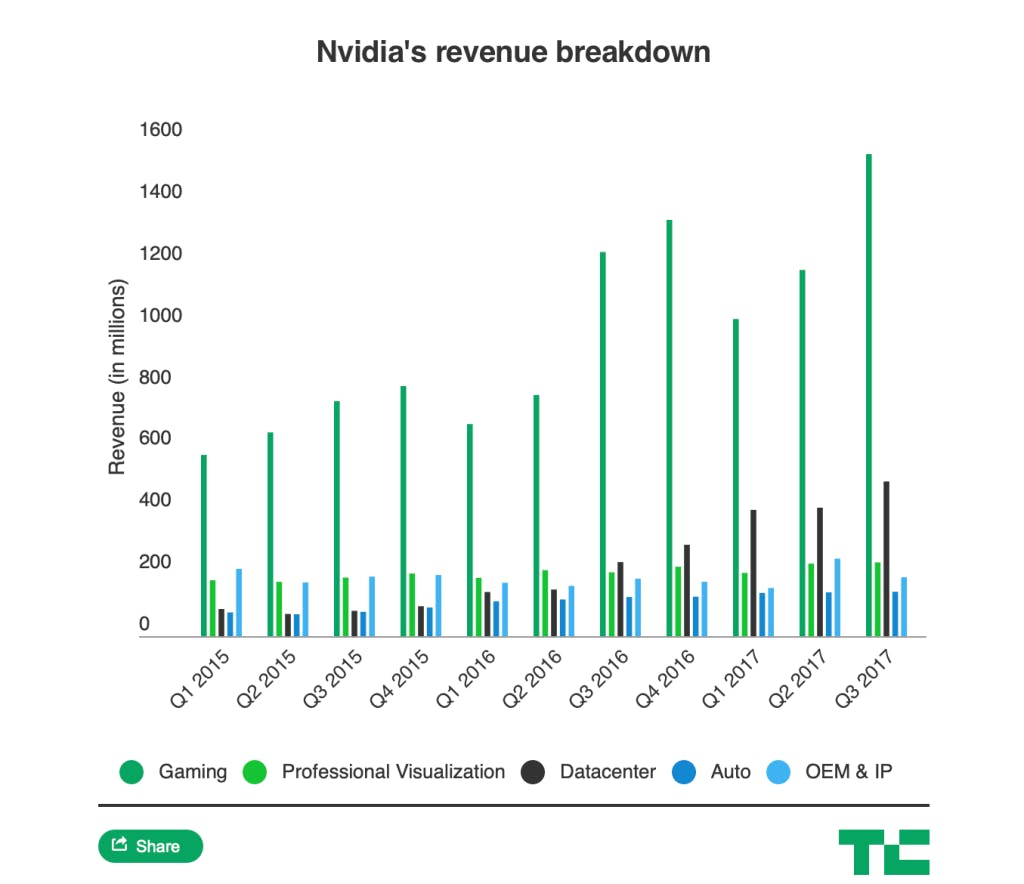
Nvidia and Intel are in a well-publicized arms race to capture the autonomous vehicle market. With the ongoing PR focusing on AV, one could almost forget that Nvidia gets its revenue from gaming first and foremost, with data centers as the second driver of revenue. In fact, Nvidia’s revenue breakdown in order is: primarily gaming (4x all other revenue), data centers, professional visualization, OEM and IP, and then in last place, auto.

On a side note, gaming is a formidable industry worth $160 billion to $180 billion (this is 3x the size of the OTT market, for instance) – which is one reason Nvidia should stabilize in the short term. Nvidia is also set to capture data centers by providing chips for the GPU cloud, which powers machine learning and artificial intelligence. You can see this growth in the chart above as data center revenue has begun a nice upward trajectory. In other words, one reason I recommend Nvidia in the long-term precisely because they are not dependent on autonomous vehicles for future growth. When the autonomous vehicle revolution finally gets here, it’ll be a nice bonus to their already strong profit margins.

Intel on the other hand is dependent on the data center revenue that Nvidia is slowly chipping away at (apologies for the pun). Intel will have to prove it can compete with the GPU-processing power of the market leader in virtually every forward-thinking segment.

Note: In the short term, both of these stocks currently face potential volatility due to trade war issues with China.

Predictions at current prices:
Sell: Tesla, GM and Intel
Hold: Nvidia

[1] https://www.forbes.com/sites/edgarsten/2018/08/13/sharp-growth-in-autonomous-car-market-value-predicted-but-may-be-stalled-by-rise-in-consumer-fear/#3ae3a3c7617c
[2] https://www.cnet.com/roadshow/news/2019-audi-a8-level-3-traffic-jam-pilot-self-driving-automation-not-for-us/
[3] https://www.thestreet.com/technology/this-many-autonomous-cars-will-be-on-the-road-in-2025-14564388
[4] https://cleantechnica.com/2018/09/05/tesla-autonomous-ride-sharing-network-worth-10-of-waymo-morgan-stanley/

Why Apple Will Never Buy Tesla: Autonomous Vehicles 101

It’s understandable if you missed the headlines that Apple may buy Tesla. That piece of speculative news, like most news about Tesla, has been overshadowed by the PR storm that surrounds the CEO’s behavior rather than based on the technology behind the product.

Here’s some background information for those who missed it. Simultaneously with the CEO’s investigation for violation SEC law 10b-5, rumors began to circulate that Apple may buy Tesla. Some of these rumors were started by Ross Gerber, a Tesla investor, while others sourced the VC firm Loup Ventures, and the gossip is still being echoed a month later. Essentially, the prediction is that if Tesla fails to become profitable, “Apple gains the upper hand and becomes the most likely investor or buyer.”

From a technical standpoint, the theory of an Apple acquisition is nearly impossible. The authors oversimplify (or don’t even address) where Apple is in the development stack, where autonomous vehicles (AV) are in the maturation cycle, and the ongoing failure points in AV technology that Tesla is not able to solve.

I understand there are a lot of Elon fans rooting for him, and perhaps some satisfied Tesla owners who will read this, but stock investors are in a different class. They can’t afford to follow a fad because returns are at stake. With that said, here are three blatant reasons as to why Apple won’t touch Tesla, and why I won’t either. (There is information on shorting Tesla below).

My newsletter subscribers get this information first. Sign up here.My newsletter subscribers get this information first. Sign up here.here.

1. Apple Makes The World’s Best Software– Not Vehicles

Apple will not buy Tesla for the very fact that Apple doesn’t need to manufacture a car in order to capture the autonomous vehicle (AV) market. Apple is a computer and software company and AVs will require powerful computing systems. The cars released today with connectivity features have the computing power of 20 personal computers and feature over 100 million lines of programming code. Next decade’s semi-autonomous cars will have 300 million lines of code, and the distant future of fully autonomous will have 1 billion lines of code. Apple will not limit itself to the 200,000 cars that Tesla sells annually, (or even 320,000 if the current quarter is to be sustained), while at the time assuming the overhead, cyclical sales and incumbent competition of an auto manufacturing when it can capture a piece of the 82 million vehicles sold globally through the core business of supplying software. Keep in mind, Tesla is one among many who have achieved Level 2 autonomy with no indication they can safely release beyond Level 2. This makes the small amount of production Tesla actually does even less impressive from an acquisition standpoint (more on this below).

2. Apple Vs. Google: Nothing New Here Folks

The cars that Apple and Google have on the market are used to test the operating system and nothing more. These vehicles are not necessarily trying to compete with GM, Ford, Volkswagen or Audi. That’s why Apple and Google are seeking partnerships with them – they’re not competing with them. For instance, Google has run tests with Lexus/Toyota, and Jaguar Land Rover, and Apple has partnered with Volkswagon. Even still, we are at least a decadeaway from having full autonomous vehicles on the road due to technical mishaps, security vulnerabilities and government regulations. Of these, security will be the biggest hurdle to overcome as you can’t test for every possible scenario. This is because the electrical components in a car (known as the electronic control units, or ECUs) are connected via an internal network. The peripheral ECU introduces vulnerabilities such as the vehicle’s infotainment center, which means WiFi or Bluetooth can grant access to core systems such as the brakes and transmission.

AVs closest comparable for security today is the smartphone, with roving mobile sensors and signals, and iOS is challenging to hack. Can GM and other Detroit manufacturers duplicate the level of secure, computing power which Apple has perfected over the last 40 years with a closed ecosystem and the last 10 years with roving mobile signals? It’s not likely Detroit will compete with Cupertino on the machine learning required for 300 million lines of code or more, combined with full-system security, and it’ll take only one car hack before this is realized. (GM’s On Star was hacked in 2015).

This is true in the reverse, as well. Cupertino and Mountain View don’t have the talent recruits or experience that Detroit and Munich have in car manufacturing. Tesla most certainly doesn’t as the CEO is a mobile payments entrepreneur from Paypal (yes, he led a team that launched  rockets — but there are no competitors here – except NASA which only spends money – therefore this is irrelevant for what Tesla faces).

3. Baby Steps: Connected Car, then Semi-Autonomous, then Fully-Autonomous

As Tim Cook said, “[Autonomous Systems] are probably one of the most difficult AI projects to work on.” There are six levels to autonomous vehicles as published by SAE International. The cars released today are primarily “connected cars” featuring driver assistance (level 1) or partial automation (level 2). Tesla’s Autopilot is a Level 2 system.

What will it take to get to a Level 3? Level 3, also known as conditional automation, is hands-off and eyes-off, but still requires a human. The first to market (and only vehicle to reach the public market as of yet) is the Audi A8 featuring Traffic Jam Pilot which continues to see delays in the United States. This is why it may be at least a decade before we see level 4, high automation, or level 5, full automation. (This is despite Elon Musk tweeting that Tesla will release full automation by 2019 – but at this point, it’s safe to say we should not put your money behind these tweets).

Gartner, one of the most trusted sources for predicting technology development cycles, has placed autonomous vehicles at more than 10 years out on their most recent hype cycle graph. This hype cycle graph predicts the maturation phases for new technologies and is hauntingly accurate in predicting the ebb and flow of tech and startup fads. Remember the wearables crash? Yes, Apple Watch survived but many did not – including Google Glass despite its backing. How about Virtual Reality – especially fan favorite Oculus? As you can see in the chart below, we have just exited the peak of inflated expectations and are on the way towards the trough of disillusionment. Short sellers of Tesla this year and last year may have been basing their calls on the CEO’s behavior but we are now about to enter major technology road blocks and consolidation that unbiased analysts predict will put even the highest performing AV companies to the test – with many low performing AV companies will not survive (see where Tesla is rated below). The current shorts are not wrong, they are simply too early in the maturation process for AVs and have had a bumpy ride because of this.

Graph

4. Would you Bet On a Horse in Nineteenth Place?

In a recent report released in Q1 2018 by Navigant Research, automated driving systems were rated on 10 criteria: go-to market strategy, partners, production strategy, technology, sales, marketing and distribution, product capability, product quality and reliability, product portfolio, and staying power. Of the nineteen companies that Navigant objectively analyzes, Tesla came in last place at number nineteen.

There is a “cost and complexity” once you take a “human driver out of the control loop,” as Navigant states, and it is my belief that the partnerships which are forming between software companies and auto manufacturers will continue to outrank Tesla in product capability, reliability and security (something Navigant did not report on) – not to mention the basics of production cycles and manufacturing vehicles at scale.

Here are the top 10 from the Navigant leaderboard:

Top 10 Vendors:

  1. GM
  2. Waymo
  3. Daimler-Bosch
  4.  Ford
  5.  Volkswagen Group
  6. BMW-Intel-FCA
  7.  Aptiv
  8.  Renault-Nissan Alliance
  9. Volvo-Autoliv-Ericsson-Zenuity
  10. PSA

Conclusion:

Apple has many opportunities to enter the connected car and semi-autonomous vehicle market, and the best card to play will be the through the OS in the level 1-2 category similar to Google’s recent announcement that the Android OS and Google Assistant will be featured across the Renault-Nissan-Mitsubishi Alliance. Taking these baby steps now is a much smarter move for Apple than acquiring a horse that is in nineteenth place with the race heating up to reliably and safely reach Level 3 and Level 4 autonomy. In this regard, there is nothing to here to acquire.

Although there is no doubt that Waymo is ahead of Apple (and everyone, really) in the race towards automation, if Gartner and many other unbiased sources are correct, Apple has time to develop a driving system in-house (or perhaps acquire a machine learning automation startup) as we are at least 10 years from full automation.

Beth.Technology Prediction: Telsa shorts were right but their timing was off. We are in a Level 2 AV bubble, and it will burst as Level 3 and Level 4 experiences growing pains (lots of cash has poured in with too high of expectations on when when AV will start to turn a profit). Tesla, a luxury electric car company, will struggle greatly in the competitive hurricane for reliable and safe automation. Therefore, I’m considering a short on Tesla in 2019 or 2020, which I plan to time with the AV bubble bursting.