Last week, David reviewed SPACs on a Zoom webinar for premium members.
You can watch the webinar here:You can watch the webinar here:
As we balance risk and reward on our premium service, we felt it was necessary to acknowledge that SPACs can offer retailers a better entry at a lower price than what IPOs offer.
SPACs offer retail investors the ability to invest early in a company. In the case of Snowflake, a company that went public via a traditional IPO, retail investors did not have this opportunity. By the time Snowflake debuted on the public markets, the share price had soared over 200% from its indicated opening price.
Why would a company want to go public via a SPAC? The main thing is fast cash and the ability to bypass the regulatory hurdles of a traditional IPO. SPACs allow companies to get to the public markets quicker. A lot of SPACs we are currently seeing are companies that are still pre-revenue, or have very little revenue, and mostly unprofitable. SPACs are ideal for companies that want to get to the public markets as quick as they can and not have to deal with a long, drawn out traditional IPO process.
This happens to be one of the main risks as these are mostly newer, unprofitable companies with not a lot of revenue. SPACs had a bad reputation in the past because the industry was not as regulated and there was a lot more fraud. The, SEC, however has cracked down on it and the regulation on SPACs has certainly ramped up.
With SPACs, there are plenty of companies that will not make for good long term, or even short-term, investments. However, there are also a number of gems that are going public via SPACs. Below are a few of my favorite SPACs currently.
What are SPACs?
SPACs are special purpose acquisition companies, sometimes called blank check companies, formed to raise capital for the purpose of acquiring an existing company and bringing them public. They are traditionally formed by investors with expertise in a certain industry, who are looking to pursue deals in that industry.
SPACs usually begin trading on the public markets at $10/share, which is typically the net asset value. This is not always the case and there are exceptions, including Bill Ackman’s SPAC, PSTH, which began trading at $20. However, you will typically see the blank check company start trading at a NAV of $10.
The SPAC company then enters a timeline where they look to make a deal. Once that deal is done and approved, the SPAC combines with the business they are merging with and starts trading publicly under a new ticker.
Proterra (ACTC)
Proterra designs and manufactures electric transit buses and electric charging systems. They are North America’s #1 electric transit bus original equipment manufacturer. They also develop leading electric powertrains for other commercial vehicle OEMs and develop fleet level chargers for commercial vehicles.
Proterra management estimates its total addressable market to total $260B. They have the first mover advantage in the electric transit bus market with over 16M total miles traveled. Proterra has also inked partnerships with BMW, Daimler, Con Edison, and most recently Komatsu to develop all electric construction equipment.
There is a lot of opportunity in this industry as world shifts to EVs. The company expects to generate $153M in revenue for the FY’20, a number they are projecting to multiply 16x by 2025 to approximately $2.5B.
Jennifer Granholm, Joe Biden’s secretary of energy nominee, has over $1M in Proterra stock options and currently sits on the company’s board. At the current valuation of around $5B, Proterra may end up being a bargain in an industry that is poised to see tremendous growth over the next decade.
Stem Energy (STPK)
Stem Energy is an AI-driven energy storage solutions business. This is another market poised for tremendous growth over the next few decades, with a projected $1.2T in new revenue opportunities for integrated storage that are expected to be deployed by 2050. Battery storage capacity is expected to increase 25x by 2030.
Stem focuses its technology on battery optimization and energy storage. The company already has over 900 systems operating on their Athena software. They have 75% market share in California’s behind-the-meter storage market, which the largest market in the US.
There are a number of global catalysts in the energy storage industry. A few examples include the Paris Accord, Japan’s Net 0 emissions pledge, and California’s mandate for 0 non-EV passenger vehicle sales by 2035
Stem competes in the same market with Enphase, another stock that we like, as well as SolarEdge and SunRun. There is a lot of opportunity for multiple winners to emerge in this space. Stem Energy is positioning themselves to be one of those winners with some of the partnerships they have inked including Apple, Amazon, and Walmart.
One of the main risks for Stem Energy is a high degree of execution risk as the business is still so new. They currently only have $33M in revenue. That number is expected to multiply 28x by 2025, which would put them around $1B in revenue in 5 years. The company also expects to reach profitability in 2022.
If Stem can reach its goals, this stock has a tremendous runway for growth still ahead of it. We will monitor how the company executes moving forward as the execution risk is still high for a company with less than $50M in total revenue.
Churchill Capital (CCIV)
Another SPAC to keep a close eye on is Churchill Capital. There is no DA or letter of intent yet, but Bloomberg reported a couple weeks ago that they were in talks to bring Lucid Motors public. The stock has more than doubled on huge volume after the announcement of these talks.
This is high-risk, high-reward type play as deals can fall through. Churchill Capital was originally in talks to merge with DirecTV, but those talks have since fallen through.
Lucid Motors’ prototype Lucid Air is the only electric sedan able to achieve a quarter-mile time under 10 seconds. The car can hold 517 miles on a single charge. Peter Rawlinson, Lucid Motors’ CEO, was the chief engineer who helped design the Tesla Model S. The Lucid Air model is a car similar to the Tesla Model S.
We plan to wait until there is confirmation that this merger is indeed going to happen to make a move. If that occurs, we will re-evaluate and may decide to enter the stock.
SoFi (IPOE)
SoFi aspires to be the new age bank of the future for millennials and gen z. They have a 1-stop shop platform where they offer a full suite of products which includes Investments, savings, student loans, personal loans, home loans, credit cards, insurance, small business finance. These products are all accessible digitally through their app, combining everything consumers want in one place.
SoFi has 3 distinct revenue streams: Lending, Financial Services, and their tech platform. The company currently generates 83% of their revenue from their lending segment and only 2% from financial services. By 2025, however, they are projecting financial services to become 32% of that revenue and lending to be 43%.
The financial services platform will be the main focus area for SoFi moving forward. The company received a national bank charter license approval and is planning to use the $2.4B from the SPAC merger with Social Capital to build out that banking business. SoFi has partnerships with Samsung and Mastercard to launch a new cash management account feature with no fees.
SoFi management estimates it total addressable market to total $2T. The company competes with the traditional banks. SoFi has an opportunity to disrupt the traditional banking system as consumers, and younger generations especially, have lost trust in the banks.
SoFi is projecting revenue to grow 550% over the next 5 years to $3.7B. The company is expecting to reach profitability this year and by 2025 they expect to generate $1.2B in profit. Member growth is expected to accelerate from 1.8M customers in 2020 to 3M by the end of 2021.
SoFi also has an accelerating enterprise business with 50M accounts right now, representing 138% growth YoY. Chamath Palihapitiya, the venture capitalist leading this SPAC merger, called the company the AWS of FinTech. SoFi is the back end platform for a lot of different financial service providers including Robinhood, Chime, and Dave.com.
Other Stocks Discussed on the Webinar that are on David’s Top List:
Fiverr (FVRR)
Fiverr continues to be one of my top ideas. Fiverr is the premier digital freelancing platform. During the pandemic, the company saw a surge in demand and parlayed that into a record year of growth. The company now boasts over 80% revenue growth and 83% gross margins while also reaching profitability for the first time this year.
The freelancing industry still has plenty of growth left. The accelerated industry growth we saw this year proved to be a bigger advantage for Fiverr than any of its competitors. When compared to Upwork, their biggest competitor, Fiverr comes out on top by a wide margin.
Younger generations, including millennials and gen z, are much more interested in freelancing than previous generations. A couple of the main reasons they point to for this include the flexibility that freelance work can provide and the ability to work fully remotely.
Fiverr is also expanding their platform for large businesses to use. The introduction of Fiverr Teams, which is just getting rolled out now, is a subscription-based model for large businesses to work and collaborate with freelancers through Fiverr. This will add a source of recurring revenue to Fiverr’s business model.
App download data from SensorTower shows Fiverr app downloads grew 100% YoY in January after also growing 100% YoY in December. Fiverr app downloads grew 15% month-over-month. This data shows that Q4 is likely to be very strong when Fiverr announces earnings on February 18th. This data also points to a tremendous start to Q1, which is a very positive sign as we get into more challenging comps.
Plug Power (PLUG)
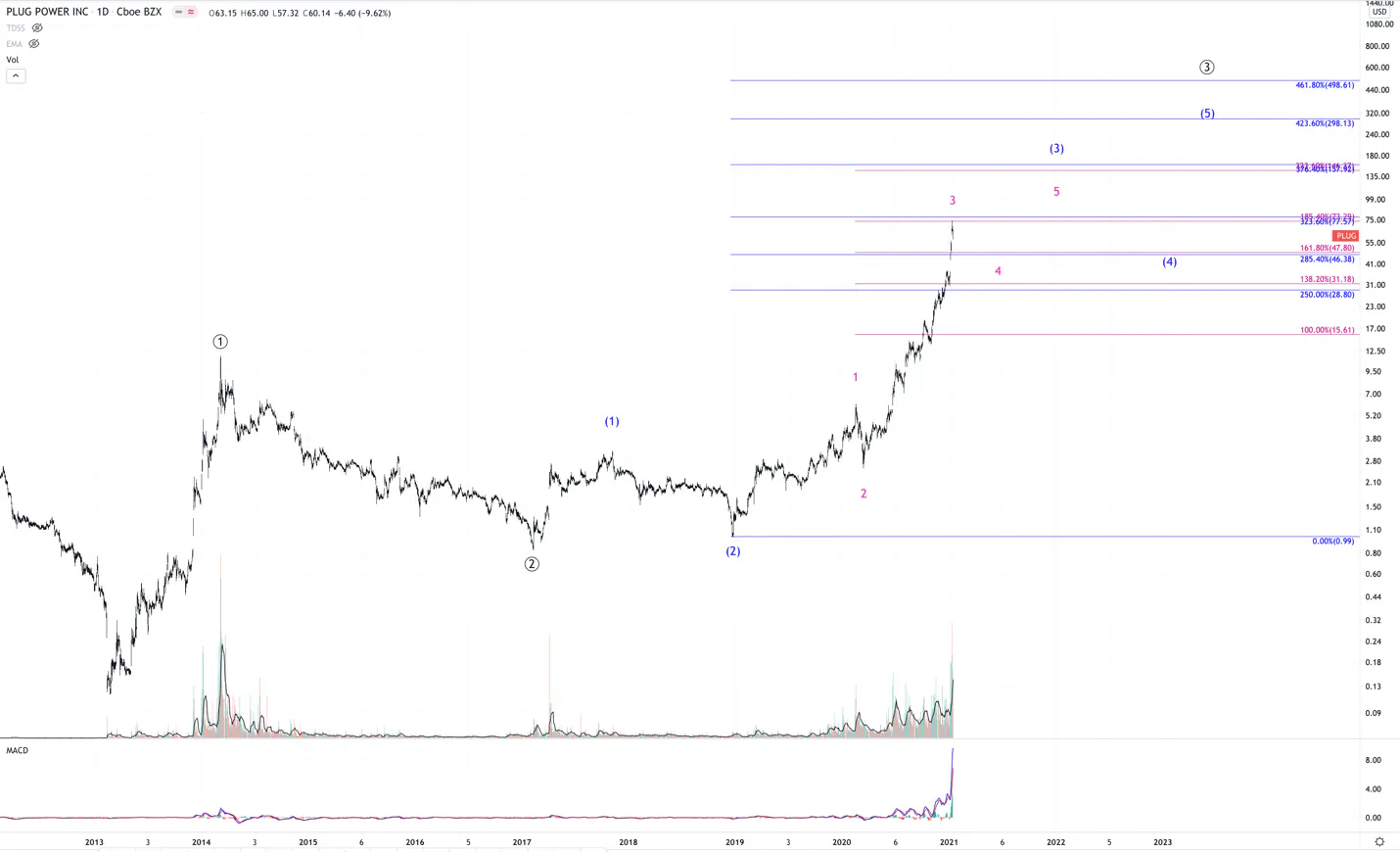
Plug Power is the leading provider of comprehensive fuel cell technology. When I’ve written about this stock in the past, I predicted that there would be political pressure for big companies to reduce their environmental footprint. Amazon and Walmart partnered with Plug, and I believed other big companies and partnerships would likely follow.
That is exactly what happened as Plug nailed down another big partnership with Renault, Europe’s 2nd largest automaker. This adds to the company’s existing partnerships that include Amazon, Walmart, Home Depot, BMW and others.
Plug is projected to grow revenue 44% this year, which is a conservative projection based off my research. One of the main reasons I continue to be bullish on this stock is that more and more companies are going to partner with Plug. In regards to partnerships, I believe we are still very early and could see a lot more companies connect with Plug. With a Biden presidency and democratic senate, political pressure for companies to reduce their environmental footprint will only be amplified.
Sea Limited (SE)
Sea Limited is another stock I continue to be bullish on. Sea is the #1 internet company in Southeast Asia, one of the fastest growing regions in terms of internet usage in the world. Southeast Asia remains an underpenetrated market where Sea has ideally positioned themselves as the market leader.
Sea will finish 2020 with over 90% YoY growth as the pandemic accelerated the growth of e-commerce in the region. However, analysts are still projecting a 40+ percent growth rate next year, which is significantly higher than most domestic e-commerce companies are projecting.
Sea provides a great way to get international exposure, e-commerce exposure, and also gaming exposure. They started off as a gaming company and have since remained the top gaming company in the region. This is another tremendous source of revenue for Sea.
Sea is also expanding into FinTech with Sea Money, which is their third distinct revenue segment. They recently won the digital retail banking license in Singapore. Although Southeast Asia is not as far along in terms of FinTech and digital banking as the United States, this represents a big opportunity for Sea in the future. With FinTech just getting started in SE Asia, Sea is already positioning themselves to be the #1 FinTech platform in the region.
Sea is positioned to continue to be the #1 e-commerce and gaming company in a fast-growing region. Now, they are also positioning themselves to emerge as the #1 FinTech platform in the region. There is a long runway for continued growth in this stock moving forward.