Beth had previously discussed the I/O Fund's interest in Marathon Digital Holdings (MARA) in this forum post. Below, I expand on MARA and the key drivers that correlate the company to Bitcoin's price.
MARA – a play on Bitcoin.
There are a few different BTC miner stocks on the market, and one of the top performers recently has been Marathon Digital, MARA. MARA has gone all-in on owning BTC miners, and has invested its capital into buying the most efficient bitcoin miners (S19 Pro), rather than investing in infrastructure to host these miners.
The company primarily buys BTC miners, and pays hosting fees to 3rd party infrastructure providers who store and power the miners on MARA’s behalf. The benefit of this approach is that the company can focus and invest its capital into BTC miners rather than invest in infrastructure.
In early 2020, MARA ordered 10,500 S-19 Pro miners from Bitmain, which are some of the most efficient bitcoin miners on the market. MARA then ordered another 90,000 S19 miners from Bitmain later in 2020, which was Bitmain’s largest order ever.
If all of MARA’s BTC miners were deployed today, then MARA would account for 11% of bitcoin’s global hash rate, yielding 87 BTC/day. At $60,000/BTC that’s $162m in sales per month, or $1.9 billion in sales per year. The significance of MARA’s mining capabilities leverages the company to changes in bitcoin’s price. The more bitcoin goes up in price, the more MARA will make from mining it.
MARA will have all of its bitcoin miners deployed and installed by Summer of 2022. Note – bitcoin’s global hash rate will likely increase from now until summer 2022 so MARA’s daily BTC production may not reach 87 BTC/day. However, this could be offset by a continued rise in bitcoin’s price.
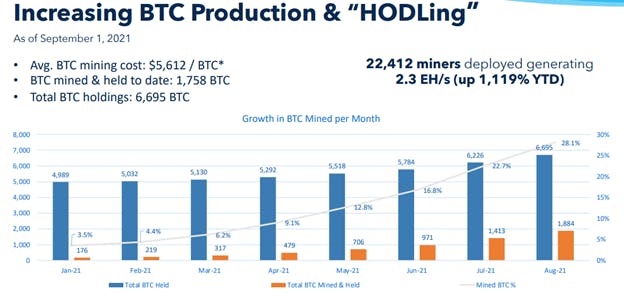
Another driver of returns for MARA is its “HODLing” strategy, or long-term holding BTC strategy. The company owned ~7,035 BTC as of 10/01/202, which was valued at $436 million. The company intends to hold more of the BTC that it mines going forward, which will further increase the company’s correlation to the price of Bitcoin.
Going forward, the two main driver’s that will increase the company’s valuation is the price of bitcoin and the company’s hash rate. If bitcoin’s price continues to rise and MARA’s production capacity remains near ~10% of global hash rate, then company will earn outsized returns. MARA estimates that its ROI on S-19 Pro bitcoin miners is close to 109% annually(@ a constant $30,000 BTC price). If BTC remains near $60k, then the ROI will likely double.
Disclosure: Bradley Cipriano and the I/O Fund may own shares in Marathon Digital Holdings and may change their respective positions within the next 72 hours. You can access the I/O Fund’s positions herehere. The above article expresses the opinions of the author, and the author did not receive compensation from any of the discussed companies
The I/O Fund discussed Apple’s privacy changes many times and it’s the reason we closed some positions last quarter (PINS, U). Not only have I been covering the deprecation of the IDFA for two years since Advertising Week New York 2019 (see below), but I also made it the central topic of a 1-Hour LTBH Webinar in May. I took it even further and released an editorial about two weeks ago. I obsessively covered this topic because I remember the last time Big Tech giants changed the rules to how the ad ecosystem worked, and frankly, it took some strong ad-tech companies out of business (Millennial Media).
So, why didn’t we trim Snap going into earnings? For two reasons. The first is they are a publisher with first-party data, which means they own the audience. They do not have a third-party data ad platform (even Twitter does with MoPub). Owning the audience provides some protection during changes to the ad ecosystem. Publishers don’t typically see long-term issues with revenue from ad ecosystem changes like this. Secondly, the advertisers on Snap can’t go anywhere else to find that audience, except maybe TikTok. It’s a rising (or lowering) of all boat situation. The apps where Millennials are found on mobile will be affected similarly in terms of tracking and measurement. Snap’s advertisers don’t have many places they can go to reach Millennials.
According to management, the effectiveness of their ads remained intact, rather it’s a tooling issue to where advertisers must now use two tools – Apple’s SKAdNetwork and Snap’s proprietary Advanced Conversions tool for measurement. In their words, “And that process, adopting SKAdnetwork, adopting advanced conversions, running incrementality testing, and really building trust in these new solutions after the tooling you've been using for a decade has essentially gone away. That just takes time and is really challenging …. And when we look at incrementality testing, when we look at first-party data like on platform swipes or installs, things like that, we see that those conversions are still happening at similar rates that they did in the past. So, I think we can work through the tooling issues; it will take time because they're new. But the underlying performance of the advertising platform is still very strong.”So, I think we can work through the tooling issues; it will take time because they're new. But the underlying performance of the advertising platform is still very strong.”
When pressed to say if this was a Q4 issue or a longer-term headwind, management repeatedly came back to Q4 and avoided saying it was a longer-term issue when responding to two questions that tried to nail down if this was headwind that would take “a year,” “12 months,” “quarters,” etcetera. They also mentioned they already have 50% uptake on their Advanced Conversion tool. The company also did not lower long-term guidance and rather said twice that the fundamentals in the business are intact.
There are a few ways to tell if management is giving us a clear picture and what we can expect long-term. The first is ARPU which was up 28% to $3.49. The other audience growth, which even with high Covid comps on user growth, Snap has been doing very well here with 23% growth or 306 million users and this is tied for the second highest in 4 years with last quarter. The iOS15 issues caused Snap to come in $3 million below their previous guidance for this quarter and to lower estimates for next quarter. The forward guidance of 30% at the midpoint was much lower than the previous guide of 49%. However, we don’t have the other ad-tech reports yet to compare. Without that, it’s impossible to say if Snap is weathering iOS changes quite well or worse than its peers. That’s a key thing to understand – Snap has a disadvantage in terms of the market’s reaction because they reported first. I need to see Facebook, Pinterest, Twitter, and some ad exchanges like The Trade Desk and Unity.
This particular statement foreshadows what is to come for those who do not have their own tools (or first party data):
Adoption of our new measurement solutions, such as advanced conversions is ongoing but will take time to be fully adopted. In addition, the ecosystem for measuring advertising returns is continuing to shift, with more changes anticipated as part of IOS 15, that are expected to further reduce the availability of certain signals that are currently used broadly as tools for optimization and measurement. Continuing to evolve and adapt our measurement solutions amid the rapidly shifting operating environment is a top priority as we seek to deliver attractive returns on advertising spent for our advertising partners over the long term. The ongoing growth of our community, and strong engagement in areas of our application that we have not yet begun to monetize, provide confidence in the value of our inventory and platform over the long-term, as we continue to navigate these changes.with more changes anticipated as part of IOS 15, that are expected to further reduce the availability of certain signals that are currently used broadly as tools for optimization and measurement. Continuing to evolve and adapt our measurement solutions amid the rapidly shifting operating environment is a top priority as we seek to deliver attractive returns on advertising spent for our advertising partners over the long term. The ongoing growth of our community, and strong engagement in areas of our application that we have not yet begun to monetize, provide confidence in the value of our inventory and platform over the long-term, as we continue to navigate these changes.
What Snap is saying is that their tool will help hedge the ongoing changes that Apple has planned. What they need to solve for is the adoption of that tool. Q4 is especially challenging because supply chain issues has led to lower motivation by advertisers to adopt those tools.
I can see how the near-term headwinds concerns investors yet the company is doing all the right things – the audience growth, the ARPU growth, the first-party ad measurement tool (Advanced Conversions) and they discussed other tools coming out in Q4 to increase ROI. Plus, you’ve got AR/VR brand ads as a major catalyst. my 1-Hour LTBH Webinar on Snap, my thesis for Snap centers around on-platform and off-platform AR/VR.
The shock of lowering guidance by 19% is stronger than usual because there was no heads up. If it’s only a quarter, then Snap has too strong of a long-term story to stay down for long. I’m confident institutions will agree because of the audience growth and that AR/VR catalyst. At this point, what I don’t know is if this is industry-wide for all iOS mobile inventory or only for direct response. Snap won’t be able to help us there because app install ads isn’t their main format, etc. Snap is obviously all mobile, but again, the issues really should be transitory due to owning the data and being able to use proprietary tools. I’ll follow up when we get a few more ad-tech earnings.
The point of the LTBH portfolio is to not get shaken out of quality stories and products. This is a good example of that. I would let you know if I saw something that was out of the ordinary. I don't want to miss the AR/VR catalyst as it outweighs any temporary weakness.
More on IDFA:
I would recommend the LTBH 1-hour webinar as the starting point because it’s when I was really beginning to position us in the portfolio for iOS 15 changes. I’m also getting a lot of questions about Magnite and Roku and I cover that in the webinar. Also, Twilio’s LTBH 1-Hour Webinar and this on analysis on Magnite also talked about what our plan has been.
Please note: As we roll out new features, we are sending Members a Notice of Proper Registration. We simply can’t keep prices low if analysts, bloggers, or others who represent themselves on social media as stock pickers are subscribing to us and foregoing copyright laws to repurpose what we publish. (e.g. if you read our analysis and then tweet or blog about the tickers to grow a following, that’s a copyright violation). If you work for a competing service and use our analysis in any form, that’s a copyright violation. This does not apply to individual investors who are simply discussing their portfolios.Notice of Proper RegistrationNotice of Proper Registration. We simply can’t keep prices low if analysts, bloggers, or others who represent themselves on social media as stock pickers are subscribing to us and foregoing copyright laws to repurpose what we publish. (e.g. if you read our analysis and then tweet or blog about the tickers to grow a following, that’s a copyright violation). If you work for a competing service and use our analysis in any form, that’s a copyright violation. This does not apply to individual investors who are simply discussing their portfolios.
The notice you were sent outlines what I/O Fund’s attorney has prepared in terms of copyright violations. It also means if you improperly registered as an individual rather than a blogger/analyst, it means you must pay for a commercial publication license. This helps us keep pricing structures low for individuals and institutions/funds. If you are improperly registered, you will need to re-register appropriately – please visit this page here.If you are improperly registered, you will need to re-register appropriately – please visit this page here.
Introducing YO/LO Fund: The Blockchain is Going to Eat the Internet
In this analysis, we will discuss why blockchain and crypto is a movement and the ideology behind the technology.
We’ve stated why we are crypto enthusiasts across various research papers over the past 2-3 years, however, I want to take the opportunity to connect these dots on why blockchain may be the technology that our generation is remembered for in the centuries to come. I call this section a Quick Oscar Speech so you’re prepped for a more sentimental appeal. Context is key as to the importance of this shift and I want to get you fired up about the big picture. Considering we’ve had select cryptos as part of our LTBH since the beginning, we are clearly not seeing this as a swing trade or a way to get rich quick. Without the big picture, crypto could look silly. It’s not; rather it could be the most influential technology in history and this goes beyond decentralized finance.
We also discuss Ethereum, primarily why the window is open for competitors and what those competitors are doing to entice developer adoption on their networks. We do a brief overview of the tokens we plan to enter. Due to crypto breaking out, we will likely move quickly on this. However, our analysis is one in a series of reports that we will space out with our ongoing earnings coverage. As we go along, we will also do deep dives on individual crypto names but want to be sensitive with the upcoming earnings season and take good care of the other names in our LTBH and Momo portfolio. As you know, we are a small team with big ambitions and we juggle many balls at once. So, expect to see entries as soon as today and expect to see ongoing coverage of this space as time allows.
What is YO/LO Fund? On the forum, I discussed an upcoming launch of a new, explorative Fund where we maximize crypto exposure while having funwhile having fun. We will start small with each position and add to the tokens on breakouts. I can’t imagine a better team considering Knox’s performance record on Bitcoin in terms of risk management along with our ability to sift through trends to find winners via in-depth analysis. The reason Bitcoin and Link have done well as LTBH positions is that Knox adds and trims accordingly. You’ll also know why we are owning each coin plus full diversification within the trend. I want you to be able to go to dinner and tell your friends what a token does and why it’s important.
My Oscar Speech on why Blockchain is Important:
The blockchain is proposing a complete overhaul to how we are conditioned to believe the world must work. On one hand, opponents call crypto a tulip craze. On the other hand, the top 1% in America now has more wealth than the entire middle class at 60%. This strikes at the core of why blockchain and crypto has become a movement. To challenge the effects of society, we must look at the cause: how has centralized finance and also the centralized internet created what Silicon Valley technologists are now calling an “oligarchy.”
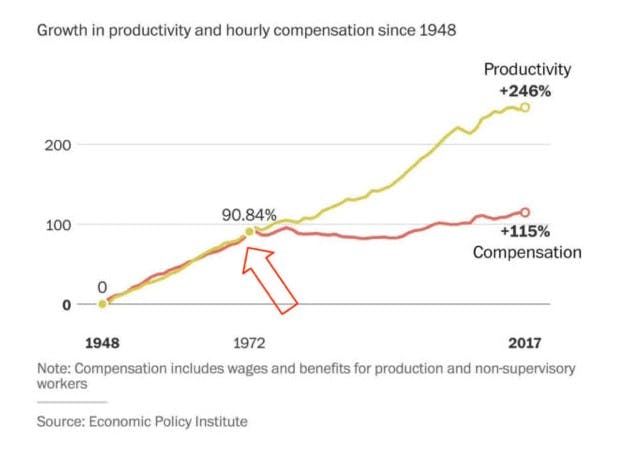
The Federal Reserve was created in 1913, however, many claim Richard Nixon’s altering of the Bretton Wood system and the untethering of the US dollar from gold set in motion the accumulation of wealth for the 1% as wages stagnated despite an increase in productivity.
As a technologist, I would also point to the advent of the internet but most importantly mobile and how this contributed to the “oligarchy” of Big Tech. If you want to listen to a great podcast about this oligarchy, I recommend Naval Ravikant’s interview here from 2018 or here on Spotify. It’s well worth the hour and he connects the dots on the overwhelming importance of the blockchain. I’ll expand on my unique perspective of what I think contributed to the oligarchy he speaks of, and why centralization is one of the biggest issues that society faces. Finally, we will discuss how blockchain will dissolve the concentration of power.
The Centralized Internet and “the Walled Castles”
The internet was intended to become a democratization of information, yet the concentration of who controls the information became greatly concentrated once the mobile device began to leak data through various sensors. For example, there have been many independent reports such as here and also here of Facebook using the microphone to transcribe conversations and to later target keywords for ads. This would be very easy for Facebook to accomplish with a taxonomy, such as “Hawaii” or “golfing.” This started in 2014 and was caught by security professionals. It was debated and denied for years, buried by Facebook’s corporate communications team. Finally, in 2019, it was reported by Bloomberg that Facebook does transcribe messages — for your protection, of course — and Amazon does it too with Alexa. According to independent security professionals, you are not imagining it when you say something in a private conversation and later see an advertisement later on a browser or inside of an application. They pinpoint this beginning in 2014.
What I call “the surveillance era” began in 2008 yet really took off around 2012. The drawbridge to what Greylock calls “the walled castles” (i.e., not a quaint walled garden) were firmly closed by 2014. The drawbridge snapped shut when the more powerful tech companies became capable of collecting exponentially more data than the competitors through software installed on the device. Or, in Google’s case, the Android operating system. Wall Street will tell you it’s all about revenue, the ads, and the number of users. That’s wrong, of course, as the walled castles were created from an advanced use of data and gobbling up many online properties that produced more data. Why would Facebook buy Whatsapp for $19 billion? The phone numbers enriched their datasets.
The mobile device era created reckless abandon in terms of collecting data. The far majority will shrug and say “how does collecting data affect me? I’m okay with ads.” For starters, if you’re okay with it (I’m not) then every tech company should be able to run surveillance software, track your browser and native app activity and transcribe your conversations to run them through a taxonomy. Why do you only allow Google, Facebook and Amazon? What’s special about them. If you’re okay with it, then all companies should be able to track what you do on the mobile device. For those that are privacy complacent, that would be thousands of them.
That seems absurd yet we’ve allowed three key companies to do this without consent. Teams of engineers and data scientists built algorithms using private data to determine what you see and what you don’t see. Freedom of the press is at the core of a free society (i.e., ask China why they tightly control the media). Section 230 has been debated for nearly a decade, yet it’s raising a question that has become increasingly more important – where do the lines blur between publishers and tech? Big Tech has enough money to make sure Section 230 turns out in their favor, and thus, we are in a vicious cycle.
The enormous amounts of data that the top 3 companies have collected has led to a concentration of who controls the information that is consumed, seen and absorbed. In an attempt to have as much data as possible, the gatekeeper for media and communications leads back to these three companies. The definition of an oligarchy is “government by a few.” Algorithms are built to determine what information is seen rather than by meritocracy and these algorithms are centralized and built by a handful of companies. Freedom of the press is not possible in a society where media must pay to be at the top of a feedmedia must pay to be at the top of a feed. Technically, press has the right to publish but it’s not seen as we no longer pay 10 cents for a newspaper to support the press. Instead, you must pay thousands (and probably millions) for content to be seen.
My very first analysis for the public markets was on Facebook’s privacy issues and I followed this up later with details on the surveillance-network in HackerNoon. Although ethics and stocks don’t tend to go together, Facebook is not one I could look past knowing the amount of data they were collecting without consent. Twitter has always been easy for me to pass up as an investment because the platform is infiltrated by bots. Social media users are not necessarily aware of this but paying advertisers certainly are as click fraud and click bots are the ad industry’s biggest issue. Basically, it’s not the best platform to run ads because advertisers have to pay for bot clicks.
On Twitter, 66% of shared news links are from bots. That’s enough to control what’s trending. What else would be the purpose of the bots? The exact answer for that is above my paygrade. However, this leads back to the issues with centralization. In a decentralized network, social media users will be validated and bot activity will be penalized, often by removing the tokens. More independent reporting will be surfaced, and we can go back to some sense of normality around how information is accessed rather than viewing content that is paid by the highest bidder (or the most active botnet).
So, how does this relate to the blockchain? First off, the centralization of the internet has far and wide-reaching effects when those with the most money are able to determine what information is seen and whose articles surface. Of course, what you see with your eyes all day/everyday affects you. It doesn’t matter if this is done through bots on Twitter, Google’s algorithms and advertising pay structures, or Facebook’s dopamine-inducing newsfeed that is largely driven by your personal data which required tens of billions of dollars to collect.
The solution is blockchain as it results in a meritocracy for content creators and a democratic, verifiable process to what is surfaced and viewed.
The benefits of democratizing the internet goes beyond social media, traditional media and journalists. There is now a Spotify competitor called Audius that distributes the profits to artists. Normally, artists make 12% of revenues in the traditional structure. With Audius blockchain, artists make 90% of the revenues. This is because there are no middlemen or agencies and the music is freely distributed. We don’t need gatekeepers that decide the music we listen to and then takes the majority of the revenue.
Although I won’t go into decentralized finance here as I already have a few times in the past, you can imagine something along the lines as music artists where there is a redistribution away from centralized banks and into the pockets of the 99%. Primarily, the credit card fees, transfer fees for wires, recording fees for documents, costs for redundant paperwork (think taxes and the IRS), the amount we pay to prevent fraud — and even on a larger scale, the ability to lend and borrow in a peer-to-peer fashion.
I want to take a moment to revisit what our original Bitcoin analysisour original Bitcoin analysis had said in August of 2019:
My prediction is that once the Lightning Network is built out, bitcoin will surpass the market cap of Apple, Google, Microsoft and Amazon to reach a minimum of $50,000 per token. This is because the protocol solves critical needs for global populations, including the reduction of financial fees for 7 billion people, and offers a need to store money during times of inflation.This is because the protocol solves critical needs for global populations, including the reduction of financial fees for 7 billion people, and offers a need to store money during times of inflation.
Bitcoin is based on the most secure network in the world, and this solves a very real need for the financial system – which cannot be automated without a decentralized blockchain solution. Technically speaking, bitcoin is also the world’s most secure financial network. The transfers eliminate 3% in processing fees and hedges against inflation. This can, and should be, worth as much as a search engine, enterprise software, a social media network, warehouse fulfillment (AMZN) or iPhone hardware.Technically speaking, bitcoin is also the world’s most secure financial network. The transfers eliminate 3% in processing fees and hedges against inflation. This can, and should be, worth as much as a search engine, enterprise software, a social media network, warehouse fulfillment (AMZN) or iPhone hardware.
Apple, Google, Microsoft and Amazon reached market caps of $1 trillion because their products scale to global populations and are required on a daily basis. Bitcoin not only scales to the global population but it also protects their livelihood – a necessity rather than a convenience. In fact, we see populations who are not necessarily tech savvy most enthusiastic about bitcoin, and this is a strong signal that it will scale beyond the reach of $1 trillion market cap. “Bitcoin not only scales to the global population but it also protects their livelihood – a necessity rather than a convenience. In fact, we see populations who are not necessarily tech savvy most enthusiastic about bitcoin, and this is a strong signal that it will scale beyond the reach of $1 trillion market cap. “
Fast forward two years, and we see that more citizens of El Salvador have crypto wallets than bank accounts (that quickly!). While the top 1% like Jamie Dimon is saying “it can’t, it won’t,” the 99% are saying “we can and we will.”
How could you not get behind that?
[Insert Oscar Music telling me to exit the stage as I’ve gone over my time][Insert Oscar Music telling me to exit the stage as I’ve gone over my time]
I want to get you fired up on this for a few reasons:
My job is to bring you important trends in technology and to silence the noise. I want to make sure I/O Fund Members do not turn away from crypto and keep an open mind.
You didn’t miss the boat; Web 3.0 starts now. But be prepared to trim/exit at the top and re-enter. We plan to do this for YO/LO.
Many of the centralized applications and websites you use today are going to come under pressure long-term. We need to lower the barrier for blockchain adoption for dapps like Audius but it’ll happen.
Because the world needs a decentralized system, global populations will be willing to pay nominal amounts for this (hence, the importance of tokens). It’ll be like paying for the newspaper again. Pocket change well spent.
This nominal amount being paid will actually save people money in the long run as the blockchain will reduce costs, reduce fraud, and increase wealth for the middle class through decentralized consensus mechanisms that don’t require a middleman. (yes! It’s that big of a deal).
In terms of contributions to society, blockchain may be the one technology that future generations remember us for as the majority of the world lives beneath the poverty line. (To compare, AI would be more of a contribution to productivity.) Those beneath the poverty line in El Salvador are showing record adoption rates for Bitcoin wallets.
Media is bought and paid for, and I believe the headlines have retail believing crypto is still a high-risk and an undesirable asset, yet institutional buying is telling us a different story. Consider that Algorand (see below), has received a $700 million round.
However, the crypto world is confusing and high risk because there are so many products to consider – this is why many investors throw up their hands and walk away or they’ll buy one of the many ETFs that are launching. We think the bigger gains come from learning to fish and so we are inviting you to fish alongside us.
Most importantly, this site offers risk management (Knox) for entries and exits. Without this, crypto can be a blood bath. The reason investors keep a separate crypto fund is they aren’t able to handle risk management whereas I/O Fund specializes in this for all tech growth stocks and assets. We did not hesitate to add BTC and LINK to our long-term buy and holdto our long-term buy and hold due to Knox’s confidence in managing risk.
We can’t guarantee there won’t be losses as crypto is extremely volatile. Only invest what you can afford to lose.
We may need to be aggressive with entering and exiting. Don’t be surprised if we exit an entire position in YO/LO Fund to buy again later at a lower price. This isn’t about convictions or fundamentals. Risk management comes first with crypto and convictions are second to this.
Ethereum’s Scaling Issue: An Opportunity for Competitors
The blockchain and decentralized networks offer three key benefits over centralized networks. These three benefits are: decentralization, security and scalability. The issue is that most decentralized networks cannot offer all three without some compromise.
This was first discussed with decentralized data in what is known as the CAP Theorem as distributed databases cannot deliver Consistency, Availability and Partition Tolerance (CAP) without some compromise. This is because if a node goes down, either the system has decided to replicate the data (make a copy) on the other node or to partition the data (split the data) between two nodes. If partitioning the data is chosen, then consistency is sacrificed. If replication is chosen, then partitioning has been sacrificed.
MongoDB is a distributed database that elects a secondary node by whichever one received the most recent update. Therefore, MongoDB offers consistency and partition tolerance all of the time and availability most of the time except when a new node is synchronizing to become a primary node.
In addition to the proof of stake mechanism helping Ethereum to scale transactions, our report also discussed the importance of shards for scalability. Rather than every node downloading every transaction, calculating it and replicating it, shards create a subset of the network where nodes are dispersed for more efficient processing. We also discussed Rollups, which allows for hundreds of transactions to be rolled into a single transaction. This replaces Plasma, the current option where only a single transfer is made per transaction.
Here is what we had said about rollups. I’m copying this so it’s understood where the delay is as the merging to Proof of Stake is happening in the next few months while sharding and rollups are delayed:
“In the ZK-Rollup scheme, a transactor and relayer are needed. The transactors create a transfer and broadcast it to the network. In this case, a shortened 3 or 4 byte indexed version of the address helps to reduce resource needs. The relayers collect hundreds of transfers and roll them up, essentially, to generate a hash that compares a snapshot of the blockchain before the transfers and a snapshot of the blockchain after the transfers. In most cases, the transfers will be recorded by a change in the wallet values. The hash that represents the wallet values or the delta to the blockchain is called SNARK proof. The changes to the hash are reported to the blockchain.4 byte indexed version of the address helps to reduce resource needs. The relayers collect hundreds of transfers and roll them up, essentially, to generate a hash that compares a snapshot of the blockchain before the transfers and a snapshot of the blockchain after the transfers. In most cases, the transfers will be recorded by a change in the wallet values. The hash that represents the wallet values or the delta to the blockchain is called SNARK proof. The changes to the hash are reported to the blockchain.
Relayers are established by staking a required bond, or token amount, in the smart contract. The result will be fewer transaction fees that are processed faster than the previous Plasma framework. In the ZK-Rollup framework, blocks are computed in a parallel computing model that lends itself to decentralization. There will be less data than the previous framework which increases throughput and scalability.”
The Ethereum network has more security risks than Bitcoin as ZK-Rollups assume a trusted state and relies on a small group of developers to establish this initial trusted state and one of the developers could manipulate the code. Quantum computing could crack ZK-Rollups if the correct hash is guessed. This is more likely than guessing an encrypted protocol.”
Ethereum’s High Gas Prices
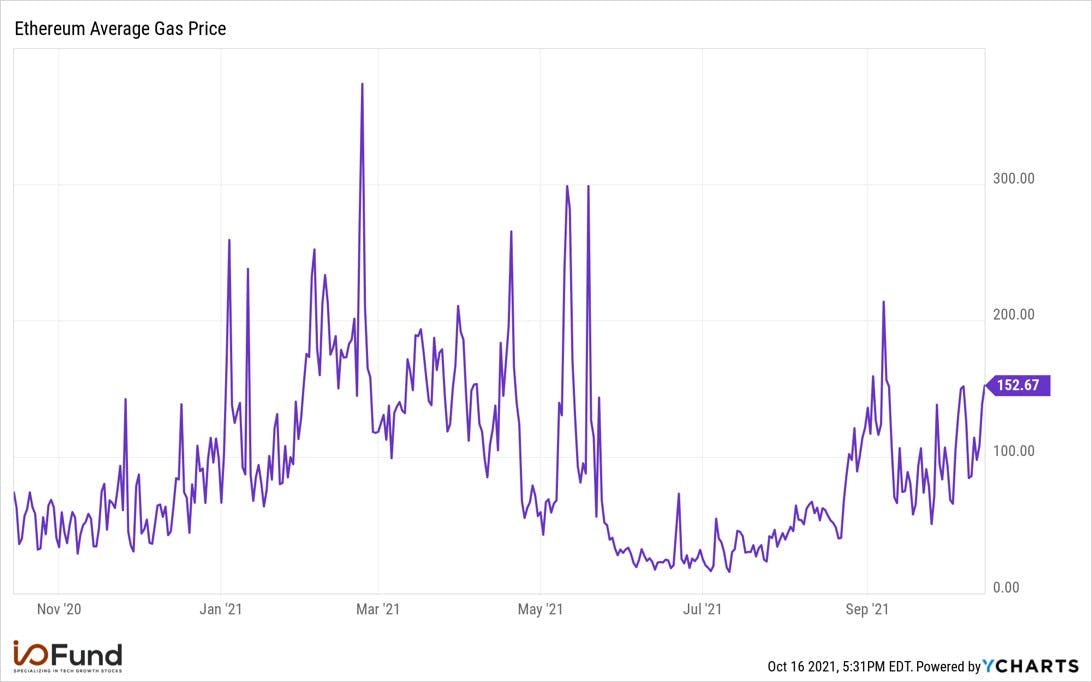
The term “gas” refers to the computational effort required to execute specific operations on the Ethereum network. Each transaction requires that a fee be paid called “gas” to offset the costs of computational resources. The market price for gas is determined by demand. If you want your transaction executed quickly or if you have a larger contract, you’ll pay more gas. As of August, the London Upgrade has changed how transactions are charged with every block having a base fee and a minimum price per unit of gas that is calculated based on demand for the block. Users also tip to compensate miners for executing the transaction.
The goal of the London Upgrade is to allow for variable-sized blocks. Previously, blocks would hit total capacity and users would have to wait for the demand to subside. You can see in the chart below that Ethereum’s gas prices are inching upward with a notable spike in September even after the London upgrade went into effect. The average gas price of 58 GWEI is about 10X higher than the Binance smart chain at 6.1 GWEI.
In September, TIME Magazine recently sold NFTs called TIMEPieces and minted 4676 tokens for the digital art. It sold out within minutes with 4,000 transactions occurring within a short period of time. The price for 10 NFTs was around 1 ETH or $2500 to $2800, yet due to gas fees, one buyer paid as much as $70,000. In addition, the wait time to transact ranges from 30 seconds to 16 minutes.
We had estimated in March that Ethereum 2.0 will need “another year minimum or about three years maximum” to reduce energy use and increase throughput for transactions per second (TPS). Recently, Buterin stated that what he thought would take one year has actually taken six years. The current roadmap for the Proof of Stake merge is for late this year in 2021 while sharding and rollups are expected by late 2022 or early 2023.
However, the delay in terms of scalability with sharding and rollups leaves an open window for competitors for about eighteen months if we assume early 2023, which is a substantial amount of time considering the activity we are seeing in NFTs and decentralized finance. The other issue facing Ethereum is that even though the network certainly has a defensible position in terms of the ecosystem and sheer number of dapps built on the network, there are competitors who are arguably stronger as scalability was solved for at time of launch. Some of this may be that the latecomers had the advantage of hindsight and could observe and improve upon the gas issues that Ethereum faced from being a first mover.
Quick Glimpse at Mid Cap:
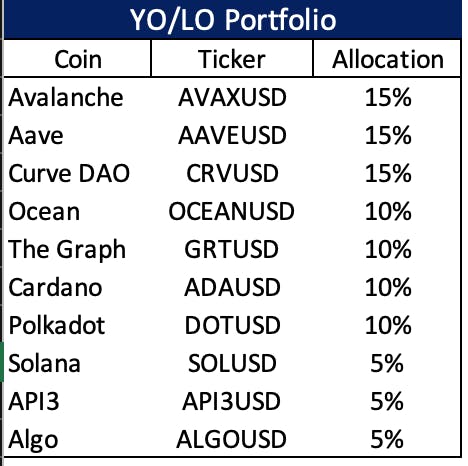
Avalanche (AVAX):
Ethereum competitor that has a maximum supply of tokens and technically a decreasing supply due to burning. The network is unique in that Avalanche utilizes three interoperable blockchains. The X-Chain is for creating and exchanging assets including NFTs, the P-Chain validates and creates subnets, and the C-Chain is for executing Ethereum Virtual Machine (EVM) contracts. The C-Chain is critical for AVAX’s growth as developers can build applications that have easy interoperability with Ethereum while improving the base layer.
The layer one blockchain hosts smart contracts like Ethereum and has a low Nakamoto coefficient, which is a quantitative method of measuring decentralization. Although transactions per second (TPS) is lower than Solana at 4,500 TPS, Avalanche has a faster time to finality of less than a second compared to Solana’s 12.5 seconds. Avalanche is also compatible with Ethereum dapps and wallets. The company recently introduced a $180 million mining incentive program to add dapps to its decentralized ecosystem. The program is called Avalanche Rush and will help popular protocols to expand from Ethereum to Avalanche.
Emin Gun Sirer, the founder of Avalanche, predates even Satoshi’s Bitcoin whitepaper. He and a research team are credited with the first cryptocurrency developed in 2003 called the Karma system, which was based on proof-of-work.
Aave (AAVE):
On the Chainlink webinar, we discussed that one major issue with centralized finance is that a regular person (such as you or myself) cannot lend money to another person in order to get the interest rates that Chase Bank gets on credit cards or a mortgage lender gets on home loans. As artificial intelligence and the blockchain remove barriers to understanding creditworthiness, there should be no reason to not pool money together to achieve these returns. We don’t need a centralized bank to do this as it’s preventing regular people from earning income (and on the flip side, it also prevents regular people from getting the credit lines they need at an affordable rate).
Aave is the leading borrowing and lending protocol. Not only can you earn interest on your deposits but you can also borrow assets. The platform also issues flash loans, which means that the lender is repaid the money upfront through a smart contract rather than providing collateral. In the event something falls through or a condition is not met, then the transfer is automatically reversed. This is one illustration as to why smart contracts promise to revolutionize the way things are currently done as they are automatic, decentralized and secure.
The company launched as ETHLend in 2017 but has expanded to other networks. Within 6 months of launch, Aave was issuing more than $100 million in flash loans per day. One year later in June of 2021, the platform had issued over $4 billion in loans (total).
Curve (CRV) & Yearn.Finance (YFI):
When we think of the issues surrounding crypto, one that comes to mind is liquidity and stability. Not only do exchanges and trades take a long time due to lack of liquidity, but the price fluctuates to such an extent that common day uses are prohibitive. The TIME NFTs are a great example.
Curve is a popular DeFi platform and automated market maker (AMM) that reduces slippage between the expected price of a trade and the price at which it’s executed. Curve allows digital assets to be traded by using a liquidity pool, or a shared consortium of tokens. These pools are optimized to stabilize pricing and those who place their tokens into the pool are rewarded. Because Curve focuses on stable coins, volatility is greatly minimized. Originally, Curve launched to assist with lower fees for trades and to also offer the additional benefit of rewards in fiat currency. The decentralized exchange (DEX) is also integrated with Yearn Finance and Synthetix for users to participate in both the fees from the Curve pool, and also the yields from yield-bearing tokens. Curve also offers interoperability with other networks to maximize access to the DEX and increase its availability, which is called composability where you can earn across the DeFi ecosystem. We are especially keen on Layer 2 solutions that remain with Ethereum yet expands to new networks during Ethereum’s 2.0 transition. Curve recently expanded to Avalanche and the composability also is a key feature as the DeFi ecosystem grows.
There are 39 pools for swapping stablecoins. Curve competes with companies like Uniswap, which provides for swapping of tokens but with high fees. From my perspective, it makes sense that the best market maker and exchange would be a stable coin pool. A typical pool will include DAI, USDT and USDC, which are pegged to the US dollar. The automated market maker uses an algorithm rather than buyers and sellers to trade from liquidity pools, with a rebalancing that occurs partly from arbitrage traders buying any excess. The goal is stability from stable coins and also high-interest rewards from lending protocols. The automated money maker algorithm allows for high volume trading. We like this company because it solves for stability and having exposure to this is a good idea, in my opinion.
Algorand (ALGO):
Algorand is an East Coast company founded from an award-winning professor from MIT. Silvio Micali has won numerous awards including the Turing Award, Godel Prize and RSA Prize. He has been working with cryptography for decades and is known as the co-inventor of probabilistic encryption, Zero-Knowledge proofs and Verifiable Random Functions. As of now, more than 700 global organizations have partnered with Algorand including Koibanx, a LatAm asset tokenization, and the El Salvadorian government to build the blockchain infrastructure for the country.
Algorand handles 1,000 TPS and has a five-second finality. The blockchain network launched with Proof of Stake (PoS) in 2019 that awards all ALGO coin holders rather than rewarding only validators that stake a large number of tokens. The company calls this Pure Proof of Stake (PPoS) with on 1 ALGO coin required for staking whereas Ethereum requires 32 ETH or roughly $100,000 USD to stake tokens. Due to rewards being split across all tokens rather than only validators, the ALGO coin earns a 7.5% annual yield.
There is also a bifurcation between two layers that helps the network achieve a high throughput. Layer 1 executes smart contracts as ASC1s and Layer 2 executes more complex smart contracts and dapps as ASC2s, or off-chain.
Right now, it’s speculated that the Algorand network could become popular for government-backed stable coins.
Quick Glimpse at Small Caps:
Ocean:
Ocean is built to facilitate data exchanges. OCEAN tokens are used to access datasets and run AI and ML models through marketplaces. In turn, data providers earn OCEAN tokens for supplying data. The Ocean Market is an automated market maker (AMM) that facilitates the minting and exchange of data tokens. Compute-to-Data allows data sharing while preserving privacy. This allows AI and ML applications to utilize data while adhering to privacy standards. Considering that my Oscar speech was in regards to privacy as a primary pain point for centralization, I’d like to own a token that specifically addresses this ☺
The Graph:
The Graph indexes servers and powers data queries for many popular decentralized finance apps, such as Uniswap and Synthetix. Tokens are spent to perform the queries. By opening up data across the ecosystem, more dapps can be built utilizing blockchain data and APIs. By decentralizing the data layer, The Graph leverages a network of indexers to reduce the amount of overhead cost required to index servers.
API3:
You’re probably seeing a pattern here as to the trend I am preferring for small cap coins (the data layer). API3 has been called the “Chainlink killer.” Although I’m not convinced it will kill Chainlink, I’m always open to having more diversification on how to securely onload off-chain data. Rather than having a node sit between the API provider and the smart contract like Chainlink, API3 enables the API provider to run their own nodes. API3 argues that adding a middleman (Chainlink) creates a new attack surface and adds more costs.
Quick Glimpse at the Heavyweights:
Cardano:
Cardano launched with Proof of Stake (PoS) in 2017 and has been in a constant state of development since. For instance, IOHK is an engineering company that updates Cardano’s codebase with verifiable, high-liability code using the same approach as spacecrafts and high-frequency trading software. Cardano has two structures, a settlement layer and a computational layer. The consensus protocol enables ADA coin holders to delegate a stake pool, or a node, with the opportunity of becoming a slot leader as the stake increases. The rewards are distributed to ADA token holders. The blocks change every five days and the slots change every twenty seconds.
Cardano’s consensus mechanism is also very energy efficient as the PoS algorithm pushes energy back to the edge. The company is also working towards true decentralization by handing over access of Cardano’s open-source infrastructure to the community, which in turn, will allow more enterprises to leverage Cardano. The Cardano Foundation is a non-profit from Switzerland.
Polkadot:
Polkadot’s goal is for interoperability for a decentralized internet for applications to seamlessly communicate across networks. Its role is to connect networks for cross-blockchain transfers with a cross-chain system. Network validators can also be leveraged for security and consensus across multiple blockchains. Polkadot also updates without the need for a fork, which allows it to be compatible with new networks and blockchain features as they are developed. Polkadot was founded by Ethereum’s former CTO, Gavin Wood. It is backed by the Web3 Foundation, a non-profit research foundation in Switzerland that specializes in cryptography and provides grants to startups.
Solana:
Solana is an Ethereum competitor that has a very high throughput of 65,000 transactions per second on GPUs although Avalanche has a higher time to finality. Solana accomplishes this without second layers or side chains by using the Proof of History (PoH) consensus mechanism. PoH creates a historical record that proves an event has occurred at a specific moment in time. Rather than validators agreeing on a time, Solana validators maintain their own clock by encoding the time with a cryptographic hash function (SHA-256). This circumvents the need to wait for confirmation, thereby resulting in a higher throughput. The founder is from Qualcomm and Dropbox and he recruited engineers from Qualcomm to create Solana labs.
YO/LO Positions – Subject to Change:
(Friendly reminder: all of our positions are subject to change – more so in YO/LO and Momentum but LTBH can change at times too!)
In the video discussion below, I provide a quick recap on Tesla's Q3 results. The company reported record profits, record vehicle production, and a war chest of cash on its balance sheet. Specifically, Tesla reported $1.6 billion in Q3 GAAP net income, a company record. Tesla is also closing in on a 1 million annual car production run rate, with plans to expand capacity by 50% per year going forward. Luckily, Tesla has a massive $16 billion war chest of cash on its balance sheet, which will help it rapidly expand its operations.
Sign up for I/O Fund's free newsletter with gains of up to 1100% – Click here Sign up for I/O Fund's free newsletter with gains of up to 1100% – Click here Click here
However, the company is still early in its growth projections and has a path to nearly 20M annual production capacity in the next decade. Tesla also announced its entrance into the auto insurance space, which I think will help the company reach its ambitious capacity expansion goals. Looking forward, Tesla still has plenty of growth ahead of it, which should help support its share price. Watch the video below to find out more!
Disclaimer: This is not financial advice. Please consult with your financial advisor in regards to any stocks you buy.
We’d like to let you know that our terms and conditionsterms and conditions have changed.
The major change is that we had a legal team work up a new registration flow new registration flow to ensure our subscribers are properly registered.
The deadline to properly register is October 27, 2021.The deadline to properly register is October 27, 2021.
Publication Licenses for Analysts, Bloggers, and Journalists
If you represent yourself to the public as an analyst, a blogger, or a journalist, then you are not allowed to register as an individual.
This means, if you publish research on stocks on any domain, including Twitter, then you must register properly. We do intend to enforce this as it’s a copyright violation to write, summarize or interpret another person’s work as your own. This also helps us keep costs low for our individual investors as repurposing our content negates the reason why our Premium Members are paying for subscriptions. We take this violation very seriously.
Institutional Licenses
If you work for a Fund, a bank, or an institution of over $10 million in size, we would be honored to have you. We have a tier for subscriptions that allows you to share our research with your pool of clients and your coworkers without having to pay for each individual license. We have priced this to be competitive with the returns we believe our research and trade notifications will help procure, while also including an extra access point to I/O Fund’s analysts once per month.
If you're wondering how to update your Registration type, please follow these instructions:
Go to your account settings by selecting, "My AccountMy Account"
Hit the Open Settings Button in the Change plan or billing info section
Click on the Update Plan button to update your membership
Browse through the PLANS AVAILABLE section. Select from the 30 days, 12 months to Yearly Plan Options!
After Selecting a New Plan, hit Continue to Confirm your new plan.
Your Premium Registration will be updated once you hit Confirm!
Follow Video Tutorial:
Thank You for Your Membership
We want to thank each and every Member for sticking with us as we have grown over the past two years. In order to keep the pricing of our site competitive, we must strictly enforce copyright and ask that our research not be shared publicly and/or repurposed under another person’s name. The monthly amount of $65 does not represent the number of hours our team works, and this edge can be quickly eroded if other’s claim our ideas.
We appreciate the community working together to let us know of any violations to the first item, which is bloggers, journalists, and other public stock commentaries. To thank you for this effort, we promise to keep our pricing low even as we add more features.
We appreciate you as a member and thank you for your business.
– The I/O Fund Team
This quarter we chose Nvidia, Lam Research, Ambarella, Advanced Micro Devices, Broadcom, Marvell Technology, and Qorvo for an earnings preview. We also tried to understand what analysts are expecting from these companies. The list includes popular names in the semiconductor sector and companies like Qorvo, which has been out of favor recently in the eyes of investors.
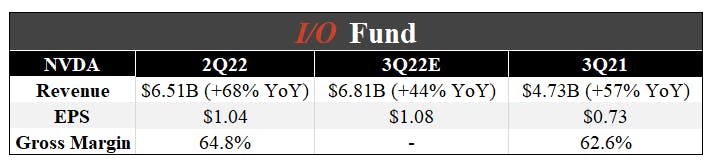
Nvidia’s revenue growth is expected to continue to be strong. Management mentioned in the last earnings call that the QoQ growth will be led by strong demand in the data center along with other segments that are also growing steadily. They also indicated that the gross margins will be around 65.2% plus or minus 0.5%. We also expect some new comments on the Arm acquisition in the earnings call. You can read our analysis of Why the Arm Deal Should be Approved here.
KeyBanc analyst John Vinh has an overweight rating on the stock and increased the price target from $245 to $260. He mentions that “The firm's quarterly supply chain findings are mixed, as demand remains healthy, but a multitude of supply disruptions, including COVID lockdowns in Southeast Asia, power restrictions in China, and kitting issues, could result in near-term uncertainty and limit upside.”
Jefferies increased the price target to $260 from $233. They are positive on the company due to the strong performance of the company’s data center and software segments. Their report also suggests that Nvidia’s share in accelerator instances increased 1% in July to 79% on new deployments of A100 and V100 chips.
Goldman Sachs analyst Toshiya Hari said after the company’s strong previous quarter earnings report, “We increase our go-forward estimates on the back of today’s print, and importantly, continue to view Nvidia as the best positioned company to address and monetize the proliferation of accelerating computing”.
Please note, the I/O Fund may or may not agree with the financial analysts mentioned above yet we objectively report what the Street is saying. You may view our previous analysis on Nvidia below:
Our premium members have been updated frequently on the company with ongoing entries at $31.50, $51.20, $97.40, $105.30, $120.60, $124.50, $123.50, $138.90, $206.60, $208.90
Lam Research – Earnings on October 20th
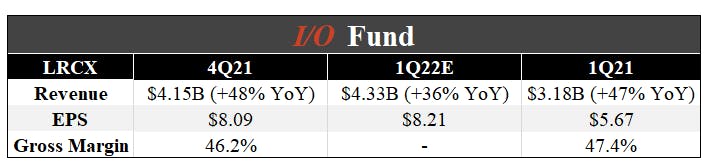
Lam research continues to have steady revenue growth. The wafer fabric equipment demand has been strong as the semiconductor industry is benefitting from the leading technologies like 5G, IoT, AI, and edge computing.
UBS analyst Timothy Arcuri who has a buy rating on the stock lowered the company’s price target to $715 from $780. The analyst sees some “potential moderation" in DRAM and NAND WFE spending moving through 2022.
Sign up for I/O Fund's free newsletter with gains of up to 1100% – Click hereSign up for I/O Fund's free newsletter with gains of up to 1100% – Click hereClick here
Susquehanna analyst Mehdi Hosseini downgraded the stock to neutral and lowered its price target to $690 from $750. The analyst says "the beat-and-raise cycle for the company is already behind us with all the good news already dialed. With quarterly wafer fab equipment peaking in the second half of 2021, there is enough of a deceleration in spend growth rate into 2022 that cannot be offset by services and/or share gains.”
Ambarella Inc – Earnings on November 23rd
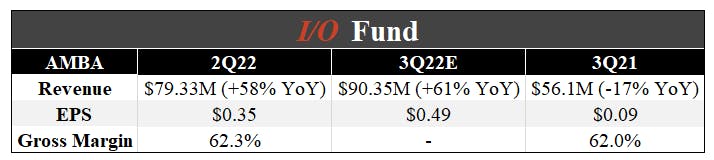
Ambarella has seen rapid revenue growth in the last quarter and consensus estimates suggests 61% revenue growth in the next quarter. The company has successfully tapped the computer vision technology market with the increasing demand for its chips for drones, VR cameras, security cameras, and automotive cameras. However, it would be prudent to note that the growth was partly due to lower comps due to Covid-19.
KeyBanc analyst John Vinh upgraded Ambarella to Overweight from Sector Weight with a $185 price target. The analyst sees "multiple favorable tailwinds" related to the adoption of computer vision within the security and automotive end markets amid limited competition with the HiSilicon ban. He also has increasing confidence in front-facing advanced driver assistance systems adoption. Further, with its "highly differentiated CV/AI assets" and adoption in auto tech, Ambarella represents one of the most attractive takeover targets in semiconductors.
Roth Capital analyst Suji Desilva believes “Ambarella represents a differentiated investment opportunity in computer vision and low-power video processors.” He has a buy rating on the stock and has raised the company’s price target to $170 from $130.
Cowen analyst Matthew Ramsay has an outperform rating with a price target of $150. The analyst said “that the business is really inflecting in terms of growth and operating leverage with upside that is no longer a leveraged story to GoPro and drones.”
Advanced Micro Devices Inc – Earnings on October 27th
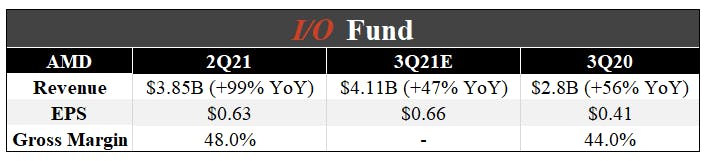
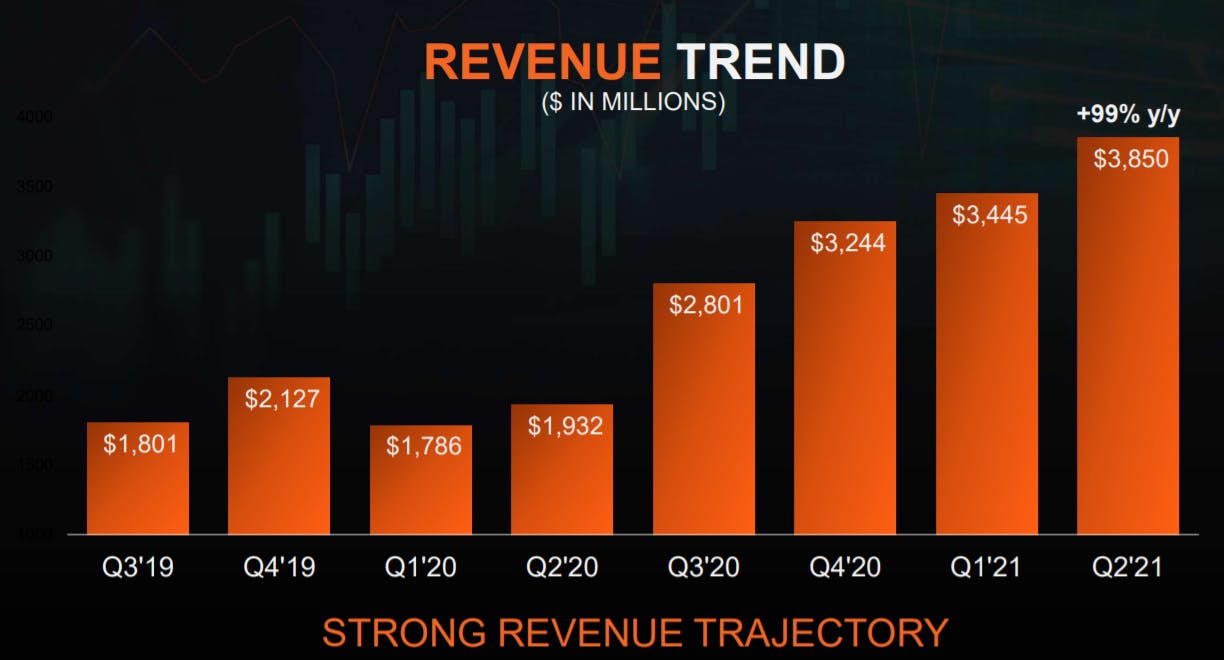
The company had a blowout last quarter. It also raised the revenue guidance for the full-year 2021 and the 5nm roadmap is on track for 2022. The company has been able to capture market share from Intel and reports suggests that Intel might cut CPU server prices.
Piper Sandler analyst Harsh Kumar has a price target of $120 and an overweight rating. The analyst says AMD is looking very solid into year-end and is very well positioned as enterprise spending returns, as the company should benefit within both the PC and server markets.
BMO Capital analyst Ambrish Srivastava has a price target of $110. He says " Considering the company's continued execution and the expansion in estimates, the shares look relatively more reasonably valued than they did earlier in the year,” argues Srivastava, who also believes there is continued upward bias to estimates through the year as AMD starts to ramp designs it has already won on the data center side.
Goldman Sachs analyst Toshiya Hari has a buy rating and a price target of $130. In his words “We believe AMD’s recent CPU/GPU wins in supercomputing have important and positive implications for the company’s forward trajectory in the data center, as design wins in supercomputing are awarded based primarily on performance with good insight into future technology/product roadmaps”.
Broadcom Inc – Earnings on December 10th
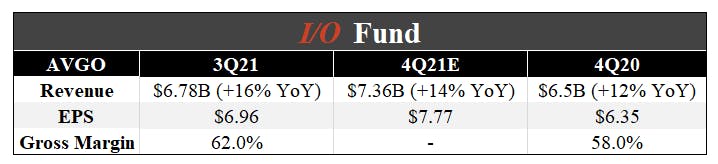
Broadcom delivered record revenues in the third quarter with good growth in cloud, 5G infrastructure, broadband, and wireless. The management expects the trend to continue in the next quarter. The free cash flows were 51% of total revenue and they expect the cash flows to be strong in the next quarter.
Sign up for I/O Fund's free newsletter with gains of up to 1100% – Click hereSign up for I/O Fund's free newsletter with gains of up to 1100% – Click hereClick here
Barclays’ analyst Blayne Curtis has an overweight rating and a price target of $540. In his words “AVGO has one of the highest exposures to the Enterprise end market (50% of semi revenue), which should continue to improve into next year.AVGO guided Wireless up 33% QoQ (in line with our model) and we see some upside into Jan given likely contents gains at AAPL (WiFi 6E, touch, wireless charging, DCM) with another potential step up in 2023 with the AAPL modem. AVGO remains one of our preferred names for 2022 given its cheap relative valuation, more resilient end markets into next year (Ent, DC, Wireless), further content gains at AAPL, and likely accretive Software M&A”.
Truist analyst William Stein has a buy rating and a $564 price target. In his words “Investors should continue to buy the stock for its 3% dividend yield and the double-digit dividend growth over the long term”.
JPMorgan analyst Harlan Sur has an overweight rating and a $600 price target. He believes that the “stock offers a solid setup for 2022 based on order visibility and product cycles”.
We’ve discussed in the past how Broadcom could potentially be a good choice for an inflation trade:
The company’s revenue growth has been strong due to the growth in the data center revenues (40% of 2Q FY22 revenues). The inclusion of Inphi also provided an earnings bump. The management believes that the data center will further drive the third quarter growth along with 5G business. During the recent Investor Day the company increased the long-term growth rate to 15%-20%.
Needham analyst Quinn Bolton has a buy rating and a $75 price target. "Marvell's management highlighted the significant growth opportunities associated with cloud-optimized silicon. These growth drivers are accelerating the company's SAM, which is now forecast to grow from $20bn in 2021 to $30bn in 2024, or at a 13% CAGR, with the 5G/data center/automotive portion of this SAM growing at a 20% CAGR over this period.”
Barclays’ analyst Blayne Curtis has an overweight rating and a price target of $70. In his words “Marvell raised its growth target of 15-20% with drivers across every segment. This has been a multi-year transition but the message was very clear that the company has re-shaped its portfolio to take advantage of growth in the Cloud and Infrastructure markets with the broadest set of IP and process technologies.”
KeyBanc analyst increased the price target to $80 from $70. “Marvell increased its long-term revenue growth target to 15%-20% from 10%-15% previously. The increased growth rate is being driven by Increased focus on optimizing solutions for cloud data center growth, emphasis on auto, cloud and 5G, and expansion into autonomous compute processors, which represents a $5.3B TAM.”
Qorvo Inc – Earnings on November 04th
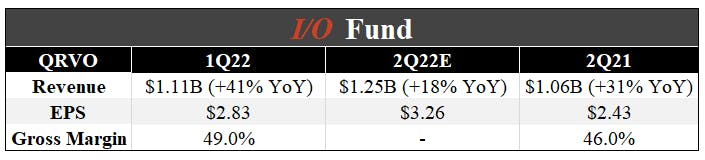
The company’s 1Q FY 22 results have been good. However, the stock has failed to meet market expectations. The management’s revenue guidance for the next quarter is $1.235B to $1.265B, the midpoint $1.25B suggests a 18% YoY growth and a growth of about 27% YoY when adjusted for last year’s 14-week quarter. They also increased the top line forecast for the fiscal year 2022 to 15%-20% from the earlier of approximately 15%.
Oppenheimer analyst Rick Schafer raised the company’s price target to $250 from $220 after the company earnings beat and forecast upgrade. He is positive on the company increasing the outlook in spite of the supply constraints.
Benchmark analyst David Williams has a buy rating and $225 price target. He is also positive after the company’s strong previous quarter results. “The demand environment remains strong and he continues to appreciate incremental content gains in 5G with increasing complexity”.
Craig-Hallum analyst Anthony Stoss also raised the company’s price target to $225 from $220. The analyst cites “big bottom-line beat, with Qorvo posting a 52.5% gross margin, and operating margin of 33.1% near record levels.”
The I/O Fund is a team of analysts that share their research publicly as they build a portfolio of 30 stocks. Our team has record results for a retail Fund and we also have four-digit gains on some of our free newsletter coverage. You can learn more about our premium service by clicking here or sign up for our free newsletter here. by clicking here or sign up for our free newsletter here.
Our premium members have been updated frequently on Nvidia with ongoing entries at $31.50, $51.20, $97.40, $105.30, $120.60, $124.50, $123.50, $138.90, $206.60, $208.90
Disclaimer: This is not financial advice. Please consult with your financial advisor in regards to any stocks you buy.
Taiwan Semiconductor officially opened the sector’s earnings with a bang as it beat consensus estimates and also guided strong revenue in the fourth quarter. Specifically, the company’s Q3 YoY sales growth of 16% beat estimates by 0.5% while guidance for Q4 sales growth represents an acceleration to 23% YoY growth, which came in ahead of the consensus estimate by 1%.
The results are positive considering some of the recent bearish Wall Street reports on semiconductors that suggested lower revenue due to the chip shortage, China worries, and Covid-19 negative impact, mainly in Asia. There were similar worries in the last quarter and most companies were able to beat estimates. In this earnings preview, we review key semiconductor companies to get a pulse on what to expect.
In the analysis that follows, we give a brief overview of the semi-conductor sector and discuss key metrics that investors should be aware of heading into Q3 earnings.
Semiconductor Stocks: Top 10 EV/FWD Revenue Multiples
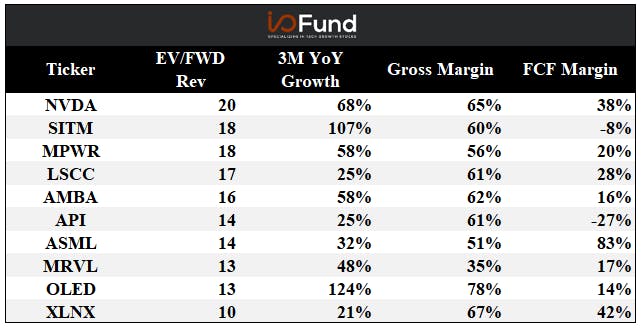
Below is a table of semiconductor stocks ranked by their EV/FWD sales multiples, along with their most recent YoY growth rate, gross and free cashflow (FCF) margins. Semiconductors have experienced strong demand in 2021 and the market has rewarded the outperformers with premium multiples.
Nvidia (NVDA) sports the highest multiple of the group at 20x, likely due to its dominate position with GPUs. SiTime (SITM) isn’t far behind NVDA at 18x. SITM’s premium multiple of 18x is likely a function of the firm’s strong 107% YoY growth rate as demand for its silicon timing solutions has increased in multiple different industries.
The I/O Fund recently covered Nvidia in a full length analysis on why Beth believes Nvidia will surpass Apple’s valuation over the next 5 years. In the analysis, we discuss how the A100 Ampere architecture is able to unify training and inference on a single chip, whereas in the past Nvidia’s GPUs were mainly used for training. The A100 is becoming the best-selling GPU of all time and these leaps in performance is partly why Nvidia has done so well against competitors.
Semiconductor Stocks: Top 10 Three-month Forward YoY Growth Rates
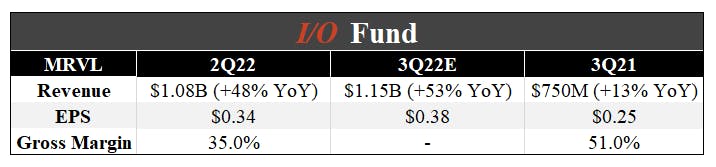
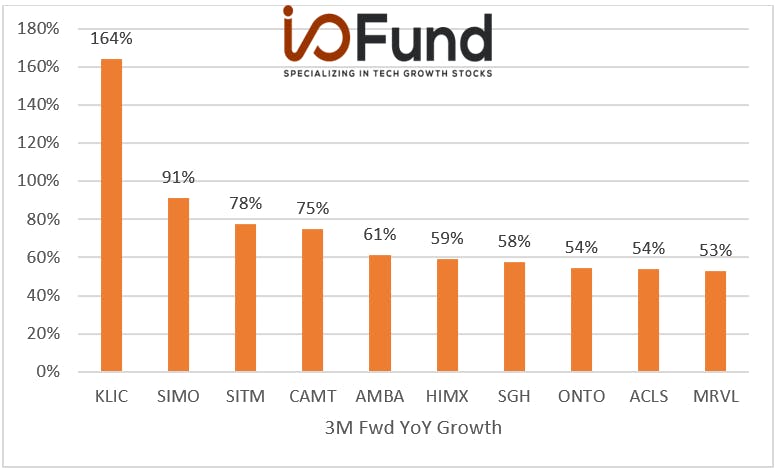
Looking forward, semi-conductors are expected to continue to grow strongly. Kulicke & Soffa (KLIC) is expected to grow over 100%, driven by increased demand for its solutions in the semiconductor, automotive and advanced display markets. Many other names are expected to grow over 50%+ in the upcoming quarter. Marvell (MRVL) is expected to grow 50%+ next quarter, but this growth is skewed by the firm’s acquisition of Inphi. Adjusting for the Inphi acquisition, MRVL’s organic growth next quarter is expected to grow 20%, which would represent an acceleration from the prior quarter organic rate of 17%.
Top 10 Weekly Share Price Movement
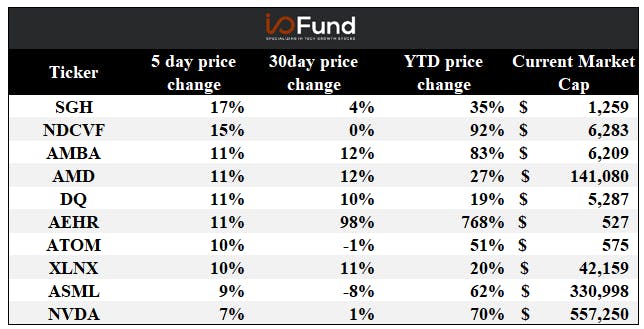
In the table below, we ranked the semiconductor stocks that saw the largest one week increase in their share price. Ambarella’s (AMBA) stock is one of the top performers this past week, as analyst anticipate 61% growth next quarter. AMD is also up 11% over the last week, and analyst expect the company to continue to capture market share going forward. We explore what analysts are saying about these stocks and a few others in more detail in our I/O Fund’s Preview of 7 Semiconductor Stocks Ahead of Q3 Earnings.
Top 10 Changes in sales growth estimates – last 90 days
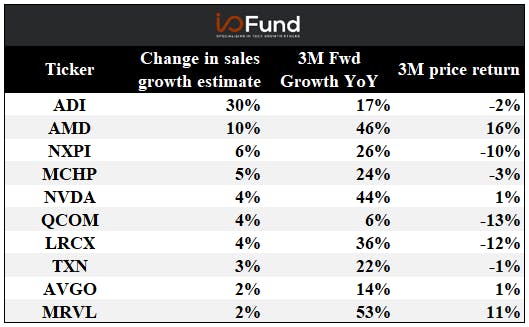
The table below ranks the companies that have had the largest revisions to their growth outlook over the last 90 days. ADI completed its acquisition of MXIM, which largely explains the rise in forward growth expectations, and absent the acquisition management had initially guided for 17% YoY growth. AMD revenue estimates for Q3 have increased 10% over the last 90 as the company’s guide for Q3 sales came in above expectations.
Update on EV/Fwd revenue multiples:
Overall stats:
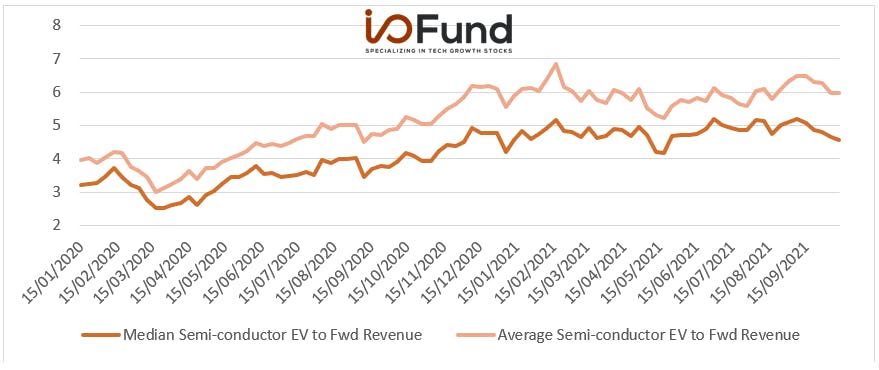
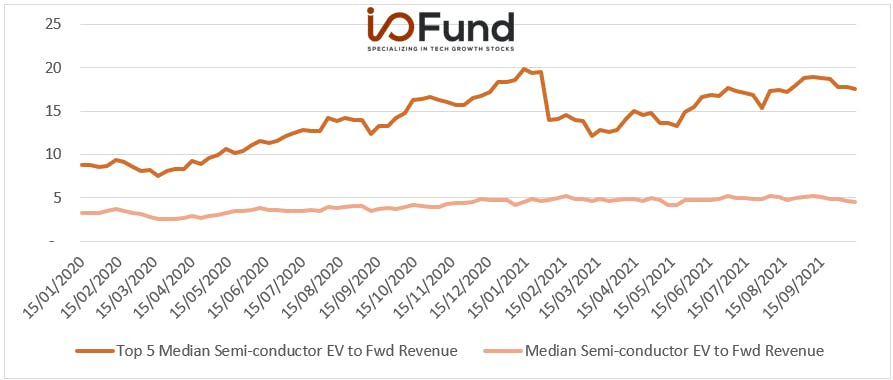
Overall Semi-conductor forward median 5x
Top 5 Semi-conductor forward median 18x
Overall Semi-conductor forward average 6x
EV/FWD SALES:
Semiconductor valuations have trended up during the year as demand for semis has remained robust driven by a global chip shortage. The world may be entering a new normal where semiconductors are used in everything, reducing their cyclical nature and leading to a premium multiple being awarded to the group.
TOP 5 EV/FWD SALES:
The chart above highlights the large dispersion in valuations in the semi-conductor space, as market leaders such as NVDA and AMD have been awarded much higher multiples than the peer median. While median valuations have been mostly static the last two years, the top 5 group has seen its valuation drop from 20x in Q4 2020 down to 12x in Q1 2021 but has since recovered to 18x ahead of Q3 earnings season. If Q3 earnings come in strong, then the market may push valuations back up to their historic highs.
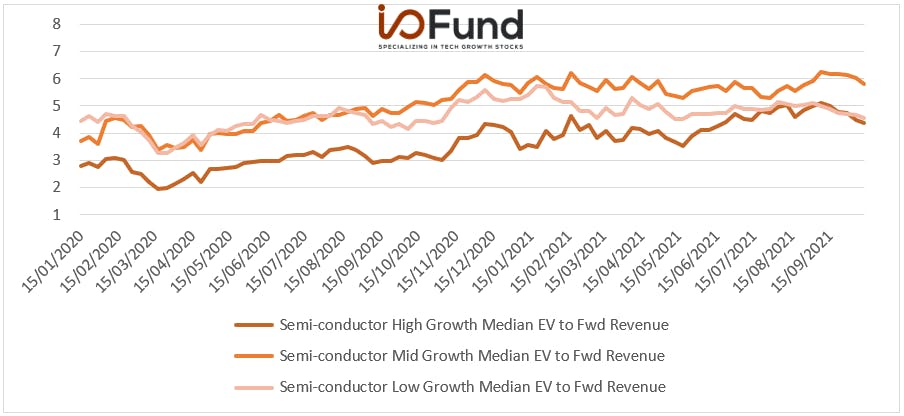
EV TO FWD SALES Semiconductor Universe:
We can further dissect the change in semi-conductor valuations by breaking up the group into high growth (>30%), mid growth (>15% and <30%) and low growth (<15%). The above chart shows that the high and mid-growth semiconductor stocks used to be valued much lower, while mid-growth semis have seen their valuations remain fairly static.
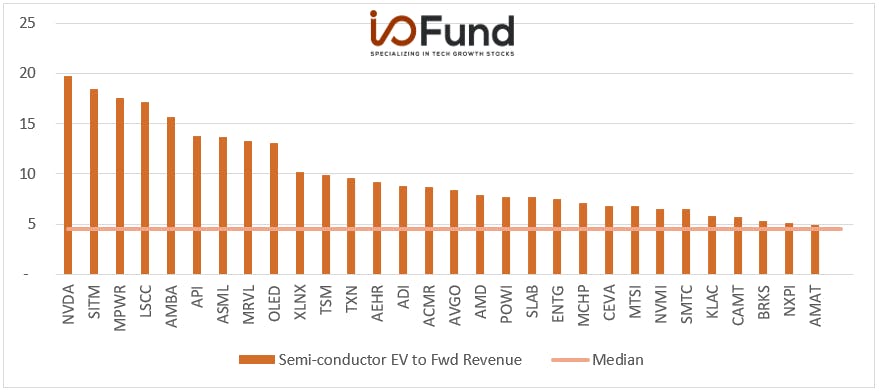
EV TO FWD SALES Semi-conductor UNIVERSE:
The above chart provides a more holistic view of the top 30 valued semiconductor stocks based on EV to FWD sales estimates. NVDA has the richest valuation and is valued nearly 400% higher than the peer median. As mentioned above, this is likely due to the firm’s dominate position in the GPU market.
Sign up for I/O Fund's free newsletter with gains of up to 1100% – Click hereSign up for I/O Fund's free newsletter with gains of up to 1100% – Click hereClick here
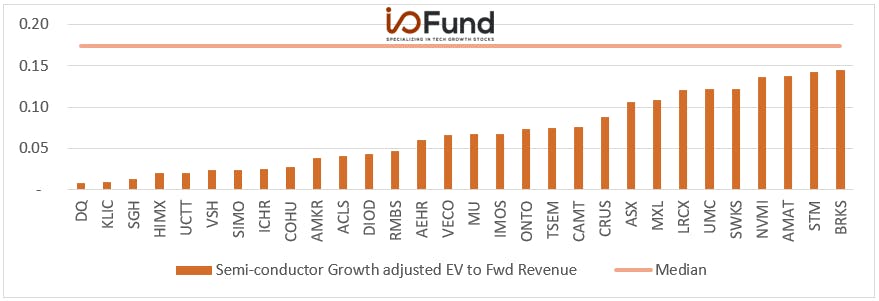
The last chart is based on EV to FWD sales but also takes into account forward growth expectations. By scaling valuation relative to forward growth, we can more clearly see which companies are cheapest relative to forward growth. A low value in the chart below means that a company is cheap relative to growth. Note that some names may be skewed due to acquisitions. DQ looks to be the cheapest based on this metric, however the company is based in China so the market may be discounting it due to political risks.
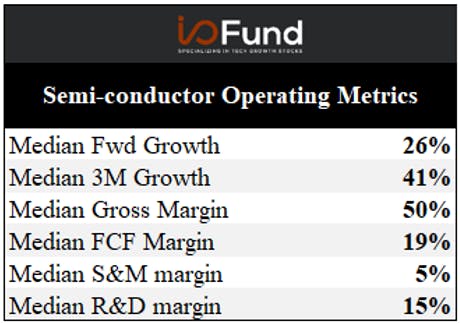
Finally, the last table we will be discussing includes aggregate semiconductor operating metrics. The above table shows that the group as a whole is performing well, as the average median growth rate in the most recent quarter was a robust 41% YoY rate. The group’s median FCF margin of 19% also highlights the strong position the group is in, as many semiconductor peers are cashflow positive and are also growing rapidly.
Strong growth and cashflows highlight the good health of the semiconductor sector, which makes sense considering the strong demand for chips in the current market. Find out which semiconductor stocks the I/O Fund will be watching heading into Q3 earnings in our I/O Fund’s Preview of 7 Semiconductor Stocks Ahead of Q3 Earnings.
The I/O Fund is a team of analysts that share their research publicly as they build a portfolio of 30 stocks. Our team has record results for a retail Fund and we also have four-digit gains on some of our free newsletter coverage. You can learn more about our premium service by clicking here or sign up for our free newsletter here.by clicking here or sign up for our free newsletter here.
Disclaimer: This is not financial advice. Please consult with your financial advisor in regards to any stocks you buy.
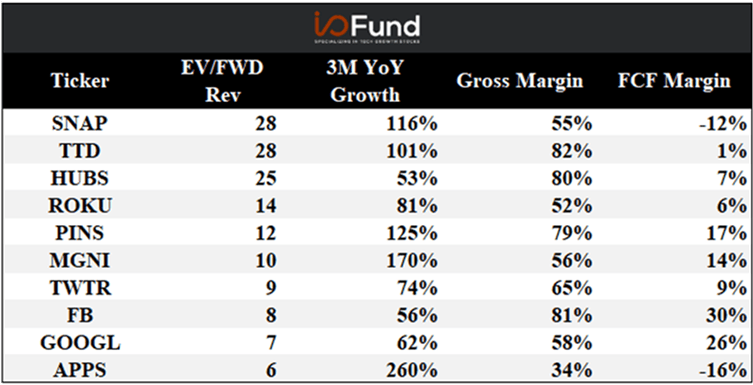
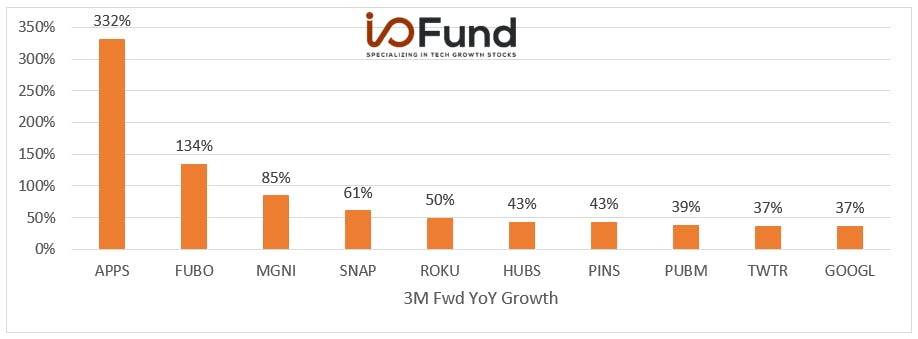
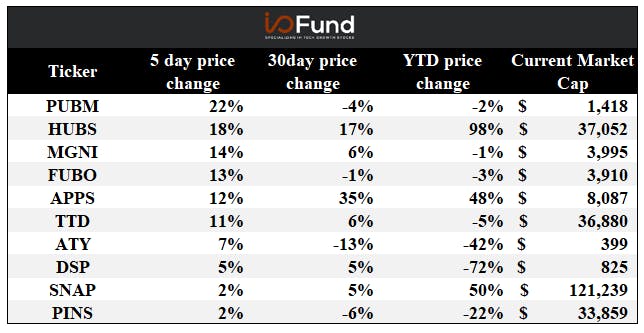
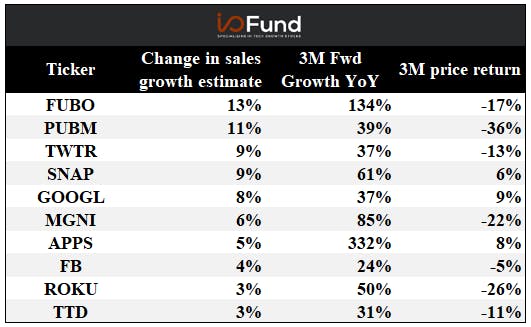
This quarter, we chose to go over Roku, Snap, PubMatic, The Trade Desk, Magnite, Pinterest, and Digital Turbine for an earnings preview on what to expect from these ad-tech companies. This list was chosen by those with the most forward growth, those with the highest valuations or those that have recently completed an acquisition so we can look deeper into what the Street is expecting from management.
Roku Inc– Earnings on November 05th
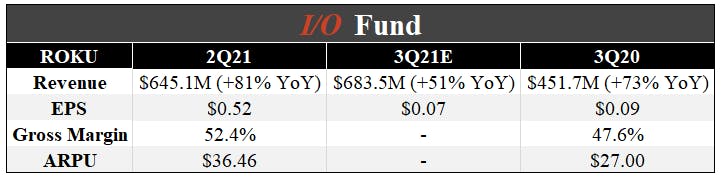
Below is a chart of Roku’s financials from last year, last quarter and what is expected in the upcoming quarter.
The consensus estimates suggests that the revenue growth will be slowing down in the next quarter. Below are the analysts’ views on Roku.
Wells Fargo analyst Steven Cahall has recently downgraded the stock to Equal Weight and reduced the price target from $488 to $350. He states that "The primary reason we go from Overweight to Equal Weight is, while there may still be a long ARPU runway, it's far better understood," Cahall writes in a note. "Consensus CY22E/CY23E ARPU is +50%/+47% over the past year to now $50/$60. In our January deep dive, we called CY22E ARPU of $55 a bull case scenario; but current consensus shows our alpha has decayed. The Q2 ARPU beat slowed a lot from Q1."
On the other hand, Guggenheim analyst Michael Morris says that the recent sell-off is a good opportunity to buy the shares as he upgrades the stock from a neutral rating to a buy with a price target of $395. “We expect the connected television ad marketplace will continue to grow at a rapid pace and that Roku will be a primary beneficiary — this view is unchanged,”
KeyBank analyst Justin Patterson has said that the New Amazon fire TV’s as an incremental positive to the company and its competitive position. He notes that Amazon’s devices appear to be similar to Roku’s offering.
Please note, the I/O Fund does not necessarily agree with the financial analysts mentioned above rather our goal is to objectively review companies. Our premium members have been updated frequently on Roku and we have been able to buy this stock very early before the market understood the true potential of this cord-cutting and AVOD play.
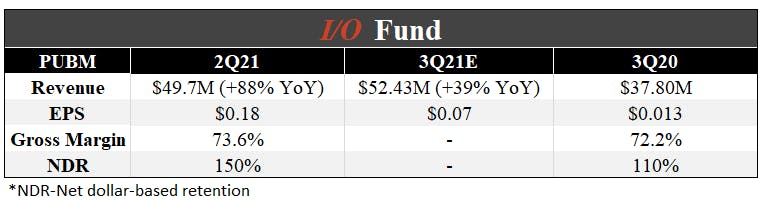
PubMatic revenue growth rate is expected to show a notable deceleration in comparison with the recent quarter although margins remain high. We will be keeping an eye on the net dollar-based retention ratio in the next quarter. The management has raised the 2021 revenue growth forecast to 38% to 40% and 25% next year.
Macquarie analyst Tim Nollen has an outperform rating on the stock with a price target of $37. He believes that the company benefits from “a strong advertising backdrop in which traditional advertising is shifting to digital, open Internet players are gaining share from walled gardens, and ad spend is consolidating around fewer SSPs,".
Macquarie further states “PubMatic is banking on real CTV growth coming from open exchange, where the OpenWrap bidding engine will be able to grow alongside that migration – though that still needs time to play out”.
“And on an enterprise value/sales basis, it's trading at roughly a 3.5x discount to its closest peer, Magnite and a 5x discount to the broader ad-tech universe.”
You can find the ad-tech companies which had their growth estimates updated in the last few months here.
The Trade Desk Inc – Earnings on November 05th
The consensus revenue estimates for the next quarter suggests a sharp drop in the revenue growth, as well. One of the primary reasons for the strong revenue growth in the second quarter was due to lower comps as Q2 2020 revenue fell 13% YoY.
Needham analyst Laura Martin has a buy rating with a price target of $100 and her 3Q21 revenue estimate is $284M.
She is of the view that “Digital markets have proven themselves to have winner-take most economics, and we believe TTD is the winner among DSP’s (demand side platforms). 30% of TTD’s revenues come from CTV which should accelerate TTD’s growth trajectory since CTV revenues are growing 3-5x faster than other digital media categories. About 15% of TTD’s 1H21 revenues came from outside the US, and offshore is growing faster than the US, suggesting a longer growth runaway”.
Sign up for I/O Fund's free newsletter with gains of up to 1100% – Click here Click here
Citi analyst Nicholas Jones has a price target of $85 and a neutral rating. He believes: “Trade Desk is a dominant and best-in-class adtech player, but continues to see risk associated with technology disruption and privacy regulation”.
The revenue growth is expected to be lower than the second quarter but higher than the previous year. The adjusted EBITDA in the second quarter showed a strong growth when compared to the previous year. The management also expects to show an improvement in the third quarter.
Goldman Sachs’ analyst believes that the company has a high chance to achieve its target of 50% plus revenue growth in the next three years. Goldman Sachs also believes that the strong growth will be accompanied by margin expansion with the EBITDA margins improving from -13% in 2021 to 40% in 2026. It has a price target of $90.
RBC is also positive on the company. They have initiated coverage on the company with an outperform rating and a price target of $88. According to the analysts “Snap has everything pointed in the right direction to become a top social media business,stable footing in an attractive secularly growing ad market, an evolving direct response/ad-load/downfunnel commerce narrative leading to potential ARPU [average revenue per user] and profitability upside and finally, new products that could invite broader usage and incremental monetization.”
Channel checks were more mixed, but the analysts think the possibility of adverse near- or medium-term effects “seems low” compared to the stage of the company’s developing monetization.
The company is benefitting from the strong growth in digital advertising. However, as discussed earlier the super growth was partly due to the M&A with SpotX.
Analysts are positive on this stock as Berenberg analyst Alexandra Ross has initiated coverage with a buy rating and a price target of $37. Other analysts who are positive about the company include Susquehanna analyst Shyam Patil. He likes the company as a CTV play and is also optimistic about the recent acquisitions of SpotX and SpringServe.
Earlier this year, Truist analyst Thornton said, “Magnite is well positioned in the connected-TV advertising space, with secular growth in connected TV estimated to represent more than half the company's overall revenue by 2024”.
Pinterest Inc – Earnings on October 28th
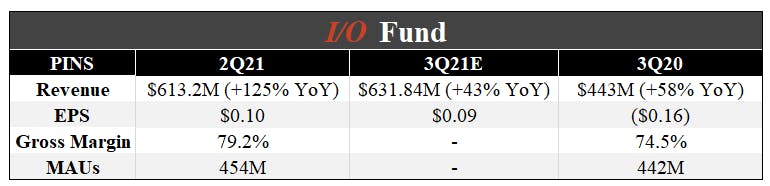
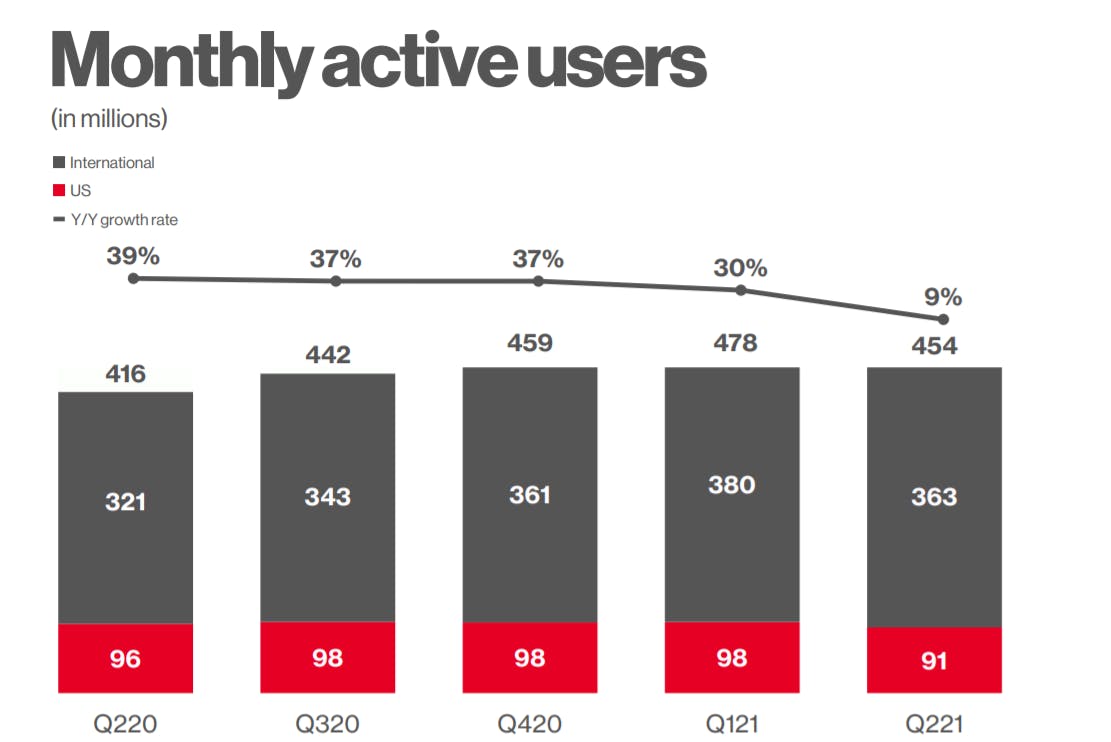
The stock fell after releasing the 2Q 21 results as the company failed to meet the consensus global monthly active users (MAUs) in spite of beating the revenue and EPS consensus estimates. The management in the earnings call mentioned that due to the lack of visibility they will not be giving guidance for MAUs for this quarter.
RBC Capital analyst Brad Erickson initiated coverage of Pinterest with a Sector Perform rating and $58 price target. “We believe user growth is likely closer to plateauing than not and our channel feedback indicated that outside of targeted categories, conversion needs improvement, particularly vs FB where we think user crossover is virtually 100%. Expectations have come down after last quarter’s miss. However, we need to see an improving content or commerce experience before getting more constructive”.
Sign up for I/O Fund's free newsletter with gains of up to 1100% – Click here Sign up for I/O Fund's free newsletter with gains of up to 1100% – Click here Click here
Piper Sandler analyst Thomas Champion has a neutral rating and a $68 price target. He believes “that the post Q2 earnings selloff may be overdone. Recent monthly active user declines seem driven by non-mobile app users, which contribute less to the financial model”. He sees a more favorable setup for the stock into year-end.
Earlier this year, Argus analyst downgraded the stock to neutral in response to lower user growth in the second quarter. “The disappointing guidance reflects the decline in online sales as traditional stores reopen and users spend more time away from home. But it has strong brand recognition in the U.S. and prospects for growth in international markets over time."
Canaccord analyst Austin Moldow has upgraded the stock from a hold to a buy. He also raised the price target to $95. “The company has now gotten stronger with its transition into "a full phone lifecycle monetization engine" thanks to the addition of in-app advertising, which grew the total addressable market. He further notes that the Digital Turbine's valuation has "become more reasonable" and the fundamentals have improved up to justify the valuation”.
On the other hand, Macquarie analyst Tim Nollen has initiated coverage on the company with a neutral rating and $60 price target. He's unable to determine the relative position of Digital Turbine's on-device software versus ironSource's (IS). Digital Turbine's in-app advertising business has only just now come on board, and while these acquisitions are growing fast, they are notably smaller than peers”.
Oppenheimer analyst Timothy Horan reiterated an Outperform rating and $100 price target. "Single-Tap could be a revolutionary product, akin to the transition from banner ads to video. Despite the already significant dollars, Single-Tap is very early in its growth phase, with APPS being very selective on the brands being allowed to participate. The moat on Singe-Tap is sizable: IP, hundreds of millions of devices scale, as well as huge investment in last-mile measurement and attribution."
Bradley Cipriano and Royston Roche contributed to this article.
Disclaimer: This is not financial advice. Please consult with your financial advisor in regards to any stocks you buy.
In this earnings preview, we review key companies in ad-tech to gauge what to look for in the upcoming Q3 earnings reports. Last quarter, ad-tech saw a rebound in ad spend from Covid yet it’s likely we saw the high-water mark for many companies as the ad industry faced extraordinarily low comps coming out of the historic lows of Q2 2020 when Covid led to reduced spend.
Snapchat will be the first among the ad-tech companies to kick-off the Q3 earnings when it reports on October 21st. In the analysis that follows, we give a brief overview of the ad-tech sector and discuss key trends that investors should be aware of heading into Q3 earnings.
Below is a table of ad-tech stocks ranked by their EV/Fwd sales multiples, along with their most recent YoY growth rate, gross and free-cashflow (FCF) margins. Many Ad-tech names are growing strongly, but M&A activity has inflated some growth rates such as APPS and MGNI. Adjusting for acquisitions, APPS and MGNI reported pro-forma sales growth rates of 104% and 79%, respectively. PINS had the strongest organic topline growth at 125%, as international sales at the company surged 227% YoY during Q2.
Top 10 EV / Fwd Revenue Multiples
However, we can see the high-water mark starts to kick in with the upcoming quarter. Looking forward, Digital Turbine is forecast to grow the strongest in Q3, but this is skewed due to the company’s recent acquisitions. FUBO has high expectations heading into Q3 as subscriber growth from the NFL season which started in Q3 should help fuel sales growth at the company.
Top 10 Three-month Forward YoY Growth Rates
The below table ranks the ad-tech stocks that saw the largest one week change in their share price. With Ad-tech earnings on the horizon, the market may be pricing in which stocks it anticipates to perform strongest. Notably, Digital Turbine and HubSpot have been strong all year and have been some of the strongest Ad-tech stocks recovering from the recent sell off in tech stocks.
Sign up for I/O Fund's free newsletter with gains of up to 1100% – Click here Sign up for I/O Fund's free newsletter with gains of up to 1100% – Click here Click here
We can also see the market continues to question Fubo per the YTD price action below. We’ve written in detail as to why we think the company is stronger than the market realizes due to tailwinds from OTT live sports specifically and the monetization potential from sports betting. We’ve also recently commented on Twitter that Roku is likely to do even better globally than domestically as ad-supported streaming will be preferred over subscriptions in countries with lower GDPs. Considering that the Roku team created the leading operating system in 2008 and has led in the United States for 13 years over Amazon and Google, we think the team is capable of entering new geographies.
Top 10 Weekly Share Price Movement
In the table below, ad-tech stocks are ranked by percentage of change in their forward sales growth estimates over the last 90 days. A rise in growth estimates can lead to a higher multiple, however the market remains in a “wait and see” stage for names such as FUBO and PUBM, as their stocks have declined despite an increase in forward expectations. FUBO has high expectations as sports streaming from the NFL should boost revenues, while PUBM is a relative newcomer to the Ad-tech market and the Street may be waiting for the company to prove it can compete. In general, PubMatic is in a tough place to compete in the tech stack due to the number of competitors on the supply side.
Top 10 Changes in sales growth estimates – last 90 days
Although ad-tech has seen some double-digit declines over the past three months, we do not think this will last for long. Ad-tech is a robust industry that is cash efficient and tends to outperform other sectors in tech. For instance, two of the FAANGs are ad-tech related and there could be more tailwinds for those who hold first-party data as Facebook and Apple duel over third-party ad tracking and measurement. We covered this here.
At the I/O Fund, we have plenty of exposure to ad-tech and are not concerned with any temporary pullbacks.
Update on multiples
Below, I give an overview of topline multiples for the Ad-tech sector. The multiples shown below are calculated by scaling Enterprise Value (market cap + debt – cash) to forward sales. A higher multiple means the company has a premium valuation.
Overall Ad-tech stats:
Overall Ad-tech forward median 7x
Top 5 Ad-tech forward median 24x
Overall Ad-tech forward average 10x
EV/FWD SALES:
Ad-tech valuations peaked during the beginning of the year and have trended down since. The multiple compression has driven the median Ad-tech EV/Fwd sales multiple to 7x, which is below the median 10x multiple that Ad-tech received heading into Q3 earnings last year (2020). If Ad-tech performs strongly in Q3 2021, then the Street may award Ad-tech a higher multiple.
Sign up for I/O Fund's free newsletter with gains of up to 1100% – Click here Sign up for I/O Fund's free newsletter with gains of up to 1100% – Click here Click here
The I/O Fund has stated that we see the current market as a buying opportunity with an in-depth macro analysis from Portfolio Manager, Knox Ridley. The valuations illustrate that we are nearing the 6 Median EV to Forward Revenue and the 10 Average EV to Fwd Revenue, which barring a black swan event like March of 2020, is low for ad-tech valuations. We to tend not hunt for bottoms, rather we prefer to trim near tops and add to key positions near bottoms. Therefore, for the style of the I/O Fund, the current valuations are a buying opportunity and we sent a recent Roku buy notification to our I/O Fund Members at $309.30.
By bifurcating the data for the top 5 in the chart below, we see the valuations in some names have largely recovered their multiple compressions since the beginning of the year. Snap, The Trade Desk, Hubspot, Roku and Pinterest have the highest valuations. The recovery in these premium valued names suggests that the market believes that these five stocks will likely outperform the rest of the group going forward.
TOP 5 EV/FWD SALES:
Below, we break the valuations into the following buckets:
Ad-tech High Growth Median EV to Fwd Revenue 10x
Ad-tech Mid Growth Median EV to Fwd Revenue 4x
Ad-tech Low Growth Median EV to Fwd Revenue 4x
We can further dissect the change in ad-tech valuations by breaking up the group into high growth (>30%), mid growth (>15% and <30%) and low growth (<15%). The above chart shows that the high-growth Ad-tech stocks were valued higher earlier in the year, as the market may be anticipating a slowdown in ad spend in the near term.
EV/FWD SALES IN GROWTH BUCKETS:
The chart below highlights the large gap in valuations for ad-tech leaders such as TTD and SNAP and the rest of the sector. SNAP and TTD are valued ~400% higher than the median multiple of 7x, while relatively new entrants PUBM and TRMR are valued below the Ad-tech median, at 6x and 4x, respectively.
EV TO FWD SALES Ad-tech UNIVERSE:
We also include a chart based on EV to Fwd sales but this takes into account forward growth expectations. By scaling valuation relative to forward growth, we can more clearly see which companies are cheapest relative to forward growth. Stocks on the right side of the chart below have the cheapest growth, meaning that they are trading at a bargain. Some standouts are SNAP, which fell from being valued 4x the median to just 2x the median once growth was accounted for. Moreover, FUBO is one of the cheapest Ad-tech stocks when considering their forward growth rates. TTD remains the most expensive and APPS and MGNI are skewed by recent acquisitions, meaning that they appear cheaper because of acquired sales.
Finally, the last table we will be discussing are ad-tech operating metrics. The above table shows that the group as a whole is performing well, as the average median growth in the most recent quarter was a strong 81%, however this should be discounted due to the low base period in the prior year due to Covid (discussed above). Looking forward, the market expects ad-tech to continue to grow strongly as the median growth estimate is 38%.
In the video discussion below, I check in on Bumble following the company’s IPO earlier in the year. Bumble’s stock is down 30% since its IPO, as total growth at the company has somewhat stagnated. However, Bumble users are split 50/50 between Bumble and a Russian dating app called Badoo. Badoo isn’t growing, but Bumble is. In fact, Bumble sales grew strongly in the latest quarter.
I suspect that the Street may be overlooking Bumble because of the underwhelming results of the consolidated company. However, by stripping out Badoo from the company, Bumble results appear much stronger. Bumble App sales grew 55% YoY, which was much faster than Tinder’s 26% YoY growth rate in the latest quarter. Yet, despite its stronger growth rate, Bumble trades at half the valuation of Tinder (MTCH).
Sign up for I/O Fund's free newsletter with gains of up to 1100% – Click here Sign up for I/O Fund's free newsletter with gains of up to 1100% – Click here Click here
Looking forward, I believe that as Bumble App users continue to grow strongly, user mix will favor Bumble over Badoo. This trend will force the Street to take an interest in the fast-growing company. As a result, the large valuation delta between BMBL and MTCH (Tinder) will likely close as Bumble’s growth is better appreciated by the market. If we value BMBL based purely on Bumble App sales (excluding Badoo) but use Tinder’s multiple, there is plenty of upside in Bumble’s share price.
Disclaimer: This is not financial advice. Please consult with your financial advisor in regards to any stocks you buy.