Alphabet Stock: Search Giant Is Just Getting Started

This article was originally published on Forbes on Aug 10, 2023,07:15 am EDTForbes Forbes on Aug 10, 2023,07:15 am EDT

Given the macro headwinds, not many investors expected the magnitude of the Nasdaq-100’s rally through the first six months of 2023. Going into this year, we were positioned for bottom-line focused investment themes that we felt would be able to deliver earnings growth due to secular demand for its products, and in some cases, be able to reduce costs to maintain profitability.

Big Tech versus Tech Sector earnings

Below is an analysis of consensus earnings estimates from Zack’s on Q2 Technology Sector earnings trends through July 26 plus expectations for the next three calendar quarters.

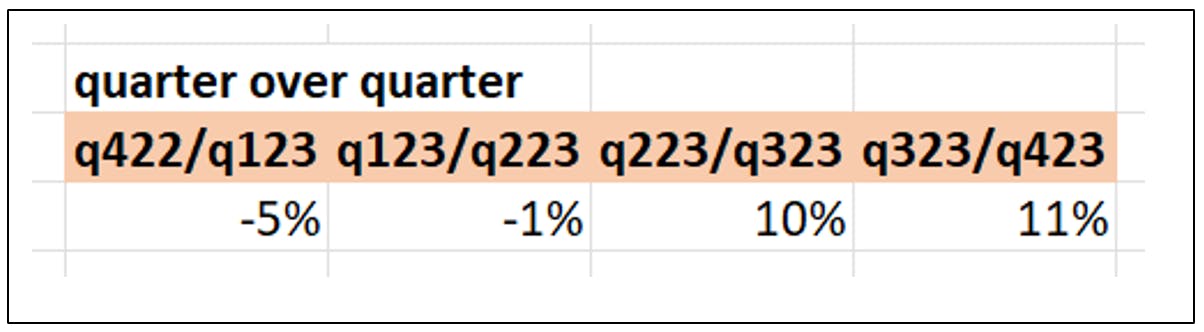
For the past three quarters, sales and earnings have declined on a year-over-year basis. However, there appears to be stabilization as year-over-year comps get easier and the market is estimating a modest resumption of growth in Q3 and an acceleration in Q4 to Q124.
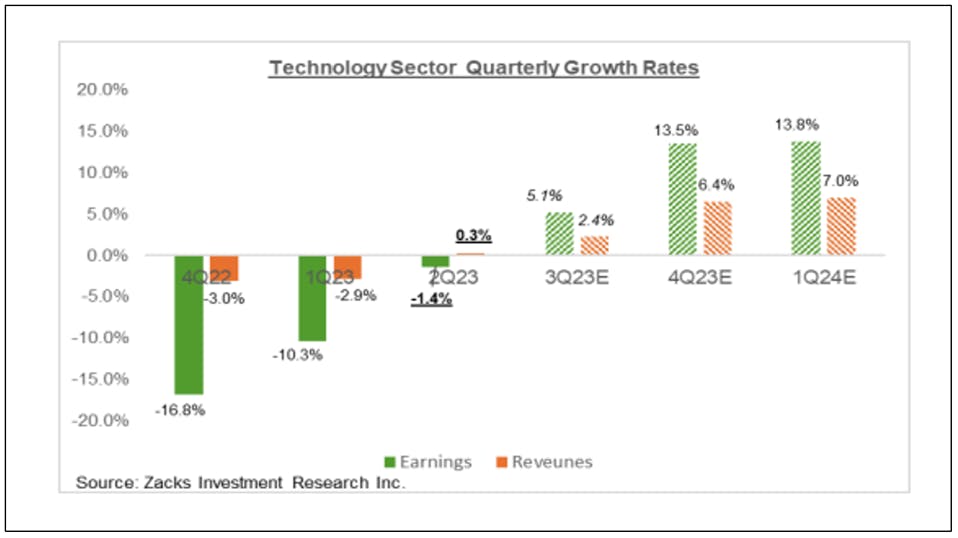
Tech Sector Quarterly Growth Rates

Meanwhile, Zack’s looked at the earnings picture for the “Big 7 Tech Players” – Microsoft, Alphabet, Meta, Nvidia, Apple, Tesla and Amazon. The earnings profile for the Big 7 is estimated to be more robust compared to the overall technology sector.
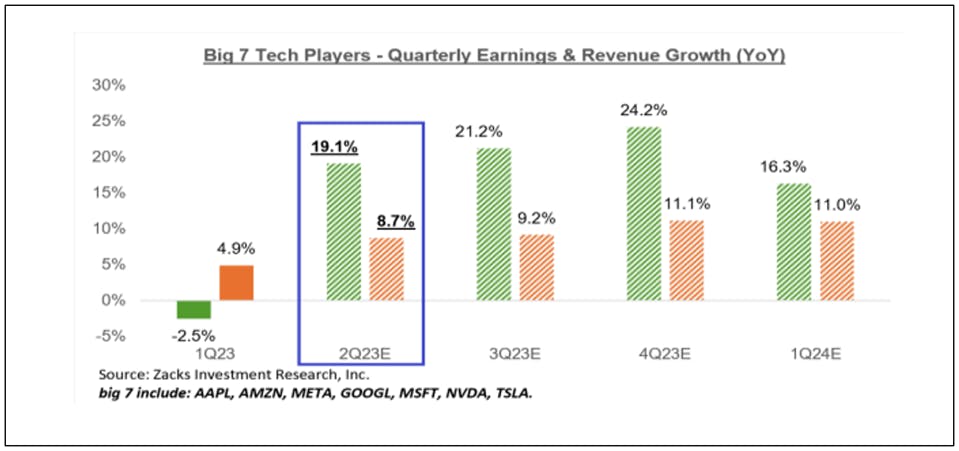
Big 7 Tech Players - Quarterly Earnings and Revenue Growth (YoY)

In addition to a better earnings profile, Big Tech prices and valuations have benefited from other factors that investors are seeking

  • Focus on their AI capability and having the financial resources to make the required investments so that they make a positive contribution to future earnings.
  • Company size (i.e. large cap) and the ability to manage margins in the face of macro headwinds by meaningfully reducing costs but not at the expense of critical high ROI investments.
  • Credit quality – following Fitch Ratings’ downgrade of U.S. government debt to AA+. Big Tech Credit worthiness is on par if not greater than US debt. For example, Alphabet has the same AA+ rating.

Amongst the Big 7, we believe Alphabet stands out for several reasons:

Sign up for I/O Fund's free newsletter with gains of up to 221% – Click hereClick hereClick here

Year of Execution – Alphabet

Beginning in mid-2022, IO Fund began to transition allocation toward larger cap tech stocks because we felt they are in a better position to navigate a macro downturn. Big Tech has levers at its disposal to manage its margins by rightsizing its cost base. Importantly, at the same time they have the financial strength to make the investments required to capitalize on the AI opportunity and take market share from its weaker competitors. The medium-term bull case is that once revenue begins to meaningfully reaccelerate helped by its AI offerings, the combination of optimizing its cost structure and efficiencies garnered from technology investments leads to expanding margins. This is similar to Meta and its “Year of Efficiency”.

At the moment we prefer Alphabet (GOOGL) over Meta (META). We see a similar story playing out for Alphabet and its “Year of Execution”. We believe it’s in an earlier stage than Meta in its self-help process and its core business areas are just now showing signs of stabilization. Alphabet’s margins are beginning to rebound and have now returned to the percentage they were at in Q1 2022. Meanwhile 1) Resilience in Search, 2) stabilization in YouTube Ads, 3) Market share and profitability gains in Cloud and 4) Growth in Other Google (i.e. YouTube subscription) make us optimistic that revenue will accelerate and there is upside to margins for the remainder of the year.

In the recent Q223 earnings call, management commented on the QoQ strength in margins: “A quick comment on the sequential improvement in operating margins in the second quarter. There are two factors to note. First, the benefit from an acceleration in search advertising revenue growth in the second quarter. Second, the vast majority of the charges related to our workforce reduction and optimization of our global office space were taken in Q1.”

Every Thursday at 4:30 pm Eastern, the I/O Fund team holds a webinar for premium members to discuss how to navigate the broad market, as well as various stock entries and exits. We offer trade alerts plus an automated hedging signal. The I/O Fund team is one of the only audited portfolios available to individual investors. Learn more here.Learn more hereLearn more here.

Search moat is strong

For all the hoopla surrounding ChatGPT and the belief that it will provide MSFT an opportunity to take share from Alphabet’s core search business, it has yet to happen according to Search Engine. According to their analysis, Microsoft is losing market share. It peaked at 9.92% in October 2022 and is now at 7.14%. With its market position firmly entrenched, Alphabet has the audience to roll out its Search Generative Experience (SGE). On its own, the Search business has proved resilient because it provides advertisers an attractive ROI on their ad spend. Looking ahead, SGE will improve advertisers’ ROI and will likely provide Alphabet additional pricing power. This will also improve their retail vertical. Meanwhile, consumer interest will further strengthen Alphabet’s dominant market position in Search.

However, let’s not forget about anti-trust trial

One of the reason we’re very positive on the AI potential for Google’s businesses is that it is sitting on the world’s very best consumer data, which is not an exaggeration in the least bit. Its ability to lead in artificial intelligence and large language models should not be underestimated.

Therein lies the issue. Google undisputedly has the world’s best consumer data, but did this grow to become part and parcel with operating a monopoly? The Department of Justice has asserted anti-trust violations against Google with the trial beginning in September 2023.

We anticipate two outcomes. The antitrust outcome will be mild, and Google will be empowered to continue to dominate. Or, the outcome will require the ad properties to be broken up, leading to a weaker stance for Google. This could benefit smaller ad-tech players, which we have identified and are monitoring closely.

The I/O Fund Analyst Team contributed to this analysis
Recommended Reading:

Super Micro Q4 Earnings: Half of Revenue is from AI

Here we are in 2023, spoiled by the best Nasdaq performance in the history of the index. 2022 seems like a distant memory. Well, Super Micro’s earnings are here to remind us that stocks do not go up forever, even on a nearly perfect earnings report.

I will take this opportunity to make a plug for technical analysis, as Super Micro due for a pullback from some time, per Knox’s Positions Report here. There is very little in the fundamentals that would directly cause a selloff, and so the information below is going to frustrate anyone who thinks only fundamentals drives stock prices.

Super Micro beat on all accounts, and also raised full year guidance. Cash flow was negative this quarter but likely to be temporary. I’ve included some notes on this below.

We had written going into the earnings report that Super Micro had pre-announced Q4, and it was a sizable beat:

Today, the company has taken this further and raised FY2024 guidance considerably from $8.61 billion expected to $10 billion at the midpoint. Rough math of a 17% gross margin and a 9% net margin gets us comfortably above the $14.73 EPS expected for FY2024, as well, in the $16.00 adjusted EPS to $17.00 GAAP EPS range.

Management did a good job on the call discussing what would cause them to raise the guidance even more for FY2024. The brief answer is they will raise again if they can obtain key components from the supply chain. I detail this for you below.

Scorecard:

The current fiscal Q4 results are bolded for easy reference. Percentages are YoY unless stated otherwise.

Revenue and EPS:

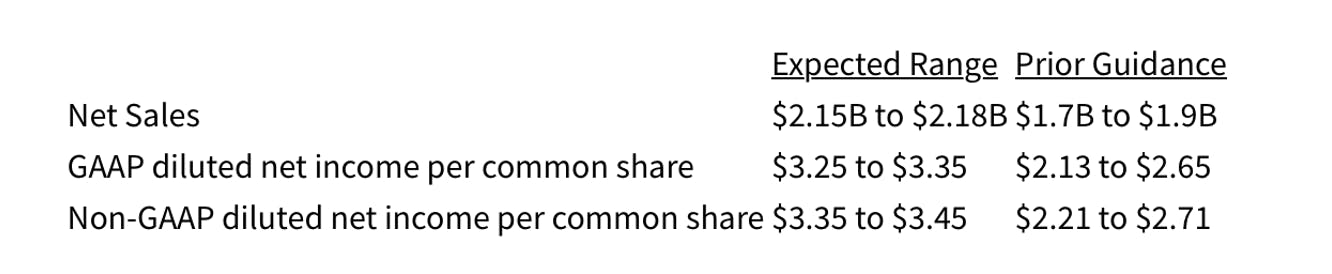
  • SMCI Management raised Q4FY23 revenue guidance to $2.15B-2.18B from previous guidance of $1.7B to $1.9B, vs consensus of $1.96B. Today, the company reported $2.18 billion for growth of 34% YoY and 70% QoQ.
  • Q4 GAAP eps guidance raised to $3.25 to $3.35 from $2.13-$2.65. The company reported $3.43 GAAP EPS.
  • Non-GAAP guidance raised to between $3.35 to $3.45 from $2.21 to $2.71 vs consensus of $2.88. The company reported adjusted EPS of $3.51 for growth of 34% YoY.
  • Q1FY24 consensus eps of $3.19. The company guided for $2.75 to $3.50 EPS, so this is technically a slight miss at the midpoint of $3.13 EPS but the guide is still within range.
  • FY24 consensus eps of $14.51 and revenue of $8.47B. The company raised full year guidance to $9.5 billion to $10.5 billion, or $10B at the midpoint. This implies a comfortable beat on the bottom line with the current margin profile.

Margins:

  • Current gross Margin of 17% versus Q323 gross margin of 17.6% and 18.7% in Q223
    undefined
  • Current operating margin of 10.60% versus Q323 opm of 7.7% and 11.9% in Q223.
  • Current net margin of 8.9% compared to 6.7% last quarter and 9.8% in Q2

Cash Flow:

This quarter, the operating cash flow was (-$9) million and free cash flow was (-$17) million for a 0% margin. This compares to $198m in op cash flow and $190m in free cash flow last quarter with margins of 15.5% and 14.8%, respectively. In Q2, the margins were 8.9% and 8.4%, respectively.

The cash flow was also negative in Q4 of last year. Management stated the following regarding the negative FCF: “Cash flow used in operations for Q4 was $9 million compared to cash flow generated by operations of $198 million in Q3 due to higher accounts receivable, offset by lower inventory and higher accounts payable from backend loaded shipments in the quarter due to supply constraints.” 

The company has $440 million in cash and $290 million in debt for a net cash position of $150 million, down from $176 million. Per management: “we utilized our bank lines of credit to support higher revenues and accounts receivable as we ramped up production of new AI/GPU design wins.”

Here was a question on the call, which seemed to relay that cash flow would be similar to previous levels: 

Jon Tanwanteng

Hi, thanks for the follow up. Dave, I was wondering if you could talk about your working capital needs in the sort of environment. Can you generate positive cash flow going forward? Are you going to be using cash as you as you try to fulfill this OpEx demand? 

David Weigand 

Yeah, John. We see the business generating good cash flows, as it has historically. And we think that the — especially in this constrained supply market, where we could deliver more if we had more supply. But we're so really, the constrained supply ends up moderating the working capital. And so we grew our business last quarter quite a bit and grew our ARR. So that utilized a lot of working capital, but we have no concerns about working capital.

Key Metrics:

52% of Super Micro’s revenue is driven by AI-related designs. Compare that to many AI bubble stocks that do not have any AI revenue yet.

To help illustrate what that has done for Super Micro, analysts raised FY 2025 expectations from 11% revenue growth to 71% revenue growth over the past three months. That is a considerable jump thanks to it’s here-and-now AI exposure.

The OEM appliance and large data center revenue of $1.17 billion grew 59% year-over-year and 94% QoQ. The boom in AI-related data center sales helped to push this segment to over 100% growth in FY2023.

The Enterprise and channel vertical, which also includes AI/ML revenue, was up 19% year-over-year and 51% QoQ to $976 million.

Earnings Call:

Supply is the Primary Headwind; Not Demand:

When management raised guidance, this is what the CEO stated: “However, given the record high backlog, we see fiscal year 2024 revenue between $9.5 billion to $10.5 billion with room to deliver more depending on availability of supply.”

Basically, Nvidia’s chips are so popular that Super Micro is competing with many others for a very limited supply of these chips. Super Micro has a strong relationship with Nvidia and the company is not bashful about making it known. Here is what was stated in the opening remarks: “Couple of months ago, I was honored to have my close friend, NVIDIA CEO Jensen Huang, join me on stage at Computex to highlight our optimized new generation GPU solutions for this AI era” along with a list of Nvidia-powered systems that Super Micro supports. 

In our pre-earnings write-up, we had stated: “The bulk of SMCI’s growth will depend on supply chain, which we outlined in our recent analysis. The demand is there, can the company meet the demand or are the key component supply shortages going to keep the company’s growth in line for now? Clearly, the pre-announcement is a good sign that the supply chain is not getting in the way too much, however, this remains the top concern for SMCI's near-term growth. Per our analysis, lead times are at 26 weeks compared to a 10-14 week target. This is an improvement from 40 weeks. Read more here.”

Here was the first question regarding the supply:

Ananda Baruah:

“[…] And so I guess the first question is, is what's the opportunity do you see to maybe even do teach stronger than the fiscal '24 guidance. I guess, what would be the puts and takes there? And, if you were to be able to exceed the 2024 guidance, what would be some of the things you think would need to occur?”

Charles Liang

“[..] And for sure, they need 10 times 20 time more system. And we just cannot ship at this moment, because of supply chain […] So I mean, we are on the right track, yes expecting supply chain can improve so that we can grow our revenue.”

Can the Company Keep Growing …

As if a beat in Q4 and a raise for FY2024 isn’t good enough, analysts on the call wanted to know what the possibility is that Super Micro continues to beat and raise. It was helpful that the CEO stated, “With LLM large language model and other AI applications booming, I now expect the $20 billion annual revenue target to be just a couple of years away.”

Here was a question from an analyst on that note:

Ananda Baruah

That's really helpful. And so, Charles, just to make sure that I understood that accurately, is that to say, if the supply chain — so if you can, if you can get more from the supply chain, actually use it to say this way you have order visibility, such that if you can procure more, you would have the ability to share gains, exceed the fiscal '24 range that you provide is a really supply chain issue, I guess, is what I'm asking. Did I hear that accurately?

Charles Liang

Yeah, absolutely […]

This was also stated at the very end by the CEO:

Charles Liang

And even a supply condition, I believe we can surpass $10.5 million for sure easily.”

Conclusion

On the Microsoft post-earnings report, I had stated “Let’s be real, the Nasdaq has rallied more than it has in its 52-year history off fairly unimpressive top line growth in the tech industry and minimal to no earnings growth. Although fellow growth investors have greatly benefited, we shouldn’t be surprised if the buying is exhausted at the moment.”

Per a recent Zack’s report (behind a paywall): “For the Tech sector, we now have Q2 results for 41.2% of the sector’s total market capitalization in the index. Total earnings for these companies are down -0.4% on +2.1% higher revenues, with 94.7% beating EPS estimates and 73.7% beating revenue estimates.”

This is not enough growth to sustain the rally we have seen.

Of the tech earnings results this year, Super Micro is a rare gem that has materially grown both top line and bottom line in a big wayin a big way. But, to be fair, the stock has been rewarded and is up considerably this year. Tech investing is not linear, and so what we have is a solid earnings report that is being sold off as buyers are drying up and/or investors are taking gains.

From my perspective, this is a great report and stands out from the weakness we are seeing in many earnings reports. Our plan is to buy on any weakness using technical analysis, so you can look for those trade alerts when the stock hits our buy zone.

 Recommended Readings:

SuperMicro Pre-ER Fiscal Q4: Momentum Continues

We recently did a SMCI deep dive here.  We expect SMCI to benefit from the AI trend due to its position between hyperscalers and major chip design companies. 

Our investment thesis is playing out as SMCI recently revised up its Q4FY23 guidance which was better than expectedQ4FY23 guidance which was better than expected. So we will listen to the drivers behind this upward revision and whether it will carry through to FY24 and its potential impact on FY2024 consensus earnings estimates. 

Revenue and EPS:

  • SMCI Management raised Q4FY23 revenue guidance to $2.15B-2.18B from previous guidance of $1.7B to $1.9B, vs consensus of $1.96B
  • Q4 GAAP eps guidance raised to $3.25 to $3.35 from $2.13-$2.65
  • Non-GAAP guidance raised to between $3.35 to $3.45 from $2.21 to $2.71 vs consensus of $2.88
  • Q1FY24 consensus eps of $3.19, FY24 consensus eps of $14.51 and revenue of $8.47B

Margins:

  • Q323 gross margin was 17.6%  vs  18.7% in Q223  
  • Adj Q323 gross margin was 17.7%  vs 18.8% in Q223
  • Q323 opm was 7.7% vs 52 % in 11.9% in Q223.
  • Adj Q323 gross margin was 8.7% vs 12.8% in Q223 

Cash Flow:

  • In Q323, SMCI posted $198m in op cash flow and $190m in free cash flow. Margins were 15.5% and 14.8%, respectively.
  • In Q223, SMCI posted $161m in op cash flow and $151m in free cash flow. Margins were 8.9% and 8.4%, respectively. 
  • $363m in cash and $187m in debt. 

What we are watching for:

  • The bulk of SMCI’s growth will depend on supply chain, which we outlined in our recent analysis. The demand is there, can the company meet the demand or are the key component supply shortages going to keep the company’s growth in line for now? Clearly, the pre-announcement is a good sign that the supply chain is not getting in the way too much, however, this remains the top concern for SMCI's near-term growth. Per our analysis, lead times are at 26 weeks compared to a 10-14 week target. This is an improvement from 40 weeks. Read more here.
  • Discussions around their 10%+ customer Meta and the other unnamed 10% customer increasing orders (ideally) and/or any other new customer wins that can be named or quantified
  • Comments on the partnership with Nvidia, per our write-up: “Supermicro is closely partnered with Nvidia on the H100 GPU rollout with air flow designs that reduce fan speeds, lower power consumption, lower noise levels and lower the total cost of ownership.”
  • Discussions on other partnerships, such as AMD and Intel.
  • FY2024 consensus eps estimate is $14.51. There was a miss last quarter on EPS, which management stated: “The shortfall was primarily due to key new component shortages for Supermicro’s new generation server platforms which have been mostly resolved to-date.” We will look for this EPS to stand and will evaluate if there can be a beat in the future.
  • We will assess if SMCI is taking more market share, and if so, how much market share?
  • We will listen for and note any discussions on the margins (this was also detailed in our most recent writeup in the conclusion).


What analysts are watching for:

Loop Capital analyst Ananda Baruah raised the firm's price target on Super Micro Computer to $400 from $325 and keeps a Buy rating on the shares ahead of its Q2 results tomorrow. Having positively pre-announced Q4 earnings last month, the company's commentary will provide the "latest rungs on the ladder" to achieving long-term EPS of $20.00 

Rosenblatt analyst Hans Mosesmann raised the firm's price target on Super Micro Computer (SMCI) to $375 from $300 and keeps a Buy rating on the shares after the company pre-announced "record" bookings. The market is "set to be on its heels for several quarters" and the firm sees Super Micro capturing incremental AI supply as a premier enterprise partner to Nvidia (NVDA) and its Hopper ramp, the analyst tells investors. 

Wedbush analyst Matt Bryson notes that Supermicro updated its Q4 outlook, with revenues now expected to come in at $2.15B-$2.18B, vs. the original guidance range of $1.7B-$1.9B and consensus at $1.8B. EPS is now expected to be about $3.35-$3.45, compared to the previously provided range of $2.21-$2.71. As part of the release, management signaled that order rates and design activity remain at record levels driving rapid backlog growth, the firm adds. While Wedbush doesn't see any near-term risk to Supermicro results, the firm is retaining its more cautious stance and Underperform rating on the name with a price target of $65.

The I/O Fund Analyst Team contributed to this analysis
Recommended Readings:

This Next AI Trend Could be Worth Trillions

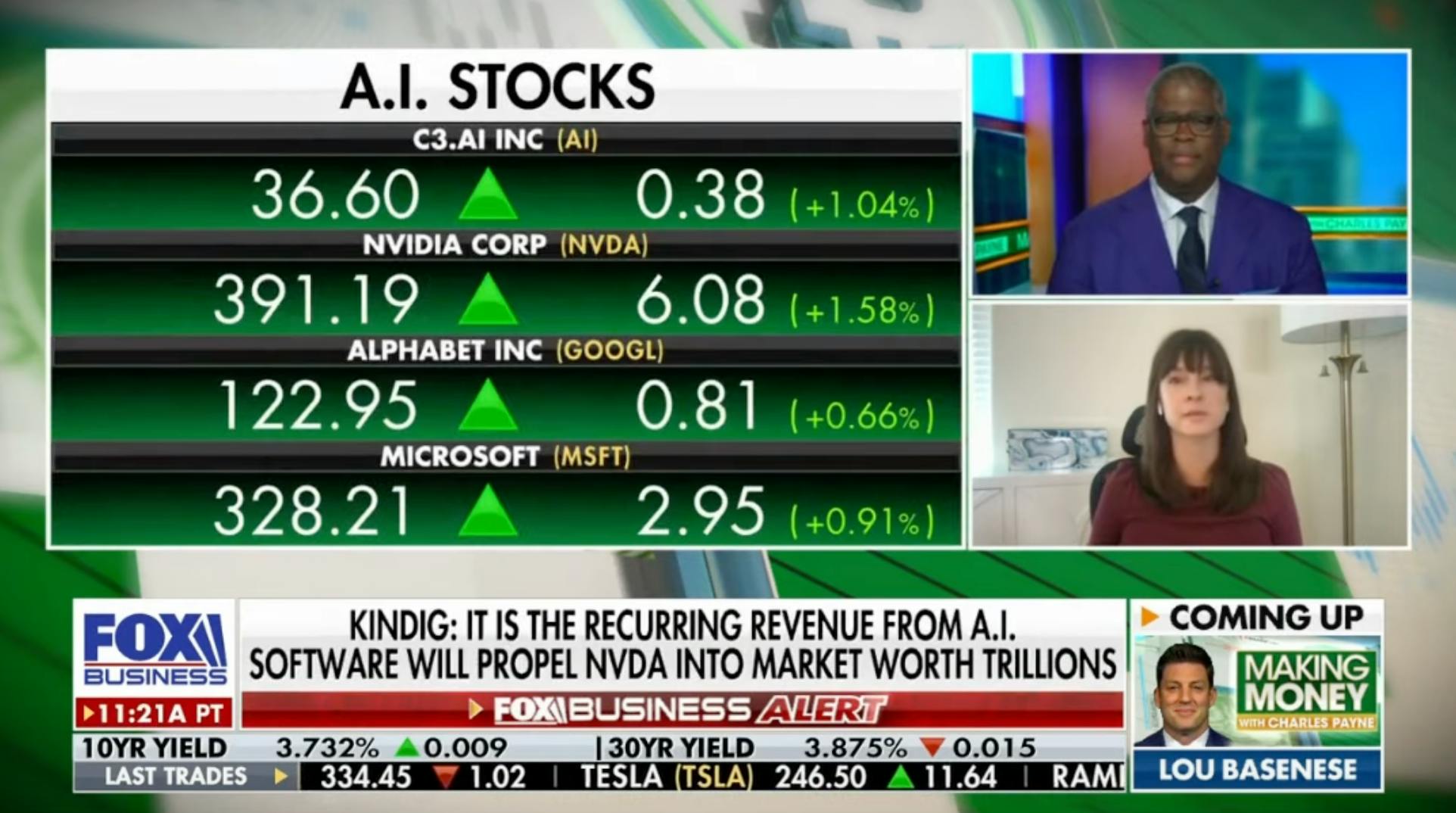
In the clip below, Beth Kindig discusses how AI will drive stock market caps well into the trillions of dollars.

Disclaimer: This is not financial advice. Please consult with your financial advisor in regards to any stocks you buy.

Recommended Readings:

AMD Q2 Earnings: ETA for AI Ramp is Q4 & 2024

AMD has been referencing a ramp for the data center in H2. Given that Q3 revenue growth is below expectations, this would imply that Q4 will have to really deliver.

AMD’s management reiterated “we do have that confidence” that there will be an “aggressive ramp in Q4 and 2024.” This was not the only statement on the topic, rather the quote we provided to premium members where management confirmed “50% year-over-year growth in the second half” was by and far the main focus of the call.

Notably, a large portion of the sales in Q4 will come from the El Capitan supercomputer, a highly anticipated launch that we discussed recently in our AMD Deep Dive.

The analysts that dug into the “50% year-over-year growth in second half” comment were trying to ascertain the following:

  • Is the 50% still valid despite the Q3 miss? If so, this implies +$700 million sequential revenue for Q4
  • Of this roughly $700 million for Q4, what’s the product mix between EPYC processors and MI300 GPUs
  • If El Capitan contributes “several hundred million” for Q4 then when will Tier 1 hyperscalers begin to drive sales for MI300 GPUs

In addition to these questions, which we outline below, the pertinent Q&A was on how much of a slowdown AMD is seeing for general purpose CPUs (Gen 3) as hyperscalers and the enterprise go through an optimization period. Here is what was specifically stated: “In the datacenter market, we see a mixed environment as AI deployments are expanding. However, cloud customers continue optimizing their datacenter compute and enterprise customers remain cautious with new deployments. Against this backdrop, we expect strong growth driven by higher fourth gen EPYC and Ryzen 7000 processor sales and initial shipments of our Instinct MI300 accelerators in the fourth quarter.”

Regarding Bergamo and Genoa-X specifically, management stated that Microsoft Azure is seeing “5X higher performance in technical computing workloads compared to their prior generation” and that Bergamo is delivering “more than double the performance than competitive offerings for cloud-native applications, while offering full x86 software compatibility.” As a reminder, Gen 4 CPUs went into production this quarter.

The MI300s will ship in Q4 with the competitive edge of more memory bandwidth and memory storage. This is ideal for the inference phase, which is used heavily by large language models. We detailed the MI300s in our deep dive here.

On the Client side, AMD has officially bottomed (barring any new, unforeseen circumstances). Management stated that “client segment will grow in the seasonally stronger second half of the year” including a launch of a dedicated AI engine for the mobile 7040 Ryzen CPUs. When discussing AMD’s AI opportunity, it is vitally important that we not lose sight of the opportunity AMD will have to expand its AI portfolio to the Client Segment. Hybrid AI architectures are coming (which means AI is going to go beyond the data center and expand toward the edge), and AMD will be at the forefront. As long as dollar content per chip is higher (which it will be), then AMD will benefit nicely in the next replacement cycle (and beyond). That is a record for parentheses in a paragraph!

For gaming, AMD has yet to bottom. The embedded segment will be weaker than usual over the next two quarters. This segment has been unusually strong post-Xilinx acquisition but is coming up on sky-high comps, so will be cooling off in the medium-term. Due to the M&A with Xilinx, AMD was posting 1,000% to 2,000% growth in the 2022 quarters.

Scorecard

All numbers for current quarter and YoY unless otherwise stated

Overall, everything was in line except the forward guide for Q3 was a miss. This is important because it means the pressure is on Q4 to deliver the H2 growth management had referenced in the prior Q1 earnings call. 

In addition to this, we want to see margins rebound quickly after Client and Gaming stabilize. In the past, the CFO has stated that the margins will return to normal when these two segments return to normal. The gross margin of 51% is in good shape but the operating margin of 0% is below AMD’s GAAP operating margin of 20% to 25% in the boom years of 2020/2021. Net margin of 0% compares the net margin of 15% to 20% in the boom years.

Although a tad vague, the CFO stated the following when pressed about the margins: “The model we leverage to generate profitability, we should be able to get back to 20%.”

EPS & Revenue:

EPS: Consensus estimates $0.57 versus $0.58 reported (in line)
Revenue: Mgmt midpoint guidance of $5.3B (-19% YoY) versus $5.4 billion reported for (-17%) growth (in line)
Next quarter revenue consensus of $5.85B versus $5.7B reported (miss)

Group sales by division (a reference guide of what was reported the last two quarters)

Data centers – $1.3B Q1 vs $1.3B in the current quarter (flat QoQ, down 13% YoY)
Client segment – $739m Q1 vs. $998 million in the current quarter (up 35% QoQ, down 54% YoY)
Gaming – $1.8B Q1 vs $1.6B in the current quarter (down 10% QoQ, down 4% YoY)
Embedded – $1.6B in Q1 vs $1.5B in current quarter (up 16% YoY, down 7% QoQ)

Gross Margins based on midpoint 

Mgmt adj guidance of 51% versus 51% GM reported (in line)
Mgmt adj $ guidance of $2.65B versus $2.665B reported (in line) 

Operating Margins based on midpoint 

GAAP operating margin of (-3%) last quarter versus 0% GAAP OM this quarter for (-$20M) in losses
Adjusted operating margin guidance of 19.8% vs versus 20% reported (in line) for $1.068B in profit

Cash flow + Cash 

Last quarter operating and free cash flow was $486M and $328M for a margin of 9% and 6%, respectively. This quarter, operating cash flow was $379M and $254M for a margin of 7% and 4.7%.

Earnings Q&A

As stated in the intro, there were many questions about the 50% growth in the second half comment from Q1. Here were a few of the more important discussions.

Matt Ramsay 

“Last quarter, you had given us some metrics around potentially being able to grow your datacenter business by 50% in the second-half of the year versus the first-half. And maybe you could give us a little bit of an update on how you're thinking about that milestone and the drivers of growth across CPU and accelerator for the back-half? Thanks.”

Lisa Su

“And we are still looking at a zip code of, let's call it, 50% plus or minus second-half to first-half. So, it's a big ramp, but when we look at all the components, I think that the customer pull is certainly there. And it's exciting to be in this part of the industry.”

When asked again about Q4, and whether the company has the supply to meet the demand, the CFO stated: “We feel that we have ample supply for an aggressive ramp in the fourth quarter and into 2024. But this is certainly one of the areas that we spent quite a bit of time to ensure that we do have that confidence.”

As stated in our AMD deep dive, El Capitan launches in November. Per management, this will contribute “several hundred million” in revenue for Q4. Of the obstacles that AMD must overcome, our analysis made it quite clear it was the software part of the equation that AMD must solve.

Per management: “There is a sort of large, call it, lumpy supercomputer win, so our El Capitan win will be in the fourth quarter primarily, with a little bit in the first quarter” and later it was stated by management: “You can assume that the El Capitan is several hundred million” of the Q4 data center revenue. Ideally, AMD announces commercial customers soon. I’m sure Meta will be one of the first customers, considering the company has been ordering Bergamo from AMD, was on stage at AMD’s conference recently in June, and PyTorch is optimizing its framework for AMD’s software stack RocM. It’s just a guess at this point, but that’s a lot of collaboration.

Conclusion:

AMD has high institutional ownership of +70%, which exceeds many of the FAANGs. The reason is that it’s a tough company to cover and retail investors avoid AMD for this reason. There are many moving pieces with exposure to a handful of major markets, a wide variety of customers, deceivingly lumpy revenue, known to be in second place against 800-pound gorillas, plus trying to figure out where AMD fits requires understanding of both hardware and software.

While some are offput by AMD’s complexity compared to Nvidia’s simple, straightforward thesis, this company has all of the ingredients to be a major AI player. As you’ve probably heard already on the quarterly webinars, my stance is there will be fewer winners in AI compared to other microtrends, and so to find a company like AMD will be quite rare.

Also, as a gentle reminder, Nvidia’s H100 started shipping in Q4 of last year and it took until April for there to be a “wow” moment. I can’t guarantee a “wow” moment will happen (my personal speculation is that it will happen), but this provides investors a minimum time frame of what to expect for Tier 1 hyperscalers to ramp orders after qualifying the two new accelerators.

Rather than pinpoint an exact month or quarter, let’s just say that 2024 should be the year that AMD puts up notable AI revenue. Those are my words. Here is management’s way of saying it: “So, we would expect early deployments as we go into the first-half of 2024, and then we would expect more volume in the second-half of '24 as those things fully qualify.” 

 Recommended Readings:

AMD Pre-Earnings Q2: Management Confidence is High for H2

We recently published a deep dive on the potential of AMD’s MI300s here. In the medium-term, starting later in 2023 and into 2024, we laid out reasons why we are very positive about the competitive and financial opportunity it presents for AMD.

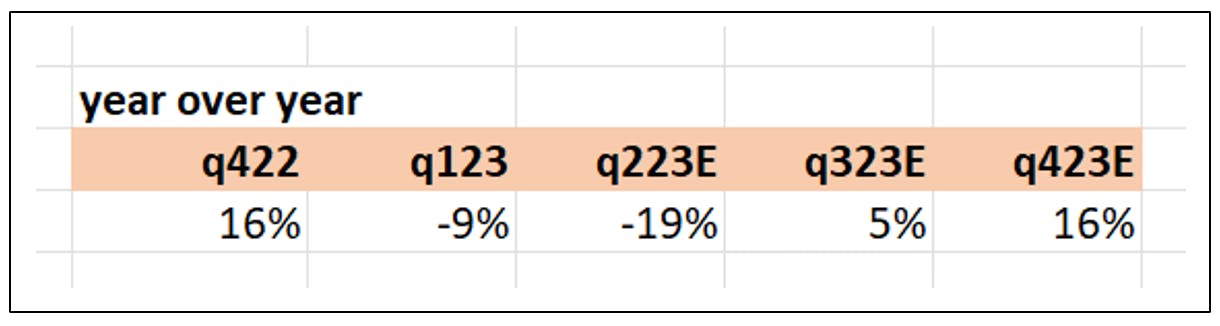
In the short-term, AMD faces a delicate balancing act of confronting weakness in PCs while providing assurances of a 2nd half rebound and acceleration into 2024. In that regards, AMD Q2 earnings report will be closely watched for evidence of this. For the past 3 months, analysts have steadily reduced their quarterly earnings estimates to reflect weakness from the consumer-facing PC segment. However, the multiple has expanded in part due to the optimism surrounding AMD’s AI opportunity. It’s also helpful that AMD continues to take market share from Intel on CPUs, which we’ve covered extensively.

Here are the Q2 estimates going into earnings announcement on 8/1 (amc).

All numbers for current quarter and YoY unless otherwise stated

EPS & Revenue:

  • EPS: Consensus estimates $0.57 vs $0.60 last quarter
  • EPS: Next quarter consensus estimates $0.74
  • Revenue: Mgmt midpoint guidance of $5.3B (-19% y/y) vs Consensus of $5.32B
  • Next quarter revenue consensus of $5.32B
  • Full year revenue consensus of $23B (-2.5% y/y)

Group sales by division (a reference guide of what was reported the last two quarters)

  • Data centers – $1.3B Q123 vs $1.7B Q422  
  • Client segment – $739m Q123 vs. $903m Q422
  • Gaming – $1.8B Q123 vs $1.6B Q422

Gross Margins based on midpoint

  • Mgmt adj guidance of 51% vs last quarter of 50% actual
  • Mgmt adj $ guidance of $2.65B vs last quarter of $2.68B actual 

Operating Margins based on midpoint

  • Mgmt adj op margin guidance of 19.8% vs last quarter of 21% actual
  • Mgmt adj operating margin $ guidance of $1.6B vs last quarter of $1.1B actual

Cash flow + Cash

  • Last quarter operating and free cash flow was $486B and $328B for a margin of 9% and 6%, respectively
  • Last quarter cash stood at $2.8B and $333m in debt

Here are the things we’ll be looking for:

Will Q223 mark the bottom?

The market will be looking to see if this is the bottom in yearly revenue growth

And improvement on a sequential quarterly basis.

When an anticipated bottom is approaching, a beat can be aptly rewarded. Also, the opposite, a miss can be severely penalized. The reason the pressure is on when a bottom is expected is because a beat often translates to a quicker recovery where a miss at this junction translates to a slower or delayed recovery. Our goal is to see AMD come in as expected (at least) and offer strong commentary on H2.

In providing their Q223 guidance, this is how AMD described the factors driving y/y decline and improvement (less negative) sequentially.

“Now turning to our second quarter 2023 outlook. We expect revenue to be approximately $5.3 billion, plus or minus $300 million, a decrease of approximately 19% year-over-year and approximately flat sequentially. Year-over-year, we expect the Client, Gaming and the Data Center segment to decline, partially offset by Embedded segment growth. Sequentially, we expect Client and Data Center segment growth to be offset by modest Gaming and Embedded segment decline.”

Data Centers:

AMD has indicated the decline in Data Center revenue was primarily due to lower enterprise server processor sales plus some inventory correction: “Data Center segment revenue of $1.3 billion was flat year-over-year with higher cloud sales offset by lower enterprise sales. In cloud, the quarter played out largely as we expected. EPYC CPU sales grew by a strong double-digit percentage year-over-year but declined sequentially as elevated inventory levels with some MDC customers resulted in a lower sell-in TAM for the quarter.”

However, due to the visibility AMD has, H2 is expected to be quite strong – note, that doesn’t necessarily help us AMD investors with Q2 but it’s good to know management is expecting a shift on the horizon in terms of growth. You may recall that we pulled out the conversation below because we felt it was important to portray management’s confidence level for H2 growth rates. You can view more important quotes from the last call on our post-earnings write-up here.

Question

“So you said double-digit Data Center. Was that a full year statement? Or was that a second half year-over-year statement? Or was that a half-over-half statement for Data Center?”

Lisa Su

“Yes. Let me be clear. That was a year-over-year statement. So double-digit Data Center growth for the full year of 2023 versus 2022.”

Question

“Got it. Which just given what you did in Q1 and sort of are implying for Q2 needs something like 50% year-over-year growth in the second half to get there. So you're endorsing those — you're endorsing that now?”

Lisa Su

I am…

Jean Hu

Yes, your math is right.

Client and Gaming Segment

The decline in these 2 segments will be less compared to Data Centers. Per AMD’s CFO Jean Hu:

“Client and Gaming segments would be seasonal. So you would expect that the Data Center would be more than seasonal. So maybe to help you size that, think about the Data Center sequential drop as double digit, whereas the Client and the Gaming segments are more like single digit, if that helps.”

PCs will be an important factor for both the Client and Gaming segment. AMD’s plan to navigate PC weakness was to under ship for a quicker rebound, which was Nvidia’s strategy for gaming. This makes it more painful in the short term but sets up a better recovery in the long term. According to management, this is the bottom for PCs and they expect a rebound in H2.

In Intel's Q223 earnings call, they gave positive indications that the pc environment was improving.

“We have worked closely with our customers to manage client CPU inventory down to healthy levels. As we continue to execute against our strategic initiatives, we see a sustained recovery in the second half of the year as inventory has normalized.” 

Profitability

Despite the decline in sales, AMD has been able to maintain steady gross margins. For Q2FY23, AMD has guided for an adj gross margin guidance of 51% vs Q123 of 50% actual vs Q422 of 51% actual.

If Q2 is in fact the bottom, we will look for comment on what levels of profitability can be achieved when these segments return to growth.

MI300 release – We’ll listen for any updates on MI300 which is due to be released in Q4 and is expected to contribute to revenue by early 2024. You can read more about these highly anticipated GPUs in our most recent analysis here.

Here’s what analysts are saying

07/31 Susquehanna analyst Christopher Rolland lowered the firm's price target on AMD to $135 from $145 and keeps a Positive rating on the shares. The firm previewed AMD's Q2 results and said they face a number of near-term headwinds including softer Genoa, console, GPU, Xilinx and an elevated DC expectation, putting Street estimates at risk. However, longer term Susquehanna loves the server gain and MI300 opportunities.

07/26 Citi sees "bad news" for Intel (INTC) and AMD (AMD) in the earnings reports from three of the largest cloud service providers – Alphabet (GOOG, GOOGL), Meta (META), and Microsoft (MSFT). Meta lowered 2023 capex 10% and Alphabet's Q2 capex was lower than anticipated, the analyst tells investors in a research note. Microsoft's fiscal Q4 capex of $8.9B beat the consensus of $8.1B, but the company didn't provide a full year capex guide for fiscal 2024, adds the firm. It believes the Street was expecting a raise in capex given the strength at Nvidia was expected to broaden out to other artificial intelligence chip suppliers. Citi is below consensus on AMD as it expects the company to lower Q3 guidance given weakness in the data center market. It has a "negative catalyst watch" on AMD and remains Neutral rated on both AMD and Intel.

07/26 Jefferies analyst Mark Lipacis said that Microsoft's (MSFT) and Alphabet's (GOOGL) comments regarding capex and AI spending on their earnings calls lead the firm to believe that its "above-consensus" Nvidia (NVDA) estimates "may prove conservative." The firm, which notes that "AI" was mentioned 170 times on the calls, which is twice the rate in the companies' Q4 reports, views Microsoft's and Alphabet's commentary as positive for Nvidia as well as AMD, Intel, Marvell and Broadcom.

Note: Read our takeaway that is similar to Jefferies’ Mark Lipacis that capex comments were positive on Google’s call here and Microsoft’s call here

07/11 KeyBanc analyst John Vinh raised the firm's price target on AMD to $160 from $150 and keeps an Overweight rating on the shares. While near-term challenges associated with delays of its MI300 AI server and stability issues with its PC NB Ryzen Phoenix could result in near-term risk to estimates, AI server wins give KeyBanc high conviction that AMD could see well over $2B in AI revenues in 2024.

07/12 TD Cowen analyst Matthew Ramsay raised the firm's price target on AMD to $135 from $115 and keeps an Outperform rating on the shares. The firm believes investors are prepared for a mixed Q2/Q3 on revenue and margins as the macro remains challenging. The firm adjusted 2H estimates to be more 4Q-weighted. and they believe investor focus post earnings will again turn longer-term to AMD's strong Datacenter prospects, including a crystallizing AI strategy supported by stronger HW/SW roadmaps. 

(06/14) Goldman Sachs raised the firm's price target on AMD (AMD) to $137 from $97 and keeps a Buy rating on the shares after the company's Data Center & AI Technology Premiere event. The analyst states that the firm was encouraged by AMD customers' endorsements and continues to model share gains for AMD in server CPUs primarily at the expense of Intel (INTC), adding that AMD should grow into a credible second supplier over the medium- to long-run.

How we plan to handle our position will be posted in real-time on I/O Fund Advanced Market Signals

The I/O Fund Analyst Team contributed to this analysis
 Recommended Readings:

NASDAQ REBALANCE: WHAT YOU NEED TO KNOW

This article was originally published on Forbes on Forbes Forbes on Jul 28, 2023,12:07am EDT

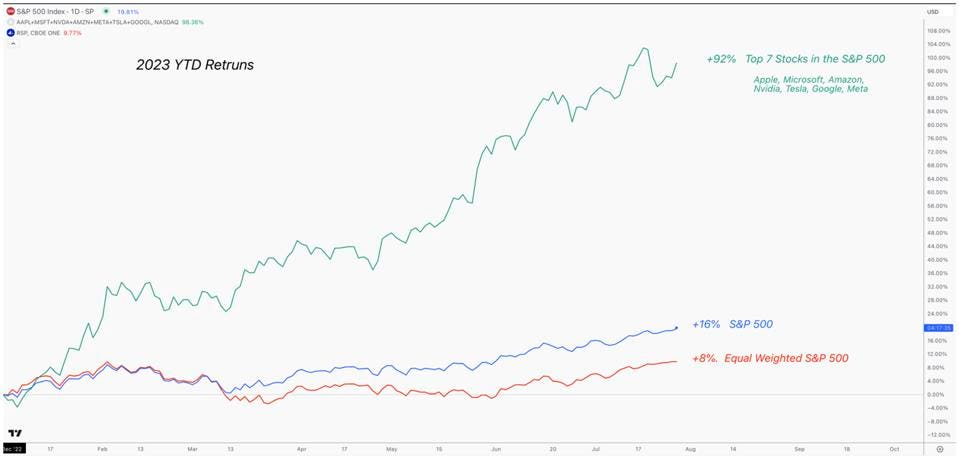
On June 30th, the NASDAQ posted the strongest first six months in the index’s history, dating back to 1971. The 6-month returns of 30.5% in 2023 easily beats the prior record of 25.2% in 2019. The majority of the rally was driven by seven stocks: Apple, Microsoft, Nvidia, Amazon, Tesla, Meta, Google. These 7 stocks are up a collective 98% YTD, while the equal weight S&P 500, which provides an equal weighting to all 500 stocks in the index, is up only 9%.

Tech Stock 2023 YTD Returns

Source: I/O Fund

Sign up for I/O Fund's free newsletter with gains of up to 221% – Click hereClick hereClick here

This level of narrow leadership continues to pose a problem for active managers who are more diversified than the NASDAQ-100. In fact, by Q1 of 2023, only 1/3 of active managers were ahead of their benchmark in 2023.

As a result, the NASDAQ is being forced by the SEC to rebalance their tech-heavy index, the NASDAQ-100, which will shift the focus away from the top seven stocks in the market, and redistribute weightings to less popular names in the index, like Starbucks and Broadcom, to name a few.

The reason for the rebalance is due to the Magnificent Seven taking up 55% of the Index’s weighting prior to the rebalance. Here was the NASDAQ-100’s weighting prior to the rebalance (as of July 18)

MSFT – 12.7%

AAPL – 12.1%

NVDA – 7.4

GOOGL – 7.3%

AMZN – 6.8%

TSLA – 4.5%

META – 4.4%

On July 14th, the new weighting was announced: NVDA and MSFT would receive the biggest cuts of about 3% each, while AAPL only got shaved by 1% (making it the new top position). Google was cut by 2%, while META and TSLA by 1%. The new rebalance dropped the overall weighting from 55% to ~38%. The NASDAQ-100 topped about 4 days later, and has since been in a minor correction.

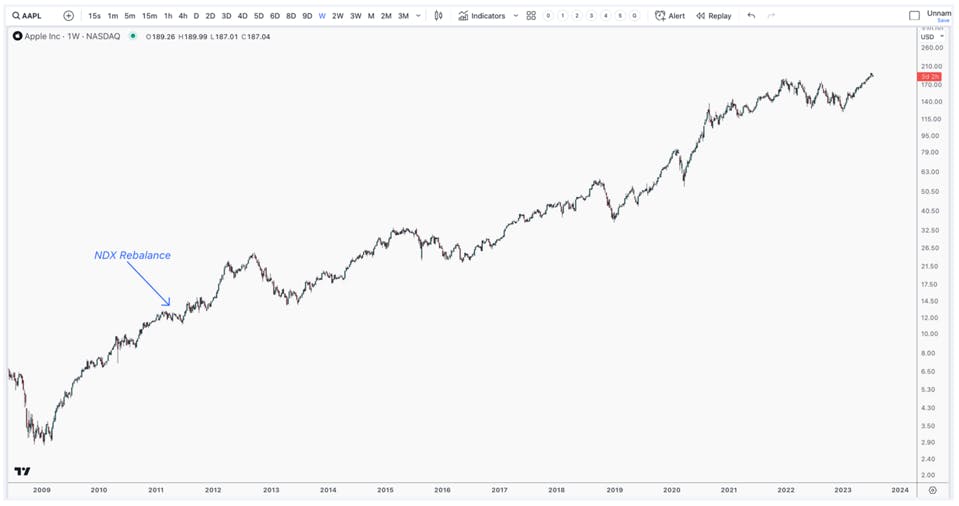
Being a static index, a rebalance is a rare occurrence, as it has only happened twice since 1998. The last time was in April of 2011 and was focused on Apple’s outsized weighting in the index. At the time it accounted for just over 20%, and was rebalanced back to 12%. Below shows when this was announced and how it affected the stock. Though the macro environment was much different in 2011, it’s worth noting that Apple had an immediate dip that was quickly bought.

Every Thursday at 4:30 pm Eastern, the I/O Fund team holds a webinar for premium members to discuss how to navigate the broad market, as well as various stock entries and exits. We offer trade alerts plus an automated hedging signal. The I/O Fund team is one of the only audited portfolios available to individual investors. Learn more here.Learn more hereLearn more here.

Apple Chart - NDX Rebalance

Source: I/O Fund

We believe this is worth monitoring as $209 Billion is currently in QQQ, an ETF that tracks the NASDAQ-100. This means that MSFT, for example, lost $18.8 Billion in demand from this single ETF having to rebalance in accordance with the new changes. Furthermore, many institutional funds are benchmarked to this index, and are in the process of rebalancing their portfolios to coincide with these changes, which should further affect demand.

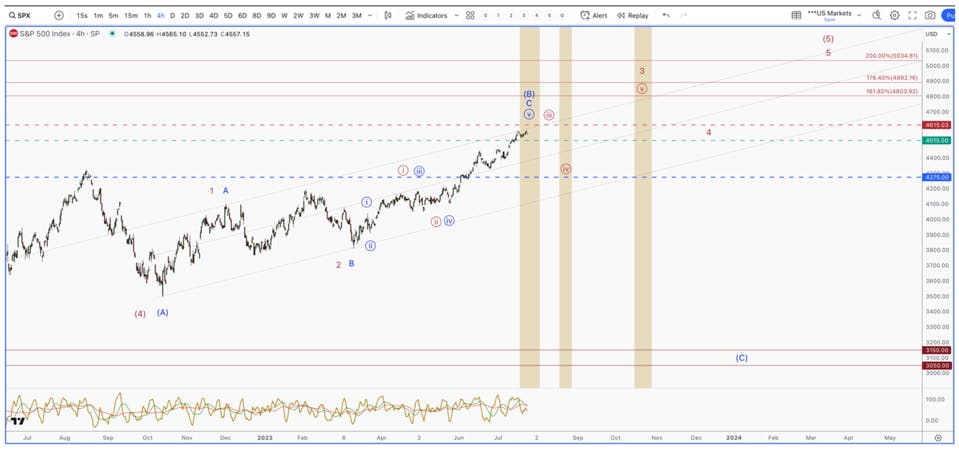
Our current take on the market is that if SPX break below 4515, then the market has likely topped. Below 4275 and SPX has put in a big top and this would be bearish. On the other hand, if 4275 is defended, then our firm will layer into more stocks as this would be bullish. The level of 4275 is of critical importance and we will update our Premium Members with our buy plan if we get here.

S&P 500 Chart

Source: I/O Fund

I/O Fund Portfolio Manager, Knox Ridley, contributed to this article .

Recommended Reading:

Microsoft FYQ4: Cooling Off Before AI Heats Up

Let’s be real, the Nasdaq has rallied more than it has in its 52-year history off fairly unimpressive top line growth in the tech industry and minimal to no earnings growth.

Although fellow growth investors have greatly benefited, we shouldn’t be surprised if the buying is exhausted at the moment. The reaction to Microsoft’s earnings is a clue that this could be the case.

Microsoft was in line for this quarter. However, the guide was a tad weak at $52.3 billion compared to $54.5 billion. It’s also important to note that estimates had been coming down going into the ER. We had consensus of $54.9 billion a month ago.

The operating margin of 43.3% is expected to be flat moving forward, which is good news for AI chip investors such as ourselves, because some of the capex is going toward data center buildouts and outsized AI demand. Also, Microsoft has a strong margin right now so flat is certainly acceptable. Part of Microsoft’s strong margins comes from extending the useful life of their servers and equipment, which we’ve covered in the past

Psychologically, Azure dipping below Google Cloud revenue growth rate for the first time is not ideal. The reality is that Azure is growing at a similar growth rate on a much higher revenue base, but headlines will take hold of these oversimplified percentages. Within Azure, AI contributed 2% and management stated this is the number to watch moving forward. Regardless, if optimizations end and we see recurring software from AI kick-in, we should see Azure bottom and accelerate in growth in calendar year H1 2024. This is key for MSFT investors. Reference more notes below.

Copilot 365 is among the top reasons to remain invested in Microsoft. For $30/per user per month, enterprises can increase developer productivity by 40% to 50%. It sounded like this will be in general availability by FYH1 with results showing in FYH2 (which is calendar year H1 2024). Having deep pockets to acquire GitHub, and then rolling-out CoPilot 365 is an example of AI being a winner-takes-all market; which is that these acquisitions were carefully placed years ago.

Similar to our note on Google last night, Microsoft’s capex comments spell good things for our particular holdings in the semi-industry. With this level of exposure, these comments are arguably more important for IOF Members than Microsoft’s individual results. The market will go up (and down), but as long as capex increases, we should be in good shape with our current holdings.

There are additional questions from analysts noted below about when optimization will potentially end, when Azure will increase its growth rate, and when AI will start to affect revenue. All of these are important to note, and the pertinent Q&A is highlighted for you below.

Scorecard:

Figures are for FYQ4 ending in June and year-over-year, unless otherwise stated:

Revenue and EPS:

  • Consensus earnings of $2.54 versus $2.70 EPS Reported
  • Midpoint guidance of $55.35B (+7 y/y) and Consensus of $55.42B versus $56.2B Reported
  • FY24 Q1 consensus of $54.53B versus FY24 Q1 Guidance of $54.250B

Microsoft sales guidance by division 

  • Azure & other cloud – +26-27% y/y in constant currency, includes about 1% from AI services versus 26% Reported and 2% from AI Services
  • Productivity & Business Processes – $17.8B to $18.28B, +8.7% midpoint. CC guidance is 10% to 12% versus $18.3B up 10% and 12% on CC Basis
  • Intelligent Cloud – $23.6B to $23.9B up 13.6% midpoint, CC guidance is 15-16% versus $24 billion, up 15% and 17% on CC Basis
  • Personal Computing – $13.35B to 13.75B, (-5.6%) y/y at midpoint versus $13.9 billion (-4%) and (-3%) on CC Basis.

Margins

  • Q4FY23 MSFT gross margin of guidance of 69.5% vs Q323 of 69.5% actual vs Q223 of 67% actual versus 70.1% Reported
  • Q4FY23 MSFT operating margin of guidance of 42.1% vs Q323 of 42.3% actual vs Q223 of 41% actual versus 43.3% reported 

Cash flow + Cash 

  • Q3FY23 operating and free cash flow was $24.5B and $17.8B respectively versus $28.7B and $19.8B
  • Q3FY23 cash stood at $104B and $48B in debt versus $111.3B in cash

Earnings Call:

The number 1 question is this — when will Microsoft begin to realize strong growth from AI? Given AI has been the primary driver in this historic Nasdaq rally, we want to make darn sure there is AI revenue on the way (and soonish). I think some investors are going to get burned by piling AI stocks far too early, for example. But for Microsoft, we are a mere 9-12 months out. I’m including the quote below because this analyst is unfiltered in terms of how exciting the modeling can become:

Karl Keirstead

Okay, great. Amy, if I could double-click a little bit on the exciting news around M365 Copilot as everybody on the line looks to layer that opportunity into our models, I just wanted to get your views. Are there any guardrails you'd offer us to sort of keep us in line? Is there a degree of gross margin pressure in the Office segment? In other words, is it a fairly cost-intensive new product that we should keep in mind? And also, could it pull along Azure in the sense that you need Azure AD and perhaps some of the other cybersecurity products? So a little color there might help everybody with their modeling exercise tonight and in the coming weeks.

Amy Hood

Thanks, Karl. I think maybe I'll first start with the process we have when we release new products. And I absolutely understand we are excited, too, by the demand signal, the customer reaction, really the requests we're getting to be in the paid preview. It's all encouraging. As you know, we've — last week, we announced pricing, then we'll continue to work through the paid preview process get good feedback. Then we'll announce the general availability date, then we'll get to the GA date. Then we'll, of course, be able to sell it and then recognize revenue.

And that is why I continue to say that I am just as excited as everyone else about this, and it should be more H2 weighted. And we've, I think, given you some sizing opportunities. And I think I would use all that. But I do think this is really about pacing. And of course, we've still got to get our Security Copilot and some of the Dynamics workloads priced and released. And we'll continue to work toward that.

My note: this is calendar H2, so within 9-12 months, we should have a decent start on what AI can do for Microsoft on recurring software.

This is a brief comment on when cloud optimizations will end—which should be the perfect storm if we can get cloud to resume growth and then AI layered on top: “I think, in the next couple of quarters, what is the last catch-up optimization.” My note: I imagine this also means 9-12 months out.

Similar to Google, the comments on capex were bullish:

To support our Microsoft Cloud growth and demand for our AI platform, we will accelerate investment in our cloud infrastructure. We expect capital expenditures to increase sequentially each quarter through the year as we scale to meet demand signals.”

Later, it was also stated: 

“And we do expect, as you asked and Satya talked about, the pace of this adoption curve, we do expect to be faster. So you're seeing the CapEx spend accelerate in Q4 and then again in Q1, and we've talked about what it should look like the rest of the year” and then also: “So it's why I do comment quite often that it's both overall Commercial Cloud demand and building out capacity for AI. It's both.” My note: That’s bullish for AMD, as well, in terms of CPUs.

The CEO also stated this, which I think is interesting for our particular holdings, which is that the rate of investment is higher than the Cloud growth rate right now. “Yes. And I think just for perspective, I think it's sort of always good to think about it, right, where we have, what, 111 [billion] commercial cloud business growing at, what, 22% year-over-year. And then you had a CapEx growth, which is around the same number, 23%, 24%. So in some sense, it's sort of replacement capital plus some new capital that is going to drive new growth.” My note: keep it coming on the capex! ☺

Lastly, Microsoft expressed they believe they are the best data platform on the market. Of course, this is biased but I want to earmark this for as we go along because the argument the CEO is making is important:

“I mean to give you a flavor for it, right, so you have your data in an Azure data lake. You can bring SQL Compute to it. You can bring Spark to it. You can bring Azure AI or Azure OpenAI to it, right? So the fact is you have storage separated from all these compute meters, and they're all interchangeable, right? So you don't have to buy each of these separately. That's the disruptive business model.”

Conclusion:

I chose to cover Google quickly last night because Microsoft (as always) came in as-expected. This is not a dramatic stock to own, rather is a good choice for those who prefer their drama comes elsewhere, and outside of their pocketbook. 

The Nasdaq is due for a breather and I’m kinda hoping for a selloff so we can load up at lower prices in the Fall and Winter. Amy Hood has archery-like skills when she provides guidance – she hits the bullseye on her numbers frequently. Because it’s coming from her, I have it written in ink to expect AI revenue to appear in calendar H1 of 2024. The remaining question of how to best position (and when) will be answered through Knox’s notes and trade alerts on Advanced Market Signals. 

  Recommended Readings:

Alphabet Q2 Earnings: More on the Year of Execution

Alphabet impressed on the top line with revenue of $74.6 billion compared to estimates of $72.7 billion. This resulted in growth of 7%, or 9% on a constant currency basis, compared to 4% expected.   What is important to note is that Alphabet is rebounding on margins and has now returned to the percentage they were at in Q1 2022.

This is important because margins had contracted about 500 basis points at their trough with a 23.9% operating margin in Q4 and have now returned to a 29% operating margin. This is a QoQ increase of 400 basis points. Operating profit of $21.8 billion matches Q4 of 2021 for record operating income. Cash flow margin was also up 440 basis points.

In our pre-earnings write-up, we highlighted that Alphabet was in the Year of Execution when we said: “One of the reasons the IO Fund has invested in larger cap stocks is that they are in a better position to navigate downturns. Big Tech also has more levers to pull to manage margins such as reducing operating expenses. Importantly, at the same time they have the financial strength to make the investments required to capitalize on the AI opportunity and take market from its weaker competitors. The medium-term bull case is that once top-line begins to meaningfully reaccelerate, the combination of right-sizing costs and efficiencies garnered from technology investments leads to expanding margins.”

Also, per our pre-earnings write-up, the CFO has said in the past they are in “Execution mode” in reducing costs and this will be evident not only in 2023 but “you will see more of it in ‘24.” 

Management comments on the QoQ strength in margins were: “A quick comment on the sequential improvement in operating margins in the second quarter. There are two factors to note. First, the benefit from an acceleration in search advertising revenue growth in the second quarter. Second, the vast majority of the charges related to our workforce reduction and optimization of our global office space were taken in Q1.”

Another highlight we were looking for, per the pre-earnings write-up, was stabilization in YouTube and increased growth in Search revenue. Both materialized with Search up 5% and YouTube up 4%. These numbers are small for growth investors such as ourselves, but they also represent the strongest growth Google has reported in a year. We entered our current position with the idea that  Google has bottomed and will accelerate from here. 

Network advertising was weak at (-5.7%) but this is to be expected as mobile identifiers continue be sorted out and first-party data driven ads are more favored. Other revenues was a bright spot, up 24% and driven by “significant subscriber growth” for YouTube subscriptions plus the Pixel 7A.

Google Cloud was “better than peers” at 27.4% growth for an operating margin of 5%. The operating margin is double what it was last quarter, which was the first quarter to turn a profit. This is a positive on the evening of Microsoft’s report as Azure dipped below Google Cloud’s growth rate at 26%.

The CFO is moving to the new role of President and Chief Investment Officer.

Scorecard:

Stated in YoY growth % unless otherwise stated:

EPS and Revenue:

  • Consensus of $1.34 (+11% y/y) vs $1.45 EPS Reported
  • Consensus of $72.75B (+4.4% y/y) vs $74.6 billion Reported and 7% growth/9% on CC Basis 

Sales by division in Q123 versus Q223:

  • Google Search and other advertising – 2% versus 5% Q2
  • YouTube advertising  – (-3%) versus 4% Q2 
  • Network advertising – (-8%) versus (-5.7%) Q2 
  • Other – +9% versus 24.2% in Q2
  • Google Cloud – +28% versus 27.4% in Q2

Margins: 

  • Q1FY23 gross margin of 56.1%% vs Q422 of 53.5% vs Q323 of 54.9% versus Gross Margin of 57.20% in Q2
  • Q1FY23 operating margin of 25% vs Q422 of 23.9% vs Q322 of 24.6% versus Operating Margin of 29% in Q2

Cash flow + Cash:

  • Q1FY23 operating and free cash flow was $23.5B and $17.2B for a margin of 33.7% and 24.7%, respectively versus 38.40% op cash flow and 29.10% FCF in current quarter

Earnings Call:

Perhaps the most important question is why did Google grow this quarter when other ad-tech players are slowing down (or expected to slow down).

The answer was: “a lot of companies are focused on profitability, driving efficiencies, and they're carefully evaluating the effectiveness of their budgets. And our goal is really to help them maximize efficiency and drive strong ROI. And I think we have the proven AI-powered tools and solutions to actually do it. I called out Search and Other revenues being led by solid growth in the retail vertical. We talked about the DR and brand side on the YouTube side. I think those are the key points I would make.”

There were the obligatory questions about AI, of which this is probably the most important quote:

“It is an exciting moment overall in Cloud because there is definitely a lot of interest from customers on AI, and they definitely are engaging in many more conversations with us. So I would say, without commenting on the short term, but when I think about it long term, I view the AI opportunity as expanding our total addressable market and allows us to win new customers. Scale of investments that we can directly bring to cloud now. As I said earlier, we have over 80 models across Vertex, Enterprise Search and Conversational AI, and we are taking all of them, translating it into deep industry solutions. So, I'm excited about it. Second, it gives us an opportunity to upsell and cross-sell into our installed base.”

As Nvidia, AMD and Marvell investors (as a proxy), we want to keep an eye on capex. The comments were quite bullish in that regard:

“[..] that's why we wanted to be really clear that we do expect elevated levels of investment in our technical infrastructure, and that would be increasing through the back half of 2023, consistent with the comments we've made previously that we expected 2023 to be higher given the slower start at the front half of the year and then continuing to grow into 2024 [..] And the primary driver of this, as you know well, is to support the opportunities we see in AI across the Company, including the investments that we've already talked about, proprietary TPUs, all that we're doing with GPUs as well as data center capacity. And as we continue to see the pace of innovation accelerate, we just want to make sure we're positioned to address the opportunity across Alphabet.”

Conclusion:

We write out a lengthy and thorough pre-earnings report so our Members are aware of what to look for, and what in our eyes constitutes a strong report (or a weak report). It also helps us to eliminate biases. If a company isn’t up to par on the criteria we objectively set forth prior to the call, then we have to trim. Or, if a company clears a bar we set, then we look to add.

Suffice to say, Google has cleared the bar we set forth for our Members on Monday. You can look for us to add to this position soon.

Recommended Readings: