Why We’re Skipping Coinbase and Prefer Voyager Digital: Overview of Crypto Trading 

Voyager Digital is a smaller cap that gives investors exposure to the Bitcoin and crypto trading trend at a reasonable valuation. The company offers zero commissions and more coins than its competitors, including the rumored $100 billion market cap Coinbase that is going public soon, Kraken and Gemini. The stock is listed on the OTC market, which is higher risk than the Nasdaq as these stocks tend to be thinly traded.  

Voyager is a zero-commission competitor to Robinhood, and due to many PR mishaps, has opened a door for Voyager to become a replacement for customers who seek fewer politics around their crypto trading app.

Voyager also comes with the added benefit of offering 9% interest on stable coins as the company is a consortium for stable coins, including USD Coin (USDC) and Tether’s USDT, which have surpassed $7 billion in circulation.  As such, it provides exposure to decentralized coins like Bitcoin and stable coins based on the fiat system.

Although I am personally in favor of decentralized crypto and not stable coins, Big Tech and the Fed are likely to put immense pressure on adopting stable coins. Voyager allows investors exposure to both at a market cap of $2.18 billion, at time of writing. You can read my Facebook Libra article here where I am especially against this company entering the stable coin market.

Below we explain what makes Voyager a compelling investment, including what it does, how it makes money, valuation, catalysts, management, and potential risks.

Voyager: Zero Commissions, More Coins

As longtime crypto investors, we know all too well the issues around Coinbase and the other sites. The primary issue is the commissions that Coinbase charges, which are exorbitant to say the least. To make a $5000 trade on Coinbase, you will be charged about $80 in commissions. This isn’t competitive in an environment where stocks are traded at $0.

Voyager does not charge commissions on crypto trades and offers 9% interest on stable coins. One thing to note is that Voyager does not offer insurance like Gemini, and that our fund does not hold large amounts of crypto on trading platforms. Instead, we store crypto in cold storage wallets and use trading platforms for trading only. We discuss how Voyager makes money below, the differences in crypto platforms and how investors typically store their crypto below.

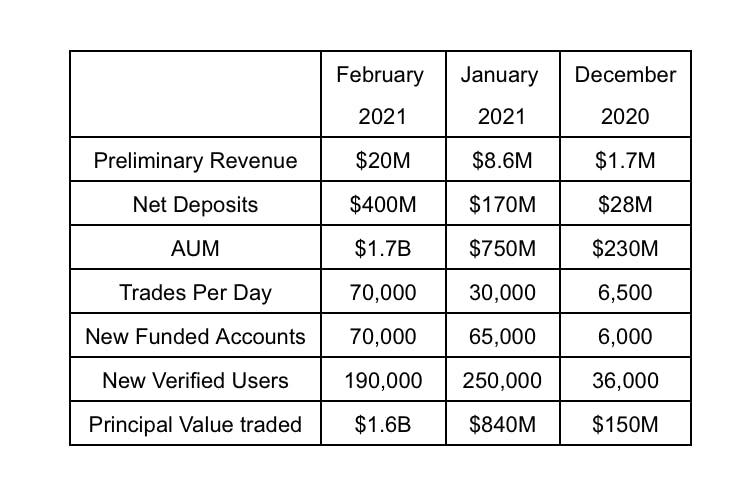
The fallout with Robinhood over GameStop has created an influx of customers for Voyager. Total revenue growth between December and February was over 1000% from $1.7 million to $20 million in monthly revenue.

Please note, my readers often ask me about the volatility of crypto and my answer to this is that crypto promises to be some of my most volatile investments. Stocks and crypto prices can drop 60% or more – and this has happened since my official coverage on bitcoin when it was priced at $12,000 and saw $4,000 before finding a base. You can read my past coverage here on Bitcoin in the summer of 2019.

Financial Overview

Although Coinbase was first to market, there is plenty of room for competitors to disrupt the company’s non-existent customer service and excessive commissions. For those who don’t trade crypto, you might be surprised to know that after paying such high fees, you are given no customer service whatsoever. The I/O Fund prefers Gemini as a commission-based platform as there is insurance offered to offset the cost of commissions.  

Voyager is FDIC-insured. However, the crypto held with Voyager is not insured. Gemini, which operates as a trust, has private insurance. Like us, crypto investors generally store their assets on a cold storage crypto wallet, which means it is not connected to the internet. In the event there is no insurance, the risk to cold storage wallets is minimal.

Significant Growth from Robinhood Tailwinds

Crypto investors are a tightknit community and we think word-of-mouth will grow nicely in this niche as it actively looks for new platforms. In December, the company reported $1.7 million in revenue and has grown to $8.5 million in January of 2021.

The company reported $2.5 million in revenue from Feb. 1 to Feb. 4—which we predicted could lead to $17 million in revenue in February. The company exceeded this and reported $20 million in revenue for February.
robinhood tailwinds growth rate data

Assets under management (AUM) grew from $230 million in December to $800 million by early February. Total assets under management by the end of February was $1.7 billion.

Trades per day averaged more than 30,000 for the month ending Jan. 31, up from approximately 6,500 in Dec. of 2020, representing 450% growth in daily trade volume. By early February, daily trades averaged 60,000 trades per day or nearly 1000% growth. In the March earnings report, the company reported a total of 70,000 trades in February.

In January, the value of customer trades increased over 500% to $840 million, up from $150 million in December of 2020. Over twelve months, the overall number of trades increased from 8,500 trades in December of 2019 to 1 million trades in January of 2021, an increase of 117,000%. This number may be irrelevant as most of this is priced in right now, yet we think it's important to look at the ongoing strength before the Robinhood issues.

Basic users grew from 150,000 in December to 440,000 by early February. The company reported 605,000 verified users at the end of February.

Here is the full statement from Steve Ehrlich, cofounder and CEO of Voyager, regarding the Robinhood catalyst and what investors can expect moving forward:

"While we believe our recent business metrics reflect the growing interest in the cryptocurrency ecosystem and long-term benefits of our business model, the unprecedented external events over the past week, including decisions made by competitive products, have brought significant upside to our metrics.

While we don't expect a repeat of the unprecedented external events of the past few weeks that have catalyzed the recent growth, we anticipate continued meaningful growth in our business, including from the pipeline of approximately 80,000 customers who have signed up and that we are presently onboarding.

We remain focused on executing our long-term business plan and expect Voyager will continue to grow the business in a more traditional pattern throughout the balance of 2021. To support this growth, we anticipate increased expenditures to materially increase our employee headcount during this period, while also growing our technology architecture stack in the near-term to accommodate significantly more users."

The company closed a private placement of $46 million on January 21st, 2021.

Voyager has seen 75%+ sequential quarter growth with increasing operating margins in 2020. Per the Investors Presentation, Voyager had a previous goal of reaching $20 billion AUM based on $500 million AUM as of Q1 2021 (this was achieved at nearly 3X the company’s original goal with currently $1.7 billion AUM). The company believes it can achieve 90% CAGR on number of funded accounts and 35% CAGR on average account size.

The company also states it takes $35 to acquire an account, and the company makes $30 per account in monthly revenue—which is excellent unit economics. Customer acquisition costs have averaged from $20 to low $30s per new account, according to Stifel Research.

In contrast, monthly revenue per account has accelerated from $40 per month at the calendar end of 2020 to $80 per month in C2021. A catalog of research reports are available from various funds and analysts covering the company, which is fairly extensive coverage considering the company's small market cap.

Voyager is a strong choice for alternative coins, as the app allows you to trade many tokens that Coinbase or Kraken does not support. For example, Voyager offers Dogecoin, a meme coin pushed by Elon Musk. It also offers interest on Bitcoin, Ethereum, Polkadot, and Chainlink.

Voyager sees its diversification across revenue streams as a way to minimize volatility. The revenue streams include listing fees, interest revenue, alternative coins and major coins.

Quarterly Financials
Voyager reported Fiscal Q2 2021 results March 1 for the period ending Dec. 31. The company had $3.56 million in revenue with $2.06 million in fees and interest income of $1.51 million. There was a net and comprehensive loss of $9 million.

Voyager expects to continue bringing new products to The Voyager platform, according to the report. In 2021 and beyond, executives anticipate adding debit cards, credit cards, stock trading, and the ability to trade on margin. Voyager will also look to grow internationally by expanding into Canada and Europe. 

Fiscal Q1 2021 results were reported on November 30th for the period ending September 30th. The company had $2 million with $1.6 million in fees and interest income of $400,000. There was a net and comprehensive loss of $3.97 million or ($0.04) EPS.

The company had cash and cash equivalents of $7.48 million and debt of $1.12 million at the last earnings report, which includes a PPP loan. There was an update for fiscal Q2 2021 on January 5th with quarterly revenue expected to reach $3.5 million.

Voyager also completed a private placement during the quarter, which increases gross proceeds raised during fiscal 2021 to C$13.8 million. It completed the acquisition of LGO, SAS, an AMF regulated entity that provides Voyager with a fully licensed European entity to accelerate its European strategy.

How does Voyager Make Money?
Voyager’s revenue is not dependent on commissions or fees. The company plans to introduce a debit card, credit card, margin, loans, and advisory products over the next year or so. Right now, the business model creates revenue in two specific ways:

1. Smart Order Routing: When you place an order to buy or sell a cryptocurrency, Voyager provides a listed price that you accept. It then connects your order to 12 exchanges. Unlike securities, which by law must have the same price across all domestic exchanges, cryptocurrencies are priced at variable levels. In other words, the same coin can be listed at two different prices at the exact same time.

Voyager uses your order to capitalize on this inefficiency by performing an arbitrage across various exchanges. The profits from such a move would typically surpass any commission or fee, allowing Voyager to provide exceptional pricing. Voyager will thus share the profits from this arbitrage with you in an attempt to execute your order at a lower price than you agreed to.

This business model will likely remain profitable until regulations change or there is too much competition in the arbitrage. Changes to the process would appear in the margins.

 2. Voyager operates like a bank. In their terms and conditions, Voyager very clearly states “We will lend, sell, pledge, rehypothecate, assign, invest, use, commingle or otherwise dispose of funds and cryptocurrency assets to counterparties, and we will use our commercial best efforts to prevent losses.”

 If you receive a loan from a bank, the loan is used by the bank as collateral for other investments. This creates multiple derivatives on a single asset. This is similar to Robinhood in that the users take on counterparty risk. Should Voyager become insolvent, you will need to stand in line behind other creditors to receive your money back.

 For taking on this risk, Voyager offers significant yield in a yield-starved economy. Like a bank, a minimal deposit must be kept to receive this interest payment, which can be as high as 9%. As part of this program, it may take up to 7 days for you to withdraw any crypto from your account. Voyager Digital is engaging in fractional lending practices, which banks have been doing for centuries.

 However, Voyager is not considered a bank or a broker-dealer. It does not provide FDIC or SPIC insurance for your cryptofor your crypto if there is a run on the bank, or if something occurs that would prevent them from meeting obligations. To conclude, FDIC insurance applies to the cash you hold at Voyager, but there is no insurance for the crypto held there. We discuss the differences in crypto trading platforms below.

Catalysts: Stablecoins and Global Expansion
Last March, Voyager acquired Circle Internet Financial’s trading app, which provided an additional 40,000 clients. The acquisition strengthens Voyager in offering the USDC stable coin that has $7 billion in circulation. Circle is backed by Goldman Sachs and is the founder of the consortium for USDC. The USDC coin allows global transfer of dollars at an instant and for a very low transaction cost.

The stable coin is part of a consortium that is also sponsored by Baidu, IDG Capital and Bitmain with participation on trading apps, such as Voyager and Coinbase. The supply of USDC has grown by 41% since the start of 2020. A recently announced acquisition of France-based digital asset exchange LGOUY expands Voyager Digital’s reach into Europe. Similarly, the firm is targeting to grow its footprint in Canada. We believe this global expansion should further boost Voyager's platform in terms of customers and revenue.

Valuation  

When we first covered Voyager on our premium site in January, the company was trading at a forward P/S of 100. We knew the revenue was growing substantially and the company would catch up to its valuation quickly. This is one reason that we think following people who understand tech growth is essential as Voyager is now reporting $20 million in revenue for the month of February alone. This places Voyager’s valuation at a forward P/S of 10 if we assume $200 million in revenue this year based off February and January numbers.

Compare this to Coinbase, a company expected to open at a $100 billion valuation, per a private auction as reported by Bloomberg. The company’s revenue in 2020 was $1.14 billion, up from $482 million in 2019 for 136% growth. If we generously assume similar growth in 2021, the revenue will be between $2.5 billion and $3 billion. Therefore, even if Coinbase can continue this high level of growth, the company will trade at a 30 forward P/S or higher.

Given these numbers and the likelihood Voyager will surprise to the upside from February’s revenue, we think the valuation on Voyager is more attractive at this time. This comes with risk as Voyager is on the thinly traded OTC markets. However, Coinbase is pursuing a direct listing and these have not performed well historically with both Spotify and Slack trading well below their opening DPO price for nearly two years after listing.

Coinbase has 2.8 million monthly transacting users and 43 million verified users. Assets under management are at $90 billion, per the S-1 filing.

Management

We personally do not see any red flags among management, which can often be the case in smaller cap companies.

CEO Stephen Ehrlich has experience running brokerages and financial companies. He was the CEO of E-Trade Professional Trading arm before it was bought by Lightspeed, and was then the CEO of Lightspeed Financial, CEO of PennTrade, and CEO of Tradier. Oscar Salazar is a Co-founder and he was early in Uber as the CTO.

The one issue that I do see is that they are involved in another company called Pager, a digital health startup. I prefer a founding team with one focus.

Major Differences in Crypto Trading Platforms plus Risks …

Since then, most major exchanges like Coinbase and Gemini have become custodians, which addresses the security risks. Coinbase, for example, keeps 98% of cryptocurrencies held in cold storage, where it is stored securely offline. The remaining 2%, which are held in hot storage, comes with insurance.

Gemini takes these security features a step further. Being classified as a trust, Gemini adheres to strict fiduciary capital reserve and cybersecurity standards by one of the toughest financial regulators, the New York Department of Financial Services.

The company also secured the SOC for Service Organizations Type 1 examination, which is typically reserved for the most stringently run financial services or technology firms. A SOC 2 review from an independent, third-party like Deloitte validates that Gemini is holding itself to high security, availability and confidentiality standards. Because of these additional measures, Gemini has become a favorite exchange/custodian for intuitional investors.

Voyager Digital was hacked as recently as December of 2020, but no customer data or assets were lost as the company shut down its systems when the vulnerability was detected.

As mentioned above, cryptocurrencies do not come with FDIC or SPIC insurance. FDIC protects depositors from banks becoming insolvent, providing guaranteed insurance of up to $250,000. The SPIC protects investors from a broker-dealer going bankrupt, providing insurance up to $500,000 in the unlikely occurrence of a broker-dealer becoming insolvent.

Counterparty risk is a reality for any crypto investor holding their coins at an exchange/custodian. If a custodian does not segregate coins and provide unique private keys that the company cannot access, the risk remains that an investor could lose a portion of their coins in the event of insolvency.

This happened to BitGrail in 2019, an Italian exchange. The courts declared that because all crypto deposits were directed towards the primary address of the exchange, and were not segregated, it was impossible to determine the coins' ownership. Thus, the remaining coins were used to pay off creditors, wiping out most of the individual investors using that exchange.

To be clear, we don't think this will happen with Voyager but are providing a 360-degree view of the risks. We think the crypto landscape has become much more secure since Mt. Gox and BitGrail, and these old stigmas prevent many investors from participating in this sweeping trend.

Coinbase, for example, clearly states that they do not segregate coins and control all private keys. In their terms and conditions, the company states that "Coinbase may use shared blockchain addresses, controlled by Coinbase, to hold Digital Currencies held on behalf of customers and/or held on behalf of Coinbase."

On the other hand, Gemini does segregate coins and states that not even the founders, CEO or president can access coins held in cold storage. They are further in the process of securing privately backed FDIC-like insurance for further protection and safeguards in the unlikely case of insolvency.

Please note, Voyager Digital is a thinly traded over-the-counter (OTC) stock. The OTC markets come with higher risk as there are no central brokers compared to stocks traded on the Nasdaq. As a small cap OTC stock tied to crypto moves, Voyager promises to be a roller-coaster ride.  

Conclusion

Coinbase also now has a competitor (Voyager) undercutting them on commissions and on the breadth of tokens. For most crypto investors, the process of holding tokens securely in cold storage is easy enough, and therefore, Voyager Digital is likely to be very popular despite the lack of insurance on crypto.

In our opinion, Voyager is a serious competitor to Coinbase – and most certainly to Robinhood. For our goals and desired gains in the I/O fund, we will take the 10 forward P/S on a company growing rapidly rather than an overpriced DPO at a much higher valuation.

Eventually, Voyager’s growth will settle but we think the value proposition of undercutting Coinbase on commissions will continue to help the app take market share in the word-of-mouth community of crypto traders.

Gemini does well for the high-dollar crypto investors, but this is not the same crowd as Voyager Digital. We see Voyager Digital as a competitor to Robinhood and Coinbase at an attractive market cap. We like the management and the diversification with stablecoins, as the Fed and Big Tech are likely to support stablecoins as time goes on. Therefore, Voyager offers exposure to both and has global expansion on the horizon.

Beth Kindig and the I/O Fund currently owns shares of Voyager. This is not financial advice. Please consult with your financial advisor in regards to any stocks you buy.

Follow me on Twitter. Check out my website or some of my other work here.Twitter. Check out my website or some of my other work here.
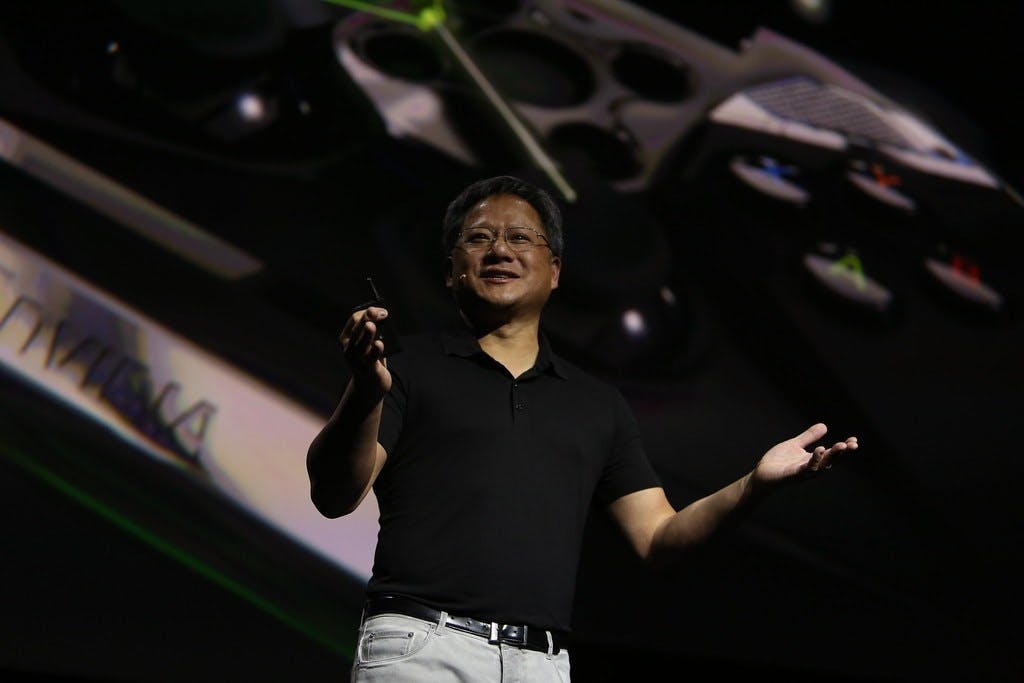
Making Sense of The Nvidia-Arm Acquisition

Last week, I wrote about the Nvidia-Arm acquisition, the politics involved as well as its chances of success. Nvidia announced last September that it reached a deal with Softbank to acquire U.K. based semiconductor and software design company Arm Ltd. for $40 billion, making it one of the biggest acquisitions in tech.

Behemoths like Google and Microsoft are opposed to the deal, which requires approval from authorities in at least four governments, including the U.S., U.K., E.U., and China. Qualcomm is fighting the acquisition, as the company relies heavily on Arm for microprocessor intellectual property (IP).

For reference, the name Arm stands for “Acorn RISC Machine” and comes from founders Sophie Wilson and Steve Furber discovering that a CPU can run faster on a small set of instructions. The discovery these two made in the early 1980s was to let the operating system break down tasks rather than add more instructions to the processor. While most CPU designs were adding more instructions to chips, Arm patented the technique of using fewer instructions that run more quickly and efficiently. Due to power constraints of the mobile device, which was introduced much later, Arm found a massive market where it dominates at 90%.

The company works quietly in the background with 22 billion chips shipped globally in 2019 and a cumulative total of 166 billion chips in 2019. The company hit 180 billion chips as of the press release on the acquisition.

Revenue is generated from licenses for Arm’s technology and royalties that come from the subsequent sale of the licensees’ chips that contain Arm’s technology. To compare, Nvidia announced it had shipped 1 billion processors in 2011 and there has not been an update for the 2 billion mark yet, with estimates of Nvidia’s shipments hitting around 100 million chips per year.

Arm is most dominant in mobile with 90% market share in mobile processors, and dominates in-vehicle infotainment and advanced-driver assistance system (ADAS) processor market at 75%. The overall share of Arm’s related markets is 34%.

Arm-based technology is found in electronic devices and PCs, including Microsoft’s Arm-based Surface and Apple’s custom CPUs for Macs. The majority of tablets and digital TVs also use Arm’s architecture.

In fact, Arm offers the most popular CPU architecture in the world. The company’s dominant market share is achieved through its developer ecosystem, which fits neatly into one of our primary theses for Nvidia, its GPU-powered cloud and developer ecosystem.

Arm will bring an estimated 15 million software programmers to Nvidia. In Nvidia’s recent earnings report, the company announced it had doubled from 1 million to 2 million developers – so Arm increases Nvidia’s reach by 7X.

Read the Full Article Here

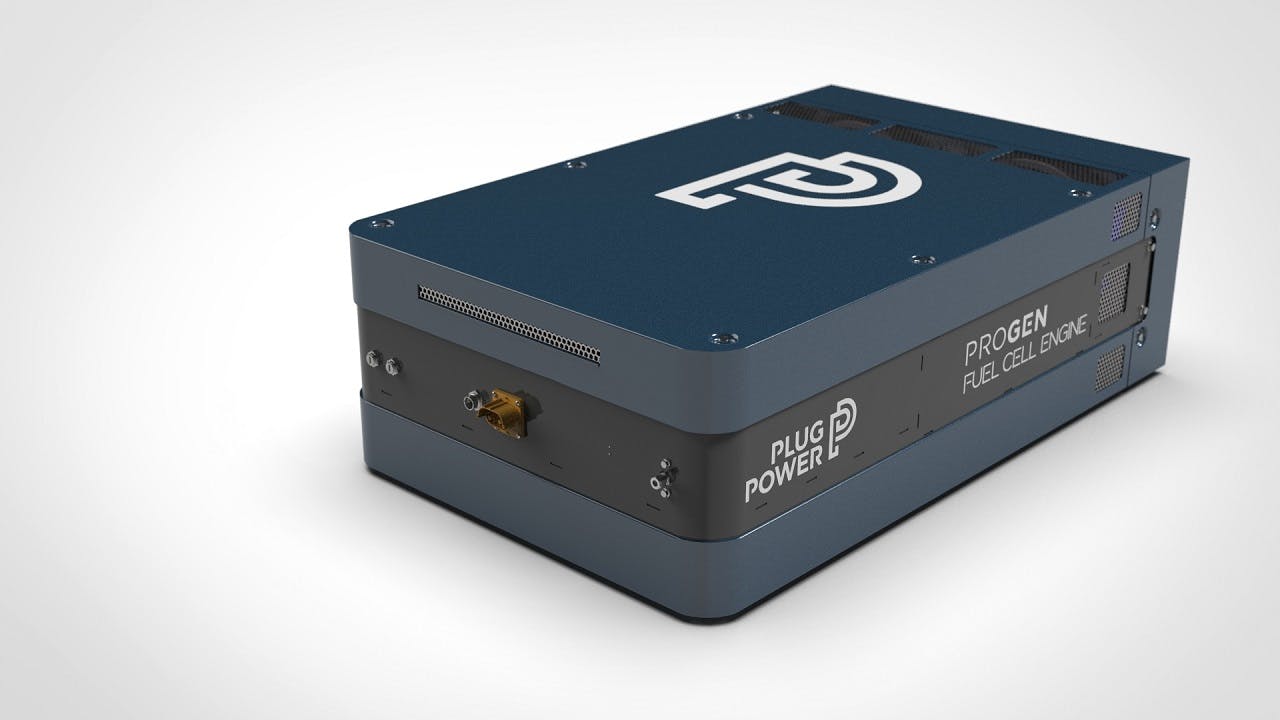
What’s Next for Plug Power?

With the Nasdaq still in correction territory, renewable energy star, Plug Power (PLUG), is more than 35% off the all-time high. This is after a large bounce off the recent $34 low.

When the stock made a new all-time high of $75 in late January, we started to get signals of a top forming. We warned our premium readers, and even provided downward price targets we would be looking to start a position. Our readers were skeptical when we suggested a short-term price target of $34 was on the table in a webinar. At the time, this level of correction seemed extreme, so we provided an upper target at $43 region. This price, based on our forward growth analysis, was a solid value.

As we hit the $34 region, we saw heavy buying. Based on the significance of this level from our analysis, we expect this level to hold on any retest in the near future. The excitement in renewable energy, plus the technical significance of the recent bottom, should put a floor at this level.

We see the move in Plug as a healthy pullback in a strong long-term uptrend. Plug is a key player in the global green energy trend. This coupled with how it has followed our outlined count, made us comfortable laying into the position on this pullback. The fact that we bottomed at the $34 region, so far, further confirms our long-term view.

We added to Plug at $43, and will look to add on any notable breakout.

Snap Investor Day

At its virtual Investor Day Feb. 23, Snap executives announced the company is on track to generate revenue growth of more than 50% YoY for the next several years, and laid out the strategy to achieve this target.   

Snap has organized its mobile app into five main screens (left to right): Map, Communications, Camera, Stories, and Spotlight. These screens are represented in the Action Bar at the bottom of the Snapchat app. Management believes Snap is only monetizing one part of the total engagement in the Action Bar—Stories/Discover.

Maps, Communications, Camera, and Spotlight remain virtually unmonetized. Management laid out its plan for each of these screens, including strategies for monetizing each.   

Source: Snap Investor Day Presentation Slides

Roadmap for Growth

Looking ahead, executives believe Camera is the company’s biggest opportunity. The key area for investment will continue to be augmented reality. CEO Evan Spiegel said Snap plans to take product innovations like augmented reality Lenses and develop them into platforms by building tools for creators and developers, and providing distribution so these creations reach the Snapchat community:

“In the past few years, our substantial investments against our vision for augmented reality have put us in a position to lead the industry, and we’re doubling down on this strategy in 2021. Augmented reality has evolved from something fun and entertaining into a real utility. Our camera can solve math equations; scan wine labels to find ratings, reviews, and prices; tell you the name of the song you’re listening to; and so much more… And we’ve barely scratched the surface of what’s possible.”

Snap’s goal is to transform its camera so users can experience the world around them in a new way. Executives plan to achieve this goal through the use of augmented reality. The company’s augmented reality platform is driven by three major efforts:

1.  Innovating in technology to unlock new capabilities in the camera.

2.  Exploring creatively to design exciting and informative experiences.

3.  Supporting a growing community of AR consumers and creators.

Executives expect the growing momentum for AR in smartphones will provide a tailwind for Snap’s AR efforts. The future of Snap’s camera includes a fully integrated AR application, which will provide ample opportunities for more effective monetization as the technology progresses. Management anticipates the advertising inventory potential for a fully integrated AR camera application within Snapchat will be enormous.

As previously mentioned, Stories is the company’s largest driver of revenue. Snap generates the vast majority of its revenue from Snap Ads inserted in between Stories. This is Snap’s most mature monetization screen, but CFO Derek Anderson noted that Stories is still not even close to realizing its full potential. Snap continues to see high demand for advertisers in this function, and Anderson expects Stories to continue to be the largest revenue driver moving forward.  

Snap also sees a lot of potential monetization opportunities in its Communications application. The company recently introduced two new offerings: Minis and Games. This is where users can engage with other members of the Snapchat community to play, learn, and have fun together. Currently, monetization of the Communications screen is predicated on the sharing of sponsored AR experiences among friends. Snap Games currently has around 30 million monthly active users and the company is beginning to roll out its monetization strategies for this function.

Snap’s strategy is to monetize Snap Games mainly with Snap Ads, similar to the Discover function within the Stories screen, with the potential to sell in-app purchases for incremental content. Snap Minis offers a plug-in platform for merchants to drive transactions. Potential examples of this include movie theater tickets, restaurant reservations, food delivery/orders, etc. As Minis and Games expand and become more popular in the Snapchat community, management believes it will become another billion-dollar platform over the long term.      

Management sees Snap Maps as a sizable opportunity moving forward. More than 250 million users engage with Snap Maps each month to find their friends and see what’s happening around the world.  The company has begun integrating businesses in Snap Maps and sees this as a tremendous opportunity for small businesses to build relationships with the Snapchat audience. There are now 35 million businesses integrated on Snap Maps. In 2021, Snap plans to focus on building utility for local businesses to begin to lay the groundwork for future monetization. The company believes that Snap Maps will ultimately be a multibillion-dollar platform and that it represents “a logical on-ramp to Snap’s advertising platform for millions of small businesses around the world.”

Late last year Snap launched Spotlight, a platform that highlights the most creative and fun snaps from the Snapchat community. The company is currently seeing 175,000 submissions per day, with more than 100 million monthly active users on Spotlight. Snap is excited about the potential of Spotlight to drive advertising revenue moving forward, as the platform is already attracting a large and engaged audience.   

Snap’s CFO Derek Anderson made the most important revelation of its investor day when talking about the company’s future projections:

“We believe that based on the monetization platform we’ve built, and the product roadmap we have discussed today, that we can responsibly grow our topline revenue at 50% or better YoY for at least the next several years.”

Conclusion

To deliver on its product road map, for the next several years Snap executives expect to continue to prioritize revenue growth over short term profits and margins. The company sees sizable potential monetization opportunities in each of its five screens. As it currently stands, Snap derives most of its revenue from just one of those five screens. 

The key takeaway from Snap’s Investor Day is the company’s roadmap, and management’s projections for sustained growth of 50% or more. The monetization opportunities for Snap’s Camera, Games, Maps, and Spotlight functions represent potentially large drivers of future revenue.  If Snap can successfully execute on its roadmap in each of these functions, the 50% growth rate over the next several years that management is forecasting is achievable.    


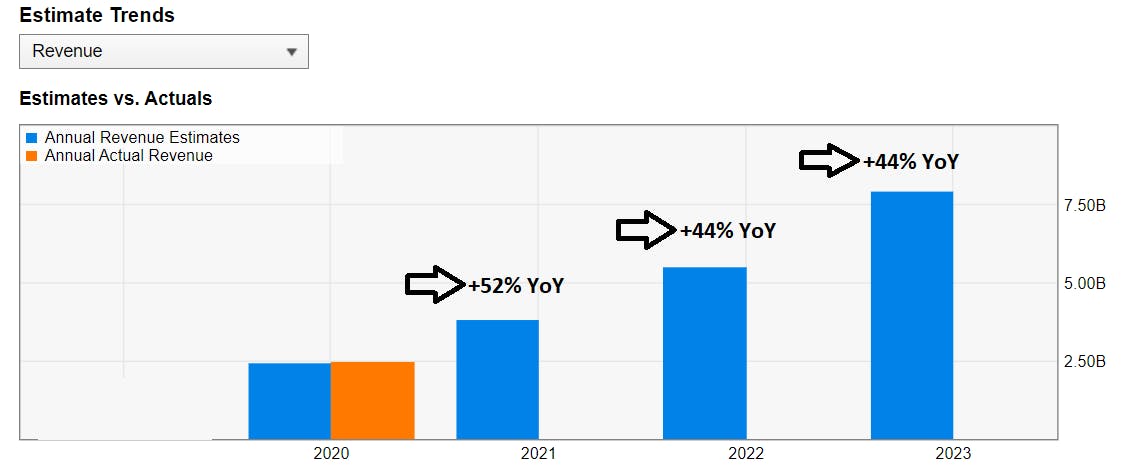
Consensus estimates for Snap are for 52% YoY growth in 2021, 44% YoY growth in 2022, and 44% YoY growth in 2023.  If Snap is able to successfully implement its monetization strategies in each of its untapped applications, there is potential for an upside surprise on current consensus revenue projections.     
  

Mohawk Group (MWK)

One key area for businesses of all sizes moving forward is the ability to leverage data and incorporate insights from that data to make important business decisions.  This is especially true for smaller and mid-sized e-commerce businesses selling on Amazon, Shopify, and Walmart.  Many third-party sellers lack the ability to scale their businesses beyond a certain size.  This is where companies like Mohawk come in with the ability to make accretive acquisitions and acquire brands with marketplace dominance to help scale these businesses.     
Mohawk’s proprietary AI-based software AIMEE drives new product development, automates sales and marketing, and manages the product life cycle.  The software utilizes data analysis to streamline a number of different tasks including product selection, new product launches, forecasting, marketing variables, pricing and media buying decisions in real-time, ROI tracking of investment, and more. 

Mohawk has its own platform and fulfillment capabilities in place to manage the entire product life cycle from procurement and manufacturing to shipping.         

Mohawk serves the rapidly expanding e-commerce and DTC markets.  The company does not have many limitations on the product categories that they choose to pursue or the marketplaces they choose to operate on.  The company currently has over 1,000 SKUs across 12 brands that sell DTC on Amazon, Walmart, and Shopify.  Management noted an 80% success rate on products going from the launch phase to the sustain phase, which they expect to reach within 3 months of the initial launch. 

Mohawk plans to ultimately grow its portfolio to include thousands of unique products with profitable and recurring revenue streams that are managed entirely by AIMEE.  Mohawk intends to grow through the creation of its own new brands organically and through its accretive M&A strategy targeting smaller 3PS sellers that lack the ability to scale their businesses.  Mohawk will continue to target brands that lack the resources to effectively scale beyond a certain point.  Once acquired, Mohawk states it is able to integrate new brands with AIMEE as early as 48 hours after completion.

2021 is projected to be the strongest years in Mohawk’s history from a fundamental perspective.      

Accelerating Revenue Growth

2021 is projected to be Mohawk’s best year for revenue growth. 

Expecting to Reach Profitability in 2021

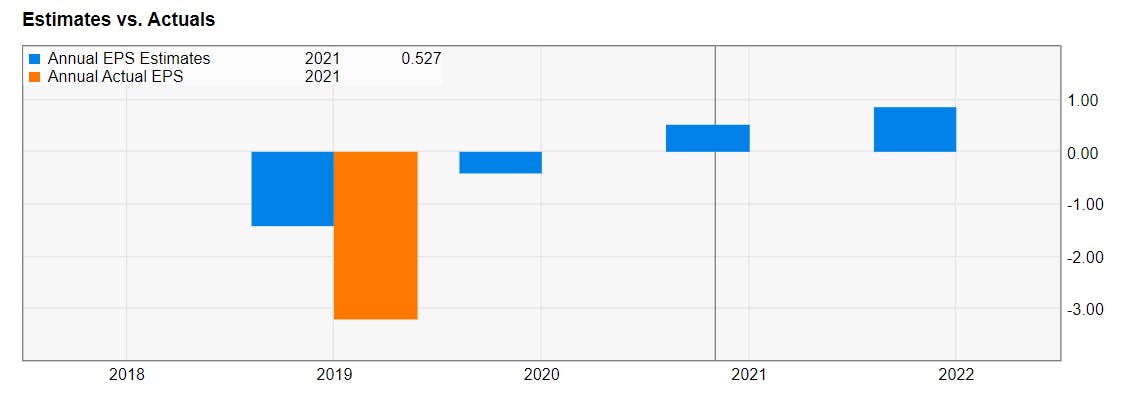
Mohawk is projecting to breakeven on EPS in 2021.

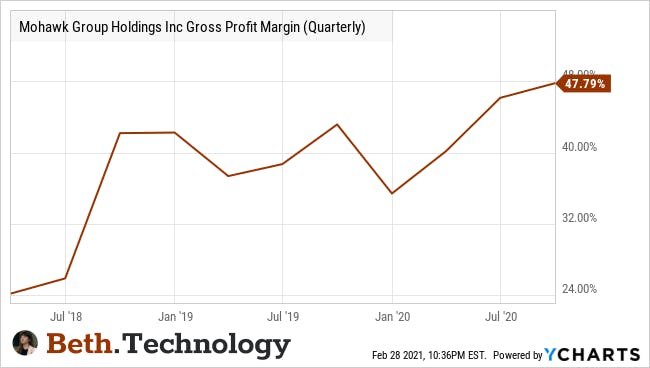
Improving gross margins

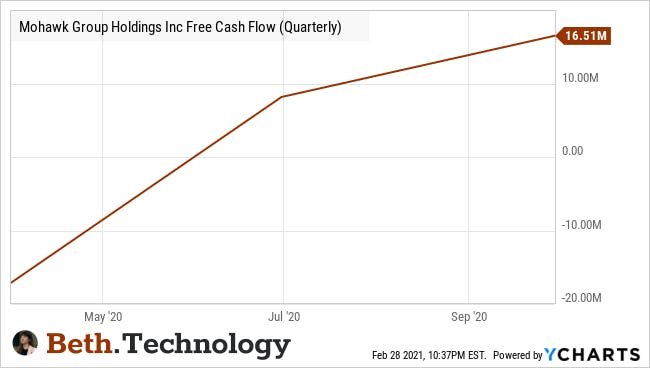
Improving Free Cash Flow and Already Free Cash Flow Positive

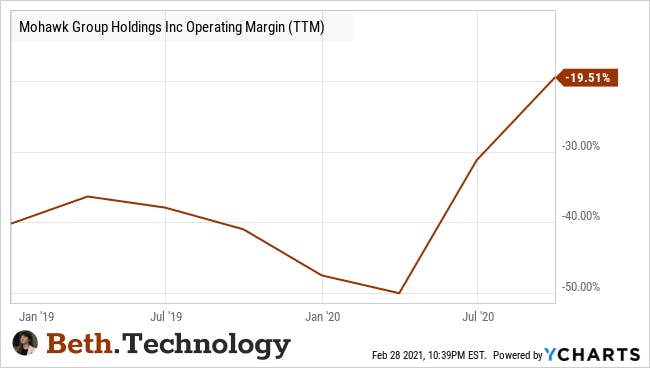
Operating Margins Improving, although still not positive

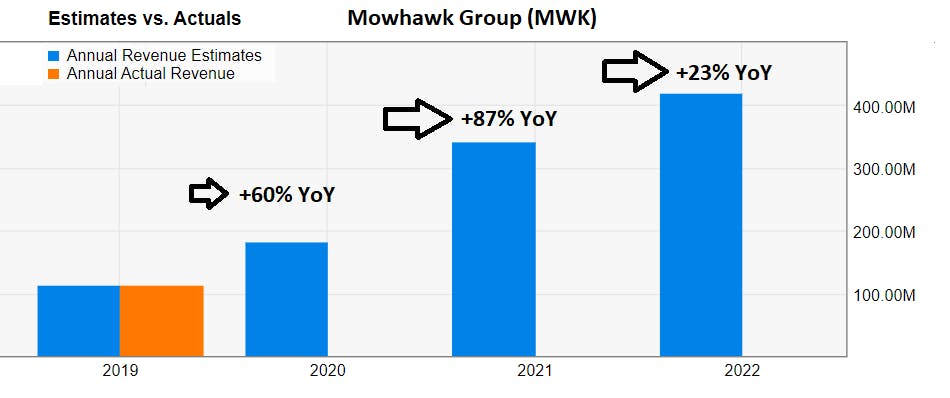
From a fundamental perspective, 2021 will be Mohawk’s strongest as a public company.  The acceleration to 87% YoY revenue growth along with EPS profitability are two important factors that could drive the stock price higher this year. 

Additionally, Mohawk is already FCF positive and has continued to improve its gross margins over the last several quarters.  Operating margin remains negative at -19.5%, but we note that Mohawk has also seen a big improvement in this number in its most recent quarter.   

In the midst of the recent tech rout, MWK’s valuation has contracted, and the stock is now trading at 3.3x 2021 revenue.  This is an attractive multiple for a company that is projected to grow 87% this year, reach EPS profitability, and is already FCF positive. 

MWK stock has exhibited relative strength during the recent tech pullback and is set to announce earnings AH Monday.  We are monitoring for an entry as we believe 2021 will be an outstanding year for Mohawk, and there is ample room to grow from the company’s current ~$1B market cap.   

Podcast with Motley Fool: I’m Bullish on These Trends for 2021

Recently I joined Tim Beyers and Brian Feroldi on The Motley Fool podcast. In the hour-long interview we discussed cloud stock valuations, trends I’m bullish on, why I think Zoom Video and Shopify are the best cloud stocks, my prediction that EVs would pullback (they later did) and why that’s a buying opportunity, and why I continue to be long FUBO due to the company being centered between two important microtrends albeit extremely early.

Here’s a brief summary of our conversation which occurred on February 9th prior to tech stocks selling off, and yet the information is even pertinent now. If you want to watch the full video, it is available below the article.

Cloud Valuations

Leading cloud stocks were trading at 50x sales when I was first interviewed by Motley Fool (minute 35:15 – 40:00). I emphasized that I don’t buy big positions in this range.

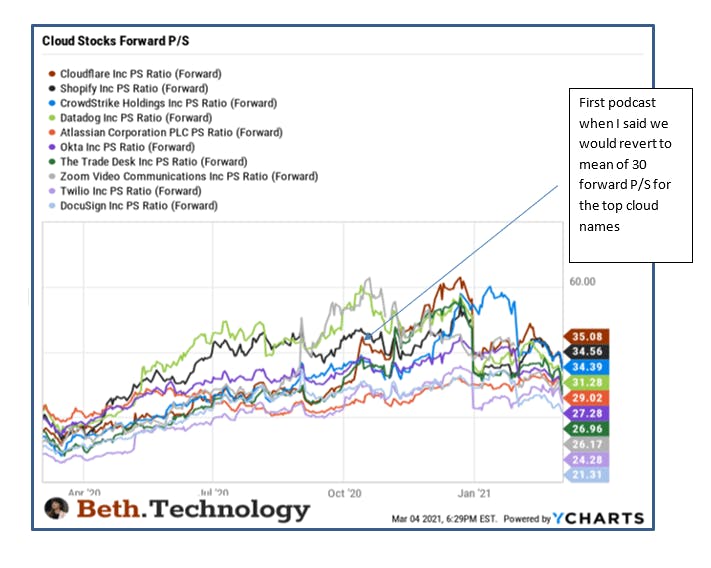
We also discussed the high likelihood that cloud stocks would soon revert to the mean of approximately 30x sales for leaders and 20x sales for average companies.

That’s exactly where we are at now, so I don’t see the sell-off as a big surprise. As I write this on March 4th – we are in the healthy pullback range as leaders often hit the forward 30 P/S range and average growth in cloud stocks the 20 forward P/S range.

cloud stocks forward p/s chart

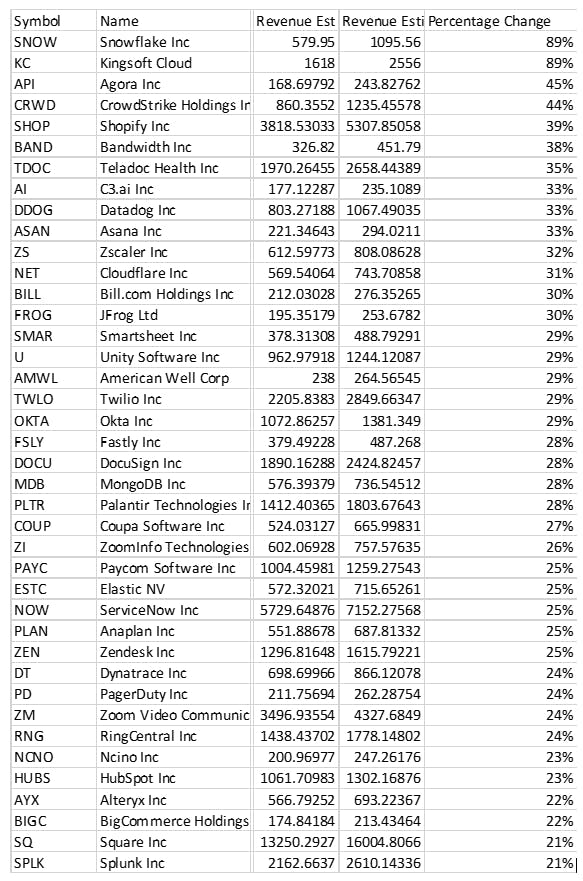
What is unusual is the sheer number of cloud stocks forecasting growth in the range of 30% to 40%. We won’t know who is going to pull ahead of the pack until we see what Q1 reports due to the tougher comps from last year. 

cloud stocks q1 reports

Please note, data was pulled approximately two weeks ago.

In the past, momentum traders could pile cloud leaders growing in the range of 50% to 70% and make their bets that those forecasting top growth would perform. Nine times out of ten, the company met its forward guidance. This year we don’t have that luxury as the category faces harder comps.

Towards the end of the interview, I was asked my favorite cloud stocks for 2021. I said it was easy to get creative here but I prefer to stick to the tried and true during years where the market doubts a tech vertical. I named Shopify and Zoom Video as my favorites as their bottom lines are exceptional and on par with Salesforce. This is one way to tell if a company has product-market fit, as they do not need to use sales and marketing budgets to drive growth. 

Cloud stocks are going to test momentum investors who don’t study underlying fundamentals. Our fund is 2/3 long-term buy and hold and 1/3 momentum and we continue to hold cloud stocks in our buy and hold portfolio. 

How I Find Stocks  
Instead of using stock screeners, I like to invest in mega trends. It’s more forgiving for the companies. Companies positioned at the center of powerful trends can pivot or change the business model and the outsized demand will overlook those mistakes.

That’s why I prefer to invest in trends rather than use screeners. Tech needs to be forgiving, because growth tech companies are trying to take over the world.

I need a big trend so I don’t lose conviction if there’s a bad earnings report or other short-term issue. Investing in trends helps me to stay patient while the management executes.

SPACs:

We chatted about SPACs prior to the selloff in this interview and I had said “proceed with caution” yet look for gems. The way we do this is by investing very small percentages in speculative names – as low as 0.5%. From there, we layer either as the company breaks out on strength OR we layer in at lower prices if we have a higher-than-usual conviction.

Here’s a breakdown as to our strategy, which is spearheaded by Knox Ridley, our research site’s portfolio manager.

  • Early trend, 1%. These trends haven’t showed up yet in earnings.
  • Some Evidence, 2% to 3%. We see some evidence for these trends in earnings.
  • Overwhelming Evidence, 5%. These trends have overwhelming evidence in earnings.

The Bull Case for Fubo

FuboTV is centered in a crucial trend, which is live sports streaming. The bear argument on Fubo is that licensing fees are too high for the company to improve margins and become profitable. This is negated by the Sportsbook launch which is coming much sooner than I originally thought. My best guess is we will see institutions initiate prior to the Olympics yet before the Sportsbook launch.

Comcast has announced a 9% stake in Fubo and Disney has a 5% stake in the company. They will want to run sports betting through a separate brand as these are family-friendly entities.

Sports are seasonal and Q1 should not be compared to Q4, yet the bears will attempt to hammer on this. At our fund, we do not compare Pinterest’s Q4 to its Q1, for example, as we understand that smart money does not do this either.

In the interview, the point I make is that live sports OTT is the holy grail as the majority of cable subscribers continue their subscriptions for this purpose. In fact, all of the cord-cutting leading up to this point (about 10-15 years) is equal to the cord-cutting opportunity of live sports fans. We do not see Fubo as a sports licensing business just as I did not see Roku as a hardware business. You can access my previous analysis on Fubo here and a library of analysis on Roku here.

Instead, Fubo is a live sports OTT business that will drive monetization through its Sportsbook. Subscribers are willing to pay $65 per month for Fubo because it offers access to a wider range of live sports.

Fubo announced last January that it plans to offer sports betting in a separate app, which is a model that worked for Sky Media in the U.K. While you’re watching live sports, you can open a separate app and make a bet with your friends. This is ideal for casual betting rather than serious gambling. With many states in debt and legalizing sports betting, this is a tailwind.

You could say, “Why don’t you go with DraftKings?” Fubo has the same size audience that DraftKings did in 2019. Yet, the valuation of DraftKings is 3-4 times higher than Fubo and fully valued. I also think Fubo will do well with casual betting compared to DraftKings.

Chinese Electric Vehicles:

The interview from February 9th was especially timely in regards to EVs as I had said they were trading at historic valuations and could see a 30-40% haircut. We like this trend so much that we started to layer in around the time of the interview and as the market has sold off, we’ve continued to build our exposure to Chinese EVs.

I’m bullish on Chinese EV companies due to China’s desire to reduce its dependence on foreign oil. The country does not produce oil like we do in the United States.

Another reason I like Chinese EVs is because nationalist China will probably want its domestic car companies to be in the top three for sales. Apple is number 4 or 5 in China for smartphones (depending on the quarter). I wouldn’t be surprised to see Tesla to follow the same path as Apple in terms of ranking in China. This is important because China’s lack of oil plus its population is a nice combination.

The I/O Fund is invested in high quality leaders of the most important tech microtrends. When we enter or exit a stock for the I/O Fund, premium subscribers receive alerts by email and text, plus regular in-depth analysis from technology analyst Beth Kindig.    

Want to know more? To receive in-depth analysis on popular technology stocks, and alerts for key entries and exits, subscribe at research.beth.technology.research.beth.technology.

Access the full interview here: 

Interview timestamps:

0:00 Introduction

1:33 Cloud valuations

5:00 Okta and Alteryx

6:45 Research Process: How I invest in major tech trends  

9:00 AR/VR Trend: Unity, Apple, Snapchat

18:00 SPACs

21:40 Opendoor

22:40 Star Peak Energy Transition Corp.

26:30 Cloud earnings

28:00 Portfolio Management: When to enter and exit

30:15 Entries: Roku, Magnite

32:00 Exits: Alteryx, Dynatrace

37:50 Fastly, Cloudflare

43:20 FuboTV

49:10 Agora.io

50:15 Chinese EV: NIO, Xpeng, Li Auto

53:30 Favorite cloud stocks: Shopify and Zoom

What’s Next for Tesla? Levels to Watch.

With the NASDAQ100 down about 10%, the current bull market’s darling, Tesla, is down about 27%. Even after a 500% increase over the past year, we believe the current correction will provide a great opportunity to participate in this real trend, which we see accelerating in 2021.

The price data with Tesla suggests that a pullback to the $500-$495 region is on the table. This would provide the most ideal entry, and if we do see a drawdown to this level, expect heavy buying. We realize this would be a sizable drawdown; however, a correction to this level would confirm that our current long-term target of $1400 would be on track.

However, it’s worth pointing out that several momentum indicators/oscillators are currently at levels that have indicated significant market bottoms. For this reason, we may look to layer into a position in the $630s if we receive a series of buy signals.

We would position Tesla as a momentum play that we would likely sell if we approach our upside targets. This is not the stock we would be comfortable holding once we enter a bigger selloff, so we will lean heavier on technical analysis to both manage risk, and take gains.

View Webinar Here:

Disclosure: Beth Kindig currently owns shares of TSLA. This is not financial advice. Please consult with your financial advisor in regards to any stocks you buy.

Q4 Earnings Analysis for Shopify, Roku, Fiverr And Palantir

In my latest Forbes article, I cover the 2020 Q4 earnings for Shopify, Roku, Fiverr and Palantir. More importantly, we explain why tech stocks have been selling off recently despite some healthy earnings reports.

We discuss key points in the earnings reports from leading e-commerce software company Shopify (NYSE:SHOP), a company that’s not sitting stagnant by any means. We review Shopify’s product road map and how the company continually innovates to maintain its lead. The company grew revenue 94% YoY to $978M, topping consensus estimates by $64M (7%). Adjusted EPS of $1.58 beat estimates by $0.37.

We also discuss Roku (NASDAQ:ROKU) and why CEO Anthony Wood does not believe his industry has seen a pull forward from COVID-19 but rather a structural shift that benefits AVOD and programmatic CTV ads long term. In my previous analysis on Forbes, I had pointed out that Roku’s true market is pay-TV advertisers (rather than cord cutters). This was echoed on the recent call (nearly verbatim). Management also explained why Peacock and HBO are not truly competitors but rather increase the pool of customers for Roku.

Moreover, driven by strong advertiser demand, Roku beat on revenue and earnings when it announced Q4 results Feb. 18 with 58% growth year-over-year and guided for 51% growth for Q1 2021.

Fiverr (NYSE:FVRR) is a stock that has seen phenomenal gains of more than 800%. We review this company’s growth potential as a gig economy leader with the recent launch of its subscription service. The online freelance marketplace platform beat on revenue and earnings as it closed out a breakthrough quarter in the company’s history.

Lastly, we talk about Palantir (NYSE:PLTR). The company is guiding for 30% growth over the next five years which didn’t match its valuation going into earnings. Under the hood, the commercial accounts growth was a paltry 4% although perhaps the recent partnership with IBM (NYSE:IBM) will help strengthen the commercial customer base.

Palantir also announced Q4 results Feb. 16. Revenue grew 40% YoY to $322M, beating consensus estimates by $21.02M. Net loss of ($0.08) per share missed estimates of ($0.02), according to Bloomberg, despite the net loss improving from ($0.29) per share for the same period last year.

Read the Full Article at Forbes

Qualcomm, Atomera, Nvidia, Lam & Chip Shortage

Over the past few weeks, I have read many lagging explanations on the chip shortage – too many fabless semiconductor companies, too few foundries, automobile manufacturers paused ordering in March and didn’t prepare for the sharp rebound, tensions with China, and even a fire at the Asahi Kasei plant that specifically manufactures sensing devices for the automobile industry.

While all of these are true, the overarching issue is that the role of semiconductors has changed from a commodity to the primary accelerant of future technologies. This is because connectivity, automation, and ultimately AI, will disrupt every corner of every industry.

We saw this happen with data and cloud but now we must accelerate this to the next level for AI/ML and the common denominator is semiconductors. Automotive is only the beginning. We can add renewables to the list and even e-commerce as AR/VR and AI/ML attempt to prop up the leaders who are competitive enough to add these features first.

As a tech stock analyst, I don’t have the luxury of lagging analysis of any kind. My subscribers require (and deserve) forward-looking, and with my intense focus on semiconductor chips, I don’t think my readers are surprised that semis are under pressure due to an increasingly important role.

I have repeated (perhaps too many times) that there is no way forward without the semis. We are seeing this manifest in automotive right now, but as investors, we should get used to hearing about semiconductor shortages.

You and I can debate Palantir, Snowflake or C3.AI, for example, and the valuations or the right angle for AI-driven software, but the common denominator to these companies is the need for semiconductors to drive forward AI and 5G.

Now, we add the enormous push for auto manufacturers to compete with Tesla, Apple, Lucid Motors and what we have is a bottle neck where the automotive industry filters into semiconductors.

My guess is the demand won’t be letting up for many years as we are no longer in the cyclical pattern that semis are notorious for. Instead, demand will outpace supply for years to come.

Is this a bad thing or a good thing for our stocks? As investors, we can either listen to the news or listen to management. In this case, they are not aligned. Machines trade off news and natural language processing (NLP) but as human investors, we have the advantage of looking deeper into the issues.

I have written volumes of analysis leading up to the triple-digit growth we are seeing now in the data center from AI accelerator chips. Most of this was written when data center growth was negative. For instance, my Nvidia thesis was set end of 2018 — and in 2019 Nvidia reported negative data center revenue year-over-year for four quarters in a row.

I mention this because following a trend’s trajectory is more important than immediate gratification from the market. The trend will always win out over time.

I have maintained that chips will eventually lead the AI market and are the best angle for investing in edge computing. I have also defended our stocks against custom silicon. Now we have the first of what I predict will be many semiconductor shortages and bullish to me.

The shortage is that there are hundreds (thousands really) of companies that rely on semiconductors. This will come to a head with AI and 5G as those who go-to-market soon with these features will have an enormous competitive advantage.

Below, we will first look into the supply shortage as it pertains to the automotive industry. We will then discuss earnings and management statements from Qualcomm, Atomera, Nvidia and Lam Research.

Our goal is to see 60% or higher returns in these names. We have chosen semis as our foundational hedge and you can consider cloud software along with semis on risk/reward ratio. We understand the market has conditioned some investors to see very large gains in a short period of time. This is a mirage produced from quantitative easing, and now more than ever, we want quality companies that have a solid bottom line in our portfolio to protect us long-term. This also allows us to take moonshots with SPACs and other high-growth names comfortably.

Regarding the supply shortage, the last thing we are interested in doing is disrupting our long-term thesis for a short-sighted bump in the road. I explain why I think this is short-sighted and why we continue to be long NVDA, AMD, QCOM and LCRX. We are also long MRVL although earnings will occur after this blog is released.

Reference:

5G PDF
Qualcomm Blog
Atomera PDF
Atomera Update
Nvidia PDF
Nvidia Update July 2020
Lam Research PDF
Please search by stock ticker here for any additional research including Knox’s trade setups.

Background on Automotive Semiconductors

We’ve discussed the AI semi market growing at about 45% CAGR over the next few years. The 5G chip market has an even higher CAGR of 63%. However, automotive is forecast for a smaller growth rate of 10.7% CAGR.

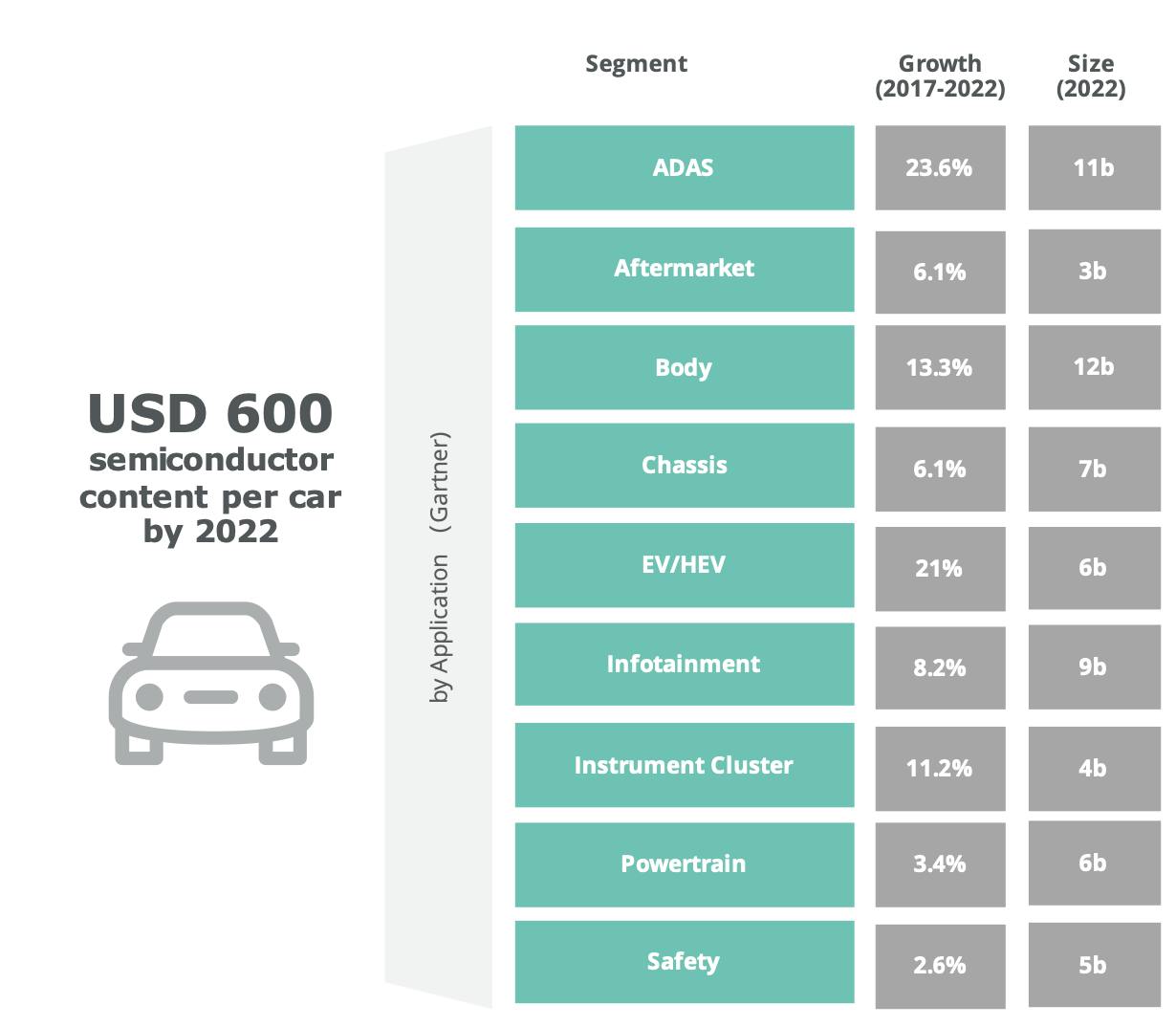
Therefore, anything automotive-specific is not central to our thesis. However, semiconductor components in the automotive sector will add an additional 600 USD for each vehicle by 2022, according to Deloitte. This is a nice boon for Nvidia and Qualcomm. Xilinx also has exposure to the automotive segment. (These are the stocks we cover although there are others of interest in the semiconductor category).

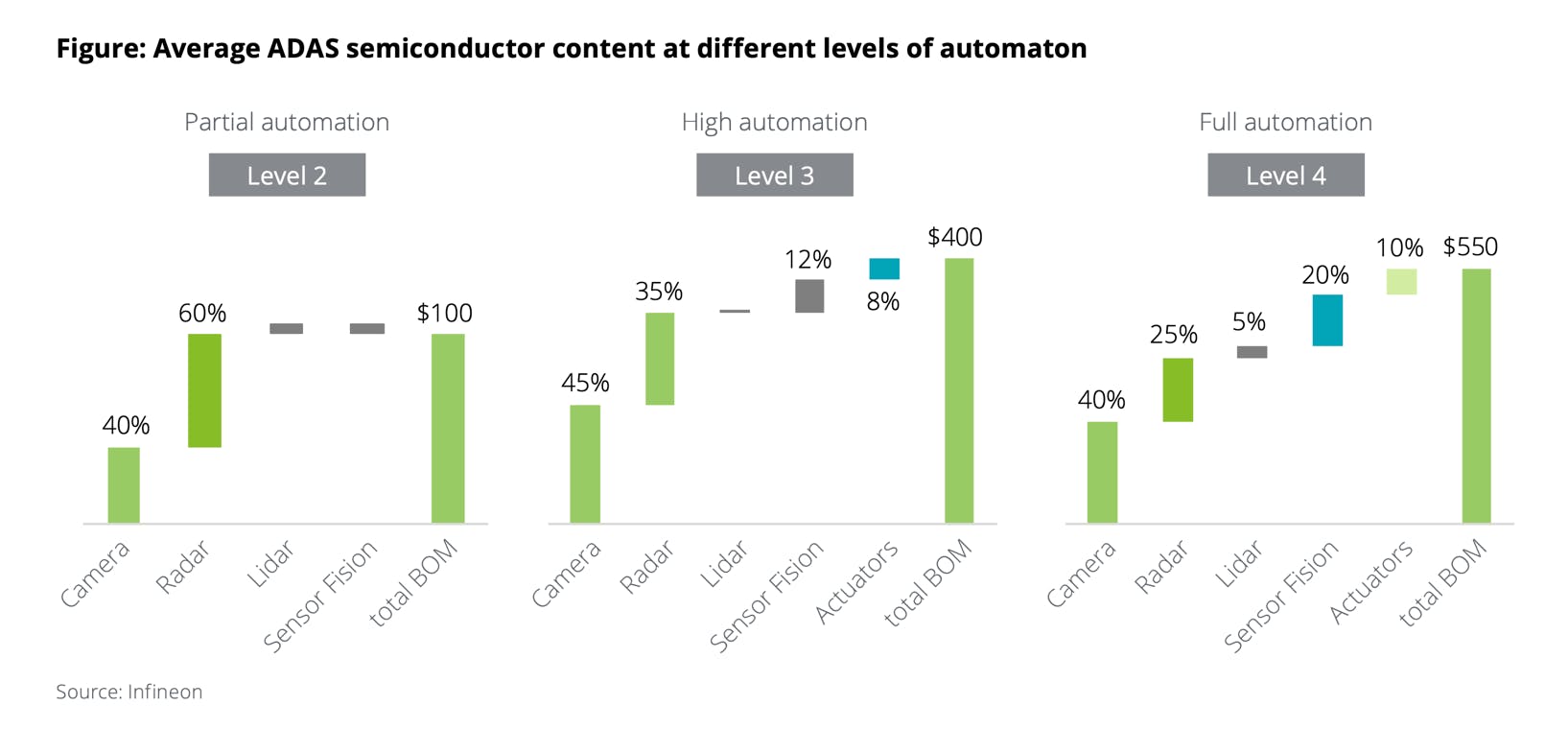
ADAS leads the growth over a five-year period with semiconductor content that will add USD 100 for partial automation and up to 400 USD for a higher level of automation. Full automation will add USD 550.

Today, automotive semiconductors are primarily driven by microcontrollers (MCUs), sensors and memory. Over the next decade, electric vehicles, automation, digital connectivity and security will drive greater demand from this sector.

ADAS (advanced-driver assisted systems) are forecast to grow by 23.1% between 2017-2022 which drives demand for integrated circuits and MCUs. EV/HEV (electric vehicles and hybrid) are forecast to grow by 21% between 2017-2022 and Infotainment by 8.2%.

Source: Deloitte

Automation requires about 30 sensors for the most advanced autonomous driving at Level 5. The industry is developing more advanced microcontrollers and MPUs to handle and process the sensor data so the vehicles think/act like humans. For EVs, sensors and controls are required to run the engine efficiently.

The primary suppliers for automotive semiconductors include: Nvidia, NXP/Freescale, Renesas, Panasonic, Toshiba, Infineon, STMicro, Texas Instruments, Broadcom/Avago, AMD/Xilinx and Samsung. Intel/Mobileye is also a leader in automotive and automation.

Automotive chips are not as constrained by size although some are expanding their system-on-chip (SoC) platforms to the 7nm and 5nm size. However, the failure rate must be lower for automotive than mobile with a target of 0 failure rate compared to a target of less than 10% failure rate on mobile. Automotive chips must also tolerate high voltages and operate at a wider range of temperatures.

The specifications for integrated circuits and MCUs/MPUs are more stringent with expectations the chips will last 20 to 30 years compared to only four years for mobile.

Semiconductor foundries are required to achieve higher quality and yield; yet long-term reliability, or “latent reliability,” can be hard to achieve as components must perform on the road under normal wear and tear including electromagnetic interference, which can be hard to simulate.

Basically, automotive requires more R&D at the foundry level.

On a side note, we had initiated in Luminar and ultimately closed the position. LiDAR will continue to test investors as there are many new entrants and the technology is very expensive with dynamic range still unsolved for and requiring backup cameras/sensors. The cost of LiDAR has caused some companies, such as Mobileye, to start LiDAR development in-house to lower this cost once higher volume production begins. My best guess is Apple will do the same in future years.

Whether tech will own the AV/EV space or if traditional automakers will transition to own the space is still up for debate. My guess is that tech will lead again as autos are headed towards having operating systems in the vehicle. Autonomous driving is also an incredibly hard problem to solve and has nothing in common with the traditional mechanics of combustion engines.

Chip Shortage Update:

Automotive accounts for 10% of the semiconductor industry.

According to Alix Partners, the chip shortage may cut $60.6 billion in revenue from the global automotive industry this year across the whole supply chain.

One reason that automotive is being hit harder than cloud, for example, is because automakers halted orders on car parts between March and May of last year including chips as showrooms were closed. This was compounded by the sharp rebound we’ve seen since the summer and especially during the holidays.

The plant at Asahi Kasei Microdevices is still down following a fire in October, which affects advanced sensing devices used in automotive. This also contributed to the shortage.

There is some disagreement between what the news is saying about the chip shortage lasting through 2021, and what various management teams are saying about the chip shortage, which is the worst is over and the respective companies will meet or exceed this year’s guidance.

General Motors recently stated the situation has gotten better for them with CFO Paul Jacobson stating last week, “Over the last couple of weeks as we talked about this being a volatile situation, we’ve actually seen the situation get better. At this point, I would say that we’re highly confident about being able to hit our guidance that we put out to the Street.”

GM had temporary closed car and crossover plants in Kansas, Canada, and Mexico through mid-March yet Jacobson went on to add, “We feel confident that we’re working through this issue and that we’ll be able to return to normal as soon as the back half of this year … and a high degree of confidence that this isn’t going to be an issue for us going forward.”

Audi had to furlough 10,000 employees, yet CEO Markus Duesmann said the overall output for 2021 wouldn’t be affected as the company expects to make up for lost time in the second half.

According to Sony and the availability of the PS5, the President and CEO said, “It will get better every month throughout 2021,” he said. “The pace of the improvement in the supply chain will gather throughout the course of the year, so by the time we get to the second half of [2021], you’re going to be seeing really decent numbers indeed.”

Earlier this month, Senator Tom Cotton published a report entitled Beat China that points towards the weak supply stance for the United States as a matter of military and commercial importance. The wafer fabrication capacity of the United States is at 11% of global share down from 33% in 1990. South Korea currently leads with 25%, Taiwan at 22%, Japan at 16% and China at 14%

China’s rival to advanced CPUs in the United States is the HiSilicon Kirin 9000 designed in China, yet due to sanctions on Huawei, is not able to be developed. China’s chip foundry is Semiconductor Manufacturing International Corporation (SMIC) and is also on the blacklist. SMIC is capable of producing 14nm and has plans to produce 7nm chips, whereas competitors are already releasing 5nm chips. As of 2019, China was importing 90% of its chips.

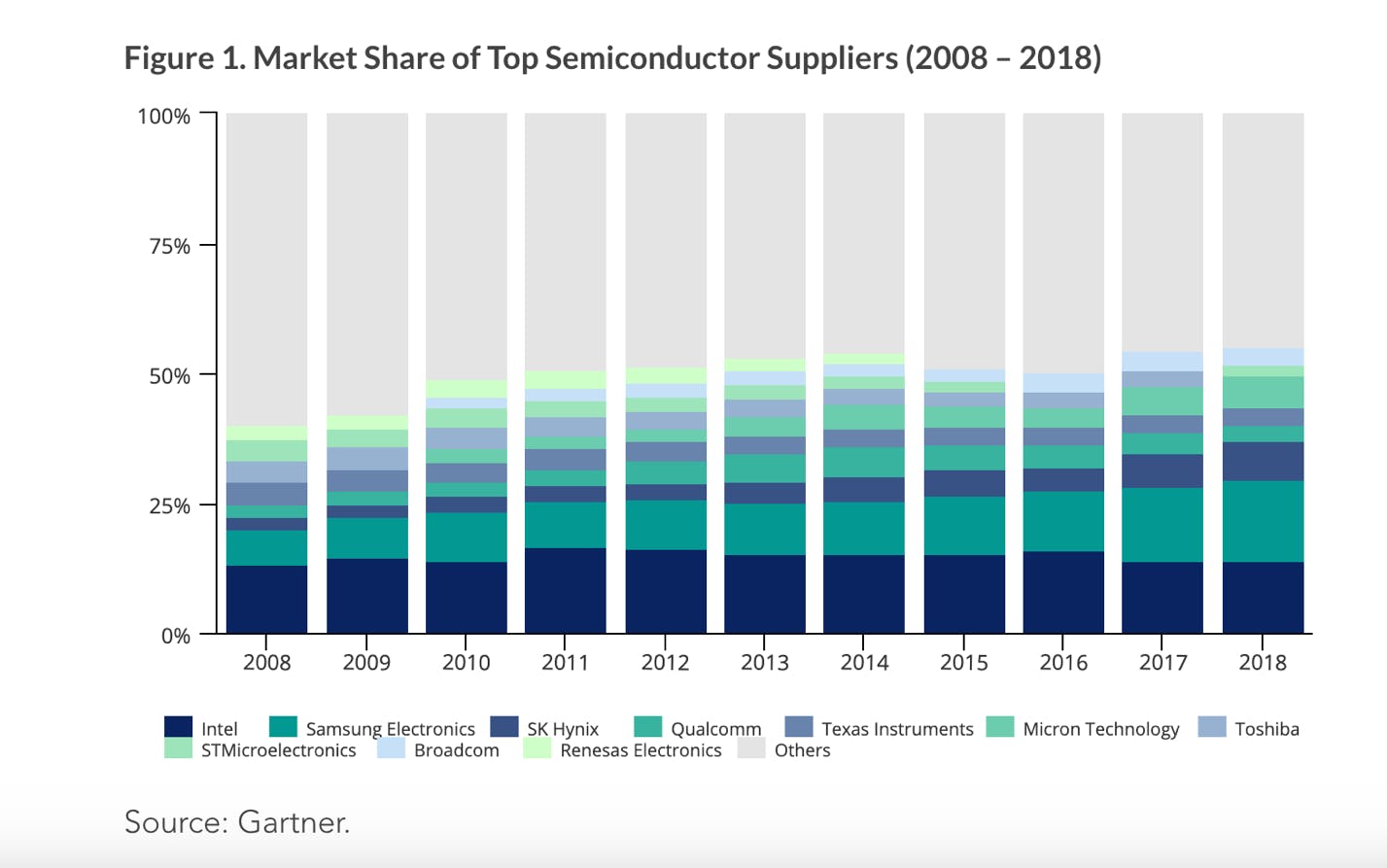
Source: Gartner

Washington and special interest groups are concerned that China will surpass the United States in supply, and later in the race towards AI and 5G. For example, China has built the world’s largest 5G network with 720,000 5G base stations.

Source: https://macropolo.org/china-chips-semiconductors-artificial-intelligence/?rp=m

Qualcomm

By most standards, Qualcomm had an excellent earnings report. The blemish that sent the stock reeling at a 15% drawdown was the $40 million miss in revenue. Management had guided for 62% forward growth for this quarter of $8.20 billion at the midrange yet analyst consensus was 63% revenue growth, which became a top line miss at $8.23 billion in revenue compared to $8.27 billion expected. Margins expanded 900 basis points to 29%.

When a company meets management guidance yet narrowly misses analyst consensus, I tend not to be too concerned.

As stated, Qualcomm reported adjusted revenue of $8.23 billion compared to $8.27 billion estimated with sales up 63%. The company beat on earnings with adjusted EPS of $2.17 compared to $2.10 estimated, representing growth of 119%.

Chip sales grew 79% year-over-year to $4.22 billion and RF front-end chips used for 5G and modems were up 157% year-over-year.

Qualcomm’s RF products have crossed $1 billion in revenues. Qualcomm is now one of the largest radio frequency suppliers in the smartphone ecosystem, supporting end-to-end product applications, including 4G, 5G sub-6 bands, and 5G millimeter bands.

Automotive grew 44% to $212 million. The automotive pipeline has grown to $8.3 billion, up from $3 billion three years ago intending to reach $1.5 billion in automotive revenues by 2024. Qualcomm offers 4G LTE and 5G connected driving experiences with V2X, WiFi and Bluetooth to connect vehicles to the cloud. There are 150 million vehicles that use Qualcomm modems. The company is expanding into computer vision, AI and multi-sensor processing for the fourth-generation automotive platform to be used by GM, Google, LG and Panasonic.

IoT grew 48% and passed the $1 billion threshold. The company is also a leader in XR (AR/VR) and indoor/outdoor WiFi 6 connectivity.

Management guided for $7.2 billion to $8 billion in sales in the current quarter, which was higher than analyst expectations, or 46% growth at the midpoint. The company is guiding for adjusted EPS of $1.55 to $1.75 for the next quarter, representing 88% growth at the midpoint.

Qualcomm has over 800 designs using their 5G modems and RF solutions.

The company had estimated 225 million 5G handsets to be sold in 2020. The overall number of handsets declined 12% in 2020 across 3G, 4G and 5G. For calendar 2021, the company estimates 450 million to 550 million 5G handsets to be sold and for overall number of handsets to grow in the “high single-digits year-over-year.” The model expects COVID to affect the first half of the year with a second-half recovery.

Huawei expands Qualcomm’s serviceable market by about 16%, according to management on the earnings call.

From the earnings call, I tend to agree with this analyst who commented on the impressive RF growth and whether this will continue, which the new CEO indicates it will:

Joe Moore (analyst)Joe Moore (analyst)

Great. Thank you. I wonder if you can give us color on the growth in RF being so impressive when you look at 5G units potentially kind of more than doubling, when you look at millimeter-wave really at one customer and one region. I’m just surprised at how robust December is and kind of can you talk to the sustainability of those revenue levels and the growth drivers going forward.wonder if you can give us color on the growth in RF being so impressive when you look at 5G units potentially kind of more than doubling, when you look at millimeter-wave really at one customer and one region. I’m just surprised at how robust December is and kind of can you talk to the sustainability of those revenue levels and the growth drivers going forward.

Cristiano Amon (incoming CEO)Cristiano Amon (incoming CEO)

Hi, Joe, it’s Cristiano. Yes, it’s very consistent to what we have been saying since the beginning of 5G. We saw 5G as an entry point for us. We have a highly differentiated solution with our modem-to-antenna platform and all of those designs. I think we updated the design count now 5G is in excess of 800 designs. They all contain 5G RF front-end components.

Also we like that it’s very diversified RF front-end revenues across our customers, also with a lot of sub-6, it’s not only millimeter-wave, even though we are very happy with the expansion prospects of millimeter-wave and that’s definitely an accelerator for Qualcomm.

So, it’s a business which is now one of the fastest-growing [businesses] we have. We’re happy we achieved the threshold of $1 billion and we’ll continue to grow as we grow 5G.

There were many hints on the earnings call that Qualcomm should have a strong 2021 performance. First, the company is expecting 5G handsets to double year-over-year in addition to overall handsets recovering from negative growth to single-digit growth. The company is also supplying both Apple and Huawei and has inroads to new market opportunities, such as IoT and automotive.

So, really what our guidance — just to reiterate it, we are saying the market was down 12%, 2019 to 2020 — calendar 2019 to calendar 2020 and would grow in high single-digits from 2020 to 2021 and this reflects kind of continuing COVID impact in the first half and then recovery in the second half.

Really within that market, what’s the critical driver for us is how 5G plays out. And so if you look at our 5G forecast, we’re expecting it to go up from 225 million in calendar 2020 to a midpoint of 500 million. So, very strong growth and that’s kind of the key driver for us in terms of how our revenue expands on the chip side.And so if you look at our 5G forecast, we’re expecting it to go up from 225 million in calendar 2020 to a midpoint of 500 million. So, very strong growth and that’s kind of the key driver for us in terms of how our revenue expands on the chip side.

And then maybe last thing I’ll point out is to Cristiano’s comment earlier, Huawei has been a very large OEM and it was — really from a chip perspective, it was mostly high silicon that was satisfying their demand.

Now, with the change in the market, we have kind of 16% of the market that was not available to us before being available. So, as we kind of look further out, we see this as a pretty material expansion of SAM for us., we have kind of 16% of the market that was not available to us before being available. So, as we kind of look further out, we see this as a pretty material expansion of SAM for us.

Nuvia Acquisition:

In January, Qualcomm announced plans to buy Nuvia, a company working on a core CPU design which can be used broadly in smartphones, next-gen laptops, infotainment systems and driver-assistance systems among other applications. The deal could lessen Qualcomm’s reliance on Arm should the Nvidia-Arm acquisition go through.

Nuvia uses Arm’s architecture but utilizes custom designs. The use of custom core designs through the Nuvia acquisition could improve margins for Qualcomm.

Nuvia was founded by “former star chip designers” from Apple and Google. The founders have worked on a combined 20 chips including Apple’s A-series microarchitectures that power the iPhone and iPad. Between them, the team also has more than 100 patents for their work in silicon. Although very little is disclosed about the stealth company and its chips, the general understanding is that the Nuvia team aims to bring the power-efficiency of mobile to the data center and in-between (i.e., edge computing).

Please note – many articles will state this is about competing with Apple’s M1 but I believe this is about Qualcomm’s desire to control the 5G market on other edge devices beyond laptops.

The management hints towards the Nuvia acquisition being much more forward-looking than PCs:

Our commitment to our high-performance processor roadmap was reflected in our recently announced proposed acquisition of NUVIA. We look forward to combining NUVIA’s world-class CPU and technology design team with Snapdragon to enable our ecosystem of customers to redefine computing performance, drive innovation, and deliver a new class of products and experiences for the 5G era.and deliver a new class of products and experiences for the 5G era.

QCOM comments on Supply Constraints:

Here is what Qualcomm said about supply constraints:

Qualcomm: Notably, our strong performance and outlook would have been even stronger had we not been supply constrained.

We are executing extremely well in our strategy to address many of the technical challenges of delivering a true modem-to-antenna 5G experience and capture a higher dollar share of content in smartphones.

This process continues through the successive releases of 5G currently under development as our foundational innovations, coupled with our ability to implement 5G in products and coordinated deployment in new verticals, continues to drive progress outside the handset industry.

Qualcomm believes the shortage will normalize by the second half of the year:

And in your opening remarks, you mentioned that revenue would have been higher if not for the shortages. Could you help us to quantify that some and then perhaps talk about the next couple of quarters, how that may play out if you recapture some of the business that you weren’t able to ship in the December quarter and how that proceeds?

Cristiano AmonCristiano Amon

Hi, Chris, this is Cristiano. Yes, happy to address. We have seen, I think, probably shortage across the entire industry. There is a couple of factors driving that. One is V-shaped recovery, I think, across many of the sectors that were present now. We saw acceleration of digital transformation also consistent with this trend of the enterprise transformation of their home.

And especially for Qualcomm and QCT, we have seen an opportunity with the expansion of addressable market. Huawei represent — or it represented 16% of the market that becomes available to us across all of our OEMs.

So, that’s driving a situation that demand is outpacing supply. We’re happy what we see right now on the premium tier, for example. In high tier, we see share gains in fiscal 2021 and we expect the situation to normalize towards the second half of the year.

Atomera

Atomera is still an all-or-nothing proposition and the recent earnings report saw a sell-off in the stock as the market attempts to figure out the company that executed the JDA.

The company started the earnings call immediately addressing the JDA with this quote. The only clue we were given is that it’s a foundry (or a company with a fab plant but probably the former):

The JDA we recently announced marks a major milestone for Atomera, including a manufacturing license which will enable our customer to deposit MST film on its wafers in its own fab positioning them for fast integration and transition to production. Our release of MSTcad V1.0 simplifies customer evaluation of MST, which should extend our reach to new customers and technologies and shorten time to revenuewhich will enable our customer to deposit MST film on its wafers in its own fab positioning them for fast integration and transition to production. Our release of MSTcad V1.0 simplifies customer evaluation of MST, which should extend our reach to new customers and technologies and shorten time to revenue” -Scott Bibaud, President and CEO.

The company is pre-revenue at $0 in the fourth quarter of 2020 compared to $138,000 in the year-ago quarter. The company incurred a net loss of ($3.9) million or ($0.19) EPS. The losses were essentially the same a year-ago.

Fiscal year 2020 saw revenue of $62,000 compared to $533,000 in fiscal 2019. Net loss was ($0.79) EPS compared to ($0.84) in fiscal 2019.

The company had $37.9 million in cash and cash equivalents as of December 31st and completed an at-the-market equity offering to raise $24.2 million in cash through the sale of shares.

The company is guiding for $400,000 in Q1 revenue. Management states this is based on payments under the JDA, which could slip from Q1 to Q2.

Here is the exact statement: “We anticipate that our Q1 revenue will be $400,000 based on payments under the JDA. However, the recognition of this revenue will depend on future events and therefore could slip from Q1 into Q2. The JDA includes other milestones that could result in additional revenue in later periods, but we’re not in a position to forecast the timing or likelihood of those milestones.”However, the recognition of this revenue will depend on future events and therefore could slip from Q1 into Q2. The JDA includes other milestones that could result in additional revenue in later periods, but we’re not in a position to forecast the timing or likelihood of those milestones.”

In the opening remarks by the management, they stated they would disclose the customer once payment was received, which looks like it should be Q1 or Q2. This is likely why we saw a bounce in the stock following the sell-off.

Here is another comment about timing of disclosure by the CEO:

“On the Phase 4, in my remarks I mentioned, we’ll show a Phase 4 when we deliver IP to this first JDA customer. I think it corresponds closely with Francis’ comments on revenue. We expect — we probably expect it to happen this quarter, but it will happen near the quarter edge, so it could go into next quarter, but not very far away.”We expect — we probably expect it to happen this quarter, but it will happen near the quarter edge, so it could go into next quarter, but not very far away.”

Guidance for adjusted operating expenses in FY2021 is in the range of $14 million to $14.5 million driven by 300mm tool costs, engineers and GMA expenses.

Here are some additional comments that management made in regards to the Phase 4 JDA:

In January, we were able to announce a newly completed JDA with a major semiconductor company who is one of our existing Phase 3 customers. This is evidence of Atomera delivering on a critical step towards commercializing MST. This JDA will result in the first customer moving to Phase 4, since our agreement includes a manufacturing license, which gives our customer the right to install our process and deposit MST on wafers in their own fab.since our agreement includes a manufacturing license, which gives our customer the right to install our process and deposit MST on wafers in their own fab.

As you can see, our pipeline does not yet show them in Phase 4 because they have not met our strict criteria yet. For a customer to enter into Phase 4, we must have delivered to them our MST IP transfer package, which is typically done when the customer’s tool is properly configured, and we have received payment. At that point, we will update the status on our customer engagement chart.At that point, we will update the status on our customer engagement chart.

The company also highlighted specific ways MST can help the 5G market:

Our improved ability to combine MST CAD modeling with internal wafer runs has helped us bring both technologies closer to production worthiness. Today, we are witnessing growth of a new market in the rollout of 5G cellular. MST SP is targeted primarily at products that are battery-operated and RF SOI brings new design options for 5G front-ends.

As the large manufacturers of 5G cellular devices seek out ways to achieve competitive advantage, Atomera’s MST will be one of the options that can provide them with a leg up. This is the type of market transition which allows new technologies like ours to get a foothold and start expanding.

The company also discussed that work will begin soon on 300mm and 200mm wafers, which will help with the advanced nodes and lead to a higher average sales price. Over 65% of the semiconductor market uses 300mm wafers.

Epi deposition work by Atomera engineers in our new facility has been underway for the last few months, allowing us to get a running start qualifying MST on our new epi tool. We are very excited to take full possession of this instrument so we can accelerate our customer work on both 300 millimeter and 200-millimeter wafers with a fully state-of-the-art setup.

Perhaps most importantly, this is what management said about the semiconductor shortage:

“And one of the things that’s being experienced by the automotive industry, as you said, they’re having shortages on these analog products, among others. But really, I think one of the big things holding them back are the analog solutions, they tend to be manufactured on older production nodes that are using 200-millimeter wafers.

Now, the challenge there is that people built these factories for 200-millimeter wafers decades ago. And they can’t expand them anymore very easily. And even if they could build a new fab, they have a hard time getting a supply of the of the processing tools that are needed to make 200-millimeter wafers because it just not made anymore, everybody’s using 300 millimeter. So one of the things that MST can do is, we can actually take a product designed on a 200 millimeter wafer, and we can help them improve the performance to a point where they could shrink the devices, maybe get something like a 20% or 25% shrink opportunity. What that means is that every single wafer would be able to make 25% more capacity. So for a manufacturer, that means it could get 25% more capacity out of a fab without having to add a whole bunch of new equipment and so forth.Now, the challenge there is that people built these factories for 200-millimeter wafers decades ago. And they can’t expand them anymore very easily. And even if they could build a new fab, they have a hard time getting a supply of the of the processing tools that are needed to make 200-millimeter wafers because it just not made anymore, everybody’s using 300 millimeter. So one of the things that MST can do is, we can actually take a product designed on a 200 millimeter wafer, and we can help them improve the performance to a point where they could shrink the devices, maybe get something like a 20% or 25% shrink opportunity. What that means is that every single wafer would be able to make 25% more capacity. So for a manufacturer, that means it could get 25% more capacity out of a fab without having to add a whole bunch of new equipment and so forth.

So yes, I would say this is something that it’s not going to probably help the manufacturers in the very near term. But long term, I think it’s going to be a continuing problem, and our technology really provides a good solution for it.”

Lam Research

This was a record quarter for Lam and next quarter is expected to be another record quarter. The CEO made comments in the recent earnings call that reflect my understanding of the opportunity ahead of the semiconductor industry:

While today’s absolute levels of WFE are significantly higher than a few years ago, we believe the rapid digitization of the global economy combined with rising capital intensity due to greater process complexity supports robust multi-year WFE spending. In fact, if there’s a common theme that underpins our outlook for the next several years, it is that sustainable growth throughout the semiconductor value chain will be driven by the proliferation of artificial intelligence, high performance computing, IoT, 5G, and the incredible societal advances and user experiences these technologies enable.it is that sustainable growth throughout the semiconductor value chain will be driven by the proliferation of artificial intelligence, high performance computing, IoT, 5G, and the incredible societal advances and user experiences these technologies enable.

We expect strong demand from a diverse set of end-use markets to positively impact semiconductor and semiconductor equipment growth in 2021 and beyond.expect strong demand from a diverse set of end-use markets to positively impact semiconductor and semiconductor equipment growth in 2021 and beyond.

To illustrate, management spoke about gaming as a category expected to grow at 50% CAGR. The number of consoles shipped is much less than mobile, however, the GPU is four times the size with 2X the DRAM bits, leading to a 5% upside for Lam and $500 million incremental WFE (wafer front end equipment).

Management also discussed 5G as a driver with 5% incremental demand in 5G resulting in $1 billion of incremental WFE. Management went on to say, “It is demand drivers such as these that have strengthened our conviction around the sustainability of WFE spending over a multi-year period.”

Because Lam is a supplier, the company predicts spending will be biased towards the first half of 2021. One drawback to Lam is the company’s dependency on China, which represents 30% of revenue and something we have to continually monitor. China is a big consumer of NAND and DRAM with $10 billion in spend last year.

Lam Research has one of the best bottom lines of any company in the technology industry. The company reported EPS of $6.03 in the current quarter compared to analyst expectations of $5.64. In the year-ago quarter, Lam reported EPS of $4.01. Revenue came in at $3.46 billion, up 33.78% from $2.58 billion a year ago.

Management guidance for the upcoming quarter is higher at $3.7 billion with EPS of $6.47 which beat analyst estimates of $3.31 billion with EPS of $6.55. the current analyst estimates have been revised to reflect management guidance.

Gross margin in the current quarter was 46.4% and management is guiding for gross margin of 46% in the upcoming quarter.

Lam is expected to close fiscal year 2021 that ends in June with $13.9 billion in revenue, representing top line growth of roughly 40% up from $10.04 billion. For the fiscal year 2021, EPS is estimated to be $24.77 for growth of 66%, up from $15 EPS in FY2020.

Nvidia

Similar to Lam, the management from Nvidia outlined many edge cases that will continue to drive growth for the semiconductor industry including the strength in hyperscalers from the adoption of AI, deep learning recommendations across the internet and ecommerce, and the industrial data center, which includes things like weather simulation, genomics, molecular dynamics simulation, quantum chemistry,  and simulating quantum computing.

On the industrialization of AI, the company is working with 7,000 startups plus corporations like John Deere and Wal-Mart on robotics machines. Jensen Huang compared this to the smartphone where the connected device will continually improve with AI the way applications continually the  mobile device.

The third phase is the industrialization of AI. And some of the great examples when I say in terms of smartphone moment, I meant that it’s a device with AI, it’s autonomous and it’s connected to a cloud service, and it’s continuously learning. So some of the exciting example that I saw, that I’ve seen and we’re working with companies all over the world, we have some 7,000 AI startups that we’re working with, and almost all of them are developing something like this. And large industrial companies whether it’s John Deere or Walmart, they’re all developing applications kind of like this.

… They’re not going to just be products that you buy and use from that point forward, but it likely be a connected device with an AI service that runs on top of it. 

The company acknowledged the industry was supply constrained but that due to proper planning, Nvidia will not see the effects in its data center segment. However, the market is timid regarding management’s statements that gaming will drive the majority of the growth sequentially.

Nvidia posted revenue of more than $5B for the first time, up approximately 61% YoY, beating expectations by $180M. 

Adjusted EPS of $3.10 beat by $0.29. GAAP EPS of $2.31 beat by $0.33.

Gaming and Data Center also hit new records. Gaming saw $2.5B in sales, up 67% YoY, and data center sales hit $1.9B, up 97% YoY.

For the full year, revenue was $16.68B, up 53% YoY. GAAP earnings was $6.90, up 53% YOY. Adjusted earnings per diluted share was $10, up 73% YoY.

The company also provided strong guidance, with revenue of $5.3B, plus or minus 2%, versus expectations of $4.51B.

Gaming has become an integral part of global culture and will remain robust going forward, said Nvidia Executive Vice President and CFO Colette Kress during the call. She also expressed optimism about growth in virtual experiences, data center, and AI.

“We are on the cusp of a new age in which AI fuels industries ranging from healthcare to scientific research to the environment,” Kress said. “With this transaction, our vision is to boost Arm’s potential so it can thrive in this new era and grow into promising new markets.”

SPAC Updates: February 26th, 2021

There is a level of speculation to SPAC investing as the majority of these companies have little or no revenue.  There is an obvious risk to speculating on young companies, which is that they will not be able to meet their future projections.  This is precisely why we choose to allocate a small portion of our portfolio to SPACs, typically not more than 1-2% of our total portfolio in any one company.  We are comfortable adding more to these positions as they grow and as the company begins to successfully execute on its goals.  Until that point, it is important to recognize that we are making speculative investments and the stocks may be extremely volatile.  Keep this in mind when sizing your own positions. 

When evaluating SPACs, we prefer companies with the most upside potential in big, fast growing markets. Below are the companies we think have potential and fit our investment profile.

Lucid Motors (CCIV)

CCIV has fallen sharply since its merger confirmation with Lucid Motors and we took that opportunity to open a position.  This is a company with enormous potential in the coming years.  As of 2020, only 3% of global car sales were electric vehicles.  The EV market is set up for exponential growth this decade and beyond as the world focuses on reducing carbon emissions. 

I discussed why Lucid’s technology is a legitimate competitor to Tesla here.  In Lucid’s Investor Deck, they are projecting 4% market share of the market by 2030.  That number would put them as 8th on the current list of auto manufacturers.  Lucid has been incorrectly characterized by some as a “Tesla Killer” or a company that must outperform Tesla to succeed.  That could not be further from the truth as management is not predicting this nor modeling this. 

Lucid has over 7,000 pre-orders for the Lucid Air Dream that is set to debut in the second half of 2021.  The company has a working manufacturing facility in Arizona that can currently produce up to 34k units per year.  The company is looking to scale that number to 365,000 annual units per year.  They are currently working on building a manufacturing facility in China. 

The Lucid Air Dream has been independently verified for each of its capabilities.  Lucid has over 20M real-world vehicle miles driven.  All OEM racing teams in the world’s premier EV racing series are powered by Lucid battery packs and software.  In its investor presentation, Lucid talked about its plan to expand its technology supplier business beyond the EV racing series with potential applications in aircraft, eVTOL, military, heavy machinery, agriculture, and marine.  Lucid has confirmed that 6 other car companies have contacted them about using their battery technology already.

The Lucid Air has 32 sensors including LIDAR to support Level 2 hands-free highway driving.  The company’s goal is to reach Level 3 hands off and eyes-off capabilities within 3 years, which no automaker currently offers.  Eugene Lee, the senior director of ADAS and autonomous driving at Lucid Motors, formerly worked on GM’s Super Cruise.   

Lucid now has $4.5B in cash on its balance sheet, a number that Tesla did not accumulate until 2019.  Tesla had $106M of cash on it balance sheet when it first IPOed.  Fisker, another EV company that has not yet delivered any cars, has $400M of cash on its balance sheet.  Lucid is also backed by Saudi Arabia’s Public Investment Fund, the country’s premier investing institution.  With a strong balance sheet and heavy backers with lots of cash, Lucid is well positioned to overcome the challenges involved with mass producing cars.    

Lucid management contains 8 former Tesla executives and 3 former Apple executives.  Peter Rawlinson, Lucid’s CEO, was the former Chief Engineer of Tesla and helped design the original Tesla Model S.  Rawlinson believes he’s taken it to a new level with the Lucid Air, beyond what he engineered with the Tesla Model S. 

Lucid is projected to reach nearly $23B in revenue in 2026.  If the company can reach this mark, it could reasonably trade at least 4x above its current ~$48B valuation. 

Source: Lucid Investor Presentation

There are obvious hurdles for Lucid and risks involved with this investment.  However, we are comfortable speculating on Lucid because of its world class technology, accomplished management team, outstanding balance sheet, and large backers.         

Stem Energy (STPK)       

I covered STPK in detail here.  Stem has proven to be a volatile SPAC for us, but we remain bullish on the company’s long-term prospects.  Stem currently has $200M of contracted backlog and over 100% of 2021 revenue locked in from contracts that have already been completed.  There is potential for a big upside surprise on the $147M revenue target this year as the actual number should be closer to $200M.  The company is projecting revenue to grow at an 81% CAGR through 2026.

Source: Stem Investor Presentation            

Partnerships with Apple, Amazon, Google, Facebook, and Walmart represent a backlog of future business that will drive growth for years to come.  Stem’s value is in reducing its client’s electric bills 10-30% without changing the way they operate.  Stem’s product also helps its clients meet their corporate ESG targets, making them eligible for potential government subsidies.

Electricity production is the #2 polluter responsible for 27% of greenhouse gas emissions.  Over 75 countries including the US have committed to net zero emissions by 2050.  Stem management estimated that there is a projected $1.2T in new revenue opportunities for integrated storage that are expected to be deployed by 2050. 

There remains a great deal of untapped potential for energy efficiency improvement through implementation of new technologies.  Stem is ideally positioned to be an industry leader in the energy storage market as more companies follow the path that Apple and Amazon have already taken.    

STPK also stands to benefit from increased investments in the ESG space.  Money managers are facing greater pressure from investors, regulators, and activists to direct capital toward businesses that support a greener future.  Assets that adhere to environmental, social, and governance criteria are projected to exceed $53T by 2025.    

Proterra (ACTC)

I first covered Proterra here.  Proterra continues to prove why they are the leading electric transit bus manufacturer in North America.  This week, Proterra won a 16 year, $169M contract to lease 326 buses in Maryland’s Montgomery County.  This contract is the largest municipal government deal of any kind for buses.  The Washington DC suburb ultimately plans to replace its entire 1,422-bus fleet over the next two decades using Proterra’s electric battery technology. 

It is only a matter of time until other municipalities and cities make the switch to electric transit buses.  Proterra management estimates that its total addressable market in this industry exceeds $260B.  Currently, the company has a market cap of under $5B despite being positioned as North America’s #1 electric transit bus OEM.  Their buses have traveled 16M total miles, significantly leading all competitors.  Proterra also has partnerships in place with BMW, Daimler, Con Edison, and most recently Komatsu to develop all electric construction equipment.

Proterra is projecting revenue to grow from $193M at the end of 2020 to $2.56B by the end of 2025.

Source: Proterra Investor Presentation

Eventually, every form of transportation will need to be electrified.  Proterra has a commanding lead in North America’s electric transit bus industry and the inside track on future contracts.  Jennifer Granholm, the United States Secretary of Energy, formerly held $1M in Proterra stock options and sat on the company’s board prior to being forced to shed any potentially conflicting investments. 

Battery-electricity technology is the future of bus transportation.  We are in the very beginning of a transition to zero-emission electric buses across the country.  Proterra is the industry leader and proved it by winning the nation’s largest municipal government deal for buses.  They are ideally positioned to win more contracts in the future as more cities transition to electric bus transportation.