Apple Inc. (NASDAQ:AAPL) became the most valuable company in the world through creating and dominating the smart phone/mobile microtrend. As the majority of the global community went from zero smart phones to it becoming a necessity in their lives, Apple became the most valuable company in the world. However, like all trends, eventually it reaches the point of saturation. Instead of hypergrowth, we see competitors fight over existing customers on lower cost goods as revenue growth moves into a more consistent yet slower rate of change.
Apple epitomizes what it means to be both a good value stock and a good tech stock with its strong margins, outsized cash flows, stable balance sheet, and a loyal base of customers supporting the brand.
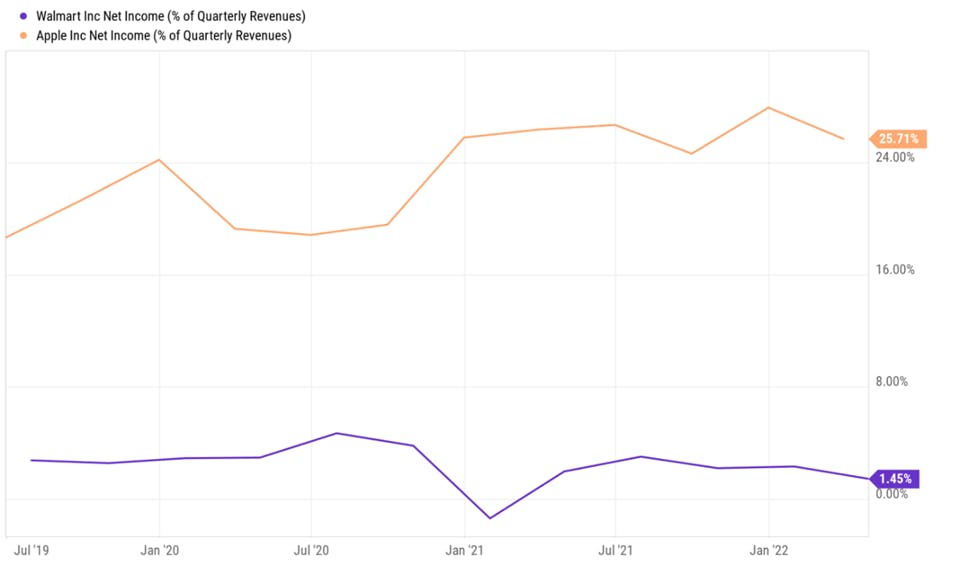
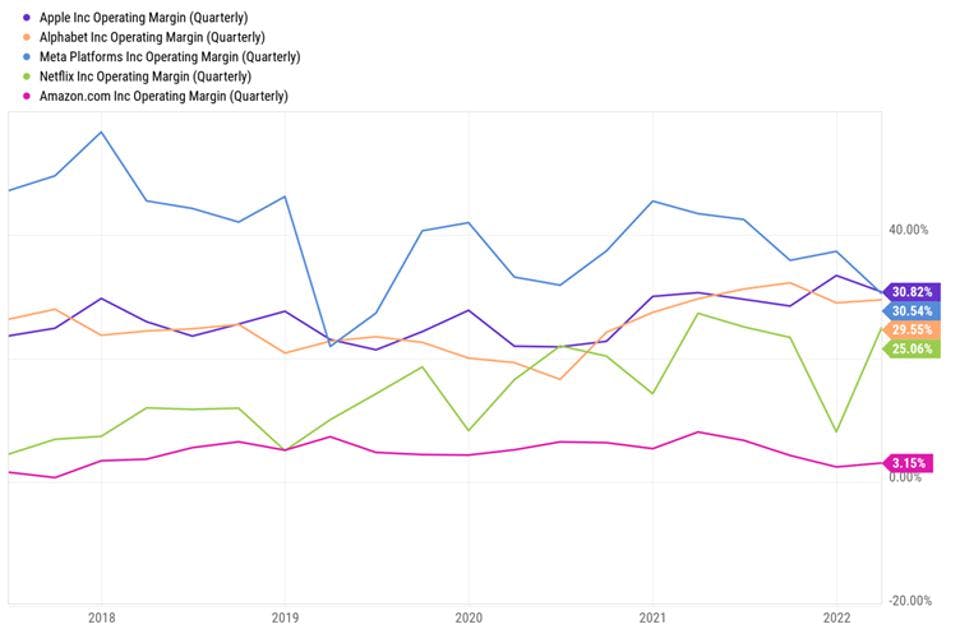
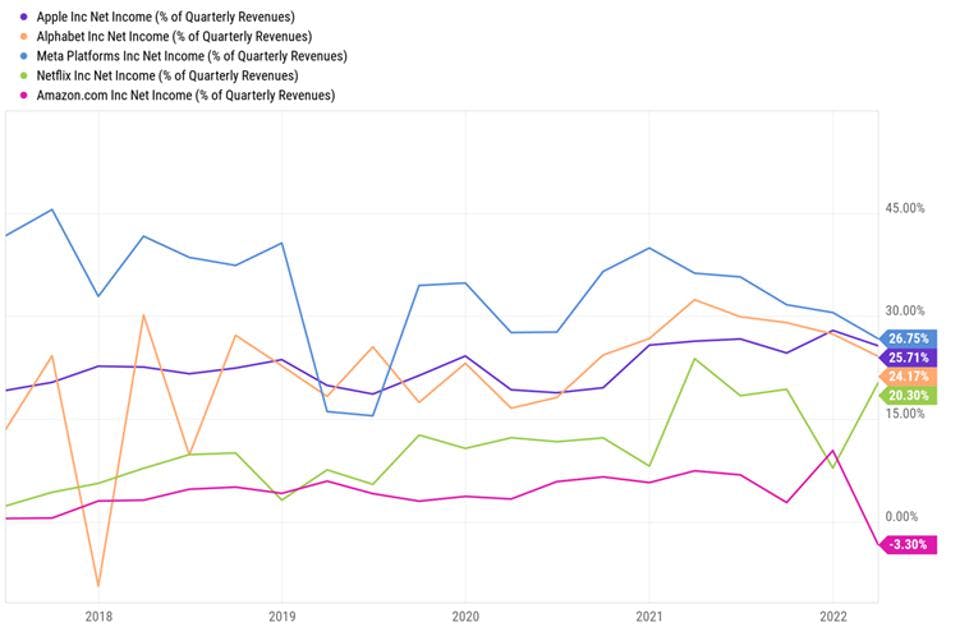
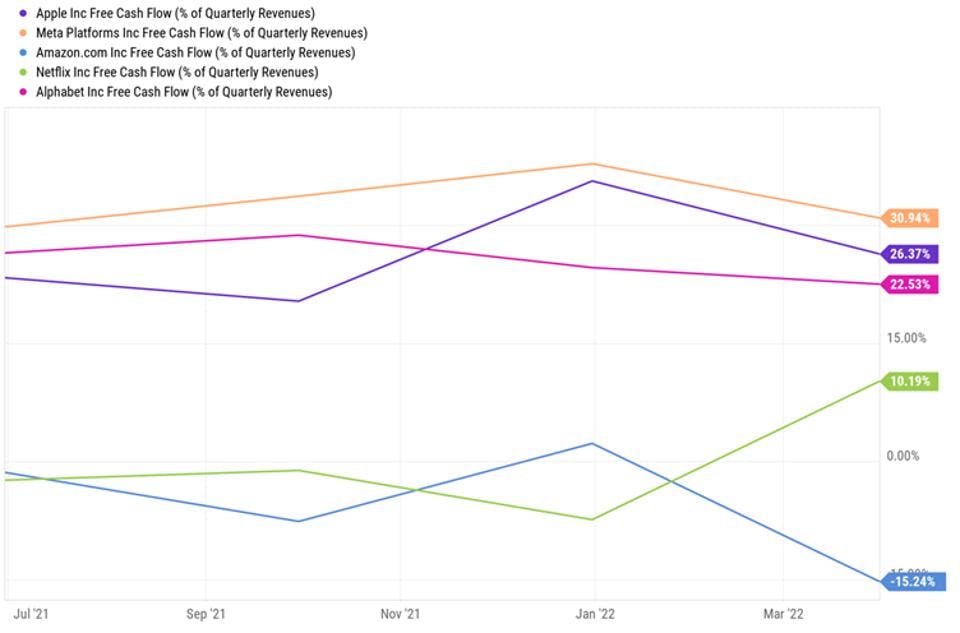
Apple has been very consistent with its margins and cash flows. The company's operating margin of 30.82% and the net profit margin of 25.71% are excellent, while most tech companies are currently struggling with the bottom line. It also has an outstanding free cash flow margin of 26.37%. The company has also been shareholder-friendly since it consistently repurchases shares.
We have not owned Apple because it is simply not involved in any of the new tech microtrends that will likely give us the next Google (GOOG, GOOGL), Apple, or Amazon (AMZN). However, this does not mean that Apple does not deserve a place within a portfolio.
Apple is an outsized beneficiary to passive investing. For those that do not want to pick stocks, and instead just own the index, Apple takes up the largest portion of this money. For example, if you don't want to own tech companies and instead want simply exposure through Technology Select Sector SPDR ETF (XLK), 23.47% of that money goes to Apple.
In regards to the S&P 500, which is the most passively owned index through various mutual funds and ETFs, Apple currently takes up 6.85% of the weighting in the S&P 500, and therefore gets 6.85% of funds going into the S&P 500. This is more than UnitedHealth Group, Berkshire Hathaway (BRK.A, BRK.B), Johnson & Johnson (JNJ), Nvidia (NVDA), and Exxon (XOM) combined!
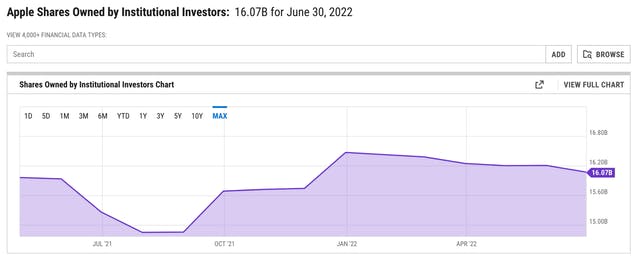
Because of how its history of share buybacks, healthy Free Cash Flow, and its very large market cap, it remains a darling within institutional funds that are managing billions. In fact, as of June 30th, 16.07 billion shares outstanding are owned by institutions. This means that roughly 98% of all shares outstanding are owned by institutions.
Even though it is not in the forefront of AI, Machine Learning, Cloud or Big Data, it is uniquely setup to capture an outsized portion of passive investors' funds as well as institutional funds. Therefore, it is difficult to imagine the broad markets making new highs without Apple.
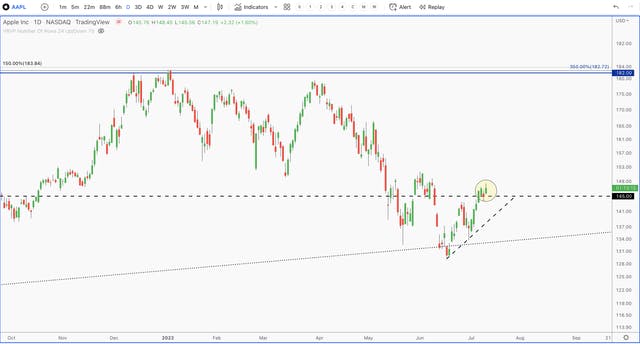
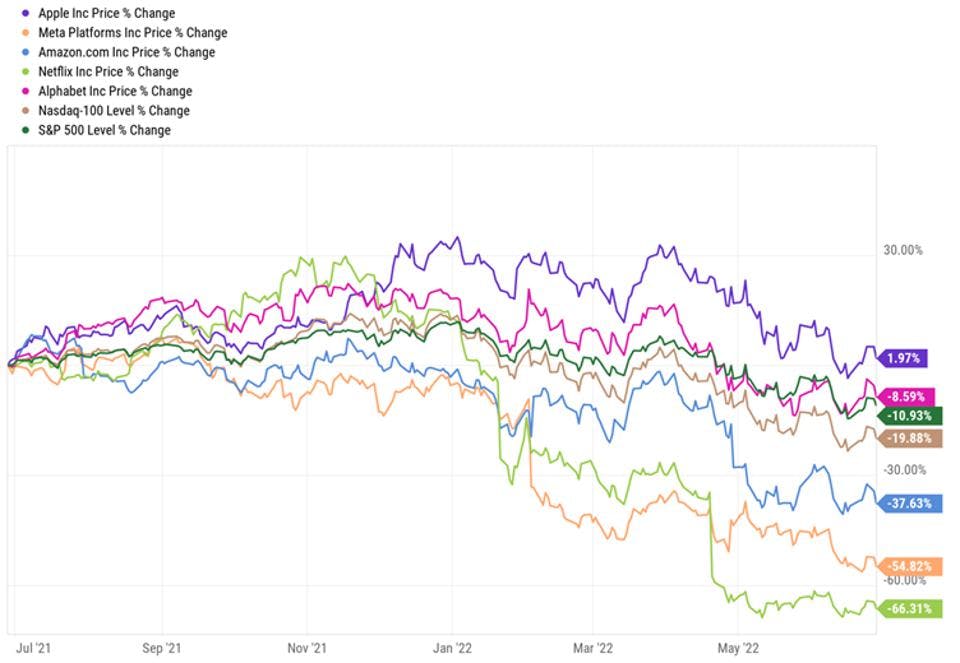
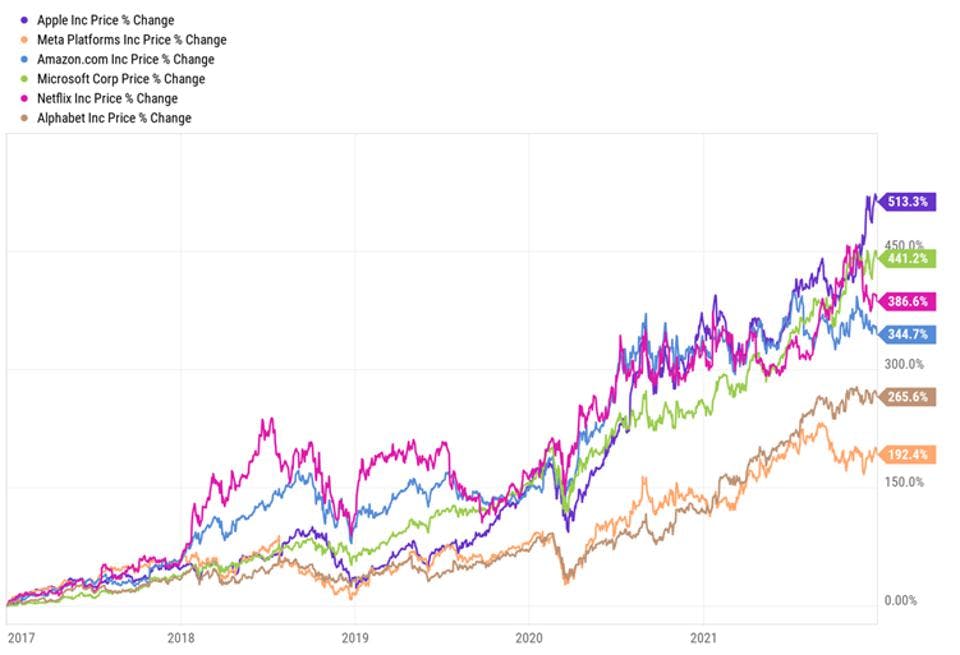
Technically, Apple has exhibited a level of relative strength in this bounce that is what you want to see in confirming a broad market trend reversal. It has reclaimed the $145 resistance level, which is a key supply zone to take back. Whether it will hold it is the question?
The fact that Apple has reclaimed the $145 level is a show of strength, regardless of the weakness in the momentum. If the other FAANGs were showing the level of strength APPL is right now by reclaiming key resistance levels, that would be encouraging that a meaningful low is underway. However, we are just not seeing that right now.
Google
We recently wrote about how Google (Alphabet) is our second favorite FAANG. In a cookie-less world due to Apple's notable change to its IDFA, owners of 1st party data, like Google, are setting themselves up to further dominate. This catalyst, coupled with its positioning within the AI microtrend, is the reason why it reserves a position within our portfolio.
Sign up for I/O Fund's free newsletter with gains of up to 403% – Click hereSign up for I/O Fund's free newsletter with gains of up to 403% – Click hereClick here
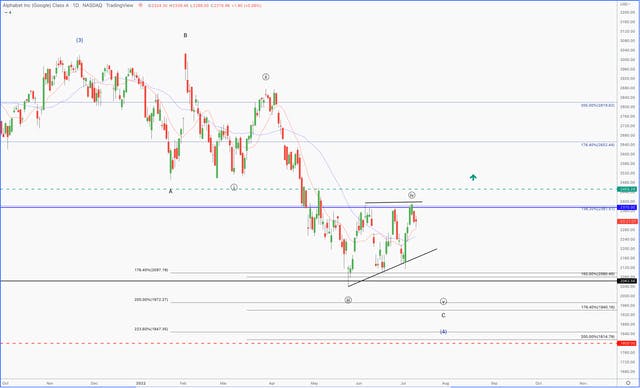
This also lines up with the technical chart on a long-term basis. Google is the healthiest chart amongst the FAANGs, as it is comfortably above its critical support zone at $1800. As long as any additional weakness is seen here, above this critical support suggests that GOOGL is one of the FAANGs that is likely to make a new high.
However, over the next month, it appears that Google is tracing a bear flag pattern. This is a common pattern that we see in 4th waves, which suggests we need one more wave to complete the 5 wave pattern in Google's drawdown.
Netflix
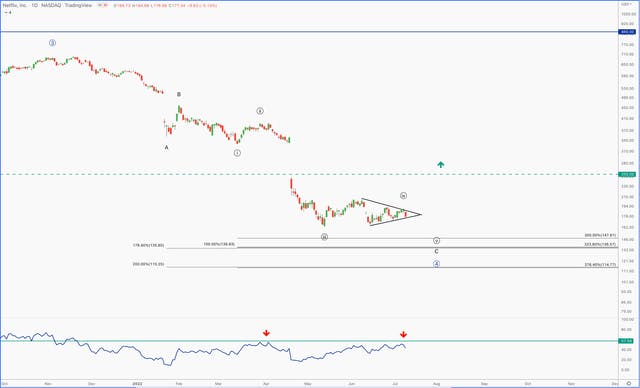
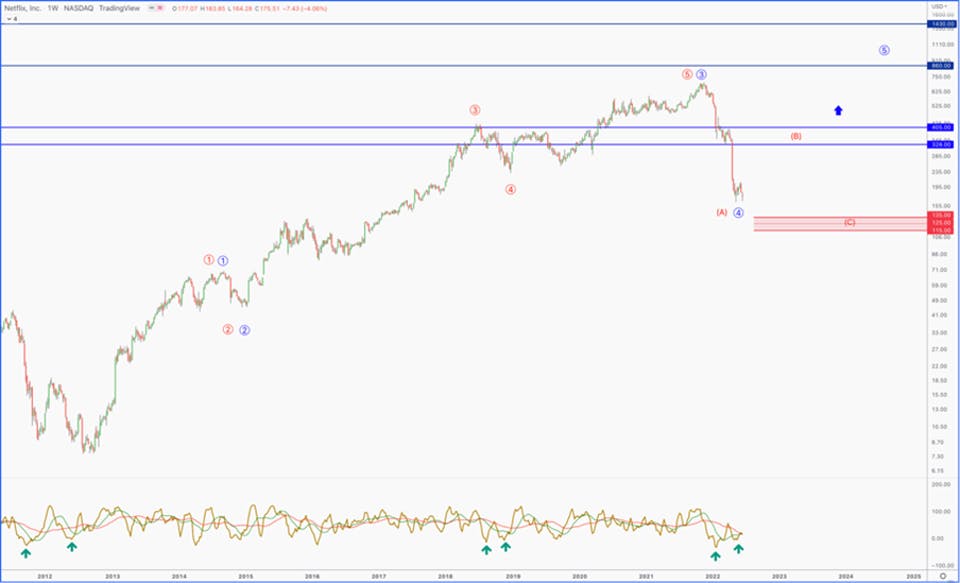
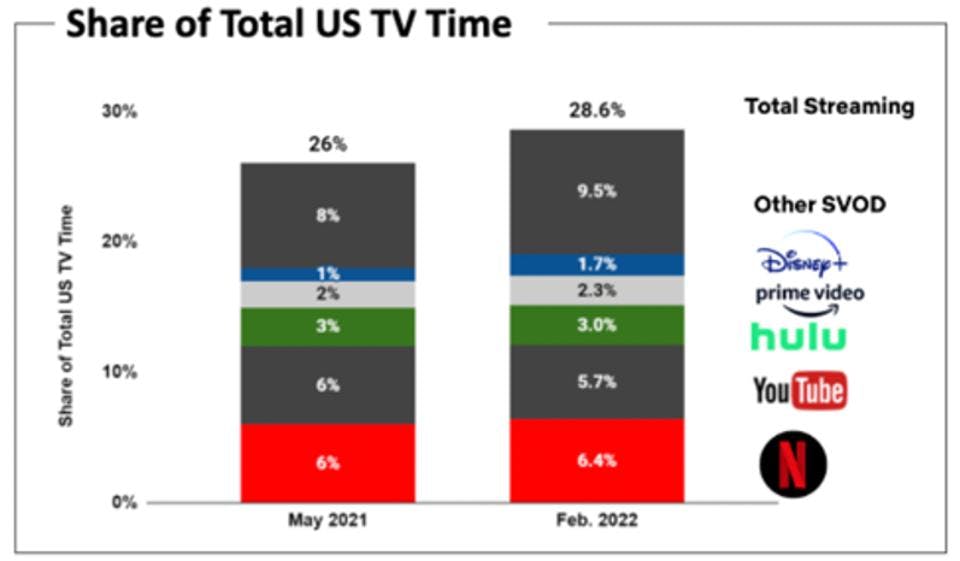
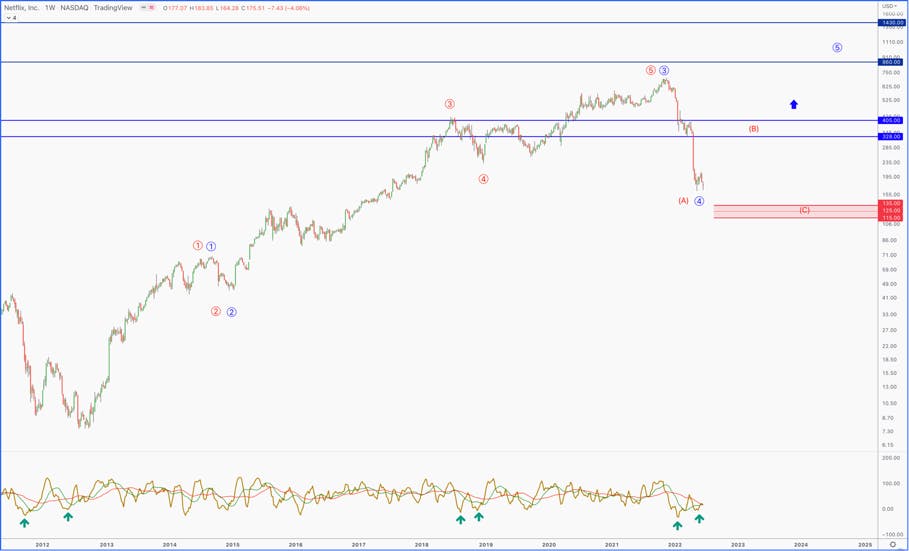
NFLX is another FAANG that we believe has a higher probability of making a new high in the next growth cycle than most believe. While market was focused on NFLX reporting a subscriber miss of 200,000, it failed to recognize that NFLX is on track to monetize around 100 million new subscribers who are sneaking onto the platform through shared passwords. We wrote about this extensively in a recently report, and as a result has entered into our matrix of potential positions to own going into the next growth cycle.
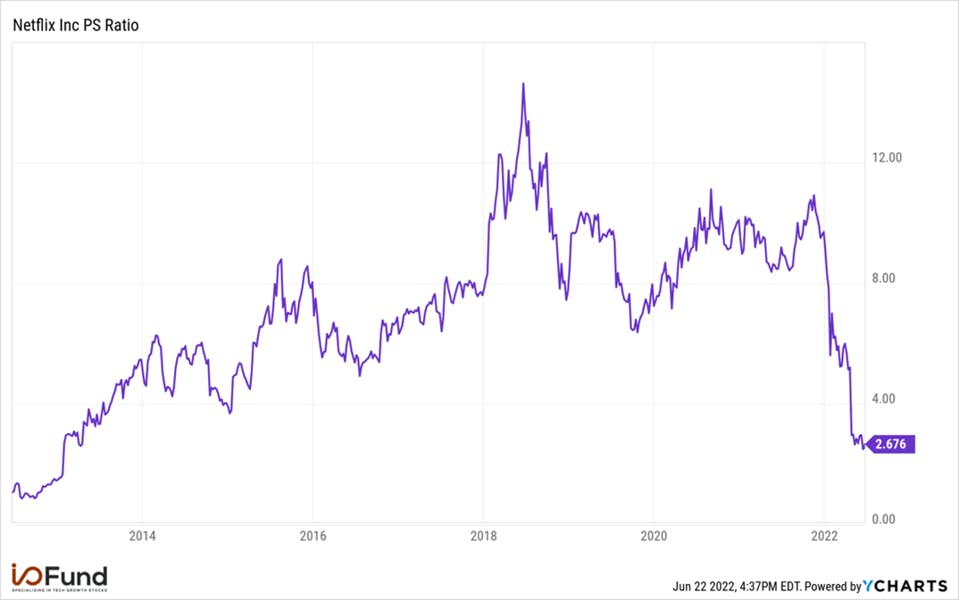
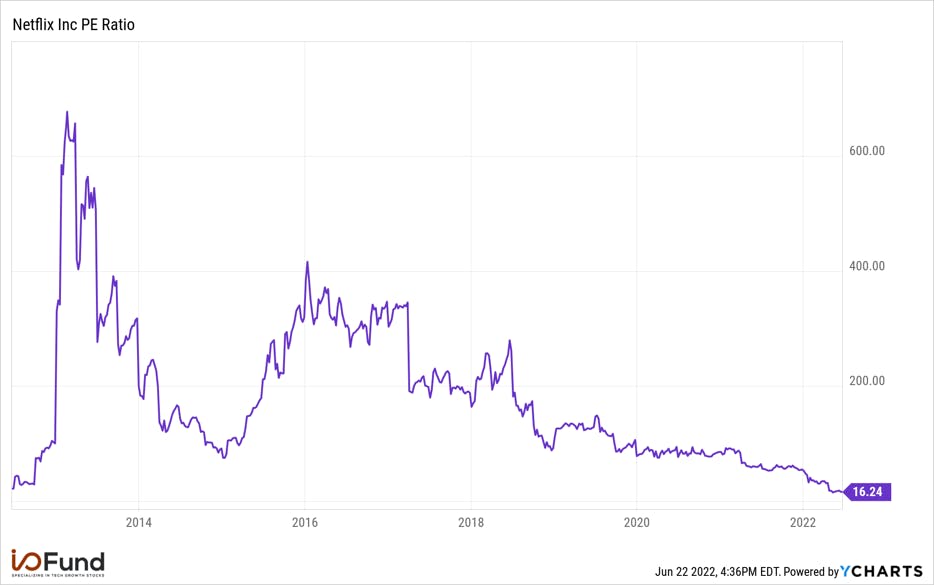
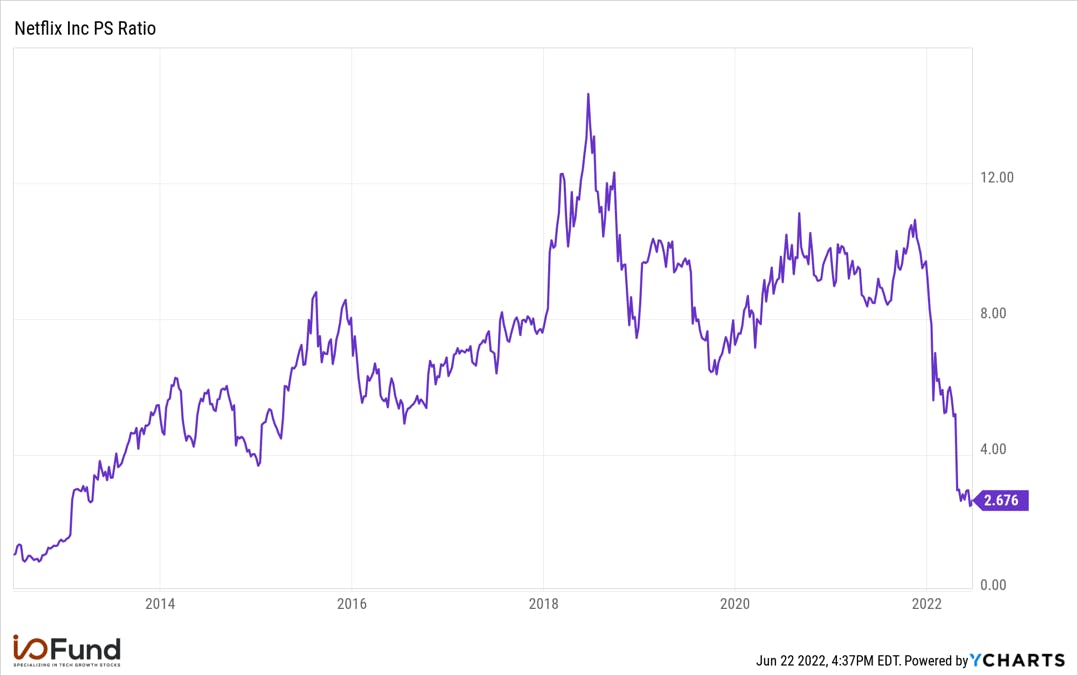
We believe NFLX is undervalued based on where this monetization will take its revenue in the coming quarters, and this is showing up in the chart on a long-term basis. However, over the next month, Netflix looks to be tracing a bear pennant pattern/triangle pattern. These are common in 4th waves, suggesting one more push lower to complete the drawdown.
Microsoft
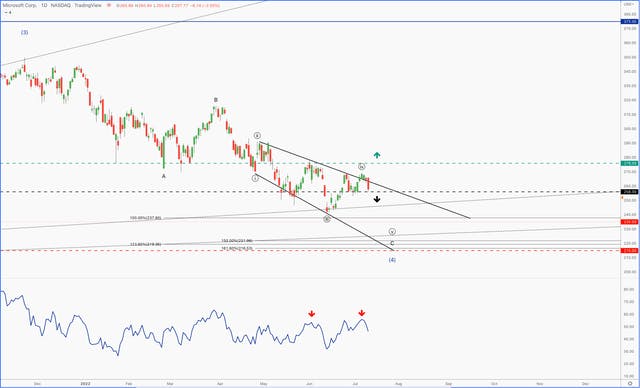
Microsoft (MSFT) is one of the FAAMGs that we believe will continue to exhibit dominance into future tech trends. It is one of the leaders in the on-going cloud trend, and is also setting itself up to lead in edge computing and machine learning. We believe Microsoft has multiple catalysts to maintain its growth, which is why we own it within our portfolio.
We think Microsoft is the best risk/reward mega-cap tech stock due to its firm foundation in the cloud and its diversified cloud products. It's also positioned for outsized growth due to its exposure to secular tailwinds such as Artificial Intelligence (AI), Machine Learning (ML), and the build out of the 5G network edge. We think Microsoft will take a substantial share of these markets at the infrastructure level due to its relationships with the Fortune 500 and Global Fortune 2000.
The company's business relationships with Fortune 500 companies, brand image, and wide user base are the moats that will help the company drive revenues in the hybrid cloud, machine learning, and artificial intelligence segments. Microsoft Azure is used by more than 95% of the Fortune 500 companies, which shows the company's dominance across enterprises.
This is also present within the long-term chart of Microsoft, as it is another FAANG that has a high probability of making a new high in the next growth cycle. As long as it critical support holds at $215, this will remain our primary outlook. However, like the rest of the FAANGs, it looks like it is setting up for one more push lower before we can start looking up.
Amazon
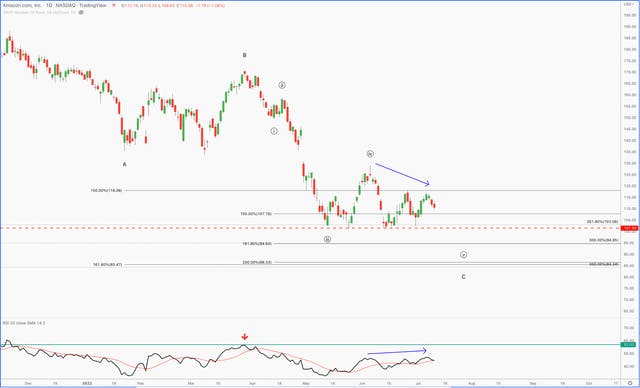
Amazon also looks ready to break the $101.50 support zone in what looks like a 4th wave top. The RSI continues to fail under the key bear market resistance at 57. We also have a confirmed Negative RSI Reversal Signal, which is when the RSI makes a higher high while price makes a lower high. This is happening well underneath the bear market resistance of 57 on the RSI. The odds favor one more push lower.
Meta
Meta Platforms (META) is the one stock within the FAANGs that has a high probability of not seeing new highs in the next growth cycle. Fundamentally, the effects of Apple's changes to IDFA has finally caught up with META. We have been warning about this shift in META since early 2020. In short, Audience Network is what allowed META to become the advertising behemoth that it is. Not only was META capturing 1st party data through Facebook, but Audience Network allowed it to capture a large portion of 3rd party data.
Sign up for I/O Fund's free newsletter with gains of up to 403% – Click hereSign up for I/O Fund's free newsletter with gains of up to 403% – Click hereClick here
We had also said back in 2018 that we think Audience Network contributed $5 Billion to $10 Billion in ad revenue (the third-party data ad exchange FB uses). Three years later, that's what Facebook stated in their February 2nd earrings call – "we believe the impact of iOS overall as a headwind on our business in 2022 is on the order of $10 billion."
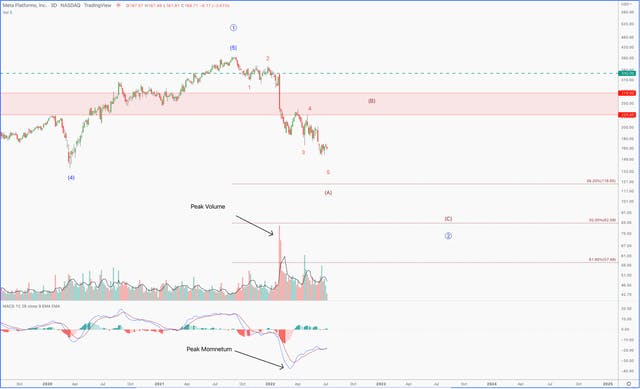
Simply put, the metaverse is simply not big enough to fill this revenue gap. This is showing up in the chart of META. For one, we have a confirmed 5 wave drop from the all-time high. For one, note how the 3rd wave, which is the most powerful move in a trend, happened on peak volume and peak momentum. This is because traders/investors realized that they are on the wrong side of the herd. They sell at any price, creating an intense moment of sentiment. The 5th waves are always on weaker volume and momentum, which is what we are seeing. Here, the shorts always press their luck, exhausting sellers for this move down.
Why this is significant is that the only corrective pattern that starts with 5 waves down is a Zig-Zag pattern. This is 5 waves down, a 3 wave retrace that fails around half way, then another 5 wave pattern down to new lows. If accurate, the next growth cycle will have META making a move back towards $225-$275 before failing.
For this to invalidate, META must reclaim the $330 resistance zone. This is unlikely due to the fundamental problems META now faces.
In conclusion, there are simply too many divergences between Apple's strength and the rest of the FAANGs to signal a meaningful low is in. I think the odds are high that we at least attempt a double bottom, if not a push towards 3500 SPX before we can start looking up. I do believe that if we do see a push to new lows, it will likely be the 5th wave in this correction. So, it should be on weaker momentum and less volume than prior moves. If so, we will continue to add to beaten down tech stocks that primed to become the next FAANGs.
Please note: The I/O Fund conducts research and draws conclusions for the Fund’s positions. We then share that information with our readers. This is not a guarantee of a stock’s performance. Please consult your personal financial advisor before buying any stock in the companies mentioned in this analysis.
If you were to guess, when do you think we wrote the following paragraph?
“When a thesis is not reflected in the revenue segments yet, there are typically lower entry points and ongoing volatility. You’ll see in the technical analysis that although I could not be more bullish on this stock long-term, there is weakness in the semiconductor sector and we hope this translates to a lower entry point for our readers.
The market is also in a fierce debate between AMD, Intel, and Nvidia and is also distracted by other chips, such as Micron and NXP. In my analysis, I look for growth. How big is the market relative to how big the company is now?
You can ignore Nvidia’s gaming revenue and other segments for the main trajectory that we are focused on. Gaming is great for stability and earnings reports, but the growth will not be from gaming (a market where Nvidia is already a mature, market leader). I’m also not focused on PC sales or the CPU-powered cloud, as the first is not a growth market and the second is not the piece in the cloud stack that will accelerate future technologies.”
That was written in 2019 yet the far majority of those concerns could be stated verbatim right now. Do we care about PC sales or gaming consoles? No, although our stance is that we have to expect these concerns will affect our semiconductor positions at times. The good news for Nvidia and AMD investors is that as time goes on, the less consumer-related hardware will have an impact. The 2022 Nvidia Investors Presentation provided numbers which show in detail how consumer exposure will become less of a concern in the future for these AI heavyweights.
When do you think we wrote this analysis?
“Over the past few weeks, I have read many lagging explanations on the chip shortage – too many fabless semiconductor companies, too few foundries, automobile manufacturers paused ordering in March and didn’t prepare for the sharp rebound, tensions with China, and even a fire at the Asahi Kasei plant that specifically manufactures sensing devices for the automobile industry.
While all of these are true, the overarching issue is that the role of semiconductors has changed from a commodity to the primary accelerant of future technologies. This is because connectivity, automation, and ultimately AI, will disrupt every corner of every industry.
We saw this happen with data and cloud but now we must accelerate this to the next level for AI/ML and the common denominator is semiconductors. Automotive is only the beginning. We can add renewables to the list and even e-commerce as AR/VR and AI/ML attempt to prop up the leaders who are competitive enough to add these features first.
As a tech stock analyst, I don’t have the luxury of lagging analysis of any kind. My subscribers require (and deserve) forward-looking, and with my intense focus on semiconductor chips, I don’t think my readers are surprised that semis are under pressure due to an increasingly important role.
I have repeated (perhaps too many times) that there is no way forward without the semis. We are seeing this manifest in automotive right now, but as investors, we should get used to hearing about semiconductor shortages.
You and I can debate Palantir, Snowflake or C3.AI, for example, and the valuations or the right angle for AI/ML-driven software, but the common denominator to these companies is the need for semiconductors to drive forward AI and 5G.
Now, we add the enormous push for auto manufacturers to compete with Tesla, Apple, Lucid Motors and what we have is a bottle neck where the automotive industry filters into semiconductors.
My guess is the demand won’t be letting up for many years as we are no longer in the cyclical pattern that semis are notorious for. Instead, demand will outpace supply for years to come.
Is this a bad thing or a good thing for our stocks? As investors, we can either listen to the news or listen to management. In this case, they are not aligned. Machines trade off news and natural language processing (NLP) but as human investors, we have the advantage of looking deeper into the issues.
I have written volumes of analysis leading up to the triple-digit growth we are seeing now in the data center from AI accelerator chips. Most of this was written when data center growth was negative. For instance, my Nvidia thesis was set end of 2018 — and in 2019 Nvidia reported negative data center revenue year-over-year for four quarters in a row.reported negative data center revenue year-over-year for four quarters in a row.
I mention this because following a trend’s trajectory is more important than immediate gratification from the market. The trend will always win out over time.
I have maintained that chips will eventually lead the AI market and are the best angle for investing in edge computing. I have also defended our stocks against custom silicon. Now we have the first of what I predict will be many semiconductor shortages and bullish to me.
The shortage is that there are hundreds (thousands really) of companies that rely on semiconductors. This will come to a head with AI and 5G as those who go-to-market soon with these features will have an enormous competitive advantage.”
That was written at the height of the bull market in February of 2021. My goal is to illustrate there has always been headlines to worry about for the semiconductors. We’ve firmly held these stocks and bought during dips. In the past, from 2018-2019, I focused on the GPU-powered cloud and the CUDA moat here and here. Our 2020 coverage centered on the A100 GPU which we discussed at time of launch for premium here and continued coverage on the A100 about a year later on the free side.
Here is background on the A100:
“Nvidia released the Ampere architecture and A100 GPU as an upgrade from the Volta architecture. The A100 GPUs are able to unify training and inference on a single chip, whereas in the past Nvidia’s GPUs were mainly used for training. This allows Nvidia a competitive advantage by offering both training and inferencing. The result is a 20x performance boost from a multi-instance GPU that allows many GPUs to look like one GPU. The A100 offers the largest leap in performance to date over the past 8 generations.”
Nvidia's AI Dominance Will be Propelled Forward by Software:
I wanted to go back through a bit of Nvidia’s history – what was the thesis and how did the thesis evolve? – before I go into how Nvidia will continue to dominate. In my opinion, I believe this is the most important analysis I have ever written on Nvidia because the company is changing rapidly into a software company.
The shift that Nvidia is going through has gone unnoticed and that’s to our benefit. Because we have been hell bent on finding what companies will dominate AI hardware, I’ve been asked frequently who do I think will dominate AI software (Palantir? Snowflake? Google?)
I’m prepared to give you that answer today: I believe Nvidia will be one of the biggest or perhaps the biggest AI software stack company in the world.the biggest AI software stack company in the world. The analysis below kickstarts our in-depth coverage on this new thesis — and I fully believe I will be quoting this analysis in five years from now when we check back on how the AI software thesis played out.
Before I go into semiconductor jargon where I risk losing your attention, I want to make sure our Members are fully aware that the segment where Nvidia will dominate with AI software is automotive. I am not talking about a few OEMs that trickle into a little bump in revenue. I am saying that Automotive is scheduled to become Nvidia’s number one segment – even over data centers – and to the tune of it being 3X larger than its gaming segment.
Don’t take my word for it because the CFO said exactly that (more on this below) and there is ample evidence that this is happening, which I also detail for you. Wall Street won’t be giving this the credit it deserves until 2023 at the earliest but you will hear non-stop “Nvidia Automotive” coverage by 2024-2026 as this segment ramps. I go over why those are the target dates below.
But first, let’s talk about the H100 and how this new GPU architecture will also help Nvidia lead on AI software at the enterprise level. There is plenty going on outside of Automotive that we need to cover so I kept automotive for last.
GTC Highlights: The Hopper H100 GPU
In March at GTC 2022, Nvidia announced the Hopper H100 GPU with 80 billion transistors and will be released in Q3 of this year. For reference, the A100 has 54 billion transistors. This is Nvidia’s solid attempt to keep their stake in the ground in leading high-performance computing over AMD’s Instinct MI250/250X and the newly announced MI210.
It’s easy to focus on hardware with Nvidia (and AMD) yet these companies are becoming more software-driven each year. By owning the majority of the market for AI accelerators, these two companies are afforded an opportunity to also own the software layer as a means to lower the barrier to entry for training models, deploying inference across various frameworks, and other workloads related to deep learning, conversational AI, video conferencing algorithms, and more. By supplying the hardware, these companies have natural inroads to machine learning operations (MLOps).
The H100 is the New Artificial Intelligence Infrastructure
DGX, DGX Pods and DGX SuperPods:
The H100 will power all AI and high-performance computing systems including the PCI express accelerator for mainstream servers and many H100 GPUs can be combined to power advanced AI through the following systems: DGX, DGX Pod and DGX SuperPod.
The difference between the A100 and H100 is the performance will be two to three times faster. The H100 GPUs and the DGX H100 server pods and super pods offer Nvidia the next leg-up as the company has solved an important bandwidth issue.
Hopper tackles some of the bigger issues around previous generations like speeding up algorithms by offering dynamic programming on GPUs to break down problems to simpler subproblems, boosting bandwidth by 3X with SHARP in-networking computing and Infiniband Switches, and the H100 can leverage NVLink to connect eight H100s into one giant GPU for 640 billion transistors, 32 petaflops, 640GB of HBM3, and 24 terabytes per second of memory bandwidth.
The chip is custom built by Taiwan Semiconductors with a 4nm design making it the world’s fastest 4nm GPU. The H100 has about 50% more memory and interface bandwidth than the A100. That’s 1.5X more bandwidth with the NVLink connection and PCIe 5.0 doubling the bandwidth of PCIe 4.0. The H100 will ship with support for 80GB of HBM3 memory at 3 TB/s speed.
The NVLink is now able to link together server nodes to build a data center-sized GPU. NVLink was originally designed to bypass the PCIe slot and has become an important tool for chip-to-chip connectivity, especially for high-speed operations. There is a dedicated chip called the NVSwitch which has increased the NVLink’s bandwidth. The ultimate goal is to run 32 servers with their own operating systems to run a single job. NVLink will complement the InfiniBand networking for high-performance computing and NVLink will be default for all of Nvidia’s chips, including GPUs, CPUs, DPUs and SoCs.
Where the H100 really stands apart is the leap in performance with about 3X more performance than the A100 and the H100 is up to 6X faster. The leap in performance is measured by H100’s ability to deliver up to 4,000 TFLOPS of FP8 compute, 2,000 TFLOPS of FP16 compute and 1,000 TFLOPS of TF32 compute and 60 TLOPS of general purpose FP64 compute. The A100 lacked support for FP8 compute at default whereas the H100 will leverage a transformer engine to switch between FP8 and FP16, depending on the workload.
According to Nvidia, the H100 delivers 9X more throughput in AI training, and 16X to 30X more inference performance. The company also states in HPC application-specific workloads, the H100 is 7X faster. The goal of the H100 was not only to add more transistors and make the H100 faster, but to also offer function-specific optimizations. This is achieved through the transformer engine.
The architecture aims to answer one of the bigger challenges facing superfast compute, which is that moving data into traditional servers overloads the CPU and system memory and becomes bottlenecked by PCI-Express.
By improving the bandwidth issue, Nvidia’s goal is to create more demand for their DGX Pod and SuperPod Systems, which in turn, will create more demand for their software.
The H100 DGX Pod is a 32-node, 256-GPU system. The H100 DGX Pod connects 32 DGX systems using the NVLink Switch System to scale into a super-GPU capable of 768 terabytes per second. To compare, the entire internet requires 100 terabytes per second. This results in 1 exaflop of AI computing.
From there, multiple H100 DGX Pods can connect through the Infiniband Switch to scale DGX Superpods with thousands of H100 GPUs. DGX SuperPods are turnkey systems that power enterprise AI. DGX SuperPods were also available with the A100 yet the H100 will have 6X better performance with 1 exaflop of FP8 AI performance to run trillions of parameters (more on this below).
Spectrum-4 Ethernet Platform
Perhaps one of Nvidia’s most important advancements for the H100 is the ability to attach the network directly to the GPU to avoid bottlenecks at the CPU. This is accomplished by sending data with direct memory access at 50 gigabytes per second. Hopper HGX and DGX are networking and interconnects that facilitate moving data with an advanced networking processor called the CX7. The result is the H100 CNX that avoids bandwidth bottlenecks and frees the CPU and system memory to process other parts of the application.
The Spectrum Ethernet platform, which consists of a Spectrum-4 Switch, CX7 SmartNIC and Bluefield-3 DPU will be used for several of Nvidia’s AI platforms, such as Riva, Merlin and Omniverse. These workloads include natural language processing, recommenders, and digital twins and will be supported by a networking system that helps exchange large databases between nodes. Whereas traditional workloads required many connections exchanging small amounts of data, the workloads of the future will require data to be shared quickly between GPUs and storage. This is accomplished by bypassing the CPU and sending data directly to the GPU while using the network hardware to move the data.
This is ideal for enterprise use cases where people are more likely to use Ethernet while AI and HPC workloads continue to use the Quantum-2 based off Mellanox’s InfiniBand. Quantum-2 allows for in-network computing to do data reductions in the network. It’s also more likely that Ethernet is used for 5G and sensors.
Eos: The First Hopper AI Factory
Nvidia is building AI factories to compete with AI supercomputers, which are blueprints for AI infrastructure that can be adopted by cloud partners and enterprises.
Eos is built with 18 H100 SuperPods, with 576 DGX H100 systems and 360 NVLink Switches. Nvidia states EOS is 1.4X faster than the fastest supercomputer and offers 4X the AI processing of the world’s fastest supercomputer. This will deliver 18 EFLOPS of FP8 AI compute or 9 EFLOPS of FP16 compute.
Previously, FP16 was the standard for AI whereas FP8 is gaining more support to become the industry standard. Depending on what AI compute you use, benchmarks will not be apples-to-apples if FP8 is compared to FP64 performance. Right now, AMD’s Frontier supercomputer is #1 with 1.1 exaflops of FP64 performance compared to the upcoming Venado supercomputer’s 10 exaflops of FP8 performance.
The difference is that the smaller bit size allows for an economical way to achieve more speed when giving up a small amount of accuracy doesn’t make a critical difference. This also helps in the face of a slowing Moore’s Law. FP8 is most commonly used for inference yet may be used for training in the future due to boosting throughput. Following the release of the Hopper H100, Intel released Gaudi2 which supports FP8. Chip makers Graphcore, AMD and Qualcomm have recently pushed for an industry-standard for the low precision floating point format FP8 rather than integer formats.
Here is what Nvidia said in the GTC keynote:
But the trend in AI computing has been toward developing neural nets that lean on the lowest precision that will still yield an accurate result. The smaller formats compute faster and more efficiently, and they require less memory and memory bandwidth. The addition of 8-bit floating-point units in the H100 leads to a significant speedup—double the throughput compared to its 16-bit units”
DPX Instructions (ISA):
The H100 improves dynamic programming with DPX Instructions that will help specific AI Algorithms to perform up to 7X faster than previous GPUs and 40X faster than CPU-based algorithms. As algorithms require more complexity, the new set of DPX instructions will help break the complex problems down into simpler subproblems using GPUs instead of CPUs or FPGAs.
The DPX ISA are expected to be broadly available with the CUDA 12.0 release. Examples of where this will be useful include disease research and drug discovery where the process can be sped up 35X for real-time processing to match the rate of DNA sequencing. Route optimization and finding the shortest distance between destinations for use in factories and autonomous driving systems, or Floyd-Warshall acceleration, is boosted up to 40X compared to CPU-only servers. These instructions will also be used for quantum computing and SQL queries as dynamic programming can help find the optimal order for joining a set of tables.
GPU Confidential Computing:
Data is encrypted at-rest and in-transit yet is often unprotected during use. Meanwhile, the data used to train AI models is worth millions in investments and is trained from domain knowledge and company-proprietary data. The new H100 offers confidential computing whereas previously only CPUs offered the protection of both data and applications during use.
Nvidia is Becoming a Leading AI Software Company
It would be easy to read the information above and to assume Nvidia is improving its hardware. However, the company’s future resides in software which will remove some of the cyclicality of hardware revenue. I believe once Nvidia’s software revenue begins to reveal itself in earnings reports, the market will finally piece together the true potential of this AI powerhouse.
It’s both the hardware and the software stack that led me to say Nvidia will surpass Apple in 5 years. You know this story well: the relationship between a hardware company leveraging their position to capture the lion’s share of the software — because that’s exactly what Apple did.
There are four layers to Nvidia’s full-stack accelerated computing: hardware, system software, platform software and applications. Below, I discuss a few ways that Nvidia is capturing more of the software stack due to vendor lock-in effects from their dominance in hardware.
As stated, in the past, our focus was the GPU-powered data center. This was a four-year thesis from 2018 and we doubled up on the thesis in June of 2020 for the A100 release. I want to make sure and emphasize that Nvidia’s lesser-known catalyst is actually the software.
The H100 is helpful in maintaining a lead in GPUs, which is critical turf to protect with GPUs being the most popular AI accelerator, however — the AI/ML catalyst will be further fueled by the Nvidia’s lead in software. This is why the majority of who will remain the AI leader will be up to developers and not the C-suite partnerships on hardware that characterized Intel’s lead over the past few decades. The developers choose the frameworks, the SDKs, libraries and the other parts of the software stack, and because of this, they also choose the GPUs they build on rather than IT departments.
Transformers
The transformer engine is one of the key aspects of the H100. Transformers are becoming one of the most popular neural-network models by applying self-attention to detect how data elements in a series influence and depend on one another.
Sequential text, images and video data are used for self-supervised learning and pattern recognition, which results in more data being used to create better models. Prior to transformer models, labeled datasets had to be used to train neural networks. Transformer models eliminate this need by finding patterns between elements mathematically, which substantially opens up what datasets can be used and how quickly. Transformers are partial to the parallel processing that GPUs offer.
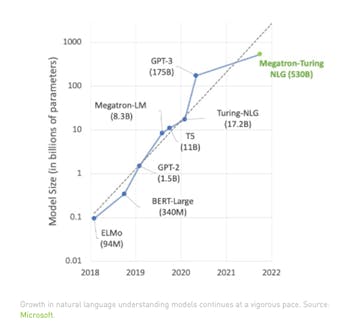
Google first introduced transformer models in 2017 and transformers are used in Google and Bing Search. Transformers also led to BERT models, which stands for Bidirectional Encoder Representations from Transformers, and is commonly used for text sequences. Transformers are also used in GPT-3 (it’s the T in GPT) which improved from 1.5 billion parameters to 175 billion parameters. GPT-3 has the ability to report on queries it has not been specifically trained on.
Nvidia and Microsoft recently worked on a Mega transformer model with 530 billion parameters and the future for AI engineers is trillion-parameter transformers and applications. The H100 is already prepping for this. According to Nvidia, the training needs for transformer models will increase 275-fold every two years compared to 8-fold for other models. The H100 GPU with its Transformer Engine supports the FP8 format to speed up training to support trillion-parameter models. This leads to transformer models that go from taking 5 days to train to becoming 6X faster to only taking 19 hours to train.
The transformer engine is software combined with the new hardware in the H100’s tensor cores. As discussed, the A100 was designed for floating-point numbers to 16 bits while the H100 is designed for 8 bits. This is helpful because AI models are moving toward neural nets that lean on the lowest precision and yet still yields an accurate result. In this case, 8 bits double the throughput of 16-bit units, compute faster and more efficiently, and they require less memory and memory bandwidth.
The main feature from the Transformer Engine is the ability to choose what precision is needed for each layer in the neural network at each step, transitioning between 8-bits, 16-bits, 32-bits, plus the H100 is able to do matrix math with two forms of 8-bit numbers with either 5-bits as the exponent or 4-bits as the exponent: E5M2 and E4M3. This is important because the E4M3 may be favored for back propagation while E5M2 may be favored for inferencing.
Pictured above: Nvidia is prepped to support model sizes growing up to 275X every two years
Triton Inference Server:
Nvidia offers AI frameworks to reduce time for developers throughout the AI workflow from data processing and ETL to deep learning model training and large-scale inferencing. These libraries include Dali, Rapids, Triton and Magnum I/O. The library supports all popular frameworks and offers pre-trained models and data pipelines.
Triton is open-source inference software that helps developers deploy models across GPUs and CPUs, it supports Tensor Flow and PyTorch, any query type and any model – such as Transformers or CNNs (used for image recognition) and RNNs (used in speech recognition). The inference engine helps developers take AI development from experimentation to production by removing the need for multiple inference servers and simplifying machine learning infrastructure on the backend.
MLOps (machine learning operations) helps developers with less ML expertise to train and deploy models yet there were limited use cases with little help in deploying custom models. Triton offers high performance inference and scalability with Dockers and Kubernetes while serving up to hundreds of models with the model control API. By supporting all popular frameworks, Triton helps developers avoid framework lock-in due to the consistent interface regardless of training framework or hardware.
Nvidia will Power the Lion’s Share of Automotive – and that means software licensing
Nvidia’s lead in automotive across dozens of OEMs requires its own deep dive. The reason I haven’t prioritized this is because Hyperion 8 is shipping in 2024 and Hyperion 9 will ship in 2026. However, as long-term investors, we should touch base now on the long-term vision for yet another large and sweeping revenue segment. In fact, automotive promises to be Nvidia’s largest segment by 2030 – so on that alone, imagine what Nvidia investors have in front of us.
Nvidia’s Orin SoC (system-on-a-chip) is designed for the neural networks that run robots and AVs at the edge. This is the central computer for the car. The Orin SoC is capable of 254 trillion operations per second by combining Nvidia GPUs with Arm CPU cores and TensorRT APIs. The goal is to help OEMs move from Level 2 autonomous systems to the elusive Level 5 and it stiffens the competition with Tesla’s FSD. Notably, at the release two years ago, Tesla pointed towards Orin’s power consumption as a potential issue for EV batteries but this has not stopped many competing EVs from adopting Nvidia’s in-vehicle hardware and DRIVE software stack.
The EV manufacturers that have already moved forward with Nvidia DRIVE Orin include: Nio, Xpeng, BYD, Lucid Group, Mercedes and Land Rover, GM Cruise — you name it, it’s probably in production with Nvidia at this moment. The company’s current automotive pipeline exceeds $11 billion over the next six years – expect this small blip of pipeline to grow exponentially.
Nvidia recently announced an upgrade to Orin called Atlan with 1,000 TOPS on one chip, or more than then Level 5 compute in AVs today. This chip will catapult forward the computing performance of AVs and is expected to be released in 2023.
Nvidia DRIVE is the operating system and software stack for vehicles that offers an execution environment and includes both security and over-the-air updates. DriveWorks is an SDK that enables self-driving applications. Drive AV offers key ingredients to an autonomous system, such as perception, mapping and planning modules. Regarding mapping, Nvidia DRIVE Map is a multi-modal drive engine that can map independently and has two map engines. Drive IX is open-source software that offers vision, voice and graphics for the user experience. (I will do a separate deep dive on Nvidia Automotive in 2023).
The entire autonomous platform is called Hyperion, which includes the compute and sensor toolkit. This includes the hardware plus a 360-degree camera, radar, lidar and ultrasonic sensor suite. As stated, Hyperion 8 ships in 2024 with Hyperion 9 shipping in 2026, which will double the processing speed and offer an increase in sensors. Nvidia offers open-source developer kits to help increase its compatibility across various projects.
Rather than train the vehicles on the road, Nvidia trains in simulation and can create virtual world obstacles for the vehicles to learn from. This is a different approach from companies like Tesla who have millions of cars on the road collecting data which they then augment for unusual events with a photorealistic simulator.
Tesla has the most data of any car manufacturer which helps the company competitively as more data equals better performing models especially in terms of object detection. More data from millions of cars on the roads also helps with prediction as Tesla collects data from incorrect predictions that can be added to the training set. By leveraging a prediction neural network, Tesla does not need to use human labeling or annotation and can instead use what’s called a temporal sequence of events — in other words, Tesla rewinds events and labels objects automatically with the use of a supercomputer.
The advantage here is that training neural networks correlates with the miles (which again, are substantial due to size of fleet on the road compared to competitors) rather than correlating with the need for human labeling. The result of automatic labeling is that Tesla is able to predict rare situations with more accuracy.
Where Nvidia delivers a strong advantage is the company has decades of history with graphics and simulation due to its gaming roots. As stated, Tesla also uses imitation learning and has a photorealistic simulator which uses vector space for labels and functions like a game engine. However, Nvidia has been quietly working on their simulation platform for many years internally despite only recently marketing Omniverse to the public. In this case, Nvidia has such a high-level of confidence in their simulation skills that they forego the real-life fleet to primarily train virtual 3D models. The company is also packaging the simulation platform for many other uses cases, such as AI factories, 5G networks, power plants and climate research. Developers can work with 3D tools through Python-based development.
To keep it simple, Tesla’s primary advantage is the data they have collected as no other EV/AV has collected this level of data from real drivers. To contrast, Nvidia has arguably the best simulation platform due to decades of graphics work. These digital twins are only now being widely marketed despite being in development for over 5 years. The license costs $9,000 and Nvidia has estimated its current addressable market is 20 million engineers. Notably, Nvidia’s Hyperion will also be deployed in millions of vehicles over time, offering similar levels of data as Tesla’s fleet.
The Tesla VS Nvidia debates have not formally begun but they are certainly in our future … so brace yourself. Ultimately, the way Nvidia stands apart is the company does not directly compete on manufacturing vehicles. This is something anyone can agree on. That means many OEMs will use Nvidia’s DRIVE system whereas Tesla is less likely to commercialize their software as they’re viewed as a main competitor.
As long as Nvidia continues to innovate and maintain a lead, the popularity of its DRIVE system is likely to remain due to the company’s strategic advantages in AI and supercomputing. The company did an excellent job of tackling the edge computing use case of autonomous vehicles first.
Hardware is only part of the equation. The long-term plan is for Nvidia to license software for autonomous vehicles, which will create a recurring revenue stream. The licensing fees will go well beyond Omniverse to include the actual owner of the vehicle paying a subscription fee to Nvidia for its software. Tesla does this with their AutoPilot software which has grown from $5,000 to $12,000 per vehicle.
$150 billion from Omniverse software – fees are charged to both users and robots/digital twins
$300 billion from Automotive – primarily software
What Nvidia is communicating is that software revenue will surpass hardware revenue long-term.
Here is what Kress stated: "Our software content per vehicle can be in the thousands of dollars over the lifetime of the vehicle compared to the hundreds of dollars for the hardware. And second, software scales with the installed base of vehicles, not annual production.”
Note on CUDA:
The software discussion on Nvidia is not complete without a mention of CUDA. We called this Nvidia’s moat back in 2018 and we continue to believe it provides an important moat. The CUDA-related libraries include frameworks that span quantum computing, robotics, 5G networks, cybersecurity and drug discovery. The universal skills taught around CUDA and Nvidia’s SDKs help to drive more business for Nvidia’s GPUs.
The primary risk right now is valuation as Nvidia trades 2X higher than its peers on both the top line sales valuations and on the bottom line with earnings and cash-based valuations. There’s probably equal risk in waiting for Nvidia to drop another 50% as there is in buying Nvidia at the 2X valuation. One reason Nvidia may be valued here is because it’s slowly becoming a software company. Regardless, Knox’s technicals help immensely in determining if the market will continue to award Nvidia it’s gold medal valuation or if the market will discount Nvidia based on sentiment-driven headlines. This is a position we plan to keep on building so you can keep an eye out for those trade alerts over the next few years.
Conclusion:
Finding great companies is only half the battle, fighting negative sentiment is the other half – and semis have no shortage of this in any market – hence our beginning quotes from 2019 and also 2021.
Nvidia is the strongest company in terms of product on the market today. That doesn’t mean semis won’t be a roller coaster – we should fully expect that semis will undulate in sentiment and price while we hold our stocks over many years. We can’t change the way Wall Street works — which is a pendulum that swings between value stocks and growth stocks — but we can describe in great detail why concerns around gaming and consumer electronics slowing down is not going to change our position. We do not care to perfectly time entries or to find a perfect bottom – you’ll be hard pressed to find any legendary investor recommend that this be an investor’s goal. What we care about is finding quality companies and building those positions over time. Nvidia fits this description.
If you were to guess, when do you think we wrote the following paragraph?
“When a thesis is not reflected in the revenue segments yet, there are typically lower entry points and ongoing volatility. You’ll see in the technical analysis that although I could not be more bullish on this stock long-term, there is weakness in the semiconductor sector and we hope this translates to a lower entry point for our readers.
The market is also in a fierce debate between AMD, Intel, and Nvidia and is also distracted by other chips, such as Micron and NXP. In my analysis, I look for growth. How big is the market relative to how big the company is now?
You can ignore Nvidia’s gaming revenue and other segments for the main trajectory that we are focused on. Gaming is great for stability and earnings reports, but the growth will not be from gaming (a market where Nvidia is already a mature, market leader). I’m also not focused on PC sales or the CPU-powered cloud, as the first is not a growth market and the second is not the piece in the cloud stack that will accelerate future technologies.”
That was written in 2019 yet the far majority of those concerns could be stated verbatim right now. Do we care about PC sales or gaming consoles? No, although our stance is that we have to expect these concerns will affect our semiconductor positions at times. The good news for Nvidia and AMD investors is that as time goes on, the less consumer-related hardware will have an impact. The 2022 Nvidia Investors Presentation provided numbers which show in detail how consumer exposure will become less of a concern in the future for these AI heavyweights.
When do you think we wrote this analysis?
“Over the past few weeks, I have read many lagging explanations on the chip shortage – too many fabless semiconductor companies, too few foundries, automobile manufacturers paused ordering in March and didn’t prepare for the sharp rebound, tensions with China, and even a fire at the Asahi Kasei plant that specifically manufactures sensing devices for the automobile industry.
While all of these are true, the overarching issue is that the role of semiconductors has changed from a commodity to the primary accelerant of future technologies. This is because connectivity, automation, and ultimately AI, will disrupt every corner of every industry.
We saw this happen with data and cloud but now we must accelerate this to the next level for AI/ML and the common denominator is semiconductors. Automotive is only the beginning. We can add renewables to the list and even e-commerce as AR/VR and AI/ML attempt to prop up the leaders who are competitive enough to add these features first.
As a tech stock analyst, I don’t have the luxury of lagging analysis of any kind. My subscribers require (and deserve) forward-looking, and with my intense focus on semiconductor chips, I don’t think my readers are surprised that semis are under pressure due to an increasingly important role.
I have repeated (perhaps too many times) that there is no way forward without the semis. We are seeing this manifest in automotive right now, but as investors, we should get used to hearing about semiconductor shortages.
You and I can debate Palantir, Snowflake or C3.AI, for example, and the valuations or the right angle for AI/ML-driven software, but the common denominator to these companies is the need for semiconductors to drive forward AI and 5G.
Now, we add the enormous push for auto manufacturers to compete with Tesla, Apple, Lucid Motors and what we have is a bottle neck where the automotive industry filters into semiconductors.
My guess is the demand won’t be letting up for many years as we are no longer in the cyclical pattern that semis are notorious for. Instead, demand will outpace supply for years to come.
Is this a bad thing or a good thing for our stocks? As investors, we can either listen to the news or listen to management. In this case, they are not aligned. Machines trade off news and natural language processing (NLP) but as human investors, we have the advantage of looking deeper into the issues.
I have written volumes of analysis leading up to the triple-digit growth we are seeing now in the data center from AI accelerator chips. Most of this was written when data center growth was negative. For instance, my Nvidia thesis was set end of 2018 — and in 2019 Nvidia reported negative data center revenue year-over-year for four quarters in a row.reported negative data center revenue year-over-year for four quarters in a row.
I mention this because following a trend’s trajectory is more important than immediate gratification from the market. The trend will always win out over time.
I have maintained that chips will eventually lead the AI market and are the best angle for investing in edge computing. I have also defended our stocks against custom silicon. Now we have the first of what I predict will be many semiconductor shortages and bullish to me.
The shortage is that there are hundreds (thousands really) of companies that rely on semiconductors. This will come to a head with AI and 5G as those who go-to-market soon with these features will have an enormous competitive advantage.”
That was written at the height of the bull market in February of 2021. My goal is to illustrate there has always been headlines to worry about for the semiconductors. We’ve firmly held these stocks and bought during dips. In the past, from 2018-2019, I focused on the GPU-powered cloud and the CUDA moat here and here. Our 2020 coverage centered on the A100 GPU which we discussed at time of launch for premium here and continued coverage on the A100 about a year later on the free side.
Here is background on the A100:
“Nvidia released the Ampere architecture and A100 GPU as an upgrade from the Volta architecture. The A100 GPUs are able to unify training and inference on a single chip, whereas in the past Nvidia’s GPUs were mainly used for training. This allows Nvidia a competitive advantage by offering both training and inferencing. The result is a 20x performance boost from a multi-instance GPU that allows many GPUs to look like one GPU. The A100 offers the largest leap in performance to date over the past 8 generations.”
Nvidia's AI Dominance Will be Propelled Forward by Software:
I wanted to go back through a bit of Nvidia’s history – what was the thesis and how did the thesis evolve? – before I go into how Nvidia will continue to dominate. In my opinion, I believe this is the most important analysis I have ever written on Nvidia because the company is changing rapidly into a software company.
The shift that Nvidia is going through has gone unnoticed and that’s to our benefit. Because we have been hell bent on finding what companies will dominate AI hardware, I’ve been asked frequently who do I think will dominate AI software (Palantir? Snowflake? Google?)
I’m prepared to give you that answer today: I believe Nvidia will be one of the biggest or perhaps the biggest AI software stack company in the world.the biggest AI software stack company in the world. The analysis below kickstarts our in-depth coverage on this new thesis — and I fully believe I will be quoting this analysis in five years from now when we check back on how the AI software thesis played out.
Before I go into semiconductor jargon where I risk losing your attention, I want to make sure our Members are fully aware that the segment where Nvidia will dominate with AI software is automotive. I am not talking about a few OEMs that trickle into a little bump in revenue. I am saying that Automotive is scheduled to become Nvidia’s number one segment – even over data centers – and to the tune of it being 3X larger than its gaming segment.
Don’t take my word for it because the CFO said exactly that (more on this below) and there is ample evidence that this is happening, which I also detail for you. Wall Street won’t be giving this the credit it deserves until 2023 at the earliest but you will hear non-stop “Nvidia Automotive” coverage by 2024-2026 as this segment ramps. I go over why those are the target dates below.
But first, let’s talk about the H100 and how this new GPU architecture will also help Nvidia lead on AI software at the enterprise level. There is plenty going on outside of Automotive that we need to cover so I kept automotive for last.
GTC Highlights: The Hopper H100 GPU
In March at GTC 2022, Nvidia announced the Hopper H100 GPU with 80 billion transistors and will be released in Q3 of this year. For reference, the A100 has 54 billion transistors. This is Nvidia’s solid attempt to keep their stake in the ground in leading high-performance computing over AMD’s Instinct MI250/250X and the newly announced MI210.
It’s easy to focus on hardware with Nvidia (and AMD) yet these companies are becoming more software-driven each year. By owning the majority of the market for AI accelerators, these two companies are afforded an opportunity to also own the software layer as a means to lower the barrier to entry for training models, deploying inference across various frameworks, and other workloads related to deep learning, conversational AI, video conferencing algorithms, and more. By supplying the hardware, these companies have natural inroads to machine learning operations (MLOps).
The H100 is the New Artificial Intelligence Infrastructure
DGX, DGX Pods and DGX SuperPods:
The H100 will power all AI and high-performance computing systems including the PCI express accelerator for mainstream servers and many H100 GPUs can be combined to power advanced AI through the following systems: DGX, DGX Pod and DGX SuperPod.
The difference between the A100 and H100 is the performance will be two to three times faster. The H100 GPUs and the DGX H100 server pods and super pods offer Nvidia the next leg-up as the company has solved an important bandwidth issue.
Hopper tackles some of the bigger issues around previous generations like speeding up algorithms by offering dynamic programming on GPUs to break down problems to simpler subproblems, boosting bandwidth by 3X with SHARP in-networking computing and Infiniband Switches, and the H100 can leverage NVLink to connect eight H100s into one giant GPU for 640 billion transistors, 32 petaflops, 640GB of HBM3, and 24 terabytes per second of memory bandwidth.
The chip is custom built by Taiwan Semiconductors with a 4nm design making it the world’s fastest 4nm GPU. The H100 has about 50% more memory and interface bandwidth than the A100. That’s 1.5X more bandwidth with the NVLink connection and PCIe 5.0 doubling the bandwidth of PCIe 4.0. The H100 will ship with support for 80GB of HBM3 memory at 3 TB/s speed.
The NVLink is now able to link together server nodes to build a data center-sized GPU. NVLink was originally designed to bypass the PCIe slot and has become an important tool for chip-to-chip connectivity, especially for high-speed operations. There is a dedicated chip called the NVSwitch which has increased the NVLink’s bandwidth. The ultimate goal is to run 32 servers with their own operating systems to run a single job. NVLink will complement the InfiniBand networking for high-performance computing and NVLink will be default for all of Nvidia’s chips, including GPUs, CPUs, DPUs and SoCs.
Where the H100 really stands apart is the leap in performance with about 3X more performance than the A100 and the H100 is up to 6X faster. The leap in performance is measured by H100’s ability to deliver up to 4,000 TFLOPS of FP8 compute, 2,000 TFLOPS of FP16 compute and 1,000 TFLOPS of TF32 compute and 60 TLOPS of general purpose FP64 compute. The A100 lacked support for FP8 compute at default whereas the H100 will leverage a transformer engine to switch between FP8 and FP16, depending on the workload.
According to Nvidia, the H100 delivers 9X more throughput in AI training, and 16X to 30X more inference performance. The company also states in HPC application-specific workloads, the H100 is 7X faster. The goal of the H100 was not only to add more transistors and make the H100 faster, but to also offer function-specific optimizations. This is achieved through the transformer engine.
The architecture aims to answer one of the bigger challenges facing superfast compute, which is that moving data into traditional servers overloads the CPU and system memory and becomes bottlenecked by PCI-Express.
By improving the bandwidth issue, Nvidia’s goal is to create more demand for their DGX Pod and SuperPod Systems, which in turn, will create more demand for their software.
The H100 DGX Pod is a 32-node, 256-GPU system. The H100 DGX Pod connects 32 DGX systems using the NVLink Switch System to scale into a super-GPU capable of 768 terabytes per second. To compare, the entire internet requires 100 terabytes per second. This results in 1 exaflop of AI computing.
From there, multiple H100 DGX Pods can connect through the Infiniband Switch to scale DGX Superpods with thousands of H100 GPUs. DGX SuperPods are turnkey systems that power enterprise AI. DGX SuperPods were also available with the A100 yet the H100 will have 6X better performance with 1 exaflop of FP8 AI performance to run trillions of parameters (more on this below).
Spectrum-4 Ethernet Platform
Perhaps one of Nvidia’s most important advancements for the H100 is the ability to attach the network directly to the GPU to avoid bottlenecks at the CPU. This is accomplished by sending data with direct memory access at 50 gigabytes per second. Hopper HGX and DGX are networking and interconnects that facilitate moving data with an advanced networking processor called the CX7. The result is the H100 CNX that avoids bandwidth bottlenecks and frees the CPU and system memory to process other parts of the application.
The Spectrum Ethernet platform, which consists of a Spectrum-4 Switch, CX7 SmartNIC and Bluefield-3 DPU will be used for several of Nvidia’s AI platforms, such as Riva, Merlin and Omniverse. These workloads include natural language processing, recommenders, and digital twins and will be supported by a networking system that helps exchange large databases between nodes. Whereas traditional workloads required many connections exchanging small amounts of data, the workloads of the future will require data to be shared quickly between GPUs and storage. This is accomplished by bypassing the CPU and sending data directly to the GPU while using the network hardware to move the data.
This is ideal for enterprise use cases where people are more likely to use Ethernet while AI and HPC workloads continue to use the Quantum-2 based off Mellanox’s InfiniBand. Quantum-2 allows for in-network computing to do data reductions in the network. It’s also more likely that Ethernet is used for 5G and sensors.
Eos: The First Hopper AI Factory
Nvidia is building AI factories to compete with AI supercomputers, which are blueprints for AI infrastructure that can be adopted by cloud partners and enterprises.
Eos is built with 18 H100 SuperPods, with 576 DGX H100 systems and 360 NVLink Switches. Nvidia states EOS is 1.4X faster than the fastest supercomputer and offers 4X the AI processing of the world’s fastest supercomputer. This will deliver 18 EFLOPS of FP8 AI compute or 9 EFLOPS of FP16 compute.
Previously, FP16 was the standard for AI whereas FP8 is gaining more support to become the industry standard. Depending on what AI compute you use, benchmarks will not be apples-to-apples if FP8 is compared to FP64 performance. Right now, AMD’s Frontier supercomputer is #1 with 1.1 exaflops of FP64 performance compared to the upcoming Venado supercomputer’s 10 exaflops of FP8 performance.
The difference is that the smaller bit size allows for an economical way to achieve more speed when giving up a small amount of accuracy doesn’t make a critical difference. This also helps in the face of a slowing Moore’s Law. FP8 is most commonly used for inference yet may be used for training in the future due to boosting throughput. Following the release of the Hopper H100, Intel released Gaudi2 which supports FP8. Chip makers Graphcore, AMD and Qualcomm have recently pushed for an industry-standard for the low precision floating point format FP8 rather than integer formats.
Here is what Nvidia said in the GTC keynote:
But the trend in AI computing has been toward developing neural nets that lean on the lowest precision that will still yield an accurate result. The smaller formats compute faster and more efficiently, and they require less memory and memory bandwidth. The addition of 8-bit floating-point units in the H100 leads to a significant speedup—double the throughput compared to its 16-bit units”
DPX Instructions (ISA):
The H100 improves dynamic programming with DPX Instructions that will help specific AI Algorithms to perform up to 7X faster than previous GPUs and 40X faster than CPU-based algorithms. As algorithms require more complexity, the new set of DPX instructions will help break the complex problems down into simpler subproblems using GPUs instead of CPUs or FPGAs.
The DPX ISA are expected to be broadly available with the CUDA 12.0 release. Examples of where this will be useful include disease research and drug discovery where the process can be sped up 35X for real-time processing to match the rate of DNA sequencing. Route optimization and finding the shortest distance between destinations for use in factories and autonomous driving systems, or Floyd-Warshall acceleration, is boosted up to 40X compared to CPU-only servers. These instructions will also be used for quantum computing and SQL queries as dynamic programming can help find the optimal order for joining a set of tables.
GPU Confidential Computing:
Data is encrypted at-rest and in-transit yet is often unprotected during use. Meanwhile, the data used to train AI models is worth millions in investments and is trained from domain knowledge and company-proprietary data. The new H100 offers confidential computing whereas previously only CPUs offered the protection of both data and applications during use.
Nvidia is Becoming a Leading AI Software Company
It would be easy to read the information above and to assume Nvidia is improving its hardware. However, the company’s future resides in software which will remove some of the cyclicality of hardware revenue. I believe once Nvidia’s software revenue begins to reveal itself in earnings reports, the market will finally piece together the true potential of this AI powerhouse.
It’s both the hardware and the software stack that led me to say Nvidia will surpass Apple in 5 years. You know this story well: the relationship between a hardware company leveraging their position to capture the lion’s share of the software — because that’s exactly what Apple did.
There are four layers to Nvidia’s full-stack accelerated computing: hardware, system software, platform software and applications. Below, I discuss a few ways that Nvidia is capturing more of the software stack due to vendor lock-in effects from their dominance in hardware.
As stated, in the past, our focus was the GPU-powered data center. This was a four-year thesis from 2018 and we doubled up on the thesis in June of 2020 for the A100 release. I want to make sure and emphasize that Nvidia’s lesser-known catalyst is actually the software.
The H100 is helpful in maintaining a lead in GPUs, which is critical turf to protect with GPUs being the most popular AI accelerator, however — the AI/ML catalyst will be further fueled by the Nvidia’s lead in software. This is why the majority of who will remain the AI leader will be up to developers and not the C-suite partnerships on hardware that characterized Intel’s lead over the past few decades. The developers choose the frameworks, the SDKs, libraries and the other parts of the software stack, and because of this, they also choose the GPUs they build on rather than IT departments.
Transformers
The transformer engine is one of the key aspects of the H100. Transformers are becoming one of the most popular neural-network models by applying self-attention to detect how data elements in a series influence and depend on one another.
Sequential text, images and video data are used for self-supervised learning and pattern recognition, which results in more data being used to create better models. Prior to transformer models, labeled datasets had to be used to train neural networks. Transformer models eliminate this need by finding patterns between elements mathematically, which substantially opens up what datasets can be used and how quickly. Transformers are partial to the parallel processing that GPUs offer.
Google first introduced transformer models in 2017 and transformers are used in Google and Bing Search. Transformers also led to BERT models, which stands for Bidirectional Encoder Representations from Transformers, and is commonly used for text sequences. Transformers are also used in GPT-3 (it’s the T in GPT) which improved from 1.5 billion parameters to 175 billion parameters. GPT-3 has the ability to report on queries it has not been specifically trained on.
Nvidia and Microsoft recently worked on a Mega transformer model with 530 billion parameters and the future for AI engineers is trillion-parameter transformers and applications. The H100 is already prepping for this. According to Nvidia, the training needs for transformer models will increase 275-fold every two years compared to 8-fold for other models. The H100 GPU with its Transformer Engine supports the FP8 format to speed up training to support trillion-parameter models. This leads to transformer models that go from taking 5 days to train to becoming 6X faster to only taking 19 hours to train.
The transformer engine is software combined with the new hardware in the H100’s tensor cores. As discussed, the A100 was designed for floating-point numbers to 16 bits while the H100 is designed for 8 bits. This is helpful because AI models are moving toward neural nets that lean on the lowest precision and yet still yields an accurate result. In this case, 8 bits double the throughput of 16-bit units, compute faster and more efficiently, and they require less memory and memory bandwidth.
The main feature from the Transformer Engine is the ability to choose what precision is needed for each layer in the neural network at each step, transitioning between 8-bits, 16-bits, 32-bits, plus the H100 is able to do matrix math with two forms of 8-bit numbers with either 5-bits as the exponent or 4-bits as the exponent: E5M2 and E4M3. This is important because the E4M3 may be favored for back propagation while E5M2 may be favored for inferencing.
Pictured above: Nvidia is prepped to support model sizes growing up to 275X every two years
Triton Inference Server:
Nvidia offers AI frameworks to reduce time for developers throughout the AI workflow from data processing and ETL to deep learning model training and large-scale inferencing. These libraries include Dali, Rapids, Triton and Magnum I/O. The library supports all popular frameworks and offers pre-trained models and data pipelines.
Triton is open-source inference software that helps developers deploy models across GPUs and CPUs, it supports Tensor Flow and PyTorch, any query type and any model – such as Transformers or CNNs (used for image recognition) and RNNs (used in speech recognition). The inference engine helps developers take AI development from experimentation to production by removing the need for multiple inference servers and simplifying machine learning infrastructure on the backend.
MLOps (machine learning operations) helps developers with less ML expertise to train and deploy models yet there were limited use cases with little help in deploying custom models. Triton offers high performance inference and scalability with Dockers and Kubernetes while serving up to hundreds of models with the model control API. By supporting all popular frameworks, Triton helps developers avoid framework lock-in due to the consistent interface regardless of training framework or hardware.
Nvidia will Power the Lion’s Share of Automotive – and that means software licensing
Nvidia’s lead in automotive across dozens of OEMs requires its own deep dive. The reason I haven’t prioritized this is because Hyperion 8 is shipping in 2024 and Hyperion 9 will ship in 2026. However, as long-term investors, we should touch base now on the long-term vision for yet another large and sweeping revenue segment. In fact, automotive promises to be Nvidia’s largest segment by 2030 – so on that alone, imagine what Nvidia investors have in front of us.
Nvidia’s Orin SoC (system-on-a-chip) is designed for the neural networks that run robots and AVs at the edge. This is the central computer for the car. The Orin SoC is capable of 254 trillion operations per second by combining Nvidia GPUs with Arm CPU cores and TensorRT APIs. The goal is to help OEMs move from Level 2 autonomous systems to the elusive Level 5 and it stiffens the competition with Tesla’s FSD. Notably, at the release two years ago, Tesla pointed towards Orin’s power consumption as a potential issue for EV batteries but this has not stopped many competing EVs from adopting Nvidia’s in-vehicle hardware and DRIVE software stack.
The EV manufacturers that have already moved forward with Nvidia DRIVE Orin include: Nio, Xpeng, BYD, Lucid Group, Mercedes and Land Rover, GM Cruise — you name it, it’s probably in production with Nvidia at this moment. The company’s current automotive pipeline exceeds $11 billion over the next six years – expect this small blip of pipeline to grow exponentially.
Nvidia recently announced an upgrade to Orin called Atlan with 1,000 TOPS on one chip, or more than then Level 5 compute in AVs today. This chip will catapult forward the computing performance of AVs and is expected to be released in 2023.
Nvidia DRIVE is the operating system and software stack for vehicles that offers an execution environment and includes both security and over-the-air updates. DriveWorks is an SDK that enables self-driving applications. Drive AV offers key ingredients to an autonomous system, such as perception, mapping and planning modules. Regarding mapping, Nvidia DRIVE Map is a multi-modal drive engine that can map independently and has two map engines. Drive IX is open-source software that offers vision, voice and graphics for the user experience. (I will do a separate deep dive on Nvidia Automotive in 2023).
The entire autonomous platform is called Hyperion, which includes the compute and sensor toolkit. This includes the hardware plus a 360-degree camera, radar, lidar and ultrasonic sensor suite. As stated, Hyperion 8 ships in 2024 with Hyperion 9 shipping in 2026, which will double the processing speed and offer an increase in sensors. Nvidia offers open-source developer kits to help increase its compatibility across various projects.
Rather than train the vehicles on the road, Nvidia trains in simulation and can create virtual world obstacles for the vehicles to learn from. This is a different approach from companies like Tesla who have millions of cars on the road collecting data which they then augment for unusual events with a photorealistic simulator.
Tesla has the most data of any car manufacturer which helps the company competitively as more data equals better performing models especially in terms of object detection. More data from millions of cars on the roads also helps with prediction as Tesla collects data from incorrect predictions that can be added to the training set. By leveraging a prediction neural network, Tesla does not need to use human labeling or annotation and can instead use what’s called a temporal sequence of events — in other words, Tesla rewinds events and labels objects automatically with the use of a supercomputer.
The advantage here is that training neural networks correlates with the miles (which again, are substantial due to size of fleet on the road compared to competitors) rather than correlating with the need for human labeling. The result of automatic labeling is that Tesla is able to predict rare situations with more accuracy.
Where Nvidia delivers a strong advantage is the company has decades of history with graphics and simulation due to its gaming roots. As stated, Tesla also uses imitation learning and has a photorealistic simulator which uses vector space for labels and functions like a game engine. However, Nvidia has been quietly working on their simulation platform for many years internally despite only recently marketing Omniverse to the public. In this case, Nvidia has such a high-level of confidence in their simulation skills that they forego the real-life fleet to primarily train virtual 3D models. The company is also packaging the simulation platform for many other uses cases, such as AI factories, 5G networks, power plants and climate research. Developers can work with 3D tools through Python-based development.
To keep it simple, Tesla’s primary advantage is the data they have collected as no other EV/AV has collected this level of data from real drivers. To contrast, Nvidia has arguably the best simulation platform due to decades of graphics work. These digital twins are only now being widely marketed despite being in development for over 5 years. The license costs $9,000 and Nvidia has estimated its current addressable market is 20 million engineers. Notably, Nvidia’s Hyperion will also be deployed in millions of vehicles over time, offering similar levels of data as Tesla’s fleet.
The Tesla VS Nvidia debates have not formally begun but they are certainly in our future … so brace yourself. Ultimately, the way Nvidia stands apart is the company does not directly compete on manufacturing vehicles. This is something anyone can agree on. That means many OEMs will use Nvidia’s DRIVE system whereas Tesla is less likely to commercialize their software as they’re viewed as a main competitor.
As long as Nvidia continues to innovate and maintain a lead, the popularity of its DRIVE system is likely to remain due to the company’s strategic advantages in AI and supercomputing. The company did an excellent job of tackling the edge computing use case of autonomous vehicles first.
Hardware is only part of the equation. The long-term plan is for Nvidia to license software for autonomous vehicles, which will create a recurring revenue stream. The licensing fees will go well beyond Omniverse to include the actual owner of the vehicle paying a subscription fee to Nvidia for its software. Tesla does this with their AutoPilot software which has grown from $5,000 to $12,000 per vehicle.
$150 billion from Omniverse software – fees are charged to both users and robots/digital twins
$300 billion from Automotive – primarily software
What Nvidia is communicating is that software revenue will surpass hardware revenue long-term.
Here is what Kress stated: "Our software content per vehicle can be in the thousands of dollars over the lifetime of the vehicle compared to the hundreds of dollars for the hardware. And second, software scales with the installed base of vehicles, not annual production.”
Note on CUDA:
The software discussion on Nvidia is not complete without a mention of CUDA. We called this Nvidia’s moat back in 2018 and we continue to believe it provides an important moat. The CUDA-related libraries include frameworks that span quantum computing, robotics, 5G networks, cybersecurity and drug discovery. The universal skills taught around CUDA and Nvidia’s SDKs help to drive more business for Nvidia’s GPUs.
The primary risk right now is valuation as Nvidia trades 2X higher than its peers on both the top line sales valuations and on the bottom line with earnings and cash-based valuations. There’s probably equal risk in waiting for Nvidia to drop another 50% as there is in buying Nvidia at the 2X valuation. One reason Nvidia may be valued here is because it’s slowly becoming a software company. Regardless, Knox’s technicals help immensely in determining if the market will continue to award Nvidia it’s gold medal valuation or if the market will discount Nvidia based on sentiment-driven headlines. This is a position we plan to keep on building so you can keep an eye out for those trade alerts over the next few years.
Conclusion:
Finding great companies is only half the battle, fighting negative sentiment is the other half – and semis have no shortage of this in any market – hence our beginning quotes from 2019 and also 2021.
Nvidia is the strongest company in terms of product on the market today. That doesn’t mean semis won’t be a roller coaster – we should fully expect that semis will undulate in sentiment and price while we hold our stocks over many years. We can’t change the way Wall Street works — which is a pendulum that swings between value stocks and growth stocks — but we can describe in great detail why concerns around gaming and consumer electronics slowing down is not going to change our position. We do not care to perfectly time entries or to find a perfect bottom – you’ll be hard pressed to find any legendary investor recommend that this be an investor’s goal. What we care about is finding quality companies and building those positions over time. Nvidia fits this description.
If you were to guess, when do you think we wrote the following paragraph?
“When a thesis is not reflected in the revenue segments yet, there are typically lower entry points and ongoing volatility. You’ll see in the technical analysis that although I could not be more bullish on this stock long-term, there is weakness in the semiconductor sector and we hope this translates to a lower entry point for our readers.
The market is also in a fierce debate between AMD, Intel, and Nvidia and is also distracted by other chips, such as Micron and NXP. In my analysis, I look for growth. How big is the market relative to how big the company is now?
You can ignore Nvidia’s gaming revenue and other segments for the main trajectory that we are focused on. Gaming is great for stability and earnings reports, but the growth will not be from gaming (a market where Nvidia is already a mature, market leader). I’m also not focused on PC sales or the CPU-powered cloud, as the first is not a growth market and the second is not the piece in the cloud stack that will accelerate future technologies.”
That was written in 2019 yet the far majority of those concerns could be stated verbatim right now. Do we care about PC sales or gaming consoles? No, although our stance is that we have to expect these concerns will affect our semiconductor positions at times. The good news for Nvidia and AMD investors is that as time goes on, the less consumer-related hardware will have an impact. The 2022 Nvidia Investors Presentation provided numbers which show in detail how consumer exposure will become less of a concern in the future for these AI heavyweights.
When do you think we wrote this analysis?
“Over the past few weeks, I have read many lagging explanations on the chip shortage – too many fabless semiconductor companies, too few foundries, automobile manufacturers paused ordering in March and didn’t prepare for the sharp rebound, tensions with China, and even a fire at the Asahi Kasei plant that specifically manufactures sensing devices for the automobile industry.
While all of these are true, the overarching issue is that the role of semiconductors has changed from a commodity to the primary accelerant of future technologies. This is because connectivity, automation, and ultimately AI, will disrupt every corner of every industry.
We saw this happen with data and cloud but now we must accelerate this to the next level for AI/ML and the common denominator is semiconductors. Automotive is only the beginning. We can add renewables to the list and even e-commerce as AR/VR and AI/ML attempt to prop up the leaders who are competitive enough to add these features first.
As a tech stock analyst, I don’t have the luxury of lagging analysis of any kind. My subscribers require (and deserve) forward-looking, and with my intense focus on semiconductor chips, I don’t think my readers are surprised that semis are under pressure due to an increasingly important role.
I have repeated (perhaps too many times) that there is no way forward without the semis. We are seeing this manifest in automotive right now, but as investors, we should get used to hearing about semiconductor shortages.
You and I can debate Palantir, Snowflake or C3.AI, for example, and the valuations or the right angle for AI/ML-driven software, but the common denominator to these companies is the need for semiconductors to drive forward AI and 5G.
Now, we add the enormous push for auto manufacturers to compete with Tesla, Apple, Lucid Motors and what we have is a bottle neck where the automotive industry filters into semiconductors.
My guess is the demand won’t be letting up for many years as we are no longer in the cyclical pattern that semis are notorious for. Instead, demand will outpace supply for years to come.
Is this a bad thing or a good thing for our stocks? As investors, we can either listen to the news or listen to management. In this case, they are not aligned. Machines trade off news and natural language processing (NLP) but as human investors, we have the advantage of looking deeper into the issues.
I have written volumes of analysis leading up to the triple-digit growth we are seeing now in the data center from AI accelerator chips. Most of this was written when data center growth was negative. For instance, my Nvidia thesis was set end of 2018 — and in 2019 Nvidia reported negative data center revenue year-over-year for four quarters in a row.reported negative data center revenue year-over-year for four quarters in a row.
I mention this because following a trend’s trajectory is more important than immediate gratification from the market. The trend will always win out over time.
I have maintained that chips will eventually lead the AI market and are the best angle for investing in edge computing. I have also defended our stocks against custom silicon. Now we have the first of what I predict will be many semiconductor shortages and bullish to me.
The shortage is that there are hundreds (thousands really) of companies that rely on semiconductors. This will come to a head with AI and 5G as those who go-to-market soon with these features will have an enormous competitive advantage.”
That was written at the height of the bull market in February of 2021. My goal is to illustrate there has always been headlines to worry about for the semiconductors. We’ve firmly held these stocks and bought during dips. In the past, from 2018-2019, I focused on the GPU-powered cloud and the CUDA moat here and here. Our 2020 coverage centered on the A100 GPU which we discussed at time of launch for premium here and continued coverage on the A100 about a year later on the free side.
Here is background on the A100:
“Nvidia released the Ampere architecture and A100 GPU as an upgrade from the Volta architecture. The A100 GPUs are able to unify training and inference on a single chip, whereas in the past Nvidia’s GPUs were mainly used for training. This allows Nvidia a competitive advantage by offering both training and inferencing. The result is a 20x performance boost from a multi-instance GPU that allows many GPUs to look like one GPU. The A100 offers the largest leap in performance to date over the past 8 generations.”
Nvidia's AI Dominance Will be Propelled Forward by Software:
I wanted to go back through a bit of Nvidia’s history – what was the thesis and how did the thesis evolve? – before I go into how Nvidia will continue to dominate. In my opinion, I believe this is the most important analysis I have ever written on Nvidia because the company is changing rapidly into a software company.
The shift that Nvidia is going through has gone unnoticed and that’s to our benefit. Because we have been hell bent on finding what companies will dominate AI hardware, I’ve been asked frequently who do I think will dominate AI software (Palantir? Snowflake? Google?)
I’m prepared to give you that answer today: I believe Nvidia will be one of the biggest or perhaps the biggest AI software stack company in the world.the biggest AI software stack company in the world. The analysis below kickstarts our in-depth coverage on this new thesis — and I fully believe I will be quoting this analysis in five years from now when we check back on how the AI software thesis played out.
Before I go into semiconductor jargon where I risk losing your attention, I want to make sure our Members are fully aware that the segment where Nvidia will dominate with AI software is automotive. I am not talking about a few OEMs that trickle into a little bump in revenue. I am saying that Automotive is scheduled to become Nvidia’s number one segment – even over data centers – and to the tune of it being 3X larger than its gaming segment.
Don’t take my word for it because the CFO said exactly that (more on this below) and there is ample evidence that this is happening, which I also detail for you. Wall Street won’t be giving this the credit it deserves until 2023 at the earliest but you will hear non-stop “Nvidia Automotive” coverage by 2024-2026 as this segment ramps. I go over why those are the target dates below.
But first, let’s talk about the H100 and how this new GPU architecture will also help Nvidia lead on AI software at the enterprise level. There is plenty going on outside of Automotive that we need to cover so I kept automotive for last.
GTC Highlights: The Hopper H100 GPU
In March at GTC 2022, Nvidia announced the Hopper H100 GPU with 80 billion transistors and will be released in Q3 of this year. For reference, the A100 has 54 billion transistors. This is Nvidia’s solid attempt to keep their stake in the ground in leading high-performance computing over AMD’s Instinct MI250/250X and the newly announced MI210.
It’s easy to focus on hardware with Nvidia (and AMD) yet these companies are becoming more software-driven each year. By owning the majority of the market for AI accelerators, these two companies are afforded an opportunity to also own the software layer as a means to lower the barrier to entry for training models, deploying inference across various frameworks, and other workloads related to deep learning, conversational AI, video conferencing algorithms, and more. By supplying the hardware, these companies have natural inroads to machine learning operations (MLOps).
The H100 is the New Artificial Intelligence Infrastructure
DGX, DGX Pods and DGX SuperPods:
The H100 will power all AI and high-performance computing systems including the PCI express accelerator for mainstream servers and many H100 GPUs can be combined to power advanced AI through the following systems: DGX, DGX Pod and DGX SuperPod.
The difference between the A100 and H100 is the performance will be two to three times faster. The H100 GPUs and the DGX H100 server pods and super pods offer Nvidia the next leg-up as the company has solved an important bandwidth issue.
Hopper tackles some of the bigger issues around previous generations like speeding up algorithms by offering dynamic programming on GPUs to break down problems to simpler subproblems, boosting bandwidth by 3X with SHARP in-networking computing and Infiniband Switches, and the H100 can leverage NVLink to connect eight H100s into one giant GPU for 640 billion transistors, 32 petaflops, 640GB of HBM3, and 24 terabytes per second of memory bandwidth.
The chip is custom built by Taiwan Semiconductors with a 4nm design making it the world’s fastest 4nm GPU. The H100 has about 50% more memory and interface bandwidth than the A100. That’s 1.5X more bandwidth with the NVLink connection and PCIe 5.0 doubling the bandwidth of PCIe 4.0. The H100 will ship with support for 80GB of HBM3 memory at 3 TB/s speed.
The NVLink is now able to link together server nodes to build a data center-sized GPU. NVLink was originally designed to bypass the PCIe slot and has become an important tool for chip-to-chip connectivity, especially for high-speed operations. There is a dedicated chip called the NVSwitch which has increased the NVLink’s bandwidth. The ultimate goal is to run 32 servers with their own operating systems to run a single job. NVLink will complement the InfiniBand networking for high-performance computing and NVLink will be default for all of Nvidia’s chips, including GPUs, CPUs, DPUs and SoCs.
Where the H100 really stands apart is the leap in performance with about 3X more performance than the A100 and the H100 is up to 6X faster. The leap in performance is measured by H100’s ability to deliver up to 4,000 TFLOPS of FP8 compute, 2,000 TFLOPS of FP16 compute and 1,000 TFLOPS of TF32 compute and 60 TLOPS of general purpose FP64 compute. The A100 lacked support for FP8 compute at default whereas the H100 will leverage a transformer engine to switch between FP8 and FP16, depending on the workload.
According to Nvidia, the H100 delivers 9X more throughput in AI training, and 16X to 30X more inference performance. The company also states in HPC application-specific workloads, the H100 is 7X faster. The goal of the H100 was not only to add more transistors and make the H100 faster, but to also offer function-specific optimizations. This is achieved through the transformer engine.
The architecture aims to answer one of the bigger challenges facing superfast compute, which is that moving data into traditional servers overloads the CPU and system memory and becomes bottlenecked by PCI-Express.
By improving the bandwidth issue, Nvidia’s goal is to create more demand for their DGX Pod and SuperPod Systems, which in turn, will create more demand for their software.
The H100 DGX Pod is a 32-node, 256-GPU system. The H100 DGX Pod connects 32 DGX systems using the NVLink Switch System to scale into a super-GPU capable of 768 terabytes per second. To compare, the entire internet requires 100 terabytes per second. This results in 1 exaflop of AI computing.
From there, multiple H100 DGX Pods can connect through the Infiniband Switch to scale DGX Superpods with thousands of H100 GPUs. DGX SuperPods are turnkey systems that power enterprise AI. DGX SuperPods were also available with the A100 yet the H100 will have 6X better performance with 1 exaflop of FP8 AI performance to run trillions of parameters (more on this below).
Spectrum-4 Ethernet Platform
Perhaps one of Nvidia’s most important advancements for the H100 is the ability to attach the network directly to the GPU to avoid bottlenecks at the CPU. This is accomplished by sending data with direct memory access at 50 gigabytes per second. Hopper HGX and DGX are networking and interconnects that facilitate moving data with an advanced networking processor called the CX7. The result is the H100 CNX that avoids bandwidth bottlenecks and frees the CPU and system memory to process other parts of the application.
The Spectrum Ethernet platform, which consists of a Spectrum-4 Switch, CX7 SmartNIC and Bluefield-3 DPU will be used for several of Nvidia’s AI platforms, such as Riva, Merlin and Omniverse. These workloads include natural language processing, recommenders, and digital twins and will be supported by a networking system that helps exchange large databases between nodes. Whereas traditional workloads required many connections exchanging small amounts of data, the workloads of the future will require data to be shared quickly between GPUs and storage. This is accomplished by bypassing the CPU and sending data directly to the GPU while using the network hardware to move the data.
This is ideal for enterprise use cases where people are more likely to use Ethernet while AI and HPC workloads continue to use the Quantum-2 based off Mellanox’s InfiniBand. Quantum-2 allows for in-network computing to do data reductions in the network. It’s also more likely that Ethernet is used for 5G and sensors.
Eos: The First Hopper AI Factory
Nvidia is building AI factories to compete with AI supercomputers, which are blueprints for AI infrastructure that can be adopted by cloud partners and enterprises.
Eos is built with 18 H100 SuperPods, with 576 DGX H100 systems and 360 NVLink Switches. Nvidia states EOS is 1.4X faster than the fastest supercomputer and offers 4X the AI processing of the world’s fastest supercomputer. This will deliver 18 EFLOPS of FP8 AI compute or 9 EFLOPS of FP16 compute.
Previously, FP16 was the standard for AI whereas FP8 is gaining more support to become the industry standard. Depending on what AI compute you use, benchmarks will not be apples-to-apples if FP8 is compared to FP64 performance. Right now, AMD’s Frontier supercomputer is #1 with 1.1 exaflops of FP64 performance compared to the upcoming Venado supercomputer’s 10 exaflops of FP8 performance.
The difference is that the smaller bit size allows for an economical way to achieve more speed when giving up a small amount of accuracy doesn’t make a critical difference. This also helps in the face of a slowing Moore’s Law. FP8 is most commonly used for inference yet may be used for training in the future due to boosting throughput. Following the release of the Hopper H100, Intel released Gaudi2 which supports FP8. Chip makers Graphcore, AMD and Qualcomm have recently pushed for an industry-standard for the low precision floating point format FP8 rather than integer formats.
Here is what Nvidia said in the GTC keynote:
But the trend in AI computing has been toward developing neural nets that lean on the lowest precision that will still yield an accurate result. The smaller formats compute faster and more efficiently, and they require less memory and memory bandwidth. The addition of 8-bit floating-point units in the H100 leads to a significant speedup—double the throughput compared to its 16-bit units”
DPX Instructions (ISA):
The H100 improves dynamic programming with DPX Instructions that will help specific AI Algorithms to perform up to 7X faster than previous GPUs and 40X faster than CPU-based algorithms. As algorithms require more complexity, the new set of DPX instructions will help break the complex problems down into simpler subproblems using GPUs instead of CPUs or FPGAs.
The DPX ISA are expected to be broadly available with the CUDA 12.0 release. Examples of where this will be useful include disease research and drug discovery where the process can be sped up 35X for real-time processing to match the rate of DNA sequencing. Route optimization and finding the shortest distance between destinations for use in factories and autonomous driving systems, or Floyd-Warshall acceleration, is boosted up to 40X compared to CPU-only servers. These instructions will also be used for quantum computing and SQL queries as dynamic programming can help find the optimal order for joining a set of tables.
GPU Confidential Computing:
Data is encrypted at-rest and in-transit yet is often unprotected during use. Meanwhile, the data used to train AI models is worth millions in investments and is trained from domain knowledge and company-proprietary data. The new H100 offers confidential computing whereas previously only CPUs offered the protection of both data and applications during use.
Nvidia is Becoming a Leading AI Software Company
It would be easy to read the information above and to assume Nvidia is improving its hardware. However, the company’s future resides in software which will remove some of the cyclicality of hardware revenue. I believe once Nvidia’s software revenue begins to reveal itself in earnings reports, the market will finally piece together the true potential of this AI powerhouse.
It’s both the hardware and the software stack that led me to say Nvidia will surpass Apple in 5 years. You know this story well: the relationship between a hardware company leveraging their position to capture the lion’s share of the software — because that’s exactly what Apple did.
There are four layers to Nvidia’s full-stack accelerated computing: hardware, system software, platform software and applications. Below, I discuss a few ways that Nvidia is capturing more of the software stack due to vendor lock-in effects from their dominance in hardware.
As stated, in the past, our focus was the GPU-powered data center. This was a four-year thesis from 2018 and we doubled up on the thesis in June of 2020 for the A100 release. I want to make sure and emphasize that Nvidia’s lesser-known catalyst is actually the software.
The H100 is helpful in maintaining a lead in GPUs, which is critical turf to protect with GPUs being the most popular AI accelerator, however — the AI/ML catalyst will be further fueled by the Nvidia’s lead in software. This is why the majority of who will remain the AI leader will be up to developers and not the C-suite partnerships on hardware that characterized Intel’s lead over the past few decades. The developers choose the frameworks, the SDKs, libraries and the other parts of the software stack, and because of this, they also choose the GPUs they build on rather than IT departments.
Transformers
The transformer engine is one of the key aspects of the H100. Transformers are becoming one of the most popular neural-network models by applying self-attention to detect how data elements in a series influence and depend on one another.
Sequential text, images and video data are used for self-supervised learning and pattern recognition, which results in more data being used to create better models. Prior to transformer models, labeled datasets had to be used to train neural networks. Transformer models eliminate this need by finding patterns between elements mathematically, which substantially opens up what datasets can be used and how quickly. Transformers are partial to the parallel processing that GPUs offer.
Google first introduced transformer models in 2017 and transformers are used in Google and Bing Search. Transformers also led to BERT models, which stands for Bidirectional Encoder Representations from Transformers, and is commonly used for text sequences. Transformers are also used in GPT-3 (it’s the T in GPT) which improved from 1.5 billion parameters to 175 billion parameters. GPT-3 has the ability to report on queries it has not been specifically trained on.
Nvidia and Microsoft recently worked on a Mega transformer model with 530 billion parameters and the future for AI engineers is trillion-parameter transformers and applications. The H100 is already prepping for this. According to Nvidia, the training needs for transformer models will increase 275-fold every two years compared to 8-fold for other models. The H100 GPU with its Transformer Engine supports the FP8 format to speed up training to support trillion-parameter models. This leads to transformer models that go from taking 5 days to train to becoming 6X faster to only taking 19 hours to train.
The transformer engine is software combined with the new hardware in the H100’s tensor cores. As discussed, the A100 was designed for floating-point numbers to 16 bits while the H100 is designed for 8 bits. This is helpful because AI models are moving toward neural nets that lean on the lowest precision and yet still yields an accurate result. In this case, 8 bits double the throughput of 16-bit units, compute faster and more efficiently, and they require less memory and memory bandwidth.
The main feature from the Transformer Engine is the ability to choose what precision is needed for each layer in the neural network at each step, transitioning between 8-bits, 16-bits, 32-bits, plus the H100 is able to do matrix math with two forms of 8-bit numbers with either 5-bits as the exponent or 4-bits as the exponent: E5M2 and E4M3. This is important because the E4M3 may be favored for back propagation while E5M2 may be favored for inferencing.
Pictured above: Nvidia is prepped to support model sizes growing up to 275X every two years
Triton Inference Server:
Nvidia offers AI frameworks to reduce time for developers throughout the AI workflow from data processing and ETL to deep learning model training and large-scale inferencing. These libraries include Dali, Rapids, Triton and Magnum I/O. The library supports all popular frameworks and offers pre-trained models and data pipelines.
Triton is open-source inference software that helps developers deploy models across GPUs and CPUs, it supports Tensor Flow and PyTorch, any query type and any model – such as Transformers or CNNs (used for image recognition) and RNNs (used in speech recognition). The inference engine helps developers take AI development from experimentation to production by removing the need for multiple inference servers and simplifying machine learning infrastructure on the backend.
MLOps (machine learning operations) helps developers with less ML expertise to train and deploy models yet there were limited use cases with little help in deploying custom models. Triton offers high performance inference and scalability with Dockers and Kubernetes while serving up to hundreds of models with the model control API. By supporting all popular frameworks, Triton helps developers avoid framework lock-in due to the consistent interface regardless of training framework or hardware.
Nvidia will Power the Lion’s Share of Automotive – and that means software licensing
Nvidia’s lead in automotive across dozens of OEMs requires its own deep dive. The reason I haven’t prioritized this is because Hyperion 8 is shipping in 2024 and Hyperion 9 will ship in 2026. However, as long-term investors, we should touch base now on the long-term vision for yet another large and sweeping revenue segment. In fact, automotive promises to be Nvidia’s largest segment by 2030 – so on that alone, imagine what Nvidia investors have in front of us.
Nvidia’s Orin SoC (system-on-a-chip) is designed for the neural networks that run robots and AVs at the edge. This is the central computer for the car. The Orin SoC is capable of 254 trillion operations per second by combining Nvidia GPUs with Arm CPU cores and TensorRT APIs. The goal is to help OEMs move from Level 2 autonomous systems to the elusive Level 5 and it stiffens the competition with Tesla’s FSD. Notably, at the release two years ago, Tesla pointed towards Orin’s power consumption as a potential issue for EV batteries but this has not stopped many competing EVs from adopting Nvidia’s in-vehicle hardware and DRIVE software stack.
The EV manufacturers that have already moved forward with Nvidia DRIVE Orin include: Nio, Xpeng, BYD, Lucid Group, Mercedes and Land Rover, GM Cruise — you name it, it’s probably in production with Nvidia at this moment. The company’s current automotive pipeline exceeds $11 billion over the next six years – expect this small blip of pipeline to grow exponentially.
Nvidia recently announced an upgrade to Orin called Atlan with 1,000 TOPS on one chip, or more than then Level 5 compute in AVs today. This chip will catapult forward the computing performance of AVs and is expected to be released in 2023.
Nvidia DRIVE is the operating system and software stack for vehicles that offers an execution environment and includes both security and over-the-air updates. DriveWorks is an SDK that enables self-driving applications. Drive AV offers key ingredients to an autonomous system, such as perception, mapping and planning modules. Regarding mapping, Nvidia DRIVE Map is a multi-modal drive engine that can map independently and has two map engines. Drive IX is open-source software that offers vision, voice and graphics for the user experience. (I will do a separate deep dive on Nvidia Automotive in 2023).
The entire autonomous platform is called Hyperion, which includes the compute and sensor toolkit. This includes the hardware plus a 360-degree camera, radar, lidar and ultrasonic sensor suite. As stated, Hyperion 8 ships in 2024 with Hyperion 9 shipping in 2026, which will double the processing speed and offer an increase in sensors. Nvidia offers open-source developer kits to help increase its compatibility across various projects.
Rather than train the vehicles on the road, Nvidia trains in simulation and can create virtual world obstacles for the vehicles to learn from. This is a different approach from companies like Tesla who have millions of cars on the road collecting data which they then augment for unusual events with a photorealistic simulator.
Tesla has the most data of any car manufacturer which helps the company competitively as more data equals better performing models especially in terms of object detection. More data from millions of cars on the roads also helps with prediction as Tesla collects data from incorrect predictions that can be added to the training set. By leveraging a prediction neural network, Tesla does not need to use human labeling or annotation and can instead use what’s called a temporal sequence of events — in other words, Tesla rewinds events and labels objects automatically with the use of a supercomputer.
The advantage here is that training neural networks correlates with the miles (which again, are substantial due to size of fleet on the road compared to competitors) rather than correlating with the need for human labeling. The result of automatic labeling is that Tesla is able to predict rare situations with more accuracy.
Where Nvidia delivers a strong advantage is the company has decades of history with graphics and simulation due to its gaming roots. As stated, Tesla also uses imitation learning and has a photorealistic simulator which uses vector space for labels and functions like a game engine. However, Nvidia has been quietly working on their simulation platform for many years internally despite only recently marketing Omniverse to the public. In this case, Nvidia has such a high-level of confidence in their simulation skills that they forego the real-life fleet to primarily train virtual 3D models. The company is also packaging the simulation platform for many other uses cases, such as AI factories, 5G networks, power plants and climate research. Developers can work with 3D tools through Python-based development.
To keep it simple, Tesla’s primary advantage is the data they have collected as no other EV/AV has collected this level of data from real drivers. To contrast, Nvidia has arguably the best simulation platform due to decades of graphics work. These digital twins are only now being widely marketed despite being in development for over 5 years. The license costs $9,000 and Nvidia has estimated its current addressable market is 20 million engineers. Notably, Nvidia’s Hyperion will also be deployed in millions of vehicles over time, offering similar levels of data as Tesla’s fleet.
The Tesla VS Nvidia debates have not formally begun but they are certainly in our future … so brace yourself. Ultimately, the way Nvidia stands apart is the company does not directly compete on manufacturing vehicles. This is something anyone can agree on. That means many OEMs will use Nvidia’s DRIVE system whereas Tesla is less likely to commercialize their software as they’re viewed as a main competitor.
As long as Nvidia continues to innovate and maintain a lead, the popularity of its DRIVE system is likely to remain due to the company’s strategic advantages in AI and supercomputing. The company did an excellent job of tackling the edge computing use case of autonomous vehicles first.
Hardware is only part of the equation. The long-term plan is for Nvidia to license software for autonomous vehicles, which will create a recurring revenue stream. The licensing fees will go well beyond Omniverse to include the actual owner of the vehicle paying a subscription fee to Nvidia for its software. Tesla does this with their AutoPilot software which has grown from $5,000 to $12,000 per vehicle.
$150 billion from Omniverse software – fees are charged to both users and robots/digital twins
$300 billion from Automotive – primarily software
What Nvidia is communicating is that software revenue will surpass hardware revenue long-term.
Here is what Kress stated: "Our software content per vehicle can be in the thousands of dollars over the lifetime of the vehicle compared to the hundreds of dollars for the hardware. And second, software scales with the installed base of vehicles, not annual production.”
Note on CUDA:
The software discussion on Nvidia is not complete without a mention of CUDA. We called this Nvidia’s moat back in 2018 and we continue to believe it provides an important moat. The CUDA-related libraries include frameworks that span quantum computing, robotics, 5G networks, cybersecurity and drug discovery. The universal skills taught around CUDA and Nvidia’s SDKs help to drive more business for Nvidia’s GPUs.
The primary risk right now is valuation as Nvidia trades 2X higher than its peers on both the top line sales valuations and on the bottom line with earnings and cash-based valuations. There’s probably equal risk in waiting for Nvidia to drop another 50% as there is in buying Nvidia at the 2X valuation. One reason Nvidia may be valued here is because it’s slowly becoming a software company. Regardless, Knox’s technicals help immensely in determining if the market will continue to award Nvidia it’s gold medal valuation or if the market will discount Nvidia based on sentiment-driven headlines. This is a position we plan to keep on building so you can keep an eye out for those trade alerts over the next few years.
Conclusion:
Finding great companies is only half the battle, fighting negative sentiment is the other half – and semis have no shortage of this in any market – hence our beginning quotes from 2019 and also 2021.
Nvidia is the strongest company in terms of product on the market today. That doesn’t mean semis won’t be a roller coaster – we should fully expect that semis will undulate in sentiment and price while we hold our stocks over many years. We can’t change the way Wall Street works — which is a pendulum that swings between value stocks and growth stocks — but we can describe in great detail why concerns around gaming and consumer electronics slowing down is not going to change our position. We do not care to perfectly time entries or to find a perfect bottom – you’ll be hard pressed to find any legendary investor recommend that this be an investor’s goal. What we care about is finding quality companies and building those positions over time. Nvidia fits this description.
This article was originally published on Forbes on Jul 6, 2022,12:24pm EDTForbes on Jul 6, 2022,12:24pm EDT
Growth has been hit hard this year, particularly the technology sector, yet Apple has been an exception as Apple’s stock has positive 1-year returns of 2% and YTD the company has outperformed the Nasdaq and all other FAANG stocks.
Apple epitomizes what it means to be both a good value stock and a good tech stock with its strong margins, outsized cash flows, stable balance sheet, and a loyal base of customers supporting the brand. Apple has not only outperformed FAANG stocks over a one-year period but is also leading when we compare it over five years.
Apple’s return of 513% during the five-year period from January 01, 2017 to December 31, 2021 is also higher than tech giant Microsoft’s return of 441%.
Apple is Tech’s Best Value Stock
Apple has been very consistent with its margins and cash flows. The company’s operating margin of 30.82% and the net profit margin of 25.71% are excellent, while most tech companies are currently struggling with the bottom line. It also has an outstanding free cash flow margin of 26.37%. The company has also been shareholder-friendly since it consistently repurchases shares.
While comparing to other popular value stocks like Walmart, Apple is trading at a slightly higher forward P/E ratio of 23 compared to Walmart’s 19. However, the company’s net profit margin of 25.71% is very good compared to Walmart’s 1.45%. Similarly, Apple has an excellent free cash flow margin of 26.37% compared to Walmart's negative free cash flow margin of -5.15%.
This helps illustrate why Apple’s stock has held up well as investors are able to participate in the most cash efficient company of all time while also participating in the company’s future innovation cycle.
Sign up for I/O Fund's free newsletter with gains of up to 403% -Click hereSign up for I/O Fund's free newsletter with gains of up to 403% -Click hereClick here
Apple’s recent results
Apple’s revenue in the recent quarter grew by 9% year-over-year to $97.3 billion. The company’s revenues beat Wall Street analysts estimates by 3.5%.
iPhone sales increased by 5% to $50.6 billion and 8% to $122.2 billion for the H1 fiscal year 2022 ending September. iPhone sales face a tough comparable, as in the previous year, sales grew 66% in Q2 FY2021 and by 34% in 1H FY2021. According to data from Counterpoint Technology Market Research, the overall average selling price of the iPhone increased 14% YoY to $825 in 2021.
Luca Maestri, CFO, said in the earnings call, “Tim has mentioned a number of times the iPhone 13 family is having a really strong year. We — when we look at top-selling smartphones around the world, we've had pretty incredible results during the March quarter. The top six models in the United States are iPhones, the top four in Japan, the top five in Australia, five of the top six in urban China and so on and so forth. So, the iPhone 13 has been truly a global success.”
The strong demand for M1-powered Macs helped drive growth of 15% to $10.4 billion in the recent quarter despite supply constraints. The company also mentioned that the last 7 quarters were the company’s “best seven quarters ever for [the] Mac.”
The company released the new M1 Ultra in March. The M1 Ultra connects the die of two M1 Max chips to create a system on a chip (SoC) to offer 128GB of high-bandwidth and low-latency unified memory to offer peak performance from high-performance and high-efficiency cores in the M1 Ultra’s CPU. The GPU offers optimal graphics memory for GPU-intensive workloads and the Neural Engine runs up to 22 trillion operations per second.
Apple announced the M2-powered Mac at WWDC in June, offering a faster CPU, a more powerful GPU and also a faster Neural Engine. The upcoming release will also offer 50% more memory bandwidth and a larger cache with 25% more transistors on the second generation 5nm SoC design.
Services revenue grew by 17% to $19.8 billion. As the company’s installed base of active Apple devices increased, more revenue funnels to increase the company’s services business. The company has also witnessed increased customer engagement with 825 million paid subscriptions at the end of the March quarter, up 25% YoY.
Management is also looking to tap enterprise subscription revenue as the vast majority of its revenue comes from consumers. It has launched enterprise subscription services called Apple Business Essentials in the United States for small and medium-sized businesses, which is aimed to provide support to employee device management and iCloud Storage.
Luca Maestri, said in the earnings call, “Obviously, we sell Apple Care to enterprises already today. But we know enterprise in general as a market is a very interesting market for us and we're putting a lot of effort and focus on it and we believe we have really good opportunities to grow.”
The company has managed to maintain good margins. The gross margin was 43.75% compared to 42.51% in the same period last year. The company’s services business has a higher gross margin of 72.6%, while the product gross margin was 36.4%.
The operating profits were $29.98 billion with an operating profit margin of 30.82%, compared to $27.50 billion with an operating profit margin of 30.70%. Net income was $25 billion or $1.52 per share compared to $23.6 billion or $1.40 per share. The net profit margin was 25.7% compared to 26.4% in the same period last year.
The company has good operating cash flows. In the recent quarter, it reported 28.2 billion of operating cash flows. The company has a stable balance sheet with cash and marketable securities of $193 billion and debt of $120 billion, with a net cash position that comes to $73 billion. The company returned $27 billion to shareholders through dividends of $3.6 billion and share repurchases of $22.9 billion.
The company’s share buyback strategy was appreciated by one of the analysts in the earnings call. To a question on why the company is not looking for acquisitions instead of only buying back the stock. Tim Cook replied, “We're always looking and we continue to look. But we would only acquire something that were strategic. We acquire a lot of smaller companies today and we'll continue to do that for IP and for great talent. And — but we don't discount doing something larger either if the opportunity presents itself. And so — but I don't want to go through my list with you on the phone, but we're always looking.”
Looking forward
iPhone sales account for the majority of its revenues (accounted for 52% of the total sales in the recent quarter), which helped the company reach record FY 2021 revenues of $365.82 billion, a YoY growth of 33%.
Wall Street analysts expect revenue to grow by only 7.7% this year and 5.4% in the next year. For next quarter, analysts are expecting revenue to grow by 1.53%. Management had mentioned in the earnings call that supply chain issues, and silicon shortages will negatively impact the company’s revenues in the June quarter.
“We believe our year-over-year revenue performance during the June quarter will be impacted by a number of factors. Supply constraints caused by COVID-related disruptions and industry-wide silicon shortages are impacting our ability to meet customer demand for our products. We expect these constraints to be in the range of $4 billion to $8 billion which is substantially larger than what we experienced during the March quarter.”
However, from the recent data, some analysts are pointing to wins in China. UBS analyst David Vogt said, “During May, overall smartphone shipments in China decreased ~9% YoY despite an easy comp last year (May 2021 down ~31% YoY). However, on a month-to-month basis, shipments were up ~16% as data suggests Covid lockdowns and supply chain shortages on the margin are abating, consistent with our recent checks. More importantly, we estimate iPhone shipments increased ~13% YoY and ~155% month-over-month as Apple took material share, consistent with our checks.”
Sign up for I/O Fund's free newsletter with gains of up to 403% -Click hereSign up for I/O Fund's free newsletter with gains of up to 403% -Click hereClick here
How does it compare to FAANG companies?
The company’s operating margin of 30.82% is the highest among the FAANG companies. Meta’s operating margin of 30.54% comes second and Amazon has the lowest operating margin of 3.15%.
Meta Platforms has the highest net profit margin of 26.75% among the FAANG stocks. It is followed by Apple with a net profit margin of 25.71%.
Apple stock is currently trading at a forward P/E ratio of 23. The stock is reasonably valued when compared to other FAANG stocks. Meta Platforms is the cheapest among the FAANG stocks. However, the company has a history of problems like privacy issues and the company’s loss of advertisement revenues due to Apple’s IDFA changes. You can read our analysis here on Facebook as to why the company continues to face headwinds to its core business model.
Apple has a high free cash flow margin of 26.37% and is ranked second behind Meta Platform’s free cash flow margin of 30.94% and significantly higher than the Amazon’s negative free cash flow margin of -15.24%.
Risks to consider:
Apple’s revenue growth has been decelerating. FY 2021 was an exception as revenue grew by 33%. However, growth in the FY 2020 was 5.5% and in the FY 2019, revenue fell by 2%. According to the Wall Street analysts revenue is expected to grow 7.7% in this fiscal year ending September 2022.
Morgan Stanley analyst Katy Huberty lowered the company’s price target to $185 from $195 and kept an Overweight rating on the shares. The analyst said, “High-end consumer spending intentions are beginning to deteriorate, as the stock market is down 22% year-to-date, consumer confidence is at a 10-year low, and inflation is at 40 year highs.” She further added, “The risks of a pullback at even the high-end consumer space are rising, and that a majority of survey respondents expect to reduce spending in the next six months due to inflationary pressures.”
In addition to the macro risks mentioned above, it’s worth noting that Apple’s revenue growth deceleration in 2019 also occurred when the US Consumer Price Index was at 1.71% in September 2019 compared to the current 8.6% in May 2022. It’s worth noting that Apple’s revenue deceleration occurred when inflation was low. We covered the deceleration in 2019 as we believe it was due to broad-level saturation across the mobile industry with Covid creating an anomaly in terms of demand for personal electronics.
Conclusion:
We recently covered Apple in a webinar where we discussed the two leading FAANGs in terms of sizable catalysts on the horizon that will help them to remain on the Top 5 for World’s Most Valuable Companies. Apple was not one of the two FAANGs discussed as the company does not a massive catalyst on the horizon like two of its peers —- yet this is entirely irrelevant to value investors. Thus, the stock has outperformed in an environment when value stocks are favored.
Apple has a great lineup of products with a loyal customer base supporting its valuable brand IP. The company’s margins and strong operating cash flows have positioned the company to overcome the global uncertainty. Notably, the company’s revenue growth is slowing down, and as growth investors, the stock does not fit our investment profile despite its considerable strength as a value stock.
Royston Roche, Equity Analyst at the I/O Fund, contributed to this article.
In August of 2019 we released our first premium report on Bitcoin. At the time, Bitcoin was trading between $10,000-$11,000, following a bounce greater than 200% in less than a year.
We believed Bitcoin had provided strong evidence that a meaningful low was put in, and that a new bull cycle was starting. In our premium report, we stated that we expect a drawdown to at least the $7800 region, and that we would wait for this to happen before starting a position. More importantly, we were targeting the $65,000-$75,000 region in the coming year.
Here’s a snapshot of our 2019 report:
This was a bold call at the time, — and yet the call materialized. The same system we used to target the $65,000 region in 2019 is the same system we are using to target the $88,000 – $110,000 region in the next uptrend.
We work in probabilities, and therefore manage risk accordingly. As long as any additional weakness in Bitcoin holds the $14,650 level, we believe that the volatility that we have been experiencing since November 2021 is part of a larger uptrend, with the stated targets currently in place.
Technical Analysis and Bitcoin
Bitcoin has no earnings reports, management overhauls, or supply chain disruptions that can affect its price. In other words, there isn’t a lot of news that moves the crypto market, yet this particular market moves all day and all night. It’s human nature to assume that a news event is the cause, yet this is simply not the case with crypto. Human sentiment is the primary driver of the crypto space, which is why technical analysis works particularly well.
Anytime humans come together in a codified arena and begin trading an asset with their instinct for security as the primary driver, patterns develop across price history. This is what we are measuring. One of the simplest patterns to measure is that an uptrend moves in 5 waves up, then corrects in a 3 waves pattern down. Once we get 5 waves up and 3 down, we then repeat this pattern. As of now, since the 2018 low, we only have 4 waves in place, which implies that we have one more 5th wave push before the larger bull cycle is over.
As long as any additional weakness holds the $14,650 level, then the above setup is still intact, which is targeting the $88,000 region at a minimum. However, below $14,650 and the probabilities shift that the current bull cycle is over. This means that the above 5 wave structure would fail, and we would need to see a larger reset at lower levels to start a new bull cycle. This is a crucial caveat to risk manage the potential of a renewed uptrend, and also sets up an attractive risk/reward at current prices.
Sign up for I/O Fund's free newsletter with gains of up to 403% – Click hereSign up for I/O Fund's free newsletter with gains of up to 403% – Click hereClick here
Steps to Confirming a Low
When confirming a low, there’s a specific criterion I am looking for. The first of which is do we have a complete corrective structure in place? Corrections tend to move in 3 waves, where the final wave down unfolds into a 5 wave structure, tends to be relatively dramatic, and is met with very negative sentiment.
As you can see above, we have a 3 wave correction where the final C wave is a clean 5 wave structure that unfolded in a waterfall-style event. Furthermore, regarding sentiment, the crypto fear/greed index has been in extreme fear for well over a month. In fact, on June 19th the reading was at a 6, which is one of the lowest readings in its history.
So, the first step is in place. Can we extend lower? Of course, but the structure is already quite stretched. Next, I want to see a clean 5 wave bounce off the low. The reason for this is that uptrends move in 5 wave patterns. This is also fractal, so a small 5 wave pattern builds into a larger one, and so on until you have reached your target. So, a micro 5 waves off a low suggests that we are starting a new uptrend.
As you can see above, we do have 5 waves off the low in black, followed by a 3 wave retrace that holds the low. As long as any retrace holds the $19,000 support, the micro 5 waves off the low remain intact. Below $19,000 and it opens the door to lower lows, and will also take us closer to the critical $14,650 support.
So, we have 5 waves up and 3 down, and this is now building into a larger 5 wave structure. If correct we have our first larger wave in place as well as our 2nd. The final step is that I want to see a breakout above the top of the larger first wave, which is at $21,650. This typically looks like a cup and handle pattern, and we will need to see a sustained break above this region. A push above this level, and the odds begin to increase substantially that we are beginning the final 5th wave in the larger uptrend.
As a premium member, you gain access to our library of institutional-level research and analysis, weekly webinars, real-time trade alerts, new automated hedge, and more. Learn more about our premium membership.Learn more about our premium membership.
The US Dollar and Bitcoin
Another interesting correlation is between the Dollar Index (DXY) and Bitcoin. Many will argue that DXY is not a true representation of the USD, and that a trade weighted index is more appropriate. However, the correlation is not far off, and there is much more price history in DXY to analyze than in the trade weighted dollar. For this reason, DXY provides a meaningful correlation comparison to monitor because when the dollar is strong, Bitcoin is weak and vice versa.
The above chart is comparing the US Dollar Index in green to Bitcoin. Note the inverse correlation. As the USD strengthens, Bitcoin weakens, and vice versa. As of now, DXY is in a complex topping process, and I believe is lining up with the renewed uptrend in Bitcoin.
The above chart shows DXY signaling its first weekly divergence since its last top. When you see price make a higher high, while the momentum indicator below makes a lower high, it tends to signal that momentum is fading. This tends to proceed tops, which is showing up now.
Relative Strength Index (RSI)
The Relative Strength Index (RSI) is a way to measure the buying/selling pressure within a trend. In other words, it’s a way to measure the health of a trend and can provide early warning signs of a reversal.
On a weekly chart, Bitcoin recently hit the most oversold conditions since 2011. Historically, when bitcoin’s RSI moves below 30, it tends to mark a larger low is being put in place. In June, Bitcoin’s weekly RSI hit 25, which is lower than the 2017 bubble popping and subsequent 84% drawdown that followed.
This is significant because what we have is a Negative RSI Reversal pattern happening on a large scale. This is when the RSI makes a lower low, while price makes a higher low. This pattern tends to occur in uptrends, which I believe Bitcoin is in an uptrend on a large degree.
These are all positive signals, but Bitcoin still has a lot of work to do in order to signal a meaningful low is in place. For example, price has history and so does the RSI. The weekly RSI tends to revolve around the 54 region. Most uptrends will hold this region and turn back up, while the opposite is true in downtrends.
Note the blue arrows above. These are instances where dips within a larger uptrend hold the 54 region on the RSI, and then turn back up. These are the best regions to Buy the Dip. On the other hand, in periods of significant weakness, that 54 region acts as resistance. The 54 region would flip to be areas where you would sell the rip.
Note how the last red arrow marketed the resistance just before the larger waterfall event happened in Bitcoin’s recent drawdown. This level will need to be reclaimed before any renewed strength can be shrugged off as just a bear market bounce. Right now, bitcoin’s weekly RSI is just over 30, so it has a lot of work to do.
Sign up for I/O Fund's free newsletter with gains of up to 403% – Click hereSign up for I/O Fund's free newsletter with gains of up to 403% – Click hereClick here
In conclusion, as long as we maintain over $14,650, the larger structure suggests that Bitcoin has one more push higher in the current bull cycle. With the USD starting to show signs of topping out, this lines up with the technical signals we are seeing in Bitcoin, which is suggesting a tend reversal is underway.
Furthermore, it’s important to recognize how much Bitcoin has scaled in late 2020 – 2022. Bitcoin last traded in the $19,000 region in December of 2020 as well as December of 2017. While the focus recently has been on BTC’s price decline, it’s important to keep in perspective that over the last 10+ years, BTC transactions and adoption has been on a steady upward trend with minor pullbacks along the way.
We can also see user adoption is increasing by monitoring the number of Bitcoin wallets in circulation.
Therefore, despite the immense fear in the marketplace, we believe Bitcoin can sustain a higher price than its previous all-time high if the technicals we outlined above remain intact. As stated, it’s important to recognize that the probabilities favor a 5th wave push higher. This is coming off the heels of a very stretched and complete corrective structure and sentiment that is notably worse than the 2018 low. If Bitcoin can break above the $21,650 level, and sustain a push above this region, the odds will further favor the start of a final 5th wave push higher.
We pointed out recently that the market has indiscriminately penalized tech stocks across the board and cybersecurity stocks are simply caught in the cross fire. Q1 earnings proved that cybersecurity stocks are insulated from supply chain issues and remain a number one priority across corporate budgets. Specifically, cybersecurity-related companies reported top line and bottom-line beats plus a handful raised guidance while consumer-related tech and less cash efficient cloud verticals lowered or missed guidance this past quarter.
We also covered the high probability that cybersecurity would show strength prior to earnings in our quarterly webinar. You can reference this discussion in our Q2 webinar at minute 30:09.
If you look closely, the market has been efficient recently across the cloud sector as the top valuations in the category are those with healthy top lines balanced with a positive free cash flow margin.
Source: YCharts
CrowdStrike recently released strong results as revenue grew 61% year-over-year to $487.8 million and beat the Wall Street revenue estimates by 5%. The company has also been delivering strong free cash flow, and in the most recent quarter, the company reported a free cash flow margin of 32%. The company’s modern cybersecurity products and good fundamentals has prompted us to revisit the stock. Notably, we've owned Crowdstrike twice in the past and the stock has treated us well.
Security Software Market
According to the C-Suite surveys, cybersecurity remains a top priority in corporate spending. Enterprise spending is expected to increase in 2022 from the previous year, according to Chief Information Security Officer (CISO) surveys. Considering the level of cloud spending in both 2020 and 2021, an increase in already high budgets is impressive. The CISO survey states that 44% expected budgets to increase in 2022 compared to 41% in 2021, and only 2% expected a decrease compared to 6% the previous year.
According to the Morgan Stanley CIO surveys, security software is the least likely to be cut if the economy worsens in 2022. To some degree, this could make cybersecurity a safe haven for investors over the next few years.
Similarly, Security Software ranked the second highest priority among CIOs when asked which external IT spending will see the most significant increase in spending in 2022.
According to Gartner’s CIO survey concluded in 2021, cyber and information security is the top priority of planned investments by companies for 2022. Monika Sinha, VP at Gartner, said, “There is a continued need to invest in cybersecurity as the environment becomes more challenging. A high level of composability would help an enterprise recover faster and potentially even minimize the effects of a cybersecurity incident.”
CrowdStrike Product Overview:
CrowdStrike was founded with the goal of reinventing security for the cloud era. CrowdStrike’s Falcon platform delivers comprehensive breach protection against today’s most sophisticated attacks on the endpoint. Due to the sheer number of endpoints in a corporate network, this is where the majority of attacks are made. Compromised credentials across desktops, laptops, and mobile devices are often the hardest points of access to secure.
Ponemon Institute conducted a survey in 2019 where IT security professionals reported that 68% of IT professionals had experienced one or more endpoint attacks, up from 54%. The survey is a bit outdated yet illustrates how hackers use endpoints specifically to gain access to data assets and IT infrastructure. At the time, the average endpoint breach costs $9 million.
CrowdStrike’s AI based security model is focused on collecting large amounts of data, centrally storing it in a single model, and continuously training its algorithms with vast amounts of data. The more data that the Falcon Platform collects, the more intelligent the platform becomes in detecting and stopping breaches.
The company’s cloud-native Falcon platform was built to provide automated protection to stop sophisticated cyber-attacks. It is capable of protecting workloads across servers, laptops, virtual machines, mobile, cloud, and the Internet of Things (IoT). With hybrid deployments, and the internet of things, the risk of cyber-attacks has increased, and the need to protect digital assets has increased.
The Falcon platform has 22 modules offered via a subscription-based model under various categories like cloud security, endpoint security, Crowd XDR, Security & IT Operations, Managed Services, Threat Intelligence, Identity Protection, and Log Management. These modules can be easily deployed on the customer’s endpoints and workloads and can be easily scaled depending on the needs of each customer.
One of the most popular upgrades is Falcon Complete, Crowdstrike’s fully managed detection and response solution that offers Fusion no-code security automation to proactively remediate issues. Translation: less technical employees can work alongside Falcon Complete throughout IT and security departments. This is important due to a cybersecurity training gap between the small talent pool and the dire need for larger security teams.
The upgrade process for modules within the Falcon Complete tier is driving Crowdstrike’s ongoing growth. For example, the company recently reported over 100% growth year-over-year in ending ARR for the Discover, Spotlight, Identity Protection and Log Management modules. The company also stated “the number of customers adopting 6 or more and 7 or more modules grew more than 100% year-over-year” –this is due to Crowdstrike increasing the number of modules they offer for trial from 4 to 12 in the most recent quarter.
This is not to be confused with subscription customers that adopted 6 or more modules, which grew 35%, yet may be a leading indicator of what is to come if the trials were this popular. At the end of Q1 FY2023, 71% of subscription customers had four or more modules and 59% had five or more modules. The company is “retiring” the four or more modules key metric moving forward as it’s becoming commonplace to upgrade to this number of modules.
The users need to download a lightweight agent on each endpoint and cloud workload with only a single agent required to upgrade to the various modules. The agent also protects workloads when offline and sends data to the Falcon platform. The data from workloads are analyzed by machine learning models and are capable of preventing future attacks. The events are sent to the Threat Graph in real-time to be further analyzed.
The Threat Graph is a proprietary and a dynamic graph database. It continuously looks for malicious activity by using Artificial Intelligence. The data needs to be collected only once and can be used to analyze how to prevent future attacks. It also enables the company to introduce new products by using the same data and this is one of the reasons that CrowdStrike was able to rapidly introduce new modules.
The company has a smart filtering system that helps filter enormous amounts of data. The company estimates that a typical endpoint generates 100 GB of unfiltered system event data daily. A typical corporation will have several endpoints. The company’s smart filtering helps reduce the noise, and the Falcon agent only sends the crucial data required for detecting, preventing, and investigating attacks. It thereby improves the performance and allows for efficiently analyzing large volumes of data.
The Threat Graph is a powerful product in preventing breaches as it predicts and prevents modern threats in real-time through endpoint telemetry, threat intelligence and AI-powered analytics. This works alongside the modules to offer a best-of-breed endpoint security solution that offers a combination of agent-based and agentless solutions on one dashboard across public cloud, multi-cloud, and hybrid deployments. The company feels that agent-based is still essential to offer pre-runtime and runtime protection, whereas according to Crowdstrike, agentless-only solutions offer partial visibility and lack remediation capabilities (i.e., the company is referring to SentinelOne which we’ve covered here and also here).
The company has three graphs: Threat Graph, Intel Graph and the recently-launched Asset Graph.
Threat Graph: As discussed, takes trillions of data points from millions of sensors and enriches the threat intelligence from third-party sources (hence “crowd” strike). This offers full visibility and provides automated threat prevention.
Intel Graph: Offers threat intelligence by correlating massive amounts of data and provides insights into any shifts in tactics or techniques
Asset Graph: Newly-launched to increase protection across attack vectors such as cloud, on-premise systems, mobile, IoT and connects them into a unified, visual graph rather than a list.
We’ve discussed with both Datadog and SentinelOne why standardization is key to a cloud company’s long-term growth (and survival really). Crowdstrike is a prime example of this as endpoint security companies are able to slowly move into new territory. The Humio acquisition was discussed on the call as analysts were wondering if Crowdstrike has been taking territory from SIEM vendors. Because the endpoints are arguably the most difficult to protect, I would expect both Crowdstrike and SentinelOne to successfully take more turf across security vendors as they move through product expansion.
According to the recent report from International Data Corporation (IDC), CrowdStrike is ranked No.1 in Worldwide Corporate Endpoint Security Market Share with 12.6% of the $10.3 billion market, up from 6.3% in 2019. The company is also the largest vendor in the modern endpoint security submarket with a 15.5% market share in 2021, up from 12% in 2020. Similarly, CrowdStrike has been named as the leader in ‘The Forrester Wave’ Endpoint Detection and Response Providers, Q2 2022. Source: Investor Presentation. It has also ranked No. 1 in the coveted 2021 Fortune 50 list, which is the list of companies that have best prospects for future growth.
As we discussed in our Q2 webinar at minute 30:09, cybersecurity is one of the only areas where spending is increasing following tech-heavy budgets in 2020 and 2021. Here is what Crowdstrike in regards to this point:
Joseph GalloJoseph Gallo
You’ve alluded to it and so far the numbers appear to indicate that cyber and your business is resilient. But George, in your convos with customers and Burt, in your guidance methodology, is the world a little less rosy than it was a quarter ago? Are you seeing any change in the velocity of deals closing or hesitation from customers? And if you could break that into by geo or deal size, that would be great. Thanks.
George KurtzGeorge Kurtz
Yes, I’ll try the first part. No, we haven’t seen any slowdown in terms of the willingness to buy security. It continues to be the number one risk factor for any Board of Directors. Again, when you look at some of the e-crime impact and taking out business, it is not a discretionary spend. It’s — in the hierarchy of corporate needs, it’s probably shelter.No, we haven’t seen any slowdown in terms of the willingness to buy security. It continues to be the number one risk factor for any Board of Directors. Again, when you look at some of the e-crime impact and taking out business, it is not a discretionary spend. It’s — in the hierarchy of corporate needs, it’s probably shelter.
We’ve also hammered on standardization and the driving down of costs in the Q2 webinar at 34.45 prior to this earnings season. Here is what Crowdstrike’s CEO George Kurtz had to say about this in the most recent earnings call following our webinar:
And in fact, when you look at the current environment, we have a customer saying we want to consolidate more. We want to go in with — all in with CrowdStrike. We want to get rid of this extra spend that we have in other areas, too many agents. And we can upsize our deals while decreasing the overall security spend by consolidating things like vulnerability management, by consolidating log management capabilities, et cetera. We can put it together and give them a much more effective technology with better outcome, lower cost and lower management concerns.we have a customer saying we want to consolidate more. We want to go in with — all in with CrowdStrike. We want to get rid of this extra spend that we have in other areas, too many agents. And we can upsize our deals while decreasing the overall security spend by consolidating things like vulnerability management, by consolidating log management capabilities, et cetera. We can put it together and give them a much more effective technology with better outcome, lower cost and lower management concerns.
The company’s total addressable market (TAM) is growing. It was $25 billion during the company’s IPO in 2019 and is expected to reach $126 billion in 2025 with planned new offerings. The TAM is expected to be $71 billion in 2024 with the current portfolio offering.
Financials:
The company’s revenue growth has been strong. In the recent quarter, revenue grew by 61% YoY to $487.8 million. Subscription revenue which accounted for 94% of the total revenue, grew by 64% YoY to $459.8 million. The management expects revenue to grow 52% in the next quarter to $515 million at the mid-point of the guidance.
Source: YCharts
The company’s key performance metrics are strong. Its annual recurring revenue (ARR) grew by 61% YoY to $1.92 billion, with a net new ARR of $190.5 million in the recent quarter. The company’s dollar-based net retention rate (DBNRR) was above 120% in the recent quarter. This is the 17th consecutive quarter of above 120% DBNRR which shows the company’s strong retention metrics.
The company’s subscription customers grew by 57% YoY to 17,945. It has a strong base of enterprise customers. As of January 31, 2022, the company’s customers include 65 of the Fortune 100, 254 of the Fortune 500, and 15 of the top 20 U.S. banks.
The company has stable gross margins. In Q1 FY2023, the company reported a gross margin of 74% which was at the same level as Q1 FY2022. It shows that the company has been able to maintain its cost of revenue in proportion to the increase in its revenues. Similarly, the subscription gross margin was 77% in both Q1 FY 2023 and Q1 FY2022. The adjusted subscription gross margin was 79% and was within management’s target of over 77% to 82%.
The operating margins are improving. The loss from operations reduced from -$31.3 million (-10%) in the Q1 FY2022 to -$23.9 million (-5% of revenue) in the recent quarter. The company’s operating expenses as a percentage of total revenue fell by 5.53%. Particularly, sales and marketing expenses fell by 4.95%. Its strong subscription business model is also helping the company to improve its operating leverage. The adjusted operating income was $83 million (17% of revenue) in the recent quarter when compared to $29.8 million (10% of revenue) in the same period last year. The management’s target range for the adjusted operating margin is over 20% to 22% which it expects to reach in FY2025.
Source: YCharts
The net loss was -$31.5 million (-6.5% of revenue) in Q1 FY2023 compared to -$85 million (-28% of revenue) in the same period last year. While the company’s margins are improving, as explained in the above paragraph. The wider difference in the net loss reduction was primarily due to the provision of taxes related to the Humio acquisition, which was included in the Q1 FY2022. The company reported an adjusted net income of $74.8 million compared to an adjusted net income of $23.3 million in the same period last year.
The company's cash flows are also good. In the recent quarter, the company reported a free cash flow of $157.5 million (32% of revenue). In the words of George Kurtz, President, CEO, and Co-Founder, “In 8 out of the last 10 quarters, we have delivered 30% or greater free cash flow margin. Our powerful combination of growth, profitability and cash flow is reflected in our continued performance well in excess of the SaaS industry’s Rule of 40 benchmark. In Q1, we achieved a Rule of 78 on a non-GAAP operating income basis and when calculated on a free cash flow basis, a Rule of 93.”
The company also raised the revenue guidance for FY 2023 ending January to $2.19 billion to $2.21 billion from the earlier guidance of $2.13 billion to $2.16 billion, representing a YoY growth of 52% at the mid-point of the revised guidance.
Valuation
The company is currently trading at a P/S ratio of 23 and a forward P/S ratio of 17. Its forward P/E ratio is 137. When we compare on a fwd P/S ratio, the company has a slightly higher valuation than SentinelOne and Cloudflare. However, the company ranks the best when we compare on a fwd P/E ratio. This metric will gain importance since, in the current environment, investors are looking for companies with profits. So, we believe that CrowdStrike has a better chance to outperform. The valuation is good when compared to its peers and taking into consideration the cash flows along with improving margins.
Note: Zscaler is not an exact comparable in the below chart since its fiscal year ends in July, while the other companies have their fiscal year ending December/January.
Wall Street Analysts notes
Morgan Stanley analyst Hamza Fodderwala upgraded the stock to overweight from equal weight. The analyst said, “CrowdStrike (CRWD) is seeing further adoption based on conversations with Chief Information Officers and is seeing 100% growth from its non-endpoint offerings, which now account for 15% of its annual recurring revenue, showing that its total addressable market could be $30B bigger than first thought.”
Oppenheimer analyst Ittai Kidron lowered the company’s price target to $250 from $300 and kept an Outperform rating. He said, “CrowdStrike reported a strong Q1, beating expectations behind continued momentum for its emerging modules and strong customer growth.” He adds, “While the guidance is somewhat conservative and takes into account the potential for macroeconomic headwinds, the analyst remains bullish and believes CrowdStrike is in the early innings of addressing a massive growth opportunity.”
Piper Sandler analyst Rob Owens lowered the company’s price target to $230 from $250 and kept an Overweight rating on the shares. He said, “The company reported another strong beat and raise quarter that saw all metrics come in ahead of Street expectations.” He adds, “While a $22M annual recurring revenue beat on the Street number is a smaller magnitude beat compared to recent quarters, the solid growth and margin dynamics at near $2B scale is impressive”.
Risks to consider
CrowdStrike faces tough competition from legacy providers and also innovative companies like SentinelOne. We have SentinelOne in our portfolio because we like this company’s growth profile while being centered within the (relative) safe haven of cybersecurity. We feel this is a great sector to hold a higher growth position.
The company has been undergoing losses since its inception. At the same time, the losses are being narrowing. However, if the company cannot achieve consistent profitability in the coming years, it could adversely affect the stock.
Valuation is less of a concern now than it was in the past.
Conclusion
The Cybersecurity sector will perform well as corporations and governments must protect their digital assets as breaches are very costly. We believe that companies like CrowdStrike, which have their products built for the cloud and specialize in endpoints, will stand to benefit, and will have defensible positions as they expand into other markets. We also like the improving financials, particularly the solid free cash flows, which is an important financial metric in the current uncertain macro environment.
I want to start by saying that Q2 will be lagging when the reports come out (Q2 likely to be low) and the market will be focused on Q3 guidance. It’s not possible for every single company to come in with strong reports, and instead, it’s our job to look for the companies most probable to find their legs again.
The hawkish FED stole the show but there were many headwinds that the tech industry faced – we’ve covered them in great depth including Apple’s privacy changes and supply chains including auto and lower consumer hardware sales (which has a trickle-down effect to ad-tech), plus the Ukraine war.
Even more important for our industry, tech has had to clear eight straight quarters of anomalous conditions with Q2 2022 guidance – notably, the tail spin on the high revenue water mark clears for nearly all companies by Q3 2022.
When we look at which companies are expected to have strong, accelerating revenue from the nadir of Q2, Unity stands out from the data below. We believe there could be early evidence of fundamentals lining up with technicals.
Here’s a brief description from Knox on what he wants to see before we enter Unity as a momentum play – he will post more on the forum tomorrow.
Unity is basing from the May 12th low. Interestingly, as the broad market made a lower low on May 20th as well as June 17th, Unity instead made a series of higher lows.
This is important, because it signals that the ratio of buyers to sellers from Unity’s all time low is shifting. What we need to see is a high volume breakout above $47 to signal that momentum has shifted to the upside, at least temporarily.
What’s worth pointing out is that Unity is currently holding a key support in red on the chart below. This is the 45 degree line (1×1) from the last high before Unity’s blowoff top. Note how price has used this line for key support and resistance since the downtrend began. It’s currently back above this line, which is important for halting the downtrend.
We need to reclaim the 2×1 line in blue, and breakout above the $47 resistance for us to buy. The weakness we are experiencing must hold 1×1 line as well as the May 12th low at $29. If another of these supports fail, we will step aside as the stock could reach new lows.
Analyst Consensus Showing Potential Q3 Rebound for Unity
Unity sits at the cross-section of cloud and ad-tech, and thus, it requires two looking at both categories to see the full picture for this company.
When comparing Unity to other cloud stocks, it ranks high for sequential growth from Q2 to Q3 at 17% from $305 million to $355 million, indicating the rebound is one of the best in the cloud category. If we look two quarters out to ensure the rebound is consistent, we see Unity is expected to increase revenue by 36% across two quarters from $305 million to $415 million.
Pictured Above: Unity leads but likely due to headwinds that ad-tech faced.
When we level the playing field and look at ad-tech stocks, which is probably a better indicator considering the transient headwinds facing the ad sector, Unity continues to rank high for the upcoming guide of Q3 yet is not as strong as ad-tech peers for Q4 indicating that two quarters out is when most ad-tech stocks will have rebounded.
Above: Unity leads Q2-Q3 sequential growth in ad-tech
Despite Unity showing a nice rebound for Q3 in analysts’ consensus, the far majority of ad-tech is showing a Q4 rebound:
It’s true that Q4 is affected by the holiday season yet we note many instances below where the growth is much higher between Q2-Q4 this year while these names are selling at much, much lower valuations. Please read the Q4 section below.
Unity has the following analyst consensus at this time:
Q2: +11% growth
Q3: +25% growth
Q4: +30% growth
On the bottom line, Unity expects to be consistently profitable by September of next year (2023). The biggest issue with earnings is also in the Q2 quarter while there’s a noticeable rebound for Q3 and beyond:
Q2: ($0.22) EPS
Q3: ($0.06) EPS
Q4: $0.02 EPS
Ad-Tech Showing a Rebound in Q4:
Unity:
Q3 consensus: +25% YoY growth
Q4 consensus: +30% YoY growth
Sequential growth for two quarters = +36% from $305M to $415M
Roku:
Q3 consensus: +36% YoY growth
Q4 consensus: +43% YoY growth
Sequential growth for two quarters = +55% from $805M to $1.24B
We already own Roku at a high allocation so this helps us keep the position in its current allocation going into earnings. There’s a caveat to Roku which is the hardware weighs on the bottom line but we have repeated (to the point where it’s probably becoming a bit repetitive) that we like it’s position on first-party data and we agree with its investments to strengthen what we’ve called the “Royal Flush” positioning. The company is expected to be profitable again by Dec 2023.
The Trade Desk has a rebound over a six-month period of 43% yet the valuation is quite a bit higher than its peers. There’s a great forum post here on The Trade Desk by a Member who invested in the stock. We love these long-form posts where Members discuss stocks they own outside of our portfolio – keep them coming! ☺
The Trade Desk:
Q3 consensus: +28% growth
Q4 consensus: +31% growth
Sequential growth 2 qtrs: $365M to $522M for 43% sequential growth
Snap’s rebound is slower on YoY basis yet from a Q2 low to a Q4 high in terms of sequential growth, the rebound is similar to its peers. Snap also has the highest revenue with roughly $6 billion in annual revenue compared to ad-tech peers with roughly $2 billion or less in annual revenue.
Among small caps, PubMatic actually is quite strong off the nadir of Q2:
Q3 consensus: +23% YoY growth
Q4 consensus: +22% YoY growth
Sequential Growth 2 qtrs: $61M to $96.5M for growth of 59%
Magnite is the small cap in ad-tech that we currently own and here is how the company compares. The growth listed is with SpotX.
Q3 consensus: +25% YoY growth
Q4 consensus: +16% YoY growth
Sequential Growth 2 qtrs: $125M to $165M for growth of +32%
This assumes each company will meet or exceed analyst guidance – there is no guarantee this will happen. This assumes each company will meet or exceed analyst guidance – there is no guarantee this will happen. What’s more important than making an exact prediction, however, is that we should be tracking when the rebound is scheduled to occur. We see real evidence of expectations this will occur in Q3. It’s important to remember too that ad-tech is below historic valuations and any improvement in growth will likely see these valuations return to average levels.
Consensus Shows Rebound Even with Q4 Holiday Comps
As stated above, you could argue that sequential growth across two quarters is less relevant considering that Q4 is the strongest quarter for ad-tech.
Here is last year’s Q2 to Q4 growth rates:
Unity: +15% from Q2-Q4 2021 = higher this year at 36%
Roku: +34% from Q2-Q4 2021 = higher this year at 51%
The Trade Desk: +41% from Q2-Q4 2021 = a tick higher this year at 43%
Snap: +32% from Q2-Q4 2021 = a few percentage points higher this year at 38%
PubMatic: +51% from Q2-Q4 2021 = higher this year at 58%
Magnite: +41% from Q2-Q4 2021 with two months of SpotX (lower this year at 32%)
In many cases, companies will bounce back with growth from Q2 to Q4 — yet, these companies were trading nearly 3-4X higher last year.
It should be noted that Unity typically is grouped with cloud for its valuation which is why it’s exceeded 45 forward sales in the past. When we look at the bottom line, it’s the small cap stocks that are most reasonable with Magnite and PubMatic trading in the 12 and 20 Forward P/E range, respectively.
Unity Earnings and Product Overview (Editorial):
Please note: We covered Unity following earnings on May 20, 2022 and have copied and pasted this information below as its current and timely.
Unity has demonstrated strong price action following the IPO last year due to its unique blend of cash efficient ad-tech monetization and near-monopolistic game development platform. The company is well suited for the Metaverse and industrial 3D worlds due to its history of supporting 3D game development.
In previous earnings calls, the management was confident they would not be affected by Apple’s IDFA changes or the other road blocks that caused ad-tech companies to lower guidance across the board. Unity’s confidence primarily came from their contextual ad positioning as compared to direct response. Therefore, there was high confidence going into earnings yet management delivered a sizable revenue miss due to a product mishap.
Unity previously guided for revenue growth of 36% for full year 2022, which would put the company as the leader in ad-tech growth and mid-range for cloud. In the recent call, the company lowered this guidance to 26% at the mid-point for a negative impact of $110 million. Guidance for Q2 2022 was at 7% at the midpoint, which would put Unity in the lowest quartile for ad-tech on growth and certainly for cloud. The stock dropped 35% following the announcement.
The surprise miss in revenue guidance was due to the company’s product Audience Pinpointer, which is a machine-learning powered user acquisition tool that allows game developers to acquire players based on a targeted return on their spend. Unity’s training data was also affected by ingesting bad data from a large customer. This led to Unity noticing less revenue coming from their monetization platform, and as advertisers saw less performance, they began to spend less.
Below, we weigh the pros and cons of an otherwise solid game engine and Metaverse stock.
Unity Has 2.8 Billion MAUs
Despite the temporary mishap with Audience Pinpointer, Unity has significant proprietary data and insights to feed contextual models. Unity is a game engine where more than 2.8 billion monthly active users (MAUs) play games or apps built on Unity compared to Facebook’s 2.9 billion monthly active users. The total addressable market for gaming exceeds 4 billion MAUs and Unity serves 61% of game developers.
It’s not exactly apples-to-apples with Facebook as Unity powers the games and is not a publisher like Facebook, yet it illustrates the scale the company is capable of. In the game development ecosystem, 72% of the top 1000 mobile games are made on Unity’s platform. There are 5 billion monthly app downloads.
Part of Unity’s substantial presence is the free tools it offers game developers who earn less than $100,000 annually, and for the most part they capture any developer between the indie (small) stage and up to AAA studios although many of these studios prefer to use their own in-house game engine. The company has especially found its stride on mobile.
Unity offers its products under two platforms, Create Solutions and Operate Solutions. The Create platform is used to create, edit and run 3D content. The Operate platform is used to grow and engage the user base and to also monetize content. The company derives 93% of 2021 revenue from these two platforms with a split of 64% Operate and 29% Create.
Create Solutions is where games are built and Operate Solutions is how games are monetized through ads and in-app purchases. There are also analytics offered through DeltaDNA, which collects information on end-user engagement and behavior.
Operate is successful through contextual ads rather than behavioral targeting, which has made the company resilient during Apple’s privacy changes.
On a contrarian note, because Unity has a very specific content type (gaming), there’s a chance the company is very resilient through the iOS 14 changes as targeting can occur through content type (i.e. Gaming, Financial News, Beauty & Health, etcetera). Previously, Unity Ads have been known to be more effective because the audience type and interests are narrow. There’s also a possibility that Unity is stronger with the IDFA changes as they own the game engine whereas their competitors are using third-party data only for targeting. These competitors include Vungle, AdColony, Facebook’s Audience Network, MoPub, Leadbolt, TapJoy, etcetera.Unity has a very specific content type (gaming), there’s a chance the company is very resilient through the iOS 14 changes as targeting can occur through content type (i.e. Gaming, Financial News, Beauty & Health, etcetera). Previously, Unity Ads have been known to be more effective because the audience type and interests are narrow. There’s also a possibility that Unity is stronger with the IDFA changes as they own the game engine whereas their competitors are using third-party data only for targeting. These competitors include Vungle, AdColony, Facebook’s Audience Network, MoPub, Leadbolt, TapJoy, etcetera.
Notably, Unity’s revenue miss was unrelated to Apple’s IDFA changes and was instead related to the company’s internal product Audience Pinpointer.
The Metaverse Opportunity
Developing games on Unity is low code and sometimes no code, which is ideal for 3D creators who are not necessarily developers. This lends itself well to the creator community that is most likely to drive forward the Metaverse, or Web3, and also the various industries that can benefit from 3D or AR/VR right now. The Create Solutions and tools are also great for prototyping, which speeds up the time to deployment. Unity is frequently acquiring tools and plugins to lower the barrier of entry for developers and creators. For example, Bolt2 helps developers implement logic without knowing how to code.
Last year, Unity developed a new architecture that provides native APIs to third-party providers and offers a high-level managed API to Unity developers. The new architecture fundamentally improves how Unity delivers and manages SDKs for XR platform integrations.
With Unity Pro, real-time 3D, AR and VR content can also be deployed on HoloLens and Oculus. The Unity Pixyz Plugin works with manufacturing software like AutoDesk to further industrial uses, such as automotive. Additionally, Unity does not compete with creators and is royalty-free.
The main thing to know about Unity’s products is they offer 3D creation for everyone, i.e., democratizes the process. This was initially intended for the gaming industry yet there is a natural affinity for gaming tools, IDEs, chips, etcetera, to be used for virtual worlds and the Metaverse.
The management had mentioned in the earnings call that the company was able to expand its market share in gaming and AR/VR. The company’s non-gaming business outpaced gaming business revenue as it grew 70% year-over-year. Digital twins and the metaverse are a substantial opportunity with 34 deals closed in the current quarter over $100,000, up 126% YoY.
Unity bought Weta Digital for $1.62 billion in exchange for the design tools, assets and data platform that drove film creations such as Lord of the Rings, Avengers, Avatar, and Game of Thrones. The goal is to bring the magic of film assets to the individual creator on Unity’s platform. It will also help the company to remain competitive against Epic’s Unreal Engine.
We had stated the following in a private note to our research customers when Unity acquired Weta:
“The Weta Digital acquisition helps Unity remain defensive against Epic’s Unreal Engine, which was used on virtual sets, such as Star Wars The Mandalorian. It also helps Unity build a Metaverse asset library, such as stadium scenes, character movements, large crowds, fantastical characters and backgrounds, etcetera, which can help the workflow for content creation for the metaverse. With that said, the more near-term opportunity for these acquisitions is for Unity to turn Hollywood into a customer.”is for Unity to turn Hollywood into a customer.”
Earlier this year, the company acquired Ziva Dynamics, the film software used for creating digital humans in Marvel movies, Hellblade, Jumanji, and Godzilla vs King Kong. In the recent quarter, the company received more than 8,000 sign-ups for the cloud uploads of beta version of Ziva Faces. Accroding to CEO John Riccitiello, “This service enables artists to use advanced machine learning models and massive data to train meshes for full expressiveness, instead of requiring teams of artists to spend weeks doing manual rigging.”
The company’s addressable market is growing and the management had mentioned in the last earnings call that the total addressable market for Create Solutions and Operate Solutions is $45 billion, up significantly from $29 billion during its IPO in 2020. The growth in the addressable market was due to the additions of new products and acquisitions.
Financials and Audience Pinpointer Issues:
The company finished the year 2021 strong with revenue growing 44% YoY to $1.1 billion and adjusted operating margins improved 200 bps to -4.6%. As a percentage of revenue, R&D is at 69%, which is slightly higher than it’s been in previous quarters. Expenses are frontloaded at the beginning of the year with the company expected to break even by 2023.
Q1 2022 revenue grew by 36% year-over-year to $320.1 million, which missed analyst consensus estimates by -0.32%. The company’s dollar-based net expansion rate came in at 135% compared to 140% in the same period last year and Q4 2021.
Unity’s management guided for revenue growth of 7% at the mid-point for Q2 2022. This was a stark surprise and lower than the 48% growth reported in Q2 2021. For the full-year, it has guided revenue growth of 26% at the mid-point which was lower than the earlier forecast of 36% provided during the year-end results.
The management mentioned in the earnings call that it was mainly due to two issues. According to John Riccitiello, CEO, “The first was a fault in our platform that resulted in reduced accuracy for our Audience Pinpointer tool, a revenue expensive issue given that our Pinpointer tool experienced significant growth post the IDFA changes. The second is that we lost the value of a portion of our data, training data due in part to us ingesting bad data from a large customer.”
Audience Pinpointer is a user acquisition product that is based on machine learning which helps game developers to acquire users based on a certain return on spending. The management expects these issues to be partially recovered in the third quarter and fully recovered by the end of the year. They reassured analysts on the call that there will no negative impact on the revenue for the year 2023.
As we had expected, the company was able to overcome the challenges of Apple’s iOS changes and the deprecation of the IDFA since a majority of games are built with Unity engine and analytics per the company saying: “Pinpointer tool experienced significant growth post the IDFA changes.” The CEO also stated, “We have proprietary data and insights coming from our reach to over three billion monthly active users feeding our contextual models. We have deep context, about game play, what players like to play, when and how they play games. And in gaming, this data has proven to be the most relevant for advertising.”
The management remains confident in the long-term opportunity. They estimate that there are more than four billion monthly active users and that less than 3% of users pay for games.
The company’s Create solutions is doing well and accelerated by 65% YoY to $116 million. This was driven by the strong adoption of real-time 3D. In the Content Solutions segment, some of the notable business use cases of big publishers include, “Angry Birds brought back Angry Birds Classic to mobile app stores using Unity to relaunch this treasured game and easily make it work across multiple modern devices. And Ubisoft used Unity to deliver incredible visuals and fast gameplay in Rainbow Six Mobile.”
The adjusted operating margin improved 280 bps to -7.2% which is lower than FY2021. The company had free cash flow of $86.4 million. However, the cash flow included the license fees for four years of $200 million relating to Weta FX.
Looking forward the management reiterated that it expects revenue to grow above 30% in the long-term. It also expects to be profitable in the fourth quarter of this year.
Conclusion:
Unity Software is the market leader in the fast-growing gaming industry. The company’s future growth opportunities extend beyond gaming to include industrial real-time 3D and the Metaverse. Due to its proprietary data from 2.8 billion MAUs and contextual targeting, Unity will likely come out stronger than other ad-tech companies following Apple’s privacy changes (and Google’s upcoming privacy changes circa 2023).
The market has been extraordinarily temperamental towards tech stocks and this is likely to be one of many instances where the current (low) stock price does not fully reflect the opportunity.
This article was originally published on Forbes on Jun 24, 2022,01:43am EDTForbes on Jun 24, 2022,01:43am EDT
Netflix’s stock is down a staggering 71% year-to-date. The stock’s fall from grace includes dropping its FAANG-status as the company’s market cap has decreased from $300 billion to $75 billion. This was partly due to the company reporting it lost subscribers for the first time since 2011, with a loss of 200,000 subscribers in the most recent quarter. The company also forecast a decline of 2 million paid subscribers for the second quarter.
The earnings report caused the stock to immediately lose 35% of its value. Bill Ackman sold his Netflix shares for a loss of $450 million in three months, with some goading him for his decision while others congratulated Pershing Capital for being bold and walking away from a losing position.
Meanwhile, our focus was elsewhere. In our Netflix coverage following its earnings report, we had stated “we can’t help but salivate” over which ad platform Netflix might choose to power ads to hundreds of millions of viewers. Primarily, this is because we have consistently discussed why the trend of CTV ads has plenty of runway even during an epic market selloff.
The key point is this: the global juggernaut in media is essentially stating that CTV ads are the future for streaming.
Below, we discuss why a new perspective is needed as the 200,000-miss last quarter and the 2 million miss this quarter pales in comparison to the 100 million viewers who are sharing passwords that Netflix intends to monetize. In other words, I would argue the day that Netflix’s stock price dropped 35% was consequently one of the most important days in the company’s history in terms of its chances for a boost in revenue and a renewed uptrend. Patience, though, will be required, as Netflix has work to do (minimum one to two years for full global roll-out). Yet the path to adding more subscribers is finally clear for Netflix and will pay off long-term especially during times of inflation or muted consumer confidence as it drives down household costs across fragmented subscriptions.
Netflix’s Q1 Earnings
The company reported revenue of $7.9 billion, up 10%. Excluding FX headwinds, the revenue growth in the quarter was 14%. The company guided for 10% growth in the upcoming quarter for $8.05 billion in revenue. Net cash from operations was up from $777 million to $923 million.
Netflix has maintained a healthy operating margin above 20% for most quarters and EPS beat estimates at $3.53 compared to $3.75 EPS a year ago. However, the issue with Netflix has been the lumpy free cash flow since the company began producing original content with the majority of the company’s history being deep in the red on cash flow. The recent quarter was positive $802 million, yet the company still holds gross debt of $14.6 billion on the balance sheet and net debt of $8.6 billion.
Netflix reported a subscriber miss of 200,000, yet excluding Russia, the company had net adds of 500,000 as Russia contributed to a miss of 700,000. Regardless, it’s the upcoming quarter that has the market concerned as Netflix is guiding for a loss of 2 million subscribers.
Notably, Netflix has moved towards staggered releases of hits such as Stranger Things, which could reduce churn and help renew subscriber strength.
Netflix Entering the Ad-Supported Market
We had written an editorial a year ago on Forbes called the Crucial Difference between Netflix and Roku Stock. At the time, we pointed out that: “we believe first-party data for connected TV ads is a significant trend moving into 2021 and an important distinction from subscription-video on demand (SVOD) […] Ad-Video on Demand (AVOD) has an approximate ten-year runway as the trend began taking shape when Roku launched its ad platform in late 2018/early 2019. There were AVOD players in the space before this, but the budgets were negligible.”
During the most recent earnings call, Netflix’s management team discussed the company’s plan to introduce ad-supported content:
“And one way to increase the price spread is advertising on low-end plans and to have lower prices with advertising. And those who have followed Netflix know that I've been against the complexity of advertising and a big fan of the simplicity of subscription.And those who have followed Netflix know that I've been against the complexity of advertising and a big fan of the simplicity of subscription.
But as much I'm a fan of that, I'm a bigger fan of consumer choice. And allowing consumers who would like to have a lower price and are advertising-tolerant get what they want makes a lot of sense. So that's something we're looking at now. We're trying to figure out over the next year or two. But think of us as quite open to offering even lower prices with advertising as a consumer choice.”And allowing consumers who would like to have a lower price and are advertising-tolerant get what they want makes a lot of sense. So that's something we're looking at now. We're trying to figure out over the next year or two. But think of us as quite open to offering even lower prices with advertising as a consumer choice.”
Although Reed Hastings stated “the next year or two,” the New York Times later reported that Netflix told employees an ad-supported tier could rollout by the end of 2022. There were also rumors that Netflix may buy Roku, yet upon hearing the news, we quickly refuted this idea on Twitter:
Netflix’s debt load is one reason why it’s unlikely Netflix will buy Roku as the company has a current valuation of $12 billion. This would nearly double Netflix’s debt or the company could dilute shareholders which would weigh heavily on a stock already down 70% YTD. Plus, Netflix has its hands full as a content creator competing with Hollywood, which was referenced on the call: “We've been doing this for a decade. Well, first of all, that's about 90 years less timethat's about 90 years less time than all of our competitors have been at it.”
Here’s How Netflix Stock Could Make a New High
If Netflix pulls off the feat of making a new high, fundamentally it will need to be correlated to the global roll-out of ad-supported content. I anticipate the company will test an ad-supported tier in lower yielding markets before rolling it out in the United States and Canada where the company has an additional 30 million it can monetize. Due to the testing this is required, UCAN region is unlikely to see a roll-out in 2022, rather look for this in H2 2023.
On a technical level, Netflix is the only other FAANG, along with Google, that has not made a lower low. There are always two paths a stock can take: going lower or going higher. The probabilities improve that a certain direction is favored once a stock breaks specific price targets. The below chart is tracking the 5-wave move from the 2012 low.
What we will want to see for Netflix to make a new high is a break above $405. At this point, the odds are in the stock’s favor that the bulls are in control again. Typically, after a stock reaches new highs, it has to be monitored again to make sure the price holds. If this happens, we will revisit our analysis – which is published weekly in our free newsletter.
Because we deal with probabilities in the sentiment-driven tech sector, it’s also important to point out that below $115 is what we call no man’s land, where a bottom may be particularly tough to form. We call it “no man’s land’ when a stock can potentially be in free fall and we avoid even the best fundamental stories in these zones.
The chart above shows rare, bullish divergences in the chart which would point towards $450 being more probable than a break in support at $115. There are only two other times since 2012 that this pattern has manifested, and they both marked a turning point was close.
Netflix is also trading at a 10-year record for a low valuation, which sets up the stock for a sizable rebound. In fact, the company has not traded this cheap in terms of PE Ratio for over 10 years.
When you look at top line growth, the company has not traded this cheap since 2012:
Notably, Netflix must curtail content costs while competing in a market with many big players. However, despite the nominal subscriber miss, Netflix has actually gained market share from 6% to 6.4%.
Conclusion:
Ultimately, the market has read the situation wrong as Netflix is going to monetize nearly 50% more subscribers in the near-term (1-2 years). The ARPU from advertising is unlikely to be as high yielding as the subscription tiers, yet premium CTV content sees $40 in average revenue per user. We think Netflix could set a new record on ad-supported ARPU due to its premium content and captive audience. Despite a clear path to drive record revenue and record active accounts, the stock is trading at its lowest valuation on the top line and bottom line in 10 years.
My firm’s preference is to wait until we are closer to the ad-supported tier rollout before considering a position in Netflix. When we do enter positions, we issue real-time trade alerts to our Members and publish deep dive analysis to accompany the entries we make. Please consult with your financial advisor on any stock trades you make.
It will be interesting to discuss someday how Netflix’s share price dropped 35% following the news of an ad-supported tier. The stock price took a historic hit after the company reported a subscriber miss of 200,000 and a guide of 2 million subscriber losses for the next quarter. Meanwhile, the company has a surplus of 100 million viewers sneaking passwords that the company can monetize. In my opinion, the market has lost perspective of the bigger picture.
There are two analysts who have started to crunch numbers on the opportunity and they believe it will add a base case of $12 billion in annual revenue and up to $25 billion to $35 billion in annual revenue by 2030.
“Assuming a domestic launch in the first quarter of 2023 and a global rollout over the following two years, Morris has layered in an advertising-supported tier to his multi-year forecast for Netflix and now sees total company revenue approaching $75B by 2030, he tells investors.”
Currently, Netflix is at $29 billion in annual revenue. So, wow — a doubling of Netflix’s revenue in 8 years compared to the nearly 25 years it took to get to the first $30 billion in revenue (Netflix launched in 1997).
There’s been plenty of rumors around who Netflix might choose as an ad server and supply side partner. One reason we think Roku is a candidate is because of its strong positioning with first-party data that can augment Netflix’s publisher data for enhanced targeting. Roku can also make deals around promoting Netflix on its platform, which it did for Disney, since Roku’s ad platform is the primary product compared to The Roku Channel. We think this is a strong possibility because Roku has the richest first-party data in the industry due to owning the operating system where it hosts many applications.
On the other hand, Google is not a good choice as it’s a major publisher itself. YouTube TV happens to be Netflix’s closest competitor in terms of total US TV time at 5.7% and 6.4%, respectively. It’s rare to see Big Tech competitors’ partner with one another, which can result in helping the competitor become stronger. Even though there are rumors that Netflix and Google are meeting about ads at Cannes, those events usually have meetings between all major players without any guarantee of an outcome.
Pictured Above: YouTube is Netflix’s biggest competitor
Magnite has been floated around, and this could be a strong choice for its global exposure and its ad server, SpringServe, helps put the company on par with Roku’s ad server. Comcast’s FreeWheel could also make a good partner for Netflix as the company focuses more on live broadcast and is not in direct competition to Netflix’s premium content.
We think it’s less likely that Netflix goes with The Trade Desk as a publisher, — although certainly anything could happen. However, The Trade Desk will benefit from the increased ad inventory from a demand perspective.
Truly, no matter what ad platform Netflix chooses, more than one CTV ad stock will participate as programmatic allows bidding across many sources to increase fill rates. Due to Netflix’s premium inventory, however, the company may go with a private marketplace where only two or three sources are allowed to bid.
In regards to timing, I foresee Netflix wanting to take full advantage of next year’s upfront season, which means testing and rollout will need to happen by this time next year. Otherwise, Netflix risks losing out on contracts from premium advertisers due to timing and will need to wait until the following year Q2 2024. It’s certainly feasible that strong ad partners can get Netflix’s global rollout accomplished in a year’s time – which is why I believe we will hear who Netflix has chosen as soon as Q2 earnings or by Q3 earnings. I don’t think we will need to wait until Q4 2022 as testing is likely to happen sooner.
Why is that important? Because the global juggernaut has the ability to raise the tide of all boats on CTV ads. This is the biggest news to happen to the CTV ad industry – ever, really, due to the sheer size of audience that Netflix is capable of bringing to the CTV market. There will be a compounding effect as Netflix’s entry will also more ad budgets, more premium advertisers, — and really marks the moment when CTV ads are being taken seriously even by subscription services.
I wrote an article on Netflix published in Forbes below. Of course, the real angle here is that we own Roku and Magnite and we hope one of these two is chosen as the premiere partner. It’s not speculation to say so, rather it’s taken quite a bit of conviction in the face of a fickle stock market to repeat that CTV ads have a large runway ahead of them. Four years and two years later, respectively, from our first analysis and we now have Netflix agreeing with the CTV-ads thesis. I think we should take a moment to let that sink in – as there is no company bigger or more important to agree at this juncture.
If we enter Netflix, it would be above the $450 price target outlined below. The majority of our bullishness resides with the companies we already own and our research is more about the effects on our current positions.
Netflix Stock Could Rally with Ad-Supported Content
Netflix’s stock is down a staggering 71% year-to-date. The stock’s fall from grace includes dropping its FAANG-status as the company’s market cap has decreased from $300 billion to $75 billion. This was partly due to the company reporting it lost subscribers for the first time since 2011, with a loss of 200,000 subscribers in the most recent quarter. The company also forecast a decline of 2 million paid subscribers for the second quarter.
The earnings report caused the stock to immediately lose 35% of its value. Bill Ackman sold his Netflix shares for a loss of $450 million in three months, with some goading him for his decision while others congratulated Pershing Capital for being bold and walking away from a losing position.
Meanwhile, our focus was elsewhere. In our Netflix coverage following its earnings report, we had stated “we can’t help but salivate” over which ad platform Netflix might choose to power ads to hundreds of millions of viewers. Primarily, this is because we have consistently discussed why the trend of CTV ads has plenty of runway even during an epic market selloff.
The key point is this: the global juggernaut in media is essentially stating that CTV ads are the future for streaming.
Below, we discuss why a new perspective is needed as the 200,000-miss last quarter and the 2 million miss this quarter pales in comparison to the 100 million viewers who are sharing passwords that Netflix intends to monetize. In other words, I would argue the day that Netflix’s stock price dropped 35% was consequently one of the most important days in the company’s history in terms of its chances for a boost in revenue and a renewed uptrend. Patience, though, will be required, as Netflix has a lot of work to do (minimum one to two years for full global roll-out). Yet the path to adding more subscribers is finally clear for Netflix and will pay off long-term especially during times of inflation or muted consumer confidence as it drives down household costs across fragmented subscriptions.
Netflix’s Q1 Earnings
The company reported revenue of $7.9 billion, up 10%. Excluding FX headwinds, the revenue growth in the quarter was 14%. The company guided for 10% growth in the upcoming quarter for $8.05 billion in revenue. Net cash from operations was up from $777 million to $923 million.
Netflix has maintained a healthy operating margin above 20% for most quarters and EPS beat estimates at $3.53 compared to $3.75 EPS a year ago. However, the issue with Netflix has been the lumpy free cash flow since the company began producing original content with the majority of the company’s history being deep in the red on cash flow. The recent quarter was positive $802 million, yet the company still holds gross debt of $14.6 billion on the balance sheet and net debt of $8.6 billion.
Netflix reported a subscriber miss of 200,000, yet excluding Russia, the company had net adds of 500,000 as Russia contributed to a miss of 700,000. Regardless, it’s the upcoming quarter that has the market concerned as Netflix is guiding for a loss of 2 million subscribers.
Notably, Netflix has moved towards staggered releases of hits such as Stranger Things, which could reduce churn and help renew subscriber strength.
Netflix Entering the Ad-Supported Market
We had written an editorial a year ago on Forbes called the Crucial Difference between Netflix and Roku Stock. At the time, we pointed out that: “we believe first-party data for connected TV ads is a significant trend moving into 2021 and an important distinction from subscription-video on demand (SVOD) […] Ad-Video on Demand (AVOD) has an approximate ten-year runway as the trend began taking shape when Roku launched its ad platform in late 2018/early 2019. There were AVOD players in the space before this, but the budgets were negligible.”
During the most recent earnings call, Netflix’s management team discussed the company’s plan to introduce ad-supported content:
“And one way to increase the price spread is advertising on low-end plans and to have lower prices with advertising. And those who have followed Netflix know that I've been against the complexity of advertising and a big fan of the simplicity of subscription. And those who have followed Netflix know that I've been against the complexity of advertising and a big fan of the simplicity of subscription.
But as much I'm a fan of that, I'm a bigger fan of consumer choice. And allowing consumers who would like to have a lower price and are advertising-tolerant get what they want makes a lot of sense. So that's something we're looking at now. We're trying to figure out over the next year or two. But think of us as quite open to offering even lower prices with advertising as a consumer choice.”And allowing consumers who would like to have a lower price and are advertising-tolerant get what they want makes a lot of sense. So that's something we're looking at now. We're trying to figure out over the next year or two. But think of us as quite open to offering even lower prices with advertising as a consumer choice.”
Although Reed Hastings stated “the next year or two,” the New York Times later reported that Netflix told employees an ad-supported tier could rollout by the end of 2022. There were also rumors that Netflix may buy Roku, yet upon hearing the news, we quickly refuted this idea on Twitter:
Netflix’s debt load is one reason why it’s unlikely Netflix will buy Roku as the company has a current valuation of $12 billion. This would nearly double Netflix’s debt or the company could dilute shareholders which would weigh heavily on a stock already down 70% YTD. Plus, Netflix has its hands full as a content creator competing with Hollywood, which was referenced on the call: “We've been doing this for a decade. Well, first of all, that's about 90 years less timethat's about 90 years less time than all of our competitors have been at it.”
Here’s One Path to How Netflix Can Make a New High
If Netflix pulls off the feat of making a new high, fundamentally it will need to be correlated to the global roll-out of ad-supported content. I anticipate the company will test an ad-supported tier in lower yielding markets before rolling it out in the United States and Canada where the company has an additional 30 million it can monetize. Due to the testing this is required, UCAN region is unlikely to see a roll-out in 2022.
On a technical level, Netflix is the only other FAANG, along with Google, that has not made a lower low. There are always two paths a stock can take: going lower or going higher. The probabilities improve that a certain direction is favored once a stock breaks specific price targets. The below chart is tracking the 5-wave move from the 2012 low.
What we will want to see for Netflix to make a new high is a break above $405. At this point, the odds are in the stock’s favor that the bulls are in control again. Typically, after a stock reaches new highs, it has to be monitored again to make sure the price holds. If this happens, we will revisit our analysis – which is published weekly in our free newsletter.
Because we deal with probabilities in the sentiment-driven tech sector, it’s also important to point out that below $115 is what we call no man’s land, where a bottom may be particularly tough to form. We call it “no man’s land’ when a stock can potentially be in free fall and we avoid even the best fundamental stories in these zones.
The chart above shows rare, bullish divergences in the chart which would point towards $450 being more probable than a break in support at $115. There are only two other times since 2012 that this pattern has manifested, and they both marked a turning point was close.
Netflix is also trading at a 10-year record for a low valuation, which sets up the stock for a sizable rebound. In fact, the company has not traded this cheap in terms of PE Ratio for over 10 years.
When you look at top line growth, the company has not traded this cheap since 2012:
Despite the low valuation, Netflix now has a path to monetizing 50% more subscribers (100 million) including 30 million in the United States and Canada that are currently sharing passwords.
Notably, Netflix must curtail content costs while competing in a market with many big players. However, despite the nominal subscriber miss, Netflix has actually gained market share from 6% to 6.4%.
Conclusion:
Ultimately, the market has read the situation wrong as Netflix is going to monetize nearly 50% more subscribers in the near-term (1-2 years). The ARPU from advertising is unlikely to be as high yielding as the subscription tiers, yet premium CTV content sees $40 in average revenue per user. We think Netflix could set a new record on ad-supported ARPU due to its premium content and captive audience. Despite a clear path to drive record revenue and record active accounts, the stock is trading at its lowest valuation on the top line and bottom line in 10 years.