4 Things Investors Must Know About AI

This article was originally published on Forbes onForbesForbes on Sep 20, 2024, 12:44am EDT

Last week was quite an important week for tech and AI investors, with Goldman Sachs hosting its Communacopia and Technology Conference featuring executives from the largest tech and semiconductor companies. Rarely have so many tech CEOs gathered to discuss their thoughts on AI, where the industry currently stands, and what lies ahead.

To have the CEOs of trillion-dollar companies speaking in unison on AI’s potential and investing in AI is either a staggering coincidence — or they have important insights pointing to the same conclusion, which is that AI’s primary risk is for companies who are not early enough to capture it.

We’re still in the early innings of AI, but the pace of transformation that AI is driving is unlike any other technology seen before, and that was evident at Communacopia. Below, I dig in to the four things that investors must know about AI.

1) Tech CEOs Agree the AI Revolution is Here

The AI revolution has arrived, sparked in full-scale by Nvidia’s Hopper series GPUs and OpenAI’s release of ChatGPT in late 2022. Not even two years later, Nvidia continues to sell GPUs at an unbelievable clip, with Big Tech unable to procure enough GPUs to meet internal project needs and external enterprise demand in the cloud.

AWS CEO Matt Garman explained that he truly believes AI “is a technology that over time is going to completely change almost every single industry that all of us focus on and think about and work on every single day to some level.” Garman added that the early AI use cases we’re seeing proliferate at the moment are just scratching the surface. ServiceNow CEO Bill McDermott agrees, stating that he also believes “AI is the well spring of opportunity in the global economy.”

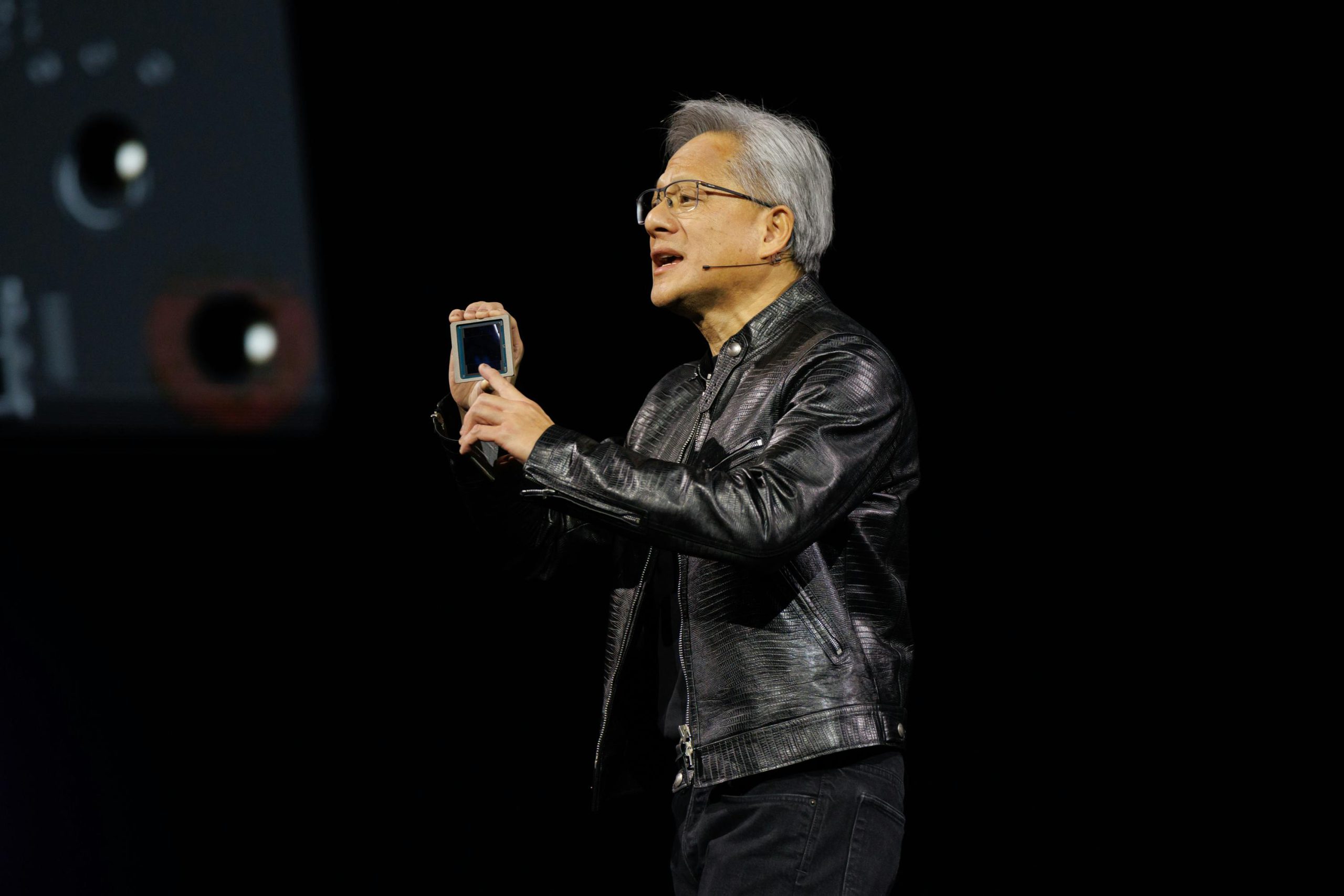
Nvidia CEO Jensen Huang echoed this, saying that “we're now in this computer revolution. … Generative AI is not just a tool, it is a skill. And so this is the interesting thing. This is why a new industry has been created. And the reason for that is, if you look at the whole IT industry, up until now, we've been making instruments and tools that people use. For the very first time, we're going to create skills that augment people. And so that's why people think that AI is going to expand beyond the trillion dollars of data centers and IT, and into the world of skills.”

Despite the immense potential AI holds, in the present, the AI industry is only just at the nascent stages of this revolution. Snowflake CFO Mike Scarpelli explained that he thinks “it's still in the very early innings,” but “the reality is that very few are using it en masse today.” Bringing AI to the masses, when adoption of AI is commonplace, is when the industry will unlock things previously seen as impossible or extremely costly, according to Microsoft CTO Kevin Scott. Scott believes we could be 5 to 10 years out from seeing what developers are capable of and what applications can be created.

Sign up for I/O Fund's free newsletter with gains of up to 2600% because of Nvidia's epic run – Click hereClick here

2) AI to Have a $10 Trillion Impact on the Economy

By heralding in a new wave of innovation and unlocking endless possibilities to advance technology currently available today, AI is expected to have a multi-trillion-dollar impact on the global economy in the coming decades.

ServiceNow CEO Bill McDermott discussed AI’s profound potential at Communacopia: “There are researchers that independently have said it will have an $11 trillion impact on the economy in the next handful of years. I believe that may be true. Maybe it's [$10 trillion], maybe it's [$9 trillion], maybe it's [$8 trillion], but it's going to be big.

And the reason for that is there is so much inefficiency. There is so much waste. There is so much human potential that can be activated by taking the soul crushing work away from people and unleashing them to do things that really matter that can help companies grow and prosper. And that has never been factored into the equation as people think about technology on a day-to-day basis, that's why we're working so hard to tell them the story.”

For context, the mobile economy, which delivered a handful of the trillion-dollar tech behemoths of today, added approximately $5.7 trillion to the global economy in 2023, up from $5.2 trillion in 2022, according to GSMA. McDermott sees AI having up to double the economic potential of mobile, though other industry forecasts point to a much larger long-term impact from AI.

According to McKinsey, generative AI is estimated to add up to $7.9 trillion to the global economy annually when combining new generative AI use cases and gen-AI related productivity gains, according to research from McKinsey, Overall, McKinsey estimates the AI economy could add $25.6 trillion to global GDP over the next couple of decades.

AI's Potential Impact on the Global Economy, $Trillion

Source: I/O Fund

Through 2030, AI’s cumulative economic impact is projected to be nearly $20 trillion, according to IDC – with every new dollar spent on AI services and solutions expected to generate $4.60 in “indirect and induced effects.” This is a massive technological shift and value add globally to be realized only five years from now and eight years following AI’s breakthrough moment with ChatGPT.

For a closer look at AI’s potential and how to invest in this mega-trend, read Investing In AI with Beth Kindig: 1-Hour Video Interview.Investing In AI with Beth Kindig: 1-Hour Video Interview.

3) Productivity Gains are Already Being Seen

Even with the view that AI is still in the early stages of its growth curve and barely scratching the surface of its potential, companies are already discovering and showcasing productivity gains, a cornerstone of how AI can quickly become a multi-trillion dollar economic force.

Google Cloud CEO Thomas Kurian explained how Google is leveraging generative AI features in Google Workspace to drive significant productivity gains for customers: “For example, if you're in a hospital, as a hospital company, nurses are the critical path. Because nurses determine how many hospital beds you can have, they control the revenue of the organization. So we work with nursing staff, for example, to do live hand-off of patients. It saves about 6 hours in a 24 hour day. And one of the leading hospitals was talking at a conference today that they estimate when rolled out, it will save them $250 million.”

Kurian also discussed how AI is improving efficiency and productivity in the insurance industry, highlighting a use case for Germany’s largest health insurer. He explained that on average, the company’s representatives “need to read 800 policy documents to determine if the claim is valid or not. They use our technology. It helps take 23 to 30 minutes down to 3 seconds. So productivity in these specific places are extremely high value.”

AWS’ Garman shared other ways AI is dramatically altering what’s possible. He said that there are pharmaceutical companies “using AI to actually invent new proteins [and] new molecules that may be able to help cure cancer or cure other diseases and things like that. And at a rate that's tens of thousands or hundreds of thousands more times than a person sitting there with a computer trying to guess what the next protein could look like to solve a particular disease. That is just a fundamentally different capability than ever existed before and has massive implications for health care.”

Garman also mentioned how bullet train operators in Japan are using AWS’ SageMaker and “built AI models to predict where they're going to have maintenance issues, [and] actually proactively predict weeks in advance where they might see components fail. And then using generative AI, they actually pull from a bunch of different data sources actually give the technician advice as to how they can go address that.”

As the industry continues to build more powerful models to advance capabilities and unlock new use cases, productivity gains, and reasoning abilities, the amount of AI accelerators needed will continue to rise exponentially. Per Barclays, for the development of three frontier AI models with 50 trillion parameters by 2027, 20 million AI accelerators would be needed to simply train each model, for a total of 60 million accelerators. This is more than 15x higher than Nvidia’s AI GPU volume from 2023, where it shipped an estimated 3.76 million GPUs.

AI can have a profound impact across multitudes of roles and industries, and this is only the tip of the iceberg in terms of how AI can boost productivity and increase efficiency – this is the larger cornerstone of AI's potential multi-trillion economic impact.

Every Thursday at 4:30 pm Eastern, the I/O Fund team holds a webinar for premium members to discuss how to navigate the broad market, as well as various stock entries and exits. We offer trade alerts plus an automated hedging signal. The I/O Fund team is one of the only audited portfolios available to individual investors. Learn more here.Learn more here.

4) AI’s Technological Progress is Moving at the Speed of Light

The AI industry is progressing exponentially fast, much faster than previous technological breakthroughs, and this is being spearheaded by Nvidia.

Nvidia has radically changed the game when it comes to progress in AI, quite essentially by breaking Moore’s Law and supercharging GPU performance in an undeniably rapid annual release cycle. As Nvidia CEO Jensen Huang put it at Communacopia, the “benefit of performance at the scale that we're doing, it directly translates to TCO [total cost of ownership].”

This is driving substantial acceleration downstream in the data center industry. Cloud providers such as Microsoft, Amazon, Alphabet and Meta not only can establish new data centers with the newest accelerators for faster performance, but also upgrade existing data centers and retire previous chip generations to significantly accelerate computing performance while realizing lower operational costs. Nvidia’s newest architecture, Blackwell, is also necessitating the adoption of liquid cooling, forcing new data centers to be reinvented from the ground up while being set up at much quicker rates.

Here’s what Microsoft CTO Kevin Scott said about data center and related infrastructure buildouts: “Everybody in the [AI] ecosystem is moving materially faster right now than they were 3 or 4 years ago, materially faster. … So far, demand for the infrastructure has materially outpaced our ability to supply it. … Do I wish it were faster? Yes, I wish it were faster. [But] it's so much faster than it was like 4 years ago.”

Not only does Nvidia not have enough chip supply to meet demand from its largest customers, but major cloud service providers Amazon, Microsoft, Alphabet, and Oracle, as well as startups such as CoreWeave, do not have enough GPU or custom silicon supply to meet enterprise and rental demand in the cloud and simultaneously utilize GPUs for internal AI R&D and product development.

The CSPs also do not have nearly enough infrastructure to support demand, especially as demand rises as the industry shifts towards real-time use cases. Shifting from today’s world of model development and training to inference, where these AI models will make predictions and draw conclusions in real-time on new data, still requires massive amounts of AI accelerators and infrastructure to support it, aside from the millions needed to train larger models.

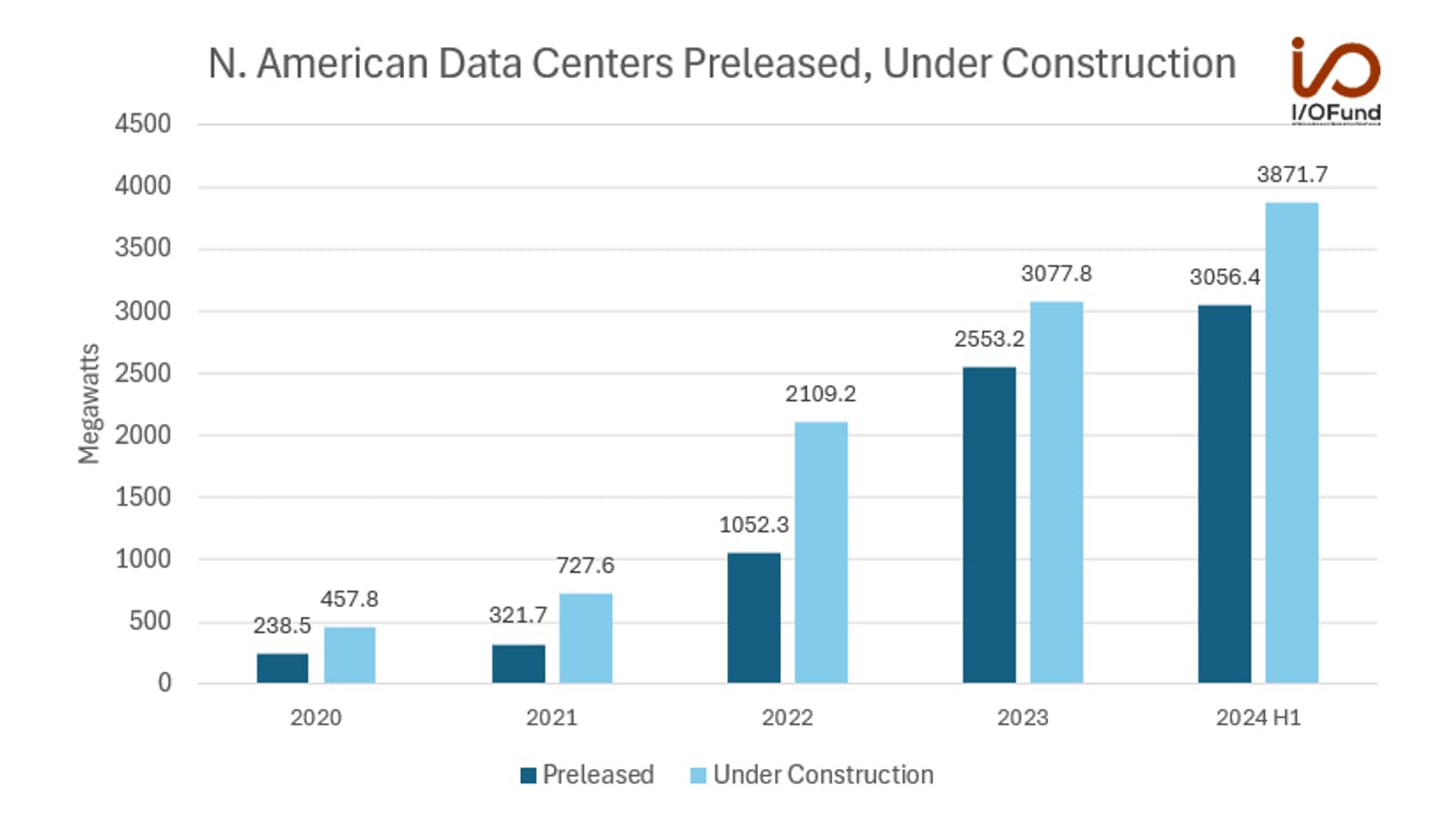
This is why data center construction is rising so rapidly – capacity under construction in North America soared more than 70% YoY to 3.87 GW in the first half of 2024. For comparison, construction in all of 2023 totaled less than 3.1 GW.

Putting this all together, Big Tech is estimated to spend north of $210 billion of capex this year, predominantly for AI accelerators and infrastructure, with cumulative spending projected to surpass $700 billion by 2027. Nvidia’s GPU supply still lags behind demand, while Big Tech is working to build data centers as quickly as possible to house these millions of future GPUs.

While $700 billion in three years is a massive sum, one that has sparked fears of an inability to generate enough of an ROI to justify such spending, productivity gains are already arising not even two years after AI’s big spark, and the long-term economic growth potential from AI-enabled productivity gains is as much as $3.5 trillion per current projections. AI spending is not set to slow, and Big Tech has left many breadcrumbs pointing out exactly why they’ll continue to spend heavily on AI.

Conclusion

Communacopia was ripe with information about the current and future state of AI and what to expect as the industry emerges from its nascent stages of growth to an expected multi-trillion-dollar economic force. Big Tech’s executives see that the AI industry is moving much faster than anything before, with physical data center buildouts speeding up to meet both demand and infrastructural upgrades to handle more powerful and power-hungry GPUs.

While Wall Street debates on if AI is a bubble, we think it’s wise to closely track what highly successful management teams are saying about AI and why it’s a trend to not miss or ignore. At this time, it’s nearly unanimous among tech CEOs that AI offers investors a rare opportunity to get onboard in the early stages of one of the largest economic and transformational trends in tech.

Please note: The I/O Fund conducts research and draws conclusions for the Fund’s positions. We then share that information with our readers. This is not a guarantee of a stock’s performance. Please consult your personal financial advisor before buying any stock in the companies mentioned in this analysis.

Recommended Reading:

AI PCs Have Arrived: Shipments Rising, Competition Heating Up

This article was originally published on Forbes on Updated Sep 13, 2024, 06:42am EDTForbesForbes on Updated Sep 13, 2024, 06:42am EDT

Chipmakers Qualcomm, Intel and AMD are working to bring AI-capable PCs to the “mainstream”, delivering powerful neural processing units to PCs for on-computer AI operations. AI PCs are not only a consumer market, rather will also be driven forward by enterprises and developers seeking to upgrade their employee PCs. This being one of the biggest upgrade cycles in PC history, competition has heightened as Q3 comes to a close.

Intel believes the AI PC “promises to be a huge improvement for everyday PC usages,” as it “represents a fundamental shift in how our computers operate.” Lenovo executives believe that “AI enables a personalized user experience that, once adopted, will lead to significant productivity gains and foster greater innovation and creativity.” AMD’s executives have explained that they “see AI as the biggest inflection point in PC since the Internet with the ability to deliver unprecedented productivity and usability gains.” Qualcomm’s CEO has said that he believes the AI PC “is as significant as Windows 95. It is changing the experience, delivering groundbreaking AI capabilities, fundamentally changing how we interact with our PCs.”

AI PCs are expected to usher in a new wave of AI underpinned by increased productivity. AI’s trajectory will increase when more people can access AI-powered applications, which in turn, will help AI developers build larger ecosystems. Existing PCs are not yet powerful or efficient enough to run AI at the edge, yet the PCs currently being released with NPUs (neural processing units) will exceed 40 trillion operations per seconds (TOPS) and this will usher forth the performance upgrades needed to make on-device AI a reality for millions of consumers and enterprises.

AI PCs Drive Growth in Q2

AI PCs gained momentum with AI PC shipments doubling sequentially despite low-single digit growth in the broader PC market in Q2. Further growth is expected in the second half of the year as Intel and AMD prepare competing chips to Qualcomm’s Snapdragon X lineup.

Current AI PC projections:

  • For Q2, PC market growth was estimated in the low-3% range:
  • Canalys is placing growth at 3.4% YoY
  • Counterpoint Research seeing 3.1% YoY growth
  • IDC reporting is reporting 3% YoY growth with its preliminary numbers.
  • Total shipment figures varied slightly for each group ranging from 62.5 million to 64.9 million, representing QoQ growth of 9.1% for the broader PC market.

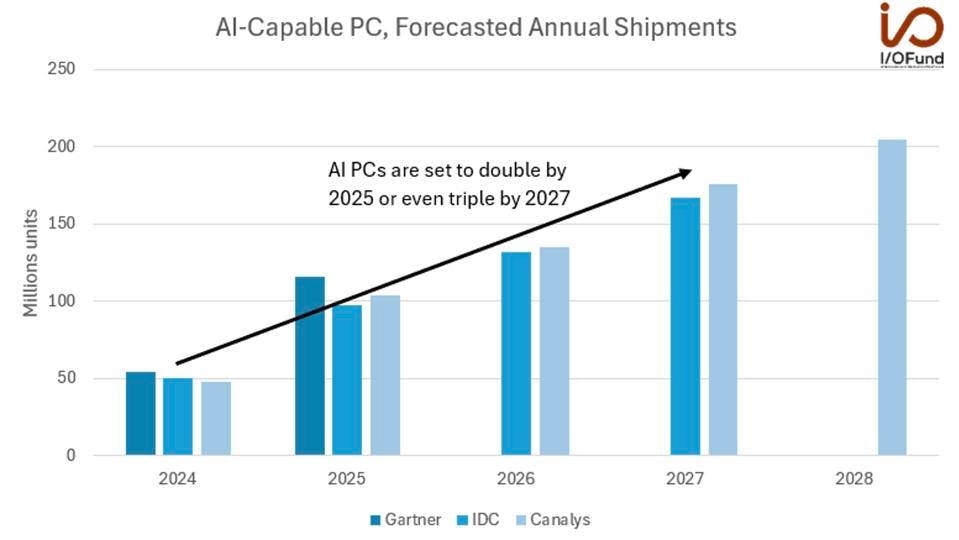
AI PCs were a predominant driver of growth sequentially, rising from approximately 7% share in Q1 to 14% share of shipments in Q2. On a unit basis, AI PCs shipments jumped 120% QoQ, from 4.0 million in Q1 to 8.8 million in Q2. For the first half of the year, that puts shipments at around 12.8 million units.

Full year forecast from Canalys projects shipments of 44 million AI PCs in 2024, implying that Q3 and Q4 will combine for 32 million units, or averaging nearly 50% QoQ growth in both quarters. IDC expects AI PC shipments to run closer to 50 million, with Gartner estimating 54.5 million earlier this year, though that would require ~300% growth from 1H to 2H.

Regardless of the exact number, the setup looks strong for H2 growth, although keep in mind, many competitors are competing for market share.

Sign up for I/O Fund's free newsletter with gains of up to 2600% because of Nvidia's epic run – Click here.Click here.

2024 is the Spark for 2025’s Boom

While 2024 is off to a strong start so far for AI PC shipments with Q2 showing triple digit sequential growth, the true growth story for AI PCs will be in 2025. This year is the initial spark for AI PCs to boom in 2025, when they are expected to quickly take significant market share.

AMD CEO Lisa Su cautioned that some investors may have mistakenly expected 2024 to be the big growth year, but that she believes that will instead be 2025. Su said at Goldman Sachs Communacopia and Technology Conference that she believes “we are at the start of a multiyear AI PC cycle. So again, you guys are always trying to go a little bit too fast. So, we never said AI PCs was a big 2024 phenomena. AI PC is a start in 2024. But more importantly, it's the most significant innovation that's come to the PC market in definitely the last 10-plus years.”

Should the broader PC market register growth in the mid-to-high single digit range to ~260 million shipments this year, AI PCs would take 17% share at 44 million units.

For 2025, shipments are forecast to rise more than 134% YoY to 103 million units, at the midpoint. Assuming high single digit growth in total shipments in 2025 to 280 million PCs, AI PCs would take close to 40% share at the midpoint of 106 million shipments forecasted.

A bar chart forecasting AI-capable PC shipments from 2024 to 2028, with separate projections from Gartner, IDC, and Canalys.

Source: Gartner/IDC/Canalys

Longer-term, growth is expected to remain robust. Intel’s executives expect AI PCs to account for more than 50% of the PC market in 2026, and as much as 80% market share by 2028. Canalys sees AI PC shipments top 200 million by 2028, taking up to 70% market share.

Commercial to Drive AI PC Growth

AI PC’s rapid adoption curve will be driven primarily by the commercial market, with AI PCs expected to be a catalyzing force ahead of the upcoming Windows refresh at the end next year.

There is indication the early majority will adopt AI PCs in 2025, and the late majority in 2026, with industry projections matching this narrative. This leaves time for consumers to participate, which so far has been a challenge for AI.

I covered this in the past, stating: “AI-capable PCs are expected to be an explosive trend through 2025 and beyond. The trajectory of AI will increase when more people can access AI-powered applications, which in turn, will help AI developers build a bigger ecosystem. Currently, there is a major bottleneck right now for AI applications to where client devices are not powerful enough or energy efficient enough to leverage AI capabilities at the edge.” For a deeper dive on AI PCs and industry commentary on the growth potential, refer to AI PC Stocks: Emerging 2024 And 2025 Story (io-fund.com).

AMD’s Su believes that while the industry is only in the “beginning” of the AI PC cycle, “next year, as we think about commercial PCs and commercial refresh cycle, we actually see AI PC as a driver of that commercial refresh cycle.” This is a view shared by IDC, which “believes the commercial market has the biggest short-term upside for AI in the PC industry,” with the consumer side “yet to be told in full.” This is a view shared by Lenovo’s executives, who believe the end of support for Windows 10 in 2025 “will necessitate a migration to Windows 11 for enterprises and commercial users, further driving demand for new PCs.”

Commercial market share of AI PCs is projected to reach almost 60% by 2027, per Canalys. This implies end-market shipments of nearly 100 million, with the remaining 40% share in consumer. Additionally, Gartner forecasts that 100% of commercial (enterprise) PC purchases will be AI PCs by the end of 2026, driven by the productivity gains realized by on-device AI, and as enterprise applications begin to take advantage of AI features. Lenovo also expects that “enterprises may increasingly require AI-enabled PCs to remain competitive.”

Every Thursday at 4:30 pm Eastern, the I/O Fund team holds a webinar for premium members to discuss how to navigate the broad market, as well as various stock entries and exits. We offer trade alerts plus an automated hedging signal. The I/O Fund team is one of the only audited portfolios available to individual investors. Learn more here.Learn more here.

Competition is Intensifying

Competition in AI PCs is quickly intensifying, with Qualcomm moving downstream to the $700 and below market with a new Snapdragon chip. The x-86 based competitors, Intel and AMD, see growth opportunities ahead, with Intel forecasting a surge in CPU shipments as it comes off the launch of its Core Ultra 200V (Lunar Lake) chips.

Nvidia and AMD reportedly are lining up powerful Arm-based CPUs to take on Qualcomm after its Arm exclusivity deal expires at the end of 2024. Apple is also rumored to be planning an M4-powered Mac refresh either by the end of this year or early 2025.

The chipmakers are competing on NPU performance, alongside efficiency:

Qualcomm’s Snapdragon X NPU offers 45 TOPS of AI performance, while CEO Cristiano Amon “claiming a performance-per-watt 2.6 times better than AMD and 5.4 better than Intel's Core Ultra 7 chips.”

Intel’s Lunar Lake chip offers up to 48 TOPS on the NPU, and Intel is claiming “1.4x AI performance over the Snapdragon X Elite running the Stable Diffusion tool in a GIMP plugin; faster overall core performance versus Ryzen and Qualcomm competition; and a 1.5x improvement over its previous generation in the performance of the integrated GPU.”

AMD’s Ryzen AI 300 series chips (Strix Point and Strix Halo) offer up to 50 TOPS performance from the NPU, the highest on the market so far.

Apple’s M4 chip offers up to 38 TOPS performance on the NPU, with the chip originally deploying on the iPad lineup with the Mac refresh rumored for this year or next.

Nvidia does not have an NPU competitor yet, as it believes its GeForce RTX GPUs offer significantly higher TOPS and more AI performance, meeting the bill for AI PCs. However, Nvidia and MediaTek are reportedly working on an Arm-based AI PC chip for a 2025 launch following the expiration of Qualcomm’s exclusivity deal.

Intel’s Shipments Ahead of Expectations, AMD Execs See Share Gains

Though we are on the precipice of going through a major shift to where Arm architecture will compete more directly with x86 architecture for PCs, Arm lost share in both desktops and notebooks in Q2, according to data from Mercury Research.

In notebooks, Arm lost 144 bp market share QoQ to 11.4% share in Q2. AMD’s notebook share rose 121 bp QoQ to 18.0%, while Intel gained 23 bp QoQ to 70.6% share.

In desktops, Arm lost 31 bp QoQ to 5.9% share, AMD also lost 83 bp QoQ to 21.6% share, while Intel’s share rose 113 bp QoQ to 72.5%.

This was reflected in Intel’s Q2 report, where management noted that its Core Ultra (AI PC chip) shipments exceeded expectations in that quarters and “more than doubled sequentially.” Core Ultra shipments have surpassed 15 million since December 2023, with Intel believing that it remains firmly on track to surpass 40 million AI PCs by the end of 2024 and more than 100 million cumulatively by the end of 2025.

Qualcomm has also said that its initial launch of Copilot+ PCs, powered by its Snapdragon lineup, is exceeding internal expectations, but management has not shed light on AI PC shipments or revenue. Analysts questioned management over the impact of AI PCs on fiscal Q4’s guide, with management stating that “it's too early to kind of have either a bullish assumption or a specific assumption on PC,” and it is more “about kind of the longer-term growth opportunity, and being very specific on sell-through in the short term is not really something that we have insight into.” Management plans to provide more information on the revenue ramp during its upcoming Investor Day conference.

Qualcomm also mentioned that “20 Copilot+ PCs from Microsoft, Dell, HP, Lenovo, Acer, ASUS and Samsung are now available across 20 countries and 47 retailers.” This is a fraction of what Intel is launching, with Intel saying that “Microsoft has qualified Lunar Lake to power more than 80 new Copilot+ PCs across more than 20 OEMs.”

Similar to its competitors, AMD has been quite bullish regarding the impact of AI PCs on the upcoming refresh cycle, as it eyes a growth opportunity in commercial PCs.

AMD’s Ryzen AI 300 series (featuring the industry’s fastest NPU with 50 TOPS) launched at the end of July to “to strong reviews,” with “more than 100 Ryzen AI 300 series premium, gaming, and commercial platforms on track to launch from Acer, ASUS, HP, Lenovo, and others over the coming quarters.” Management noted that “customer excitement for our new Ryzen processors is very strong, and we are well positioned for ongoing revenue share gains based on the strength of our leadership portfolio and design win momentum.”

This builds on CFO Jean Hu’s prior comments that AMD was “gaining share” in PCs, as CEO Lisa Su sees “clear opportunities to gain additional commercial PC share based on the performance and efficiency advantages of our Ryzen Pro portfolio and an expanded set of AMD-powered commercial PCs from our OEM partners.” AMD’s executives hold the view that the company is “underrepresented” in PCs, “but particularly in the commercial PC side.” Management believes they can do “above-typical seasonality” in the second-half of 2024, based on the timing and strength of its product launches.

Intel’s Margin Troubles and AMD’s Growth

While Qualcomm is bringing a formidable Arm-based competitor to the industry, management has provided little clues to the revenue or margin impacts from AI PCs. Intel is looking to make large strides by prioritizing shipments at the expense of margins (and shareholders), while AMD is posting the strongest YoY growth rates, though comps were still weak in Q2.

Qualcomm’s IoT revenue, which houses its PC segment, has posted YoY revenue declines since fiscal Q2 2023, or six consecutive quarters. IoT revenue in Q3 declined (8%) YoY to $1.36 billion, as the pace of declines slowed, from (32%) YoY in Q1 and (11%) YoY in Q2. Management has not stated the impact of PCs on IoT revenue growth, or its contribution.

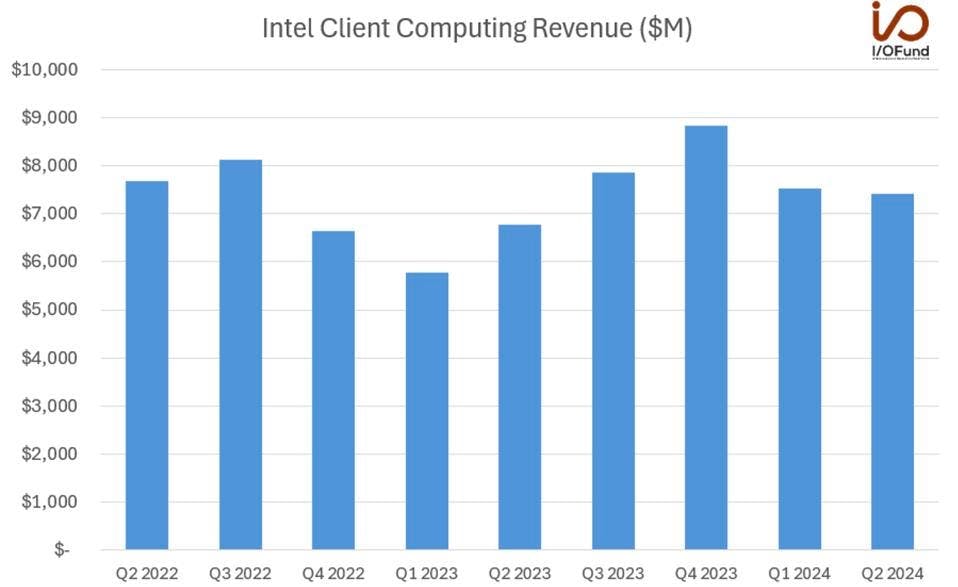
Intel reported 9% YoY revenue growth in Client Computing in Q2 to $7.41 billion, decelerating from Q1’s 31% YoY growth. On a dollar basis, growth has declined for two consecutive quarters, falling from $8.84 billion in Q4 to $7.53 billion in Q1 and now $7.41 billion.

Bar chart showing Intel's Client Computing Revenue from Q2 2022 to Q2 2024, measured in billions of dollars.

Source: Company IR

Notebook revenue declined sequentially for Intel, despite shipping AI PC chips ahead of expectations. Desktop revenue gained sequentially, but not enough to offset the softness in notebook: desktop revenue rose just 2.7% QoQ to $2.53 billion, while notebook slipped (4.3%) QoQ to $4.48 billion.

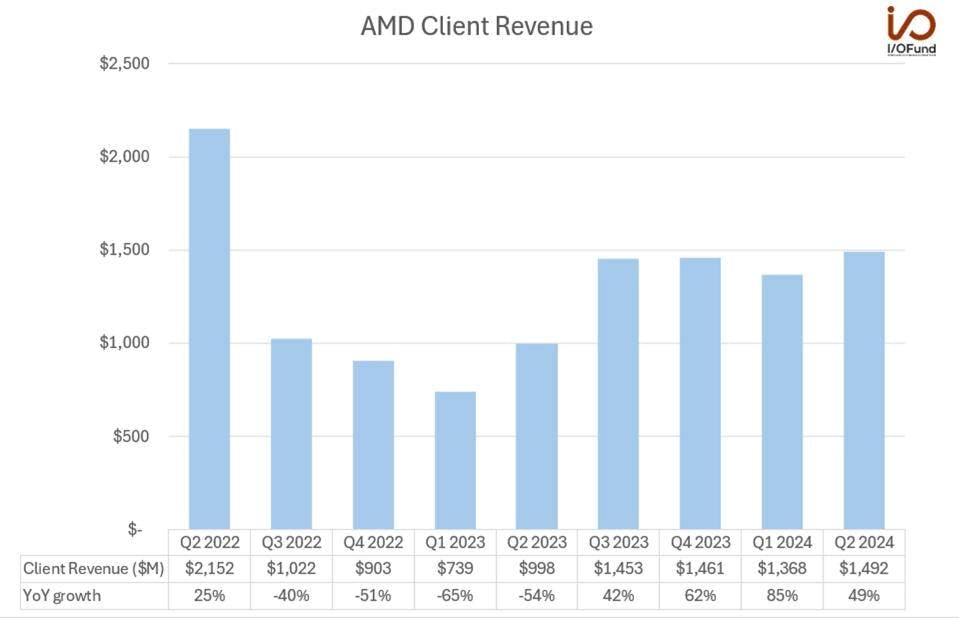
While Intel is reporting sequential weakness, AMD is seeing growth recover and growth rates remain strong. AMD’s Client segment has registered YoY growth of 42%, 62%, 85%, and 49% respectively, though against weak comps. Revenue in Q2 was just under $1.5 billion, up 9.1% QoQ and reaching the highest level in eight quarters. However, Client revenue is still one-third below its peak levels since in 2022, suffering from the sharp inventory correction that hit the industry.

Bar chart showing AMD's Client Revenue from Q2 2022 to Q2 2024, with year-over-year growth percentages.

Source: Company IR

As this growth story unfolds, operating margins will be critical to track for both Intel and AMD. Intel’s margins and profitability took a hit from its decision to prioritize AI PC shipments, and management seems keen on keeping that a priority moving forward, suggesting margins may have not stabilized. For AMD, the Client segment has historically been a significant driver of operating income. For example, in Q2 2022, when revenues were above $2.1 billion, Client’s operating margin was 31%, compared to 6% now – essentially, there’s much more ground to cover on the profitability side versus the growth side.

Conclusion

AI PCs bring x86 and Arm to the battlegrounds, with Qualcomm’s Snapdragon lineup making an attempt at the first major inroad on x86 Windows-based CPUs. Intel and AMD see strong growth ahead for their x86 competitors, though Apple is expected to bring a major upgrade with M4 chips later this year. This is ahead of possible new Arm-based CPUs from Nvidia and AMD next year.

Shipments of AI PCs have only just begun accelerating, with Q2 showing triple-digit sequential growth but penetration rates remain low. AI PC adoption is projected to skyrocket towards 70% share of total PC shipments by 2027, with growth arising predominantly in commercial markets first.

Please note: The I/O Fund conducts research and draws conclusions for the Fund’s positions. We then share that information with our readers. This is not a guarantee of a stock’s performance. Please consult your personal financial advisor before buying any stock in the companies mentioned in this analysis.

Recommended Reading:

Optical Interconnects Overview: Strong Growth Expected Ahead

Generative AI’s spending boom has not only driven increased demand for data centers as hyperscalers work to expand capacity, but also is driving a surge in optic connections. This is due to the heavy data requirements needed to support genAI services and connections needed to link GPUs together in the clusters. Optical transceivers are becoming increasingly important in addressing bandwidth, a primary bottleneck in large-scale data centers, which refers to the speed of data transfer in the data center.

Corning is a centuries-old bellwether for materials such as advanced optics. The management team recently explained in its Q2 earnings call that “traditional data centers contain a network of interconnected switches and CPUs. GenAI requires a second network within data centers to connect every GPU to every other GPU in the cluster, creating a neural network. Now because GPUs have more processing capacity than CPUs, they need higher bandwidth links connecting them. The result is about 10 times the number of fiber [optic] connections in this new network versus a traditional data center.”

We’ve previously discussed memory bandwidth as a primary bottleneck at the GPU level, but scaling from singular GPUs to hyperscale data centers featuring hundreds of thousands of GPUs sees bandwidth arise as a primary bottleneck due to the immense data transfer requirements of AI training and inference.

GenAI to Drive Optical Growth

AI requires interconnected processors, to where thousands or tens of thousands of processors are connected. In turn, connectivity is needed for accelerated compute, which includes an increased number of switches, NICs, ports and also port speed.

For example, Chat-GPT was trained on a 25,000-accelerator cluster with roughly 75,000 optical interconnects. Increasingly powerful AI models, with escalating data and compute demands, are making bandwidth, data speeds and latency critical factors for future data centers to address.

Copper had long been standard for data center interconnects, but it cannot support network speeds of 800 gigabits (800G) to 1.6 terabits (1.6T) over long distances due to substantial signal loss. This isn’t to say copper is dead – Nvidia’s GB200 NVL72 utilized copper over optics (with more than 2 miles of copper cabling in the rack) to reduce power consumption by 20 kw (the system still draws 120kw of power). According to a representative from Marvell’s Cloud Optics division, “optical is the only technology that can give you the bandwidth and reach needed to connect hundreds and thousands and tens of thousands of servers across the whole data center.”

Optical transceivers are crucial in enabling high-speed data transfer, by transmitting and receiving data from optical (light) signals to electrical signals. In data centers, optical interconnects and transceivers are becoming the de facto standard to handle AI workloads, since they can function at significantly higher speeds than copper (currently  at 800G+ speeds and moving quickly to 1.6T), with longer range, higher data capacity, and lower latency with minimal signal loss. One drawback, however, is that due to the electronic complexity of optical products, costs are higher as well as power consumption versus copper.

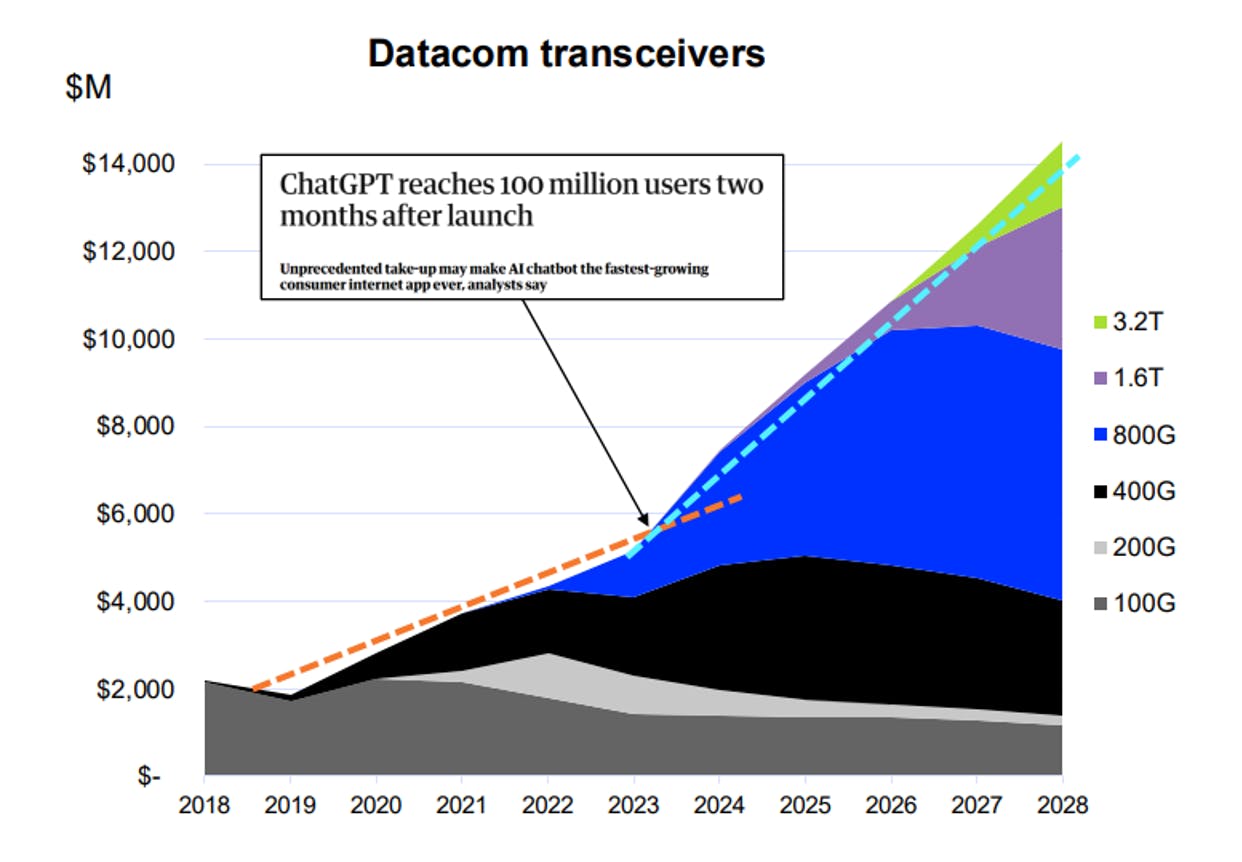
800G transceivers are a driver of growth industry-wide at the moment, with Marvell, Lumentum, Coherent, Mitsubishi Electric, Broadcom, Nvidia and others all shipping 800G transceivers and seeing high growth and demand. Coherent forecast in 2023 that the datacom transceiver market would more than double to $11.4 billion by 2028, with 800G transceivers taking more than 50% market share, up from the mid-teens in 2023, with the majority of that growth arising through 2026.

Source: Coherent

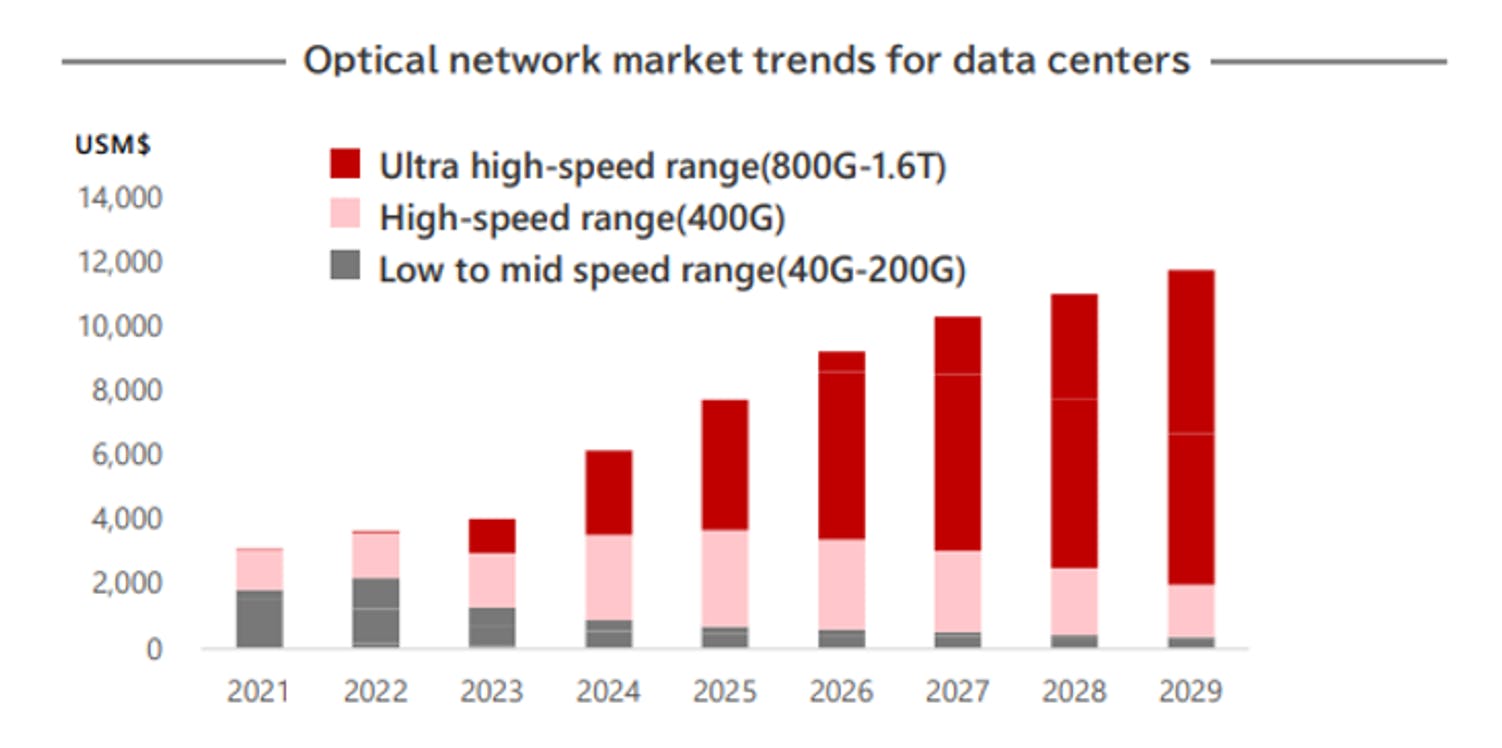
Mitsubishi Electric sees much more market share growth ahead for high-speed transceivers, forecasting the optical transceiver market to nearly triple from just over $4 billion in 2023 to $12 billion by 2029, with 800G and 1.6T transceivers accounting for more than 80% of the market.

Source: Mitsubishi Electric

Other industry forecasts suggest the broader optical transceiver market (including other end markets in industrial and telecom) will nearly double from $13.3 billion in 2024 to $24.7 billion by 2027.

Industry Executives See Strong Growth in Optics

Management teams from companies in the optical transceiver industry remain quite bullish about growth prospects in the future, catalyzed by AI data center demand.

Mitsubishi Electric, which reportedly commands nearly 50% market share in optical transmission devices for data centers, per Bloomberg, is rapidly expanding capacity to meet demand. Mitsubishi is “ramping up production capacity for optical devices to a level 50% above last year’s,” though CEO Masayoshi Takemi said that “won’t be enough to meet the strong level of inquiries we’re getting, [and] we may need double what we’ll have in September.”

Coherent CEO Jim Anderson similarly sees strong growth ahead for transceivers: “one of the most exciting growth opportunities is our optical transceiver technology, which underpins and drives the high-speed connectivity required by new AI data centers.” He added that the company “saw strong sequential growth in our 800G datacom transceiver revenue in Q4 and [is] also seeing increasing orders in backlog for the current and future quarters. We also delivered initial samples of our 1.6T datacom transceivers, which we expect to begin ramping in calendar 2025.”

Barclays analyst Tom O’Malley asked Anderson about the trajectory of the “big growth engine” for Coherent, the ramp of 800G and soon 1.6T transceivers, with Anderson saying that “It's stronger than what I had thought. And we've seen, just over the last, I would say, gosh, four to six weeks as I've spent a lot of time with our top customers across the – across all of our different product lines, but especially in our datacom business, I've gotten a much better sense for the opportunity that's in front of us, and I would say it's a very strong opportunity. And we continue to see demand strengthening, forecast strengthening, billings, backlog.”

Optics has also been a primary growth driver so far this year for Marvell, with electro-optics revenue exceeding expectations in Q2 and expected to grow in each quarter of this fiscal year. To note, Marvell is targeting to exceed its $1.5 billion AI revenue target this year, with optics contributing $1 billion or more of that sum.

Marvell CEO Matt Murphy explained in Q2’s earnings call that “demand has been extremely strong in the AI business, as we mentioned, both in custom and in our optics business. And that's the 800G products as well as traditional cloud, as well as DCI [data center interconnects]. So that's all going extremely well. And for next year, that should absolutely ripple through. We see continued strength next year above what we had communicated relative to the target for next year both in custom and in optics and the broader portfolio. … Demand has been strong. Bookings momentum has been extremely strong.”

Marvell’s management also noted in Q1 that its 800G PAM4 modules are currently the “primary interconnect enabler for state-of-the–art AI deployments,” while qualifications have begun for its 1.6T modules, which it expects will enable the next generation of AI chips. Marvell added in Q2 that “strong bookings continue for our market leading 800G PAM products and 400ZR data center interconnect, or DCI products,” while its 1.6T DSPs (digital signal processors) would begin shipments in Q3.

Marvell has the advantage of scale over its competitors. Per a Marvell spokesperson in June, “every single large language model today runs on compute clusters that are enabled by Marvell’s connectivity silicon.”

Lumentum is expecting the optical opportunity to quickly drive quarterly revenues to $500 million by the end of 2025, up 60% from last quarter’s $308 million, with management saying that transceivers will be the “number one growth area,” with EML chips and optical switching other growth drivers as the company works to rapidly boost transceiver capacity in Thailand. You can access our previous Lumentum deep dive here.

In terms of optics (and/or networking revenue), Marvell likely leads the three, with Coherent close behind. Marvell’s data center optics segment alone contributed more than $1 billion in revenue in fiscal 2024, and in Q2 FY25, optics and networking and switches likely accounted for revenue in the mid-$600 million range, given management’s comments that suggested between $200 million to $250 million stemmed from ASICs and storage. For FY25, Marvell’s optics, networking/switches and enterprise networking revenue could reach approximately $3 billion annualized (~54% of FY25 revenue estimate of $5.54 billion), with more than $1 billion in AI revenue (mgmt’s $1.5 billion AI revenue target has 2/3 coming from optics).

Coherent reported approximately $2.3 billion in networking revenue in the twelve months ending in June, or ~49% of overall revenue; Coherent has not provided an AI revenue target, but noted that datacom revenue rose 16% QoQ and 58% YoY due to AI demand. Lumentum reported $1.08 billion in cloud & networking revenue in FY24 (~80% of revenue), down 18% YoY, with management eyeing AI to drive revenue to a $2 billion-plus run rate by the end of calendar 2025.

Interestingly, it was announced on September 5 that Marvell, Lumentum and Coherent have demonstrated the industry’s first 800G ZR/ZR+ pluggable modules for 500 kilometer data center interconnects (an industry first distance for 800G modules). Utilizing Marvell’s Orion 800G DSPs, modules from the three are now interoperable, allowing regional data centers to take advantage of a multi-vendor solution and minimize vendor lock-in risk by having the ability to link together transceivers from different companies in a cost-effective and power-efficient manner.

Blackwell in Focus

Nvidia’s Blackwell is a force of its own, and with initial shipments expected to begin in Q4 this year (which ends in January), but will ship in volume come     Q1 (ending in April), analysts are working to identify which companies will be primary suppliers on the optics side as Blackwell brings an enormous revenue opportunity for Nvidia and its suppliers.

Broadcom was the latest to field questions from analysts about optics tie-ins to Broadcom, though Marvell, Lumentum and Coherent all have been questioned as well – the common denominator is that the management teams are not commenting on individual customer engagements.

Interestingly, a Broadcom announcement from March 2024 noted that “Google and Nvidia will be the first adopters of 200G per lane optics for interconnecting GPUs and TPUs in AI Clusters” as 1.6T shipments begin by the end of the year (aligning with Blackwell). Broadcom also continued its partnerships with Innolight and Eoptolink in optics; this cross-checks with a report from SemiAnalysis on GB200 component suppliers, saying that “while Marvell was 100% share on Nvidia last generation with H100. This generation, Broadcom comes in a big way. We see both Innolight and Eoptolink looking to be adding Broadcom in volume for the DSP.”

Notably, in the most recent earnings report, the CEO stated he was not “directly” in the market of supplying Blackwell, so we will see if Broadcom is downstream or not come next year. Per the CEO of Broadcom: “We’re happy to be part of that ecosystem as I said. But directly, we’re not in that [Blackwell] market as you know.”

Marvell:Marvell:

Question (Atif Malik, Citi): “Curious when are you thinking about the volume adoption of 1.6T and what is holding that if it's not the DSPs. Are the lasers not ready? Or is it just waiting for the Blackwell?”

Answer (CEO Matt Murphy): “I think the way to think about it is just timing relative to the system builds our customers call, schedule their ramp, et cetera. … I remember all these issues in the past, right. There's a green laser problem. There's this problem or that. There's always some issue in this optical space, but this time it's really, everyone's going a million miles an hour trying to get their products ramped. Our module partners are ramping up with our solution. Our end customers that are driving this are going as fast as they can.

So it's just more of a timing issue that we need to intercept the platforms as they're ramping and we're doing that. So think of that as sort of shipments in the back half, but really contributing much more meaningfully next year on the 1.6T transition. But it's definitely underway, and we see a clear path to help enable right, this part of this next generation of accelerators to be able to ship in volume with the latest optical standards. And we're at the forefront and in the lead in that regard. So yes, it will be later this year and then more volume next year and it will — I think be a big product cycle for us.”

Quick Note on CXL: About two years ago, our firm covered Marvell’s CXL memory catalyst. Compute Express Link (CXL) improves how data centers add memory by offering a new switch that offers “cache coherent” memory pooling. Essentially, this means offering a new architecture that boosts memory bandwidth and helps to enable memory pooling through partially-disaggregated racks.

The new fabric required for disaggregated memory from the CPU is based on PAM electro-optics that Marvell specializes in. In July, new CXL memory-expansion controllers were announced called Structera with partners AMD, Intel, Micron and Arm participating in the press release.  Custom CXL silicon is expected to sample in the fourth quarter and will represent an expansion to Marvell’s TAM assuming all goes well.

Lumentum:Lumentum:

Question (George Notters, Jefferies): “I'm just curious if you guys have an Nvidia qualification on this 800 gig single mode transceiver?”

Answer (CEO Alan Lowe): “Yes, we're not going to comment on who the customer is, George. I would say that — as I said before, most customers are working with us on products they don't already have. And so, for instance, we are designing 1.6T transceivers, and the performance is quite good. We plan on sampling customers this quarter on 1.6T. So, there's a few leaders that would be consuming that. And so, you can imply what you want from that, but we're not going to speak specifically about any individual customer.”

Coherent:Coherent:

Question (Vivek Arya, Bank of America): “Are you seeing any impact at all, positive or negative, because of changes in Nvidia’s product schedule or does that have no impact?”

Answer (CEO Jim Anderson): “On the first part, on the part that was about the order book, yes, we continue to see the order book strengthen. I think you asked about a particular customer. I can't comment on that particular customer, or really any particular customer. But I can say that in aggregate, we're continuing to see, again, the order book strengthen and demand growing, which is good.”

Margins May Determine the Winners

Given that optics is a fairly fragmented market with four major firms vying for market share in 800G and soon 1.6T transceivers, margins may ultimately determine the winners. This view is shared by Coherent, with management stating that on pricing and gross margins, “in general, what we would usually see in the transceiver market is the newer speed grades like 800G and then soon to be 1.6T generally carry higher gross margins than the older speed grades, right? The older speed grades are usually become commoditized over time.”

Based on Coherent and Mitsubishi Electric’s forecasts, shipment growth in 800G is expected through 2026 before shifting to 1.6T, leaving four to six quarters for these companies to drive shipments and revenues before commoditization potentially occurs with product margins shrinking.

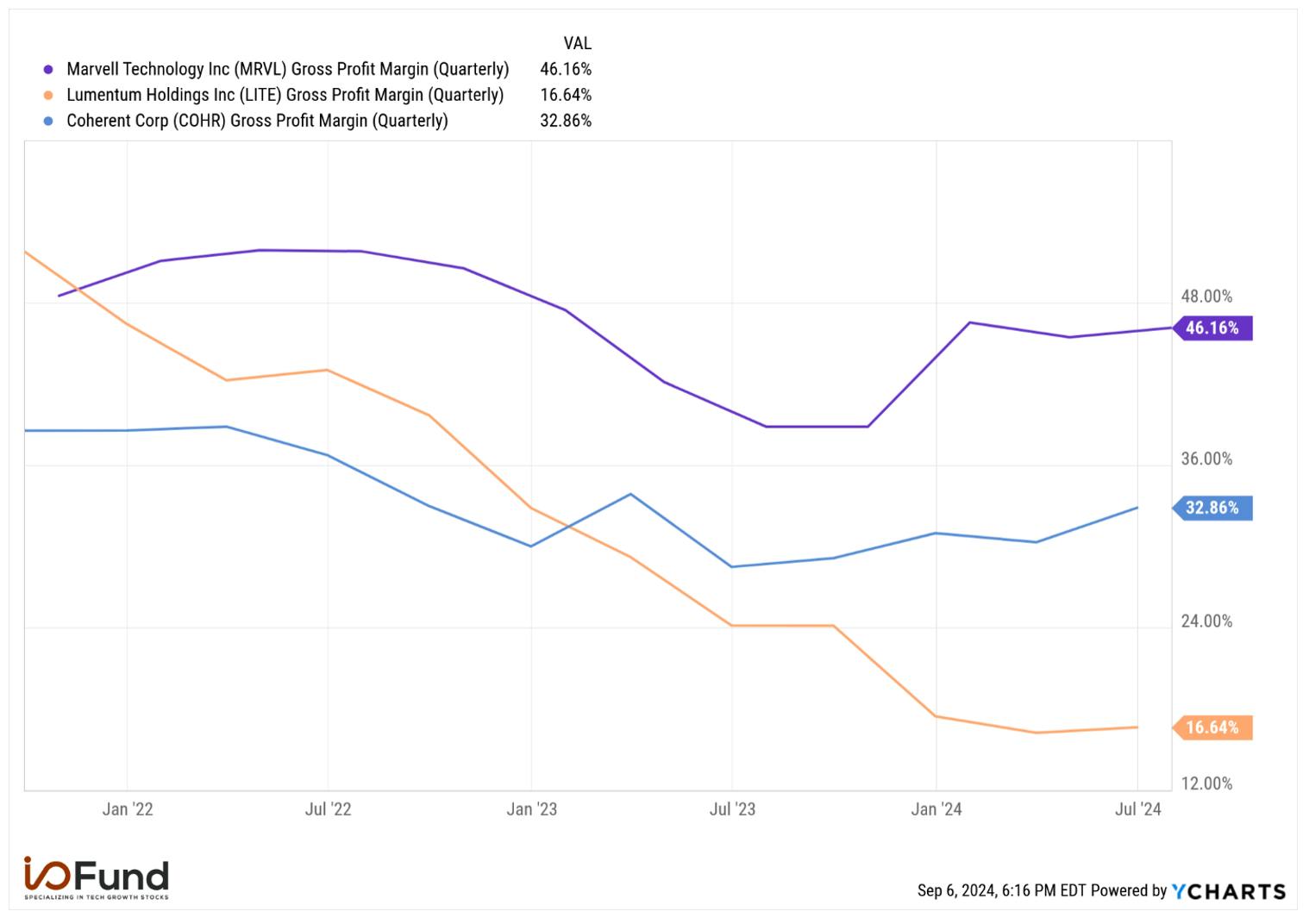
Of the trio, Marvell has the best gross margin profile, at 46.2% last quarter, compared to 32.9% for Coherent and 16.6% for Lumentum. Marvell is expecting gross margin to expand to 47.2% next quarter, while Coherent guided flat QoQ and Lumentum guiding for some sequential improvement in future quarters.

Moving down the line, Coherent is the only one of the three with a positive operating margin, reporting a ~300 bp sequential expansion to a 4.8% margin last quarter. Marvell reported a (7.9%) operating margin, while Lumentum reported a (43.3%) operating margin.

With Marvell’s success likely equally tied to the ramp of ASICs in the coming quarters, and Lumentum deep in the red, Coherent is better positioned with a stronger bottom line profile to be able to withstand pricing competition, should the manufacturers prioritize capacity expansion. In this case, Coherent has leverage to boost market share gains by undercutting on price. Coherent also is showing slightly better sequential growth than Marvell, reporting ~10% QoQ growth in networking revenue to $680 million, while Marvell reported 8% QoQ growth in data center to $881 million (though Marvell is seeing growth arise from ASICs as well); Lumentum, on the other hand, reported an (11%) YoY decline as it struggles with weaker end market demand from telecom.

One primary theme evident in Big Tech’s recent earnings reports was the need for continual investments in AI infrastructure and physical data centers, with management teams positive on the long-term potential of generative AI products and services. Lead Tech Analyst Beth Kindig spoke with Yahoo Finance following Nvidia’s Q2 earnings report last month, saying that Big Tech is “in a race toward preventing extinction,” in that whichever company succeeds in AI first “could completely dominate to a level” to where competitors’ businesses will decline substantially. This is a view shared by Alphabet CEO Sundar Pichai: “the risk of under-investing is dramatically greater than the risk of over-investing.”

We’re seeing clear growth in Big Tech’s capex with no slowdown in sight – Bank of America is estimating that the Big 4 (Microsoft, Meta, Alphabet, and Amazon) will spend a combined total of $700 billion through the end of 2026. While a majority of AI capex is expected to flow to Nvidia and other AI accelerator beneficiaries including AMD and Broadcom, physical data center construction is surging, and outfitting new data centers requires AI server racks, cooling infrastructure, power systems, connectivity and other components. One component subsegment where we’re currently seeing growth arise, with positive forward-looking commentary from executives, is optical transceivers, with Marvell, Lumentum, and Coherent among the leading manufacturers we’re currently tracking.

Big Tech’s AI Spending, Physical Data Center Construction Surging

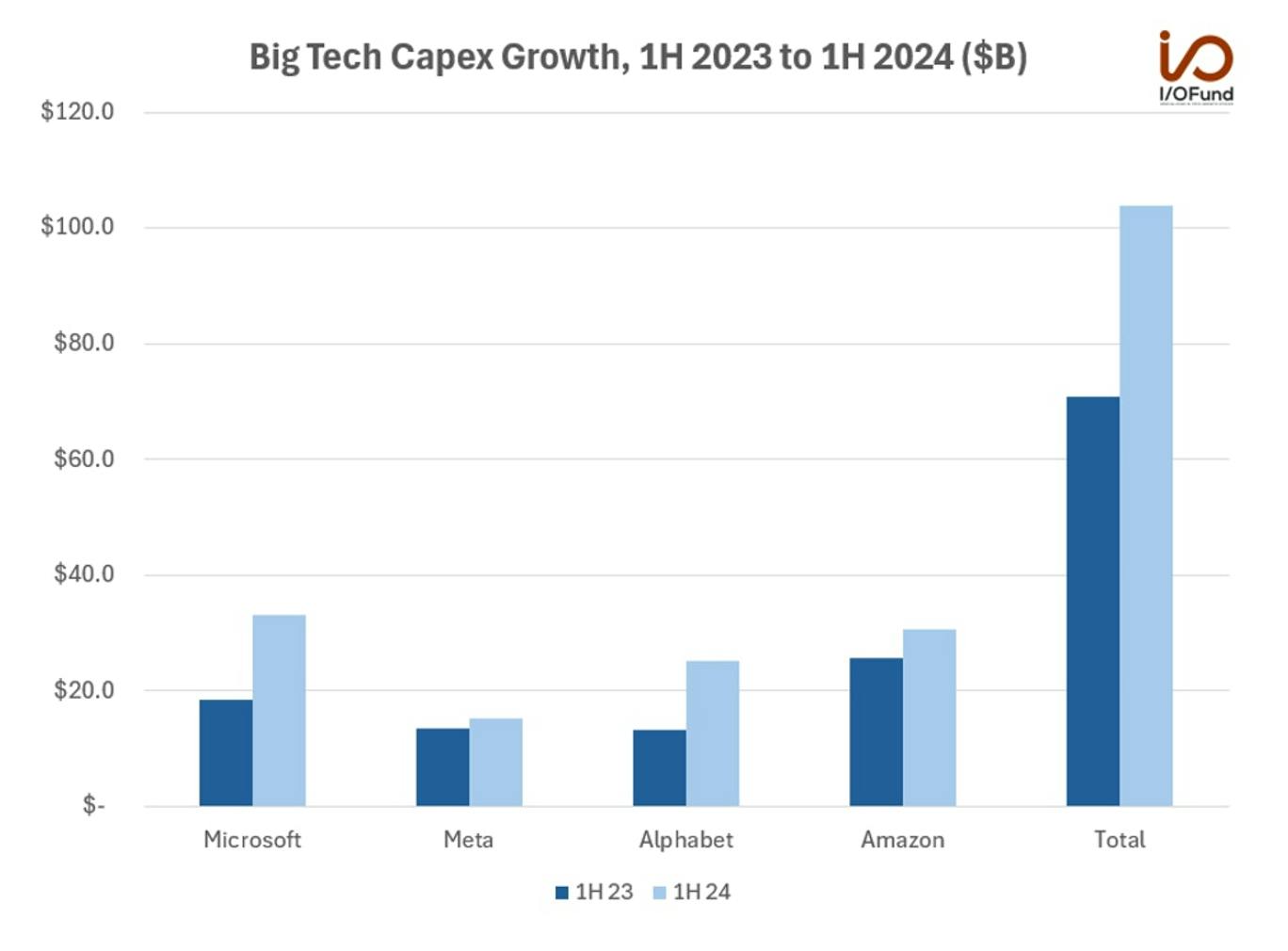
As we explained in our free newsletter in early August, “Big Tech Battles on AI: Here’s the Winner,” Big Tech’s capex spending is surging. Microsoft, Meta, Alphabet and Amazon committed more than $104 billion in the first half of 2024, up 47% YoY, with the four well on the way to spending more than $210 billion in capex for the year.

Spending is not expected to slow any time soon – UBS expects capex from the four to rise 25% YoY in 2025, well ahead of the current consensus estimates for 10% to 15% YoY growth, as AI demand still outpaces capacity as management teams push AI investments to the forefront.

The weight of four Big Tech CEOs speaking in unison on this topic (risking overinvesting and building AI capacity before it’s needed) is either a staggering coincidence — or they have important insights that are leading to the same conclusion, which is that AI’s primary risk is for those companies that are not early enough to capture it.

For a deeper understanding of Big Tech’s AI capex spending and outlook, and crucial comments on AI capacity and ROI, read our August newsletter here.here.

Stemming from this prioritization of expanding AI capacity comes a rapid uptick in physical data center construction, along with other signs that data center demand is rapidly increasing.

In North America, data center capacity under construction has soared more than 70% YoY to 3.87 GW through the end of June – for comparison, construction in all of 2023 totaled less than 3.1 GW. Preleased capacity surpassed 3 GW, with Big Tech and GPU renting startups such as CoreWeave accounting for more than 80% of this upcoming capacity.

In addition to this surge in construction activity, data from CBRE points to asking rental rates also rising, driven by tight existing supply and strong demand. Asking rental rates have increased 6.5% to $174 per kw/month this year, following an 18.6% rise in 2023 and a 14.5% increase in 2022. To put it a different way, asking rental rates have jumped 45% since 2021 (as construction began to accelerate), from ~$120 per kw/month to $174 per kw/month.

Building and optimizing these new data centers to meet the increasing performance and efficiency demands of Nvidia’s and AMD’s next-generation GPUs is placing more emphasis on fiber optics and optical transceivers for high-speed and high-capacity data transmission. 

The I/O Fund strongly believes investors should look for demand signals for AI, which is why we steered away from best-of-breed software companies where AI revenue was entirely speculative and became a trap for investors, such as MongoDB or Snowflake. Big Tech does not use these software platforms, and therefore, the demand equation had not been solved. Instead, we focused tracking capex as it relates to AI semis and data center buildouts over the past 3 years, and that remains our strategy until we see capex contracts – with optics fitting well within this strategy.

Conclusion

As the industry gears up for Blackwell’s imminent ramp into 2025, we’ll be closely monitoring sequential growth in data center and networking segments, along with management commentary about the growth trajectories in optics as it unfolds. Optical transceivers and interconnects are becoming a key component in AI data centers due to transfer speed and other benefits, with the industry set to more than double over the next few years as data center construction surges along with hyperscaler AI capex.

Our Advanced members have received technical analysis updates and a possible buy plan for one of these optics stocks, as well as a handful of other AI stocks in explosive growth trends such as AI PCs.

Damien Robbins, Equity Analyst for the I/O Fund, contributed to this analysis.

Please note: The I/O Fund conducts research and draws conclusions for the Fund’s positions. We then share that information with our readers. This is not a guarantee of a stock’s performance. Please consult your personal financial advisor before buying any stock in the companies mentioned in this analysis.

Recommended Reading:

Optical Interconnects Overview: Strong Growth Expected Ahead

Generative AI’s spending boom has not only driven increased demand for data centers as hyperscalers work to expand capacity, but also is driving a surge in optic connections. This is due to the heavy data requirements needed to support genAI services and connections needed to link GPUs together in the clusters. Optical transceivers are becoming increasingly important in addressing bandwidth, a primary bottleneck in large-scale data centers, which refers to the speed of data transfer in the data center.

Corning is a centuries-old bellwether for materials such as advanced optics. The management team recently explained in its Q2 earnings call that “traditional data centers contain a network of interconnected switches and CPUs. GenAI requires a second network within data centers to connect every GPU to every other GPU in the cluster, creating a neural network. Now because GPUs have more processing capacity than CPUs, they need higher bandwidth links connecting them. The result is about 10 times the number of fiber [optic] connections in this new network versus a traditional data center.”

We’ve previously discussed memory bandwidth as a primary bottleneck at the GPU level, but scaling from singular GPUs to hyperscale data centers featuring hundreds of thousands of GPUs sees bandwidth arise as a primary bottleneck due to the immense data transfer requirements of AI training and inference.

GenAI to Drive Optical Growth

AI requires interconnected processors, to where thousands or tens of thousands of processors are connected. In turn, connectivity is needed for accelerated compute, which includes an increased number of switches, NICs, ports and also port speed.

For example, Chat-GPT was trained on a 25,000-accelerator cluster with roughly 75,000 optical interconnects. Increasingly powerful AI models, with escalating data and compute demands, are making bandwidth, data speeds and latency critical factors for future data centers to address.

Copper had long been standard for data center interconnects, but it cannot support network speeds of 800 gigabits (800G) to 1.6 terabits (1.6T) over long distances due to substantial signal loss. This isn’t to say copper is dead – Nvidia’s GB200 NVL72 utilized copper over optics (with more than 2 miles of copper cabling in the rack) to reduce power consumption by 20 kw (the system still draws 120kw of power). According to a representative from Marvell’s Cloud Optics division, “optical is the only technology that can give you the bandwidth and reach needed to connect hundreds and thousands and tens of thousands of servers across the whole data center.”

Optical transceivers are crucial in enabling high-speed data transfer, by transmitting and receiving data from optical (light) signals to electrical signals. In data centers, optical interconnects and transceivers are becoming the de facto standard to handle AI workloads, since they can function at significantly higher speeds than copper (currently  at 800G+ speeds and moving quickly to 1.6T), with longer range, higher data capacity, and lower latency with minimal signal loss. One drawback, however, is that due to the electronic complexity of optical products, costs are higher as well as power consumption versus copper.

800G transceivers are a driver of growth industry-wide at the moment, with Marvell, Lumentum, Coherent, Mitsubishi Electric, Broadcom, Nvidia and others all shipping 800G transceivers and seeing high growth and demand. Coherent forecast in 2023 that the datacom transceiver market would more than double to $11.4 billion by 2028, with 800G transceivers taking more than 50% market share, up from the mid-teens in 2023, with the majority of that growth arising through 2026.

Source: Coherent

Mitsubishi Electric sees much more market share growth ahead for high-speed transceivers, forecasting the optical transceiver market to nearly triple from just over $4 billion in 2023 to $12 billion by 2029, with 800G and 1.6T transceivers accounting for more than 80% of the market.

Source: Mitsubishi Electric

Other industry forecasts suggest the broader optical transceiver market (including other end markets in industrial and telecom) will nearly double from $13.3 billion in 2024 to $24.7 billion by 2027.

Industry Executives See Strong Growth in Optics

Management teams from companies in the optical transceiver industry remain quite bullish about growth prospects in the future, catalyzed by AI data center demand.

Mitsubishi Electric, which reportedly commands nearly 50% market share in optical transmission devices for data centers, per Bloomberg, is rapidly expanding capacity to meet demand. Mitsubishi is “ramping up production capacity for optical devices to a level 50% above last year’s,” though CEO Masayoshi Takemi said that “won’t be enough to meet the strong level of inquiries we’re getting, [and] we may need double what we’ll have in September.”

Coherent CEO Jim Anderson similarly sees strong growth ahead for transceivers: “one of the most exciting growth opportunities is our optical transceiver technology, which underpins and drives the high-speed connectivity required by new AI data centers.” He added that the company “saw strong sequential growth in our 800G datacom transceiver revenue in Q4 and [is] also seeing increasing orders in backlog for the current and future quarters. We also delivered initial samples of our 1.6T datacom transceivers, which we expect to begin ramping in calendar 2025.”

Barclays analyst Tom O’Malley asked Anderson about the trajectory of the “big growth engine” for Coherent, the ramp of 800G and soon 1.6T transceivers, with Anderson saying that “It's stronger than what I had thought. And we've seen, just over the last, I would say, gosh, four to six weeks as I've spent a lot of time with our top customers across the – across all of our different product lines, but especially in our datacom business, I've gotten a much better sense for the opportunity that's in front of us, and I would say it's a very strong opportunity. And we continue to see demand strengthening, forecast strengthening, billings, backlog.”

Optics has also been a primary growth driver so far this year for Marvell, with electro-optics revenue exceeding expectations in Q2 and expected to grow in each quarter of this fiscal year. To note, Marvell is targeting to exceed its $1.5 billion AI revenue target this year, with optics contributing $1 billion or more of that sum.

Marvell CEO Matt Murphy explained in Q2’s earnings call that “demand has been extremely strong in the AI business, as we mentioned, both in custom and in our optics business. And that's the 800G products as well as traditional cloud, as well as DCI [data center interconnects]. So that's all going extremely well. And for next year, that should absolutely ripple through. We see continued strength next year above what we had communicated relative to the target for next year both in custom and in optics and the broader portfolio. … Demand has been strong. Bookings momentum has been extremely strong.”

Marvell’s management also noted in Q1 that its 800G PAM4 modules are currently the “primary interconnect enabler for state-of-the–art AI deployments,” while qualifications have begun for its 1.6T modules, which it expects will enable the next generation of AI chips. Marvell added in Q2 that “strong bookings continue for our market leading 800G PAM products and 400ZR data center interconnect, or DCI products,” while its 1.6T DSPs (digital signal processors) would begin shipments in Q3.

Marvell has the advantage of scale over its competitors. Per a Marvell spokesperson in June, “every single large language model today runs on compute clusters that are enabled by Marvell’s connectivity silicon.”

Lumentum is expecting the optical opportunity to quickly drive quarterly revenues to $500 million by the end of 2025, up 60% from last quarter’s $308 million, with management saying that transceivers will be the “number one growth area,” with EML chips and optical switching other growth drivers as the company works to rapidly boost transceiver capacity in Thailand. You can access our previous Lumentum deep dive here.

In terms of optics (and/or networking revenue), Marvell likely leads the three, with Coherent close behind. Marvell’s data center optics segment alone contributed more than $1 billion in revenue in fiscal 2024, and in Q2 FY25, optics and networking and switches likely accounted for revenue in the mid-$600 million range, given management’s comments that suggested between $200 million to $250 million stemmed from ASICs and storage. For FY25, Marvell’s optics, networking/switches and enterprise networking revenue could reach approximately $3 billion annualized (~54% of FY25 revenue estimate of $5.54 billion), with more than $1 billion in AI revenue (mgmt’s $1.5 billion AI revenue target has 2/3 coming from optics).

Coherent reported approximately $2.3 billion in networking revenue in the twelve months ending in June, or ~49% of overall revenue; Coherent has not provided an AI revenue target, but noted that datacom revenue rose 16% QoQ and 58% YoY due to AI demand. Lumentum reported $1.08 billion in cloud & networking revenue in FY24 (~80% of revenue), down 18% YoY, with management eyeing AI to drive revenue to a $2 billion-plus run rate by the end of calendar 2025.

Interestingly, it was announced on September 5 that Marvell, Lumentum and Coherent have demonstrated the industry’s first 800G ZR/ZR+ pluggable modules for 500 kilometer data center interconnects (an industry first distance for 800G modules). Utilizing Marvell’s Orion 800G DSPs, modules from the three are now interoperable, allowing regional data centers to take advantage of a multi-vendor solution and minimize vendor lock-in risk by having the ability to link together transceivers from different companies in a cost-effective and power-efficient manner.

Blackwell in Focus

Nvidia’s Blackwell is a force of its own, and with initial shipments expected to begin in Q4 this year (which ends in January), but will ship in volume come     Q1 (ending in April), analysts are working to identify which companies will be primary suppliers on the optics side as Blackwell brings an enormous revenue opportunity for Nvidia and its suppliers.

Broadcom was the latest to field questions from analysts about optics tie-ins to Broadcom, though Marvell, Lumentum and Coherent all have been questioned as well – the common denominator is that the management teams are not commenting on individual customer engagements.

Interestingly, a Broadcom announcement from March 2024 noted that “Google and Nvidia will be the first adopters of 200G per lane optics for interconnecting GPUs and TPUs in AI Clusters” as 1.6T shipments begin by the end of the year (aligning with Blackwell). Broadcom also continued its partnerships with Innolight and Eoptolink in optics; this cross-checks with a report from SemiAnalysis on GB200 component suppliers, saying that “while Marvell was 100% share on Nvidia last generation with H100. This generation, Broadcom comes in a big way. We see both Innolight and Eoptolink looking to be adding Broadcom in volume for the DSP.”

Notably, in the most recent earnings report, the CEO stated he was not “directly” in the market of supplying Blackwell, so we will see if Broadcom is downstream or not come next year. Per the CEO of Broadcom: “We’re happy to be part of that ecosystem as I said. But directly, we’re not in that [Blackwell] market as you know.”

Marvell:Marvell:

Question (Atif Malik, Citi): “Curious when are you thinking about the volume adoption of 1.6T and what is holding that if it's not the DSPs. Are the lasers not ready? Or is it just waiting for the Blackwell?”

Answer (CEO Matt Murphy): “I think the way to think about it is just timing relative to the system builds our customers call, schedule their ramp, et cetera. … I remember all these issues in the past, right. There's a green laser problem. There's this problem or that. There's always some issue in this optical space, but this time it's really, everyone's going a million miles an hour trying to get their products ramped. Our module partners are ramping up with our solution. Our end customers that are driving this are going as fast as they can.

So it's just more of a timing issue that we need to intercept the platforms as they're ramping and we're doing that. So think of that as sort of shipments in the back half, but really contributing much more meaningfully next year on the 1.6T transition. But it's definitely underway, and we see a clear path to help enable right, this part of this next generation of accelerators to be able to ship in volume with the latest optical standards. And we're at the forefront and in the lead in that regard. So yes, it will be later this year and then more volume next year and it will — I think be a big product cycle for us.”

Quick Note on CXL: About two years ago, our firm covered Marvell’s CXL memory catalyst. Compute Express Link (CXL) improves how data centers add memory by offering a new switch that offers “cache coherent” memory pooling. Essentially, this means offering a new architecture that boosts memory bandwidth and helps to enable memory pooling through partially-disaggregated racks.

The new fabric required for disaggregated memory from the CPU is based on PAM electro-optics that Marvell specializes in. In July, new CXL memory-expansion controllers were announced called Structera with partners AMD, Intel, Micron and Arm participating in the press release.  Custom CXL silicon is expected to sample in the fourth quarter and will represent an expansion to Marvell’s TAM assuming all goes well.

Lumentum:Lumentum:

Question (George Notters, Jefferies): “I'm just curious if you guys have an Nvidia qualification on this 800 gig single mode transceiver?”

Answer (CEO Alan Lowe): “Yes, we're not going to comment on who the customer is, George. I would say that — as I said before, most customers are working with us on products they don't already have. And so, for instance, we are designing 1.6T transceivers, and the performance is quite good. We plan on sampling customers this quarter on 1.6T. So, there's a few leaders that would be consuming that. And so, you can imply what you want from that, but we're not going to speak specifically about any individual customer.”

Coherent:Coherent:

Question (Vivek Arya, Bank of America): “Are you seeing any impact at all, positive or negative, because of changes in Nvidia’s product schedule or does that have no impact?”

Answer (CEO Jim Anderson): “On the first part, on the part that was about the order book, yes, we continue to see the order book strengthen. I think you asked about a particular customer. I can't comment on that particular customer, or really any particular customer. But I can say that in aggregate, we're continuing to see, again, the order book strengthen and demand growing, which is good.”

Margins May Determine the Winners

Given that optics is a fairly fragmented market with four major firms vying for market share in 800G and soon 1.6T transceivers, margins may ultimately determine the winners. This view is shared by Coherent, with management stating that on pricing and gross margins, “in general, what we would usually see in the transceiver market is the newer speed grades like 800G and then soon to be 1.6T generally carry higher gross margins than the older speed grades, right? The older speed grades are usually become commoditized over time.”

Based on Coherent and Mitsubishi Electric’s forecasts, shipment growth in 800G is expected through 2026 before shifting to 1.6T, leaving four to six quarters for these companies to drive shipments and revenues before commoditization potentially occurs with product margins shrinking.

Of the trio, Marvell has the best gross margin profile, at 46.2% last quarter, compared to 32.9% for Coherent and 16.6% for Lumentum. Marvell is expecting gross margin to expand to 47.2% next quarter, while Coherent guided flat QoQ and Lumentum guiding for some sequential improvement in future quarters.

Moving down the line, Coherent is the only one of the three with a positive operating margin, reporting a ~300 bp sequential expansion to a 4.8% margin last quarter. Marvell reported a (7.9%) operating margin, while Lumentum reported a (43.3%) operating margin.

With Marvell’s success likely equally tied to the ramp of ASICs in the coming quarters, and Lumentum deep in the red, Coherent is better positioned with a stronger bottom line profile to be able to withstand pricing competition, should the manufacturers prioritize capacity expansion. In this case, Coherent has leverage to boost market share gains by undercutting on price. Coherent also is showing slightly better sequential growth than Marvell, reporting ~10% QoQ growth in networking revenue to $680 million, while Marvell reported 8% QoQ growth in data center to $881 million (though Marvell is seeing growth arise from ASICs as well); Lumentum, on the other hand, reported an (11%) YoY decline as it struggles with weaker end market demand from telecom.

One primary theme evident in Big Tech’s recent earnings reports was the need for continual investments in AI infrastructure and physical data centers, with management teams positive on the long-term potential of generative AI products and services. Lead Tech Analyst Beth Kindig spoke with Yahoo Finance following Nvidia’s Q2 earnings report last month, saying that Big Tech is “in a race toward preventing extinction,” in that whichever company succeeds in AI first “could completely dominate to a level” to where competitors’ businesses will decline substantially. This is a view shared by Alphabet CEO Sundar Pichai: “the risk of under-investing is dramatically greater than the risk of over-investing.”

We’re seeing clear growth in Big Tech’s capex with no slowdown in sight – Bank of America is estimating that the Big 4 (Microsoft, Meta, Alphabet, and Amazon) will spend a combined total of $700 billion through the end of 2026. While a majority of AI capex is expected to flow to Nvidia and other AI accelerator beneficiaries including AMD and Broadcom, physical data center construction is surging, and outfitting new data centers requires AI server racks, cooling infrastructure, power systems, connectivity and other components. One component subsegment where we’re currently seeing growth arise, with positive forward-looking commentary from executives, is optical transceivers, with Marvell, Lumentum, and Coherent among the leading manufacturers we’re currently tracking.

Big Tech’s AI Spending, Physical Data Center Construction Surging

As we explained in our free newsletter in early August, “Big Tech Battles on AI: Here’s the Winner,” Big Tech’s capex spending is surging. Microsoft, Meta, Alphabet and Amazon committed more than $104 billion in the first half of 2024, up 47% YoY, with the four well on the way to spending more than $210 billion in capex for the year.

Spending is not expected to slow any time soon – UBS expects capex from the four to rise 25% YoY in 2025, well ahead of the current consensus estimates for 10% to 15% YoY growth, as AI demand still outpaces capacity as management teams push AI investments to the forefront.

The weight of four Big Tech CEOs speaking in unison on this topic (risking overinvesting and building AI capacity before it’s needed) is either a staggering coincidence — or they have important insights that are leading to the same conclusion, which is that AI’s primary risk is for those companies that are not early enough to capture it.

For a deeper understanding of Big Tech’s AI capex spending and outlook, and crucial comments on AI capacity and ROI, read our August newsletter here.here.

Stemming from this prioritization of expanding AI capacity comes a rapid uptick in physical data center construction, along with other signs that data center demand is rapidly increasing.

In North America, data center capacity under construction has soared more than 70% YoY to 3.87 GW through the end of June – for comparison, construction in all of 2023 totaled less than 3.1 GW. Preleased capacity surpassed 3 GW, with Big Tech and GPU renting startups such as CoreWeave accounting for more than 80% of this upcoming capacity.

In addition to this surge in construction activity, data from CBRE points to asking rental rates also rising, driven by tight existing supply and strong demand. Asking rental rates have increased 6.5% to $174 per kw/month this year, following an 18.6% rise in 2023 and a 14.5% increase in 2022. To put it a different way, asking rental rates have jumped 45% since 2021 (as construction began to accelerate), from ~$120 per kw/month to $174 per kw/month.

Building and optimizing these new data centers to meet the increasing performance and efficiency demands of Nvidia’s and AMD’s next-generation GPUs is placing more emphasis on fiber optics and optical transceivers for high-speed and high-capacity data transmission. 

The I/O Fund strongly believes investors should look for demand signals for AI, which is why we steered away from best-of-breed software companies where AI revenue was entirely speculative and became a trap for investors, such as MongoDB or Snowflake. Big Tech does not use these software platforms, and therefore, the demand equation had not been solved. Instead, we focused tracking capex as it relates to AI semis and data center buildouts over the past 3 years, and that remains our strategy until we see capex contracts – with optics fitting well within this strategy.

Conclusion

As the industry gears up for Blackwell’s imminent ramp into 2025, we’ll be closely monitoring sequential growth in data center and networking segments, along with management commentary about the growth trajectories in optics as it unfolds. Optical transceivers and interconnects are becoming a key component in AI data centers due to transfer speed and other benefits, with the industry set to more than double over the next few years as data center construction surges along with hyperscaler AI capex.

Our Advanced members have received technical analysis updates and a possible buy plan for one of these optics stocks, as well as a handful of other AI stocks in explosive growth trends such as AI PCs.

Damien Robbins, Equity Analyst for the I/O Fund, contributed to this analysis.

Recommended Reading:

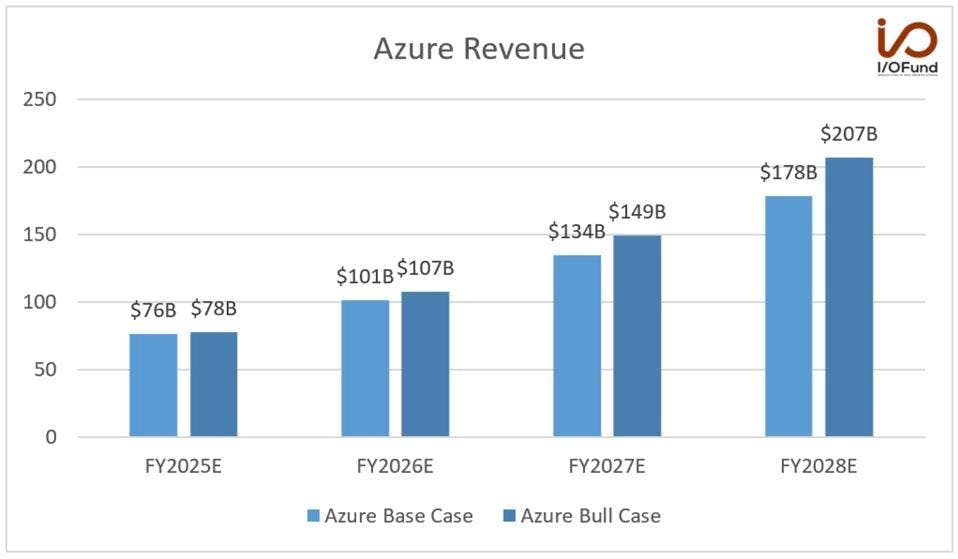
Prediction: Microsoft Azure To Reach $200 Billion In Revenue By 2028

This article was originally published on Forbes on Sep 05, 2024, 11:03pm EDTForbes on Sep 05, 2024, 11:03pm EDT

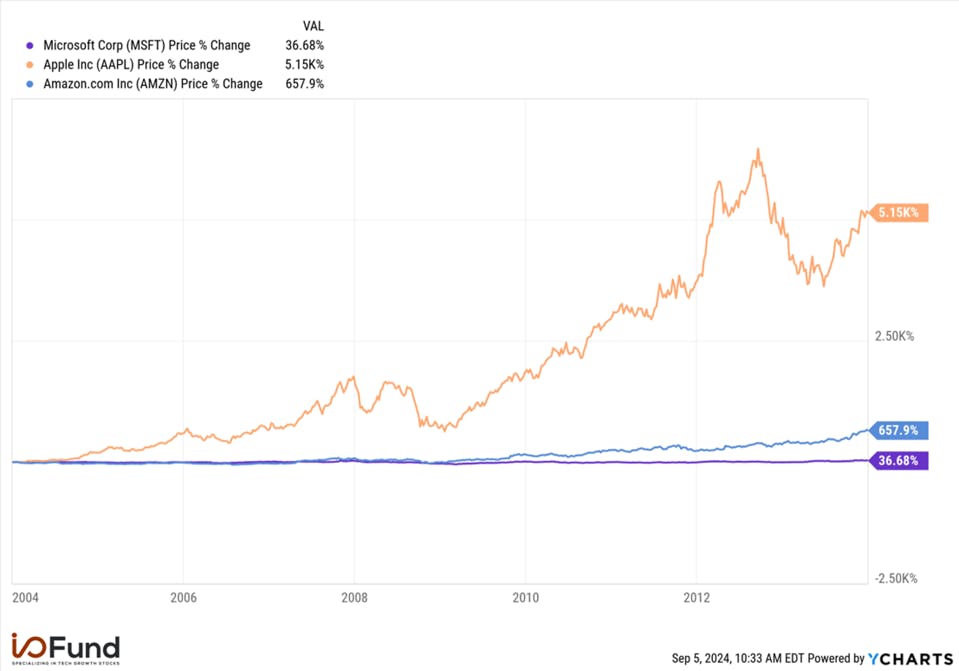
The period after the dot-com bubble including the financial crisis of 2008 were difficult years for Microsoft. The stock returned a mere 37% compared to Amazon’s 657.9% in the same time frame and Apple’s 5150%.

Microsoft, Apple, Amazon Chart Comparison

Microsoft’s stock greatly underperformed prior to Satya Nadella as CEO. Source: YChartsYCharts

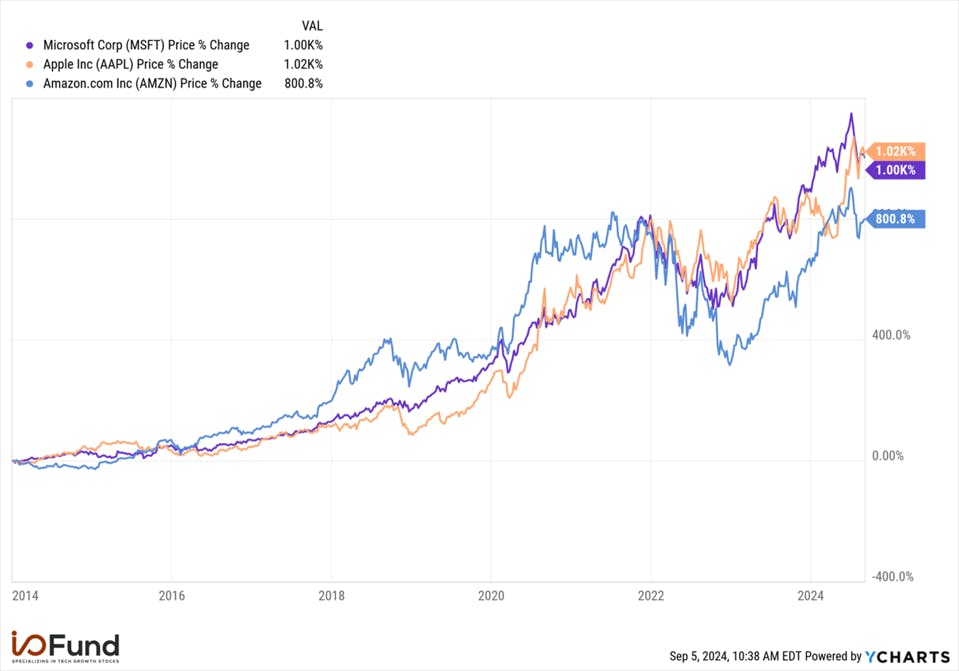
Microsoft’s trajectory changed when Satya Nadella, formally of the Azure division, became CEO in 2014 after working his way up through the company over the course of 19 years to president of the cloud business. The stock is up 1,000% in the ten years since Nadella took the helm using his multi-decade cloud experience to steer a remarkable turnaround from a corporate reputation mired in fighting open-source communities and anti-trust issues. Since Nadella became CEO, the returns in Microsoft’s stock have exceeded Amazon and is tied with Apple, as of writing.

Microsoft, Apple, Amazon Chart Comparison

Microsoft’s stock has outperformed since Satya Nadella became CEO in 2014. Source: YChartsYCharts

The competitor Nadella faced in building Azure is arguably the toughest competitor in technology – Amazon Web Services (AWS); not only for the vendor lock-in qualities of cloud IaaS as migrating a tech stack is quite costly in both time and money, but also because AWS had the first mover advantage of a four-year head start. In the tech industry, a lead this long is considered insurmountable.

Over the past ten years, Microsoft strategically exceled by targeting the Fortune 500 with 85% running on Azure today. Retaining the Fortune 500 in the migration to the cloud was accomplished through hybrid computing where Microsoft was first-to-market on serving a mix of on-premise, private and public clouds for their large enterprise customers. As the leader in on-premise systems, Microsoft was perfectly positioned to win with hybrid architectures. The company took this a step further and undercut other services on prices across its suite of software and platforms to win aggregate, long-term contracts.

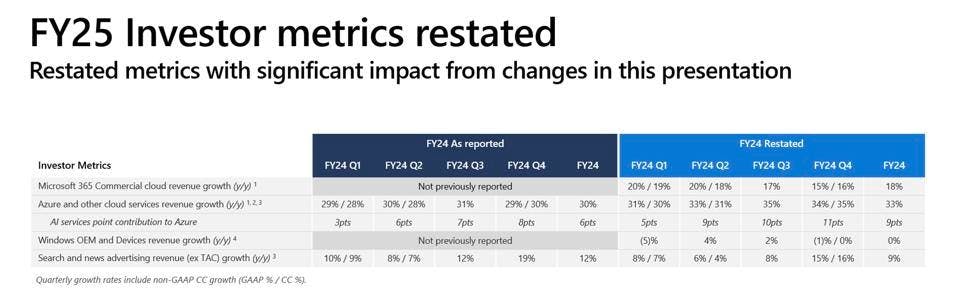
This past month, for the first time, Microsoft has announced it will be re-organizing its reporting segments, which will afford investors a better apples-to-apples comparison between Azure and AWS. According to Wells Fargo, the new Azure reporting segment stands at an estimated $62 billion as of June 2024, compared to $105 billion for AWS.

The lead we see from Microsoft today on AI revenue streams is critical enough and predictive enough that it points toward Azure surpassing $200 billion by 2028, catalyzed by the OpenAI investment, Copilot’s rapid integration into nearly every Microsoft software product, having the ace of spades — which is an operating system used in 72% of the world’s laptops and desktops, and perhaps the simplest reason of all —- Microsoft excels at the enterprise.

Sign up for I/O Fund's free newsletter with gains of up to 2600% because of Nvidia's epic run – Click HereClick Here

New Azure Reporting Reveals 11-Points of AI Contribution

Microsoft offers investors unique insights as to the monetization opportunities for AI. Last year, in the FY2023 Q4 report ending in July, Azure officially inflected due to AI. Per the report: “Azure and other cloud services revenue grew 26% and 27% in constant currency, including roughly 1 point from AI services.” In four brief quarters, Microsoft is now reporting an 8% inflection from AI: “Azure growth included 8 points from AI services where demand remained higher than our available capacity.”

Later, it was stated in an updated FY25 investor presentation that Azure saw an 11 point contribution last quarter compared to the 8 points previously reported. The metric change is due to Microsoft removing Enterprise Mobility + Security (EMS) and Power BI (BPP) from Intelligent Cloud. It’s significant that Azure is seeing low double digits while AWS and Google Cloud are not reporting their exact contribution from AI, rather are remaining vague by saying “several billions” in AI revenue.

The reporting changes also update Azure’s growth rate to 33% for the fiscal year and an impressive 35% growth in constant currency. Prior to the metric changes, management guided for a slight deceleration in Azure growth in Q1’25, with growth of 28% to 29% in CC (vs 30% this quarter), yet they expect an acceleration in H2’25 as their capital investments increase AI capacity.

Microsoft FY25 Investor Metrics

Microsoft Azure recently updated metrics to show higher AI contribution of 11 points. Source: MICROSOFT FY25 INVESTOR METRICS

According to Wells Fargo, the new metrics suggest an annualized run rate for Azure of approximately $62 billion. Investors will get the official number in next quarter’s earnings report.

Management has stated the primary issue is being capacity constrained, which all things equal, is bullish for the medium-term as it implies demand exceeds supply for Azure AI and Azure’s consumption business. Per management in the most recent earnings call: “And in H2, we expect Azure growth to accelerate as our capital investments create an increase in available AI capacity to serve more of the growing demand.”

Azure AI is a platform for developing custom AI applications and solutions. Companies use Azure AI to integrate generative AI and multimodal language models into their applications for features such as search, image recognition, natural language processing, speech to text and other AI features using developer tools, such as APIs and SDKs. The platform also offers lifecycle management for data preparation and model development and training for machine learning, supporting popular frameworks PyTorch and Tensorflow. Azure OpenAI provides access to OpenAI’s GPT-4, GPT-3.5, Microsoft’s DALL-E models, and Meta’s Llama models for companies to build custom generative AI applications and AI assistants. Companies run models on their data to improve workflows through Azure AI Studio.

Azure AI customers totaled more than 60,000, implying customer growth rate of nearly 60% YoY and up over 13% vs Q2’24 with average customer spend continuing to grow. The number of Azure AI customers using data and analytics tools also grew nearly 50% YoY.

Where Azure stands apart is that its security segment is one of the largest in the world. In 2023, it was stated Microsoft’s security segment was at $20 billion with 860,000 customers. The number of customers has been updated to 1.2 million, and if we do some simple math, that would imply the security segment is at $28 billion today – far exceeding all best-of-breed cybersecurity companies combined.

Beth's Microsoft Twitter Post

Also tied to Microsoft’s strong presence in security, the Federal Government often gets overlooked in terms of its AI impact to Azure. In a blog post, the company CTO Bill Chappell wrote: "[…] generative AI capabilities through Microsoft Azure OpenAI Service, can help government agencies improve efficiency, enhance productivity, and unlock new insights from their data. Many agencies require a higher level of security given the sensitivity of government data. Microsoft Azure Government provides the stringent security and compliance standards they need to meet government requirements for sensitive data."

Key metrics for Microsoft have been on fire lately. Bookings increased 17% YoY and 19% on a constant currency basis. This was significantly above expectations and driven by growth in the number of $10M+ and $100M+ contracts for Azure and Microsoft 365. This compares to 29% growth (31% on CC basis) in Bookings last quarter and compares to a -2% decrease (-1% on CC basis) in Bookings in the year ago quarter. Commercial RPO grew by 20% YoY to $269 billion. This compares to 20% growth last quarter and 19% YoY growth in the year ago quarter.

Commercial RPO YoY

Source: I/O Fund Stock ResearchI/O Fund Stock Research

If Azure were to continue its growth rate today on the assumption that any acceleration from AI offsets a deceleration on traditional cloud revenue (due to repatriation from moving cloud workloads to on-prem, for example), then Azure would reach revenue of $178.3 billion by 2028. That’s the bare minimum base case.

If we assume that AI contributes an additional 10 points for the next two years, and then tapers off to 8 points of AI contribution, and finally 4 points of AI contribution due to a higher revenue base, while also offsetting up to a 6-point decline in traditional cloud workloads, then Azure will reach $206.7 billion by FY2028 (ending in June of 2027).

Azure Revenue

Source: I/O Fund Stock ResearchI/O Fund Stock Research

There are some analysts forecasting $41.6 billion for AI revenue for AWS by 2027. It’s reasonable to assume Microsoft’s AI revenue will be higher as it’s the only company reporting details on AI revenue across the Big 3 and at a double-digit percentage of 11% nonetheless (or about $7 billion in AI revenue) compared to vague comments of “several billions” of AI revenue from Azure’s competitors, and likely to be the $3 to $4 billion range. Therefore, assuming Microsoft has $55 billion in revenue by 2027 compared to AWS’ $42 billion is a reasonable assumption.

Every Thursday at 4:30 pm Eastern, the I/O Fund team holds a webinar for premium members to discuss how to navigate the broad market, as well as various stock entries and exits. We offer trade alerts plus an automated hedging signal. The I/O Fund team is one of the only audited portfolios available to individual investors. Learn more here.Learn more here.

Copilot’s Rapid Integration

While OpenAI’s Chat-GPT and Google’s Bard /Gemini have gotten all of the attention, Microsoft has been quietly building an AI software empire with Copilot. Copilot features are designed to boost productivity and are integrated across consumer and enterprise software, including Windows, Edge, Office, Bing, Teams, Loop, Dynamics and Viva.

Copilot utilizes large language models that require Azure consumption. To prepare for this moment, Microsoft invested $1 billion in Open AI in 2019. Over the last five years, Microsoft has increased its investment to $13 billion. Open AI’s Chat-GPT are some of the large language models that power Microsoft’s Copilot. OpenAI leads the market on LLMs and every time Chat-GPT is integrated into a product and used across OpenAI’s user network, money funnels to Azure as Microsoft is the exclusive cloud provider in exchange for allowing OpenAI to access Azure’s infrastructure at a reduced cost. Around the time that Chat-GPT was noticed by Wall Street, Microsoft’s management team said the following about its impact on Azure:

“Second, even Azure OpenAI API customers are all new, and the workload conversations, whether it’s B2C conversations in financial services or drug discovery on another side, these are all new workloads that we really were not in the game in the past, whereas we now are.”

Developers pay between $10 to $19 per month for GitHub Copilot. According to the most recent earnings report, Copilot accounted for over 40% of GitHub’s revenue growth this year and is already a larger business than all of GitHub when Microsoft acquired it at $2 billion annual recurring revenue (ARR). GitHub Copilot has been adopted by over 77,000 companies, up 180% YoY.

Copilot Studio, a low-code tool for creating and maintaining copilots, saw a 70% QoQ increase in organizations using it to 50,000.

Copilot for Sales and Service is priced at $50 per user each, Copilot for finance is $30 per user, and for Dynamics data platform use cases, it’s priced as high as $1,397 per tenant. The highest cost is Copilot for Security, priced at $4 per hour, with an estimated monthly cost of $2920.

Although some of the upside from Copilot will be reported in other revenue segments outside of Azure, there are some tie-ins regardless of where Copilot is running. For example, enterprises need data to reside where Copilot can access it, which implies higher Azure revenue. On a more granular level, those who subscribe to Office 365 are often locked-in to Azure Active Directory (AD).

Today, Microsoft has more than 400 million 365 Commercial customer seats and 78.4 million 365 Consumer subscribers, giving a nearly ~480 million customer base to target for AI services. Assuming AI PCs help to spark a strong growth trajectory for Copilot, just a 10% adoption rate across both Commercial and Consumer by the end of the fiscal year would surpass $17 billion annual run rate. It’s likely the 10-year adoption rate will be well above 50% with an addressable market of up to 90% as more AI assistant productivity hacks are developed. This means Office 365 would land somewhere between $86 billion and $156 billion, equal to the current size of Azure or up to double the size of Azure on this revenue stream alone.

While Wall Street is worried about how much AI is costing, the I/O Fund is busy calculating how big the AI opportunity can get in the next few years and how investors can participate. Join our next webinar on Thursday September 12th where the Portfolio Manager will discuss potential entries for Microsoft and other AI-related stocks.our next webinar on Thursday September 12th where the Portfolio Manager will discuss potential entries for Microsoft and other AI-related stocks.

Copilot for Microsoft 365 is priced at $30 a month. The productivity tool combines large language models (LLMs) with the data in Microsoft Graph and Microsoft 365 apps. The use cases of Copilot in Word include giving users the first draft while saving the time on sourcing, writing, and editing the content. Similarly, Copilot in PowerPoint will help to create presentations based on previous content. Copilot in Excel can analyze trends from the data, create charts, and assist in making informative decisions.

In the second full quarter of availability, the number of people using Copilot for Microsoft 365 nearly doubled QoQ. Copilot customers increased 60% QoQ and the number of customers with over 10,000 seats more than doubled QoQ.

Power Platform, a collection of low-code development tools, saw MAUs rise 40% YoY to 48 million. 480,000 organizations have also used the AI-powered capabilities in Power Platform, up 45% QoQ. As stated, Power Platform will no longer be reported in Microsoft’s Azure segment

Copilot on the Verge of Becoming Ubiquitous

Windows operating system is in 72.3% of desktop and laptops. When you consider that Windows has most recently launched on an Arm-based PC with Qualcomm, and will also launch next year with AMD and Nvidia, that market share is likely to grow rather than contract. Similar to the penetration rate of Office 365, Windows dominates PCs regardless if the OEM is Dell, HP, Lenovo, Acer, Asus, LG, Samsung or Microsoft Surface.

Copilot+ for Windows is a sidebar that helps Windows users change settings, find files or summarize text across a desktop. Recall is a feature that helps a Windows user find documents, emails and web pages when a user simply states how they recall the file or digital asset. On some Surface laptops, there is a Copilot key, a digital pen enhanced with AI, sound and voice features enhanced with AI, and enhanced AI cameras.

Both Arm-based and x86 AI PCs are ramping this year with a CPU + GPU + NPU combo that will, in turn, proliferate Copilot+ for Windows, the AI assistant that requires a minimum of 40 TOPS (trillions operations per second). The neural processing units (NPUs) are powerful enough to deliver the official kickoff of AI edge computing as Copilot+ runs AI tasks locally on the AI PC and integrates them into various applications. This is an important moment for AI as prior to NPUs exceeding 40 TOPS, workloads were primarily sent to the cloud. By running AI assistants locally on the computer, suggestions will be faster and more accurate.

Qualcomm’s Snapdragon X Elite and Plus processors were released this last summer and offer the first GPU, CPU and NPUs that exceed 45 TOPS for AI tasks for Microsoft’s Copilot+ with a long battery life of over 12 hours. This week, Intel released its second-generation Core Ultra chips capable of reaching 48 TOPS that offers a long battery life of over 10 hours with the added benefit of running legacy x86 software without compatibility issues.

Canalys is projecting AI PC shipments to rise at a 44% CAGR from 2024 to 2028, from an estimated 48 million PCs this year, before doubling to more than 100 million in 2025 and rising to over 205 million by 2028. Cumulative shipments of AI PCs are projected to surpass 600 million over the next four years. I’ve covered additional information on the growth of the AI PC market here.

Within this rapid growth, commercial adoption is forecast to be higher, at approximately 60% by 2028 versus 40% for consumer. This is due to the productivity gains that AI PCs can enable via powerful on-device AI as well as benefits to software developers and related roles. For example, Dell’s XPS and Latitude 7455, equipped with the Snapdragon X Elite can support 13 billion-plus parameter models which means customers can run popular models like Llama 3 directly on their PCs. The fact that commercial adoption will be higher than consumer adoption is a boon for Microsoft Copilot and its suite of enterprise AI-enabled applications and platforms.

Microsoft’s Capex Spending Highest Among Cloud IaaS Providers

Microsoft is unabashedly spending tens of billions on AI infrastructure. In the last earnings report, the company announced strong QoQ increase to its capex for AI infrastructure. Capex was $14 billion last quarter, when it grew 22% sequentially. Microsoft’s capex increased 36% sequentially and 78% YoY to $19 billion in Q4.

Full year 2024 capex was up 75% YoY to $55.7 billion, yet this quarter’s run rate suggests we could see up to $80 billion in capex in FY2025. Compare this to cloud IaaS leader AWS which reported H1 capex of $30.5 billion for a run rate in capex of just over $60 billion. Notably, management is guiding for a further YoY increase in capex in FY’25. I have covered the importance of Big Tech’s capex for AI stocks in an analysis here and also in a previous webinar.an analysis here and also in a previous webinar.

Big Tech management teams have been getting an earful from Wall Street on when investors can expect to see a return. Private investors are busy calculating what level of revenue these companies must generate, estimating the return will need to be as high as $600 billion to justify the revenue Nvidia has reported in its data center segment.

Therein lies the disconnect, which is that Microsoft’s CFO, Amy Hood, states they are capacity constrained – implying the opposite problem, that the capex they’ve allocated is not nearly enough to serve Azure AI demand. Per the last earnings call: “We are – and we've talked about now for quite a few quarters, we are constrained on AI capacity. And because of that, actually, we've, to your point, have signed up with third parties to help us as we are behind with some leases on AI capacity. We've done that with partners who are happy to help us extend the Azure platform, to be able to serve this Azure AI demand. And you do see us investing quite a bit as we've talked about in builds so that we can get back in a more balanced place.”

Microsoft’s management team also pointed out about 40% of capex is spent on land, which is a long-term asset, and the rest is tied to a demand signal for inference. The CFO stated: “even in the capital spend, there is land and there is data center build, but 60-plus percent is the kit, that only will be bought for inferencing and everything else if there is demand signal.”

Therefore, investors have an important decision to make. On one hand, investors could listen to the bearish undertones that high capex spending will not be returned to investors over time, or on the other hand, view high capex spending as a bullish signal of the overflow in demand that will sustain for many years to come, with AI consumption well exceeding the capex being spent to build the infrastructure.

Conclusion:

In 2022, I wrote an 8,300 word analysis entitled Special Report: The New Kings of Tech for our research members that tied together key points on how to position our readers for AI’s big moment – well in advance of Nvidia’s stock surge. Part of this analysis was to emphasize that our readers should shift their mindset from consumer-facing stocks to enterprise-facing stocks. This is not easy to do given the FAANGs are primarily consumer stocks, and it was consumer that drove historic gains for the market over the past decade.

Here is what I wrote at the time:

“The adage is that history rhymes but it does not repeat. I believe a large addressable market is certainly required to produce the new wave of FAANGs – however, rather than consumer driving the gains, I believe it will be enterprises. Below, I discuss the enterprise-level market that will be four times larger than mobile and two stocks that will directly participate. Imagine participating in 4X the FAANGs by 2030. That’s what I believe will happen due to one key trend and I discuss exactly why this will be achieved below.” -I/O Fund’s Special Report: The New Kings of Tech, June 5th 2022

Nowhere will the AI enterprise advantage be more evident than with Microsoft’s steady ascent over the next ten years, which I believe will end with Microsoft firmly on top in nearly every category the company competes in. A few years ago, I predicted Nvidia would Surpass Apple by 2026. At the time, Nvidia had a $550B market cap and the mere thought was inconceivable . To that point, I purposely did not say Nvidia would surpass Microsoft — as once the AI opportunity fully plays out —- this company will be a tough one to catch.

Please note: The I/O Fund conducts research and draws conclusions for the Fund’s positions. We then share that information with our readers. This is not a guarantee of a stock’s performance. Please consult your personal financial advisor before buying any stock in the companies mentioned in this analysis.

Recommended Reading:

Broadcom Fiscal Q3: AI Revenue Outlook Raised, but Valuation is Stretched

Broadcom boosted AI revenue outlook for the year from $11 billion to $12 billion. Based on the forecasted $51.5 billion in revenue in fiscal 2024, AI is expected to contribute more than 23% of Broadcom’s revenue this year.

During the CEO’s opening remarks, more information about Q3’s AI revenue and Q4’s AI revenue was provided: “AI demand remains strong and we expect, in Q4, AI revenue to grow sequentially 10% to over $3.5 billion. This will translate to AI revenue of $12 billion for fiscal '24, up from our prior guidance of over $11 billion.” The issue is that AI revenue was flat QoQ compared to being up 35% QoQ last quarter.

Overall, Q3 did beat yet Q4’s guide was a bit light, with Broadcom forecasting revenue of $14 billion next quarter versus consensus for $14.04 billion. Semiconductor solutions revenue growth also missed growth forecasts with YoY growth of 5%, while estimates from Oppenheimer expected 7% growth.

The stock is priced to perfection, and we do not think this earnings report is not enough to sustain the valuation. We discuss this and more below.

Revenue

Broadcom beat Q3’s revenue estimates marginally and was one percent ahead of consensus estimates, compared to a nearly 4% beat last quarter. Q4 was also guided slightly below analyst estimates. 

  • Q3 revenue was $13.07 billion for YoY growth of 47.3%, accelerating 430 bp from 43% YoY growth in Q2. Excluding VMWare’s contribution, YoY growth was 4%.
  • For Q4, management guided for $14 billion in revenue, for YoY growth of 50.6%, marking another 330 bp acceleration, but short of the 51% growth estimate from analysts.
  • For FY24, management did not provide an updated revenue guide, with the previous guidance provided of $51 billion. However, given Q4’s guide, revenue for FY24 is projected to be $51.5 billion.

As probably the most-closely watched (and most anticipated) figure, AI revenue for FQ3 was $3.1 billion, flat QoQ. Through Q3, AI revenue totaled $8.5 billion. For fiscal 2024, Broadcom increased its AI revenue outlook to $12 billion, a 20% increase from $10 billion in Q1 and another $1 billion increase from last quarter’s view for $11 billion. The increased outlook is driven by strong growth for Ethernet and ASICs, and implies Q4 AI revenue of $3.5 billion, up nearly 13% QoQ.

The issue that remains is, will this AI revenue be enough to justify the valuation (in the near term)?

Key Segments

Semiconductor solutions revenue was $7.27 billion, increasing 5% YoY and 1% QoQ. This was a 100 bp deceleration from 6% YoY growth last quarter, while also falling short of estimates, with some analysts expecting growth of ~7% YoY and 2% QoQ.

  • Networking grew 43% YoY to $4 billion. Ethernet switching, driven by Tomahawk 5 and Jericho3-AI grew over 4x year-on-year. We’ve covered these products here. Within networking, lasers and dies used in optical interconnects grew 3X, PCI Express switches grew 2X and Broadcom is shipping 5nm 400GB NICs and 800GB DSPs.
  • The CEO stated non-AI networking bottomed in Q2 and was up 17% QoQ yet down (-41%) YoY
  • The CEO stated custom AI accelerators grew 3.5X year-over-year. Notably, we did not get a QoQ number which is where the weak metric was at $3.1B AI revenue flat QoQ.

Infrastructure solutions revenue was $5.80 billion, accelerating to 200% YoY growth from 175% YoY in the prior quarter. The segment was up 9.7% QoQ and this segment also grew QoQ last quarter, which helps to illustrate the acceleration from VMWare.

  • VMWare contributed $3.8 billion with the acquisition helping to drive the strong YoY growth.
  • VMWare’s annualized booking value (ABV) was up 32% QoQ to $2.5 billion, and is shaping up to be a major piece to Broadcom’s story. You can read more about this here. Two quarters ago, the ABV for VMWare was $1.2 billion, proving there has been a sudden acceleration underway. The VMWare segment is expected to be quite profitable, achieving adjusted EBITDA of $8.5 billion by next fiscal year. During the Q&A portion, it was discussed the overall software margin will remain between 80% and 90%.

Aligned with the commentary that the non-AI segments have bottomed (with the exception of Broadband), the remaining revenue segments reported QoQ growth despite being down double digits YoY.

  • Server storage connectivity revenue was $861 million, up 5% QoQ yet down (-25%) YoY. Server storage is expected to grow QoQ yet will be down YoY
  • Wireless revenue of $1.7 billion grew 1% YoY and is expected to grow 20% QoQ next quarter.
  • Broadband revenue declined 49% YoY and is expected to bottom in the beginning of 2025.

On the call, an analyst asked if these segments will return to prior levels, to which the CEO stated they would and he cited bookings as an indication the bottom is likely behind them.

Hock Tan:

“As you all know, we've gone through your typical down cycle of semiconductors. And I'm referring particularly to non-AI, and we have talked about that before many times. We've gone through a down cycle as the ecosystem, as many of our customers, but the broad ecosystems, work on an adjustment in inventory levels in all stages in the supply chain. And we're not immune from it, obviously as we try to insulate ourselves from it as much as possible. We've gone through it. And the signs on the indications we have seen very clearly is we have, in fact, passed through the bottom. The best indicator is the bookings we are receiving. In non-AI, our bookings in Q3 of non-AI semiconductor demand is up 20%. And so that tells us we are well on the way to recovery.”

Margins

As outlined in our pre-earnings analysis, the VMWare merger integration has weighed on margins so far in fiscal 2024, though Q3 showed more positive signs on margin recoveries. Adjusted margins strengthened sequentially across the board, with larger growth visible down the line.

  • Gross margin was 63.9% in Q3, down from 69.5% in the year ago quarter but up from 62.3% in Q2. Adjusted gross margin was 77.4%, up from 75.1% last year and 76.2% last quarter.
  • Operating margin was 29.0% in Q3, up from 23.7% last quarter and a remarkable increase from 17.3% in Q1; however, Q3’s margin remained much lower on a YoY basis, down from 43.4% last year. Adjusted operating margin was 60.8%, up from 57.2% last quarter but decreasing from 62.4% last year.
  • Net margin was (14.4%) for Q3, due to a one-time non-cash tax provision of $4.5 billion in the quarter. Adjusted net margin was 46.8%, up from 43.2% last quarter but down from 51.8% last year.

Regarding the tax liability, there was a question in the Q&A session if it was related to selling assets, to which the CFO responded that it was not due to a sale of assets, rather: “It's just we relocated the IP and that caused the $4 billion charge. The offset to that is a deferred tax liability. So think of that as noncash, very little cash impact to that.”

EPS

GAAP EPS was ($0.40), not comparable to estimates for $0.55 due to the $4.5 billion tax provision in the quarter. Adjusted EPS was $1.24, beating estimates by $0.04, and representing YoY growth of 18% and QoQ growth of nearly 13%.

Adjusted EPS growth is currently estimated to accelerate to nearly 24% YoY in Q4, and to the low-30% range for the first half of fiscal 2025. Given the sequential rebound in margins (partially due to better controlled costs at VMWare) and adjusted EPS beat in Q3, these growth projects may get revised higher in the coming days.

Q3’s adjusted EBITDA was 62.9%, with growth of 42% YoY to $8.22 billion. This was a solid improvement from 59.5% in Q2. Management guided for a 64% adjusted EBITDA margin in Q4, with the sequential improvement being driven by the integration of VMWare as Broadcom charts a path to pre-acquisition EBITDA margins.

Cash Flows and Balance Sheet

Cash flows and cash flow margins improved sequentially, while total debt took a step lower this quarter.

  • Operating cash flow was $4.96 billion, increasing more than 5% YoY and 8% QoQ. Operating cash flow margin as 38.0%, improving from 36.7% last quarter, though this is lower than pre-acquisition margins of 53.2% in the year ago quarter.
  • Free cash flow was $4.79 billion, rising more than 4% YoY and nearly 8% QoQ. Free cash flow margin was 36.7%, increasing from 35.6% last quarter but also lower than the 51.8% margin in the year ago quarter.
  • Cash, equivalents and investments totaled $9.95 billion.
  • Total debt was $69.96 billion at the end of Q3, down from $74.02 billion in Q2, with Broadcom repaying more than $9.2 billion of debt in the quarter, offset by nearly $5 billion in proceeds from long-term borrowings.

Valuation:

Broadcom is priced for perfection at 32 forward PE Ratio and 14 forward PS Ratio. We’ve covered semis since 2018 and a quality semiconductor stock rarely trades at these levels, it’s normally in the 6-8 forward PS range.

The 3-year median is only available on current PE Ratio, but I have a 3-year PE ratio of 28.5 compared to the current PE ratio of 65.8. The 5-year median is at 39.5.

Earnings Call:

Analysts asked in various ways what growth rate they could expect on AI revenue moving forward, but to no avail on any specific numbers. Here was the first question on the call:

Question
Vivek Arya (Analysts)

Just a clarification, Hock, and then the question. So I think AI revenue roughly $3.1-ish billion in Q3, flattish sequentially. What was the mix in terms of compute versus networking? And the $3.5 billion for Q4, what do you see of that mix? And then as we get into fiscal '25, I realize you're not guiding overall AI, but just how is your general kind of confidence and visibility? Do you think that Broadcom can kind of grow in line or better than the overall AI silicon industry in fiscal '25?

Answer
Kirsten Spears (Executives)

Yes. Well, as we indicated in the last earnings call, for this past quarter, I think we're talking about 2/3 in compute and 1/3 in networking. And we kind of expect Q4 to run the similar trend. And to answer your second part, no, we don't guide yet for fiscal '25, but we do expect fiscal '25 to continue to be strong, to show strong growth on our AI revenue.

-End Quote

There was a more tempered tone in terms of timing. For example, when asked where custom silicon is in the adoption curve, it was stated it will take some time.

Question
Edward Snyder (Analysts)

Right. That basically suggests that you're on the early part of your curve where I'm not trying to call the GPUs whatever, but you could be getting to something closer to the peak of the GPU market just because everything, right, beside the cost expense and as you're spending all this money and you're paying all this money for power, the ASICs become more and more attractive. So the curves are going to look different, right?

Answer
Hock Tan (Executives)

It's an accelerating curve. It may take longer than we all want it to happen but definitely accelerating because the size of the demand from those hyperscalers will totally rival that in the enterprise.

-End Quote

Conclusion:

Given AI growth has plateaued this quarter from its rapid growth, there will likely be a re-rating of Broadcom’s valuation sometime in the next 1-2 quarters. Our goal is to trim this position and buy back at lower levels. This strategy requires remaining steadfast to the bigger picture as this company is setting up to be a clear winner over the next decade. We want to do our best at actively managing the position while not losing sight of the bigger picture. With that said, valuation is a common pitfall for tech investors, who grow complacent with their positions. Our firm works to avoid valuation traps, and thus we plan to follow our disciplined process, which is to actively manage stocks that are richly valued.  

Damien Robbins, I/O Fund Equity Analyst, contributed to this analysis

Recommended Reading:

Broadcom Fiscal Q3: AI Revenue Outlook Raised, but Valuation is Stretched

Broadcom boosted AI revenue outlook for the year from $11 billion to $12 billion. Based on the forecasted $51.5 billion in revenue in fiscal 2024, AI is expected to contribute more than 23% of Broadcom’s revenue this year.

During the CEO’s opening remarks, more information about Q3’s AI revenue and Q4’s AI revenue was provided: “AI demand remains strong and we expect, in Q4, AI revenue to grow sequentially 10% to over $3.5 billion. This will translate to AI revenue of $12 billion for fiscal '24, up from our prior guidance of over $11 billion.” The issue is that AI revenue was flat QoQ compared to being up 35% QoQ last quarter.

Overall, Q3 did beat yet Q4’s guide was a bit light, with Broadcom forecasting revenue of $14 billion next quarter versus consensus for $14.04 billion. Semiconductor solutions revenue growth also missed growth forecasts with YoY growth of 5%, while estimates from Oppenheimer expected 7% growth.

The stock is priced to perfection, and we do not think this earnings report is not enough to sustain the valuation. We discuss this and more below.

Revenue

Broadcom beat Q3’s revenue estimates marginally and was one percent ahead of consensus estimates, compared to a nearly 4% beat last quarter. Q4 was also guided slightly below analyst estimates. 

  • Q3 revenue was $13.07 billion for YoY growth of 47.3%, accelerating 430 bp from 43% YoY growth in Q2. Excluding VMWare’s contribution, YoY growth was 4%.
  • For Q4, management guided for $14 billion in revenue, for YoY growth of 50.6%, marking another 330 bp acceleration, but short of the 51% growth estimate from analysts.
  • For FY24, management did not provide an updated revenue guide, with the previous guidance provided of $51 billion. However, given Q4’s guide, revenue for FY24 is projected to be $51.5 billion.

As probably the most-closely watched (and most anticipated) figure, AI revenue for FQ3 was $3.1 billion, flat QoQ. Through Q3, AI revenue totaled $8.5 billion. For fiscal 2024, Broadcom increased its AI revenue outlook to $12 billion, a 20% increase from $10 billion in Q1 and another $1 billion increase from last quarter’s view for $11 billion. The increased outlook is driven by strong growth for Ethernet and ASICs, and implies Q4 AI revenue of $3.5 billion, up nearly 13% QoQ.

The issue that remains is, will this AI revenue be enough to justify the valuation (in the near term)?

Key Segments

Semiconductor solutions revenue was $7.27 billion, increasing 5% YoY and 1% QoQ. This was a 100 bp deceleration from 6% YoY growth last quarter, while also falling short of estimates, with some analysts expecting growth of ~7% YoY and 2% QoQ.

  • Networking grew 43% YoY to $4 billion. Ethernet switching, driven by Tomahawk 5 and Jericho3-AI grew over 4x year-on-year. We’ve covered these products here. Within networking, lasers and dies used in optical interconnects grew 3X, PCI Express switches grew 2X and Broadcom is shipping 5nm 400GB NICs and 800GB DSPs.
  • The CEO stated non-AI networking bottomed in Q2 and was up 17% QoQ yet down (-41%) YoY
  • The CEO stated custom AI accelerators grew 3.5X year-over-year. Notably, we did not get a QoQ number which is where the weak metric was at $3.1B AI revenue flat QoQ.

Infrastructure solutions revenue was $5.80 billion, accelerating to 200% YoY growth from 175% YoY in the prior quarter. The segment was up 9.7% QoQ and this segment also grew QoQ last quarter, which helps to illustrate the acceleration from VMWare.

  • VMWare contributed $3.8 billion with the acquisition helping to drive the strong YoY growth.
  • VMWare’s annualized booking value (ABV) was up 32% QoQ to $2.5 billion, and is shaping up to be a major piece to Broadcom’s story. You can read more about this here. Two quarters ago, the ABV for VMWare was $1.2 billion, proving there has been a sudden acceleration underway. The VMWare segment is expected to be quite profitable, achieving adjusted EBITDA of $8.5 billion by next fiscal year. During the Q&A portion, it was discussed the overall software margin will remain between 80% and 90%.

Aligned with the commentary that the non-AI segments have bottomed (with the exception of Broadband), the remaining revenue segments reported QoQ growth despite being down double digits YoY.

  • Server storage connectivity revenue was $861 million, up 5% QoQ yet down (-25%) YoY. Server storage is expected to grow QoQ yet will be down YoY
  • Wireless revenue of $1.7 billion grew 1% YoY and is expected to grow 20% QoQ next quarter.
  • Broadband revenue declined 49% YoY and is expected to bottom in the beginning of 2025.

On the call, an analyst asked if these segments will return to prior levels, to which the CEO stated they would and he cited bookings as an indication the bottom is likely behind them.

Hock Tan:

“As you all know, we've gone through your typical down cycle of semiconductors. And I'm referring particularly to non-AI, and we have talked about that before many times. We've gone through a down cycle as the ecosystem, as many of our customers, but the broad ecosystems, work on an adjustment in inventory levels in all stages in the supply chain. And we're not immune from it, obviously as we try to insulate ourselves from it as much as possible. We've gone through it. And the signs on the indications we have seen very clearly is we have, in fact, passed through the bottom. The best indicator is the bookings we are receiving. In non-AI, our bookings in Q3 of non-AI semiconductor demand is up 20%. And so that tells us we are well on the way to recovery.”

Margins

As outlined in our pre-earnings analysis, the VMWare merger integration has weighed on margins so far in fiscal 2024, though Q3 showed more positive signs on margin recoveries. Adjusted margins strengthened sequentially across the board, with larger growth visible down the line.

  • Gross margin was 63.9% in Q3, down from 69.5% in the year ago quarter but up from 62.3% in Q2. Adjusted gross margin was 77.4%, up from 75.1% last year and 76.2% last quarter.
  • Operating margin was 29.0% in Q3, up from 23.7% last quarter and a remarkable increase from 17.3% in Q1; however, Q3’s margin remained much lower on a YoY basis, down from 43.4% last year. Adjusted operating margin was 60.8%, up from 57.2% last quarter but decreasing from 62.4% last year.
  • Net margin was (14.4%) for Q3, due to a one-time non-cash tax provision of $4.5 billion in the quarter. Adjusted net margin was 46.8%, up from 43.2% last quarter but down from 51.8% last year.

Regarding the tax liability, there was a question in the Q&A session if it was related to selling assets, to which the CFO responded that it was not due to a sale of assets, rather: “It's just we relocated the IP and that caused the $4 billion charge. The offset to that is a deferred tax liability. So think of that as noncash, very little cash impact to that.”

EPS

GAAP EPS was ($0.40), not comparable to estimates for $0.55 due to the $4.5 billion tax provision in the quarter. Adjusted EPS was $1.24, beating estimates by $0.04, and representing YoY growth of 18% and QoQ growth of nearly 13%.

Adjusted EPS growth is currently estimated to accelerate to nearly 24% YoY in Q4, and to the low-30% range for the first half of fiscal 2025. Given the sequential rebound in margins (partially due to better controlled costs at VMWare) and adjusted EPS beat in Q3, these growth projects may get revised higher in the coming days.

Q3’s adjusted EBITDA was 62.9%, with growth of 42% YoY to $8.22 billion. This was a solid improvement from 59.5% in Q2. Management guided for a 64% adjusted EBITDA margin in Q4, with the sequential improvement being driven by the integration of VMWare as Broadcom charts a path to pre-acquisition EBITDA margins.

Cash Flows and Balance Sheet

Cash flows and cash flow margins improved sequentially, while total debt took a step lower this quarter.

  • Operating cash flow was $4.96 billion, increasing more than 5% YoY and 8% QoQ. Operating cash flow margin as 38.0%, improving from 36.7% last quarter, though this is lower than pre-acquisition margins of 53.2% in the year ago quarter.
  • Free cash flow was $4.79 billion, rising more than 4% YoY and nearly 8% QoQ. Free cash flow margin was 36.7%, increasing from 35.6% last quarter but also lower than the 51.8% margin in the year ago quarter.
  • Cash, equivalents and investments totaled $9.95 billion.
  • Total debt was $69.96 billion at the end of Q3, down from $74.02 billion in Q2, with Broadcom repaying more than $9.2 billion of debt in the quarter, offset by nearly $5 billion in proceeds from long-term borrowings.

Valuation:

Broadcom is priced for perfection at 32 forward PE Ratio and 14 forward PS Ratio. We’ve covered semis since 2018 and a quality semiconductor stock rarely trades at these levels, it’s normally in the 6-8 forward PS range.

The 3-year median is only available on current PE Ratio, but I have a 3-year PE ratio of 28.5 compared to the current PE ratio of 65.8. The 5-year median is at 39.5.

Earnings Call:

Analysts asked in various ways what growth rate they could expect on AI revenue moving forward, but to no avail on any specific numbers. Here was the first question on the call:

Question
Vivek Arya (Analysts)

Just a clarification, Hock, and then the question. So I think AI revenue roughly $3.1-ish billion in Q3, flattish sequentially. What was the mix in terms of compute versus networking? And the $3.5 billion for Q4, what do you see of that mix? And then as we get into fiscal '25, I realize you're not guiding overall AI, but just how is your general kind of confidence and visibility? Do you think that Broadcom can kind of grow in line or better than the overall AI silicon industry in fiscal '25?

Answer
Kirsten Spears (Executives)

Yes. Well, as we indicated in the last earnings call, for this past quarter, I think we're talking about 2/3 in compute and 1/3 in networking. And we kind of expect Q4 to run the similar trend. And to answer your second part, no, we don't guide yet for fiscal '25, but we do expect fiscal '25 to continue to be strong, to show strong growth on our AI revenue.

-End Quote

There was a more tempered tone in terms of timing. For example, when asked where custom silicon is in the adoption curve, it was stated it will take some time.

Question
Edward Snyder (Analysts)

Right. That basically suggests that you're on the early part of your curve where I'm not trying to call the GPUs whatever, but you could be getting to something closer to the peak of the GPU market just because everything, right, beside the cost expense and as you're spending all this money and you're paying all this money for power, the ASICs become more and more attractive. So the curves are going to look different, right?

Answer
Hock Tan (Executives)

It's an accelerating curve. It may take longer than we all want it to happen but definitely accelerating because the size of the demand from those hyperscalers will totally rival that in the enterprise.

-End Quote

Conclusion:

Given AI growth has plateaued this quarter from its rapid growth, there will likely be a re-rating of Broadcom’s valuation sometime in the next 1-2 quarters. Our goal is to trim this position and buy back at lower levels. This strategy requires remaining steadfast to the bigger picture as this company is setting up to be a clear winner over the next decade. We want to do our best at actively managing the position while not losing sight of the bigger picture. With that said, valuation is a common pitfall for tech investors, who grow complacent with their positions. Our firm works to avoid valuation traps, and thus we plan to follow our disciplined process, which is to actively manage stocks that are richly valued.  

Damien Robbins, I/O Fund Equity Analyst, contributed to this analysis

Recommended Reading:

Broadcom’s AI Revenue Surge Continues: FQ3 Earnings Preview

Broadcom will release its Q3 FY2024 results after market close today. Investors will be closely watching the AI revenue updates for the ASIC market leader. Broadcom has the potential to grab the attention after Nvidia due to the company’s unique position in the AI Infrastructure space. Recently Citi Analyst also highlighted that the company is catching up on Nvidia as the top holding as it adds more AI customers and accretion from VMware. In addition, it could benefit from investor fatigue with Nvidia, which aligns with our thoughts that we have highlighted here.

The main highlight in the last earnings call was the AI revenue FY2024 guide increase from over $10 billion to over $11 billion. The company beat the top-line and bottom-line estimates and also raised the full-year revenue guidance to $51 billion from the earlier $50 billion. Analysts believe the guide was conservative due to the company ramping up new ASIC customers, the potential bottoming of non-AI networking markets, and VMware integration progressing well. The company also raised the FY2024 adjusted EBITDA guide from 60% to 61%, which is positive as margin recovery post-VMware integration is also important for the stock momentum to grind higher.

Revenue

  • FQ2 revenue grew by 43% YoY to $12.49 billion, up from 34.2% growth in FQ1. Next quarter, revenue is going to accelerate to 46% YoY growth to $12.96 billion and further accelerate to 51% growth in FQ4.
  • FQ2 was the first full quarter with a contribution from VMware, and organically, it grew by 12%. Revenue beat estimates by 4.0% and was primarily helped by the strong 280% YoY growth in AI revenue of $3.1 billion, offset by cyclical weakness in enterprises and telcos. Management hinted that non-AI semiconductor revenue had bottomed out in Q2 and was likely to have a modest recovery in the second half of the year.
  • Management increased the FY2024 revenue guide from $50 billion to $51 billion Analysts expect FY2024 revenue to grow 43.8% YoY to $51.51 billion, organic growth is about 10%.
  • Analysts expect FY2025 revenue to grow 16.8% YoY to $60.15 billion and FY2026 revenue to grow 11.6% to $67.13 billion.

Ji Yoo, Head of Investor Relations, said in the earnings call, “For fiscal '24, we expect revenue from AI to be much stronger at over $11 billion. Non-AI semiconductor revenue has bottomed in Q2 and is likely to recover modestly for the second half of fiscal '24.

On infrastructure software, we're making very strong progress in integrating VMware and accelerating its growth. Pulling all these three key factors together, we are raising our fiscal '24 revenue guidance to $51 billion.”

Margins

The merger integration process will initially drag the margins in FY2024 due to transition costs and VMware’s lower margin profile. However, cost cutting and merger synergies are anticipated to improve margins in the long term.

  • The FQ2 gross margin was 62.3%, down from 70% in the same period last year and up from 61.7% in the previous quarter. Adjusted gross margin was 76.2%, down from 75.6% last year and up from 75.4% in the previous quarter.
  • Operating margin was 23.7%, down from 45.9% last year and up from 17.4% in the previous quarter. The operating margin was mainly lower from last year due to the increase in amortization of acquisition-related intangible assets, restructuring charges, and stock-based compensation.
  • The adjusted operating margin was 57.2%, down from 62% last year and up marginally from 57.1% in the previous quarter. Excluding transition costs, the adjusted operating margin was 59% and remained the same as in the previous quarter.
  • Net income was $2.1 billion or 17% of revenue compared to $3.48 billion or 39.9% of revenue in the same period last year. The lower net income was mainly due to the points discussed in the above paragraphs and higher interest expenses this year. The adjusted net income was $5.39 billion or 43.2% of revenue compared to $4.49 billion or 51.4% of revenue last year.

EPS

GAAP EPS was $0.44 compared to $0.82 in the same period last year. The adjusted EPS grew by 6.2% YoY to $1.096 and beat estimates by 1.1%, helped by cost savings. The company has been able to reduce VMware spending to $1.6 billion from the previous $2.3 billion pre-acquisition. Management expects to exit Q4 with a spending of $1.3 billion run rate, better than the previous plan of $1.4 billion. It is further expected to stabilize at $1.2 billion post-integration.

  • Analysts expect adjusted EPS to accelerate to 14.3% YoY growth to $1.20 in FQ3 and to 23.7% YoY growth to $1.37 in FQ4.
  • Analysts expect FY2024 adjusted EPS to grow 12.4% YoY to $4.75 and accelerate to 27.7% growth to $6.06 in FY2025.

FQ2 adjusted EBITDA was 59.5%, compared to 65.1% in the same period last year and 59.8% in the previous quarter. The drop is mainly due to VMware's lower margin. The post-integration is progressing well, and management also raised the FY2024 adjusted EBITDA guide from 60% to 61%. They also expect VMware's adjusted operating margin to match Broadcom’s software margin by FY2025.

Cash Flow and Balance Sheet

The company has high debt as it has been growing through successful acquisitions. While high debt is a concern, the company is focusing on repaying medium-term debt and has strong cash flows. Also, the company’s debt prior to the VMware acquisition has long maturities.

  • Operating cash flow was $4.58 billion or 36.7% of revenue compared to $4.5 billion or 51.6% of revenue in the same period last year and 40.3% in the previous quarter.
  • Free cash flow was $4.45 billion or 35.6% of revenue compared to $4.38 billion or 50.2% of revenue last year and 39.2% in the previous quarter. Free cash flow excluding cash used for restructuring and integration was $5.3 billion or 42% of revenue. Free cash flow as a percentage of revenue declined from last year due to higher interest expenses related to debt for VMware acquisition and “higher cash taxes due to a higher mix of US income and the delay in the reenactment of Section 174.”
  • Cash was $9.81 billion and debt of $74.02 billion compared to $11.9 billion and $75.9 billion in the previous quarter. The weighted average coupon rate and term to maturity of $48 billion fixed rate debt is 3.5% and 8.2 years, respectively. The weighted average coupon rate and term to maturity of floating rate debt are 6.6% and 2.8 years, respectively. The company repaid $2 billion of floating rate debt in FQ2 and plans to maintain this quarterly repayment throughout FY2024.
  • The company paid $2.4 billion in dividends and $1.5 billion in withholding taxes due to the vesting of employee equity, eliminating 1.2 million shares.
  • Inventory was $1.84 billion compared to $1.92 billion in the previous quarter.
  • The company’s shares started trading on a 10-for-1 stock split basis on July 15, 2024 and also filed a mixed shelf offering on July 08.

Segments

Infrastructure Software

Infrastructure Software revenue grew by 175% YoY to $5.29 billion, primarily due to the contribution of VMware, accelerating from 153% growth in the previous quarter. Organically it grew by 35% YoY. The segment’s adjusted gross margins were 88% compared to 92% in the same period last year. The adjusted operating margin was 60% and excluding transition costs was 64% compared to 73% in the same period last year. The drop in margins was primarily due to VMware’s lower margin profile.

Management provided a key update on VMware in FQ2. “VMware revenue in Q1 was $2.1 billion, grew to $2.7 billion in Q2 and will accelerate towards a $4 billion per quarter run rate. We therefore expect operating margins for VMware to begin to converge towards that of classic Broadcom software by fiscal 2025.”

To illustrate VMware’s successful integration, management highlighted the streamlining of product SKUs from over 8,000 disparate SKUs to 4 core product offerings, thereby eliminating massive channel conflicts.

The company is also transitioning all VMware products to a subscription licensing model. “We are making good progress in transitioning all VMware products to a subscription licensing model. And since closing the deal, we have actually signed up close to 3,000 of our largest 10,000 customers to enable them to build a self-service virtual private cloud on-prem. Each of these customers typically sign up to a multiyear contract, which we normalize into an annual measure known as annualized booking value or ABV. This metric, ABV, for VMware products accelerated from $1.2 billion in Q1 to $1.9 billion in Q2. For a reference, for the consolidated Broadcom software portfolio, ABV grew from $1.9 billion in Q1 to $2.8 billion over the same period in Q2.”

Semiconductor Solutions

Semiconductor Solutions revenue grew by 6% YoY to $7.20 billion, accelerating from 4% in the previous quarter. The segment’s adjusted gross margins were 67%, down 370 basis points YoY, primarily due to a higher mix of custom AI accelerators. The adjusted operating margin was 55% compared to 59% in the same period last year. According to Oppenheimer, Semiconductor revenue is expected to grow 7% YoY and 2% sequentially in FQ3.

  • Networking revenue grew by 44% YoY to $3.8 billion, representing 53% of semiconductor revenue, led by strong demand from hyperscalers for AI networking and custom accelerators. According to Oppenheimer, Networking revenue is expected to grow 43% YoY and 5% QoQ in FQ3.
  • The company doubled the number of switches sold YoY, particularly the PAM-5 and Jericho3. It also benefits from the rapid transition of optical interconnects in AI data centers to 800 gigabit bandwidth.  

CEO Hock Tan said in the earnings call. “Next year, we expect all mega-scale GPU deployments to be on Ethernet. We expect the strength in AI to continue, and because of that, we now expect networking revenue to grow 40% year-on-year compared to our prior guidance of over 35% growth.”

  • Server storage revenue declined by (-27%) YoY to $824 million. Management believes Q2 was the bottom in server storage and expects a modest recovery in the second half of the year. They expect server storage revenue to decline around 20% YoY range for FY2024 from the earlier mid-20 percentage range.
  • Broadband revenue declined by (-39%) YoY to $730 million due to the continued slowdown in telco spending. Management expects Broadband to bottom in the second half of the year with a recovery in 2025. They expect Broadband to decline to a high 30s percentage from the prior guide of just over 30% YoY decline.
  • Wireless revenue grew 2% YoY and down seasonally (-19%) sequentially to $1.6 billion. Management reiterated the previous guidance of flat YoY wireless revenue for FY2024.
  • Industrial resale revenue declined by (-10%) YoY to $234 million. They expect to be down double-digit YoY from the prior guide of high single-digit decline.

AI Revenue

AI revenue grew by 280% YoY and 35% sequentially to $3.1 billion. Management has increased the FY2024 revenue guide from over $10 billion to over $11 billion. J.P. Morgan analyst Harlan Sur is bullish on the AI opportunity and estimates about $12 billion in AI revenue this year and more than $16 billion next year. He also highlighted that Broadcom has recently won OpenAI’s first and second generation AI ASIC orders, making OpenAI the fourth major AI ASIC customer for the company.

The company highlighted their expertise in Ethernet and the opportunity, as they expect all mega GPU deployments to be on Ethernet. “Talking of AI accelerators, you may know our hyperscale customers are accelerating their investments to scale up the performance of these clusters. And to that end, we have just been awarded the next generation custom AI accelerators for these hyperscale customers of ours. Networking these AI accelerators is very challenging, but the technology does exist today. In Broadcom, with the deepest and broadest understanding of what it takes for complex, large workloads to be scaled out in an AI fabric. Proof in point, seven of the largest eight AI clusters in deployment today use Broadcom Ethernet solutions.”

Valuation

The company trades at a P/E ratio of 65.8 and a forward P/E ratio of 32.2, higher than the 5-year average of 41.1. Similarly, it trades at a P/S ratio of 16.1 and a forward P/S ratio of 13.8, higher than the average of 8.6. Valuation is a concern for all semiconductor stocks. At the same time, the market is rewarding the company with a premium valuation due to its transition from a value stock to an AI growth stock.

Conclusion

Strong AI growth, merger synergies, and the Ethernet opportunity make Broadcom a leading AI juggernaut second only to Nvidia. We will look toward the report to confirm our understanding that the fundamentals are on track due to ASICs growth, the acceleration in the VMWare software opportunity and networking. 

Royston Roche, Equity Analyst at the I/O Fund, contributed to this article.

Recommended Readings:

Broadcom’s AI Revenue Surge Continues: FQ3 Earnings Preview

Broadcom will release its Q3 FY2024 results after market close today. Investors will be closely watching the AI revenue updates for the ASIC market leader. Broadcom has the potential to grab the attention after Nvidia due to the company’s unique position in the AI Infrastructure space. Recently Citi Analyst also highlighted that the company is catching up on Nvidia as the top holding as it adds more AI customers and accretion from VMware. In addition, it could benefit from investor fatigue with Nvidia, which aligns with our thoughts that we have highlighted here.

The main highlight in the last earnings call was the AI revenue FY2024 guide increase from over $10 billion to over $11 billion. The company beat the top-line and bottom-line estimates and also raised the full-year revenue guidance to $51 billion from the earlier $50 billion. Analysts believe the guide was conservative due to the company ramping up new ASIC customers, the potential bottoming of non-AI networking markets, and VMware integration progressing well. The company also raised the FY2024 adjusted EBITDA guide from 60% to 61%, which is positive as margin recovery post-VMware integration is also important for the stock momentum to grind higher.

Revenue

  • FQ2 revenue grew by 43% YoY to $12.49 billion, up from 34.2% growth in FQ1. Next quarter, revenue is going to accelerate to 46% YoY growth to $12.96 billion and further accelerate to 51% growth in FQ4.
  • FQ2 was the first full quarter with a contribution from VMware, and organically, it grew by 12%. Revenue beat estimates by 4.0% and was primarily helped by the strong 280% YoY growth in AI revenue of $3.1 billion, offset by cyclical weakness in enterprises and telcos. Management hinted that non-AI semiconductor revenue had bottomed out in Q2 and was likely to have a modest recovery in the second half of the year.
  • Management increased the FY2024 revenue guide from $50 billion to $51 billion Analysts expect FY2024 revenue to grow 43.8% YoY to $51.51 billion, organic growth is about 10%.
  • Analysts expect FY2025 revenue to grow 16.8% YoY to $60.15 billion and FY2026 revenue to grow 11.6% to $67.13 billion.

Ji Yoo, Head of Investor Relations, said in the earnings call, “For fiscal '24, we expect revenue from AI to be much stronger at over $11 billion. Non-AI semiconductor revenue has bottomed in Q2 and is likely to recover modestly for the second half of fiscal '24.

On infrastructure software, we're making very strong progress in integrating VMware and accelerating its growth. Pulling all these three key factors together, we are raising our fiscal '24 revenue guidance to $51 billion.”

Margins

The merger integration process will initially drag the margins in FY2024 due to transition costs and VMware’s lower margin profile. However, cost cutting and merger synergies are anticipated to improve margins in the long term.

  • The FQ2 gross margin was 62.3%, down from 70% in the same period last year and up from 61.7% in the previous quarter. Adjusted gross margin was 76.2%, down from 75.6% last year and up from 75.4% in the previous quarter.
  • Operating margin was 23.7%, down from 45.9% last year and up from 17.4% in the previous quarter. The operating margin was mainly lower from last year due to the increase in amortization of acquisition-related intangible assets, restructuring charges, and stock-based compensation.
  • The adjusted operating margin was 57.2%, down from 62% last year and up marginally from 57.1% in the previous quarter. Excluding transition costs, the adjusted operating margin was 59% and remained the same as in the previous quarter.
  • Net income was $2.1 billion or 17% of revenue compared to $3.48 billion or 39.9% of revenue in the same period last year. The lower net income was mainly due to the points discussed in the above paragraphs and higher interest expenses this year. The adjusted net income was $5.39 billion or 43.2% of revenue compared to $4.49 billion or 51.4% of revenue last year.

EPS

GAAP EPS was $0.44 compared to $0.82 in the same period last year. The adjusted EPS grew by 6.2% YoY to $1.096 and beat estimates by 1.1%, helped by cost savings. The company has been able to reduce VMware spending to $1.6 billion from the previous $2.3 billion pre-acquisition. Management expects to exit Q4 with a spending of $1.3 billion run rate, better than the previous plan of $1.4 billion. It is further expected to stabilize at $1.2 billion post-integration.

  • Analysts expect adjusted EPS to accelerate to 14.3% YoY growth to $1.20 in FQ3 and to 23.7% YoY growth to $1.37 in FQ4.
  • Analysts expect FY2024 adjusted EPS to grow 12.4% YoY to $4.75 and accelerate to 27.7% growth to $6.06 in FY2025.

FQ2 adjusted EBITDA was 59.5%, compared to 65.1% in the same period last year and 59.8% in the previous quarter. The drop is mainly due to VMware's lower margin. The post-integration is progressing well, and management also raised the FY2024 adjusted EBITDA guide from 60% to 61%. They also expect VMware's adjusted operating margin to match Broadcom’s software margin by FY2025.

Cash Flow and Balance Sheet

The company has high debt as it has been growing through successful acquisitions. While high debt is a concern, the company is focusing on repaying medium-term debt and has strong cash flows. Also, the company’s debt prior to the VMware acquisition has long maturities.

  • Operating cash flow was $4.58 billion or 36.7% of revenue compared to $4.5 billion or 51.6% of revenue in the same period last year and 40.3% in the previous quarter.
  • Free cash flow was $4.45 billion or 35.6% of revenue compared to $4.38 billion or 50.2% of revenue last year and 39.2% in the previous quarter. Free cash flow excluding cash used for restructuring and integration was $5.3 billion or 42% of revenue. Free cash flow as a percentage of revenue declined from last year due to higher interest expenses related to debt for VMware acquisition and “higher cash taxes due to a higher mix of US income and the delay in the reenactment of Section 174.”
  • Cash was $9.81 billion and debt of $74.02 billion compared to $11.9 billion and $75.9 billion in the previous quarter. The weighted average coupon rate and term to maturity of $48 billion fixed rate debt is 3.5% and 8.2 years, respectively. The weighted average coupon rate and term to maturity of floating rate debt are 6.6% and 2.8 years, respectively. The company repaid $2 billion of floating rate debt in FQ2 and plans to maintain this quarterly repayment throughout FY2024.
  • The company paid $2.4 billion in dividends and $1.5 billion in withholding taxes due to the vesting of employee equity, eliminating 1.2 million shares.
  • Inventory was $1.84 billion compared to $1.92 billion in the previous quarter.
  • The company’s shares started trading on a 10-for-1 stock split basis on July 15, 2024 and also filed a mixed shelf offering on July 08.

Segments

Infrastructure Software

Infrastructure Software revenue grew by 175% YoY to $5.29 billion, primarily due to the contribution of VMware, accelerating from 153% growth in the previous quarter. Organically it grew by 35% YoY. The segment’s adjusted gross margins were 88% compared to 92% in the same period last year. The adjusted operating margin was 60% and excluding transition costs was 64% compared to 73% in the same period last year. The drop in margins was primarily due to VMware’s lower margin profile.

Management provided a key update on VMware in FQ2. “VMware revenue in Q1 was $2.1 billion, grew to $2.7 billion in Q2 and will accelerate towards a $4 billion per quarter run rate. We therefore expect operating margins for VMware to begin to converge towards that of classic Broadcom software by fiscal 2025.”

To illustrate VMware’s successful integration, management highlighted the streamlining of product SKUs from over 8,000 disparate SKUs to 4 core product offerings, thereby eliminating massive channel conflicts.

The company is also transitioning all VMware products to a subscription licensing model. “We are making good progress in transitioning all VMware products to a subscription licensing model. And since closing the deal, we have actually signed up close to 3,000 of our largest 10,000 customers to enable them to build a self-service virtual private cloud on-prem. Each of these customers typically sign up to a multiyear contract, which we normalize into an annual measure known as annualized booking value or ABV. This metric, ABV, for VMware products accelerated from $1.2 billion in Q1 to $1.9 billion in Q2. For a reference, for the consolidated Broadcom software portfolio, ABV grew from $1.9 billion in Q1 to $2.8 billion over the same period in Q2.”

Semiconductor Solutions

Semiconductor Solutions revenue grew by 6% YoY to $7.20 billion, accelerating from 4% in the previous quarter. The segment’s adjusted gross margins were 67%, down 370 basis points YoY, primarily due to a higher mix of custom AI accelerators. The adjusted operating margin was 55% compared to 59% in the same period last year. According to Oppenheimer, Semiconductor revenue is expected to grow 7% YoY and 2% sequentially in FQ3.

  • Networking revenue grew by 44% YoY to $3.8 billion, representing 53% of semiconductor revenue, led by strong demand from hyperscalers for AI networking and custom accelerators. According to Oppenheimer, Networking revenue is expected to grow 43% YoY and 5% QoQ in FQ3.
  • The company doubled the number of switches sold YoY, particularly the PAM-5 and Jericho3. It also benefits from the rapid transition of optical interconnects in AI data centers to 800 gigabit bandwidth.  

CEO Hock Tan said in the earnings call. “Next year, we expect all mega-scale GPU deployments to be on Ethernet. We expect the strength in AI to continue, and because of that, we now expect networking revenue to grow 40% year-on-year compared to our prior guidance of over 35% growth.”

  • Server storage revenue declined by (-27%) YoY to $824 million. Management believes Q2 was the bottom in server storage and expects a modest recovery in the second half of the year. They expect server storage revenue to decline around 20% YoY range for FY2024 from the earlier mid-20 percentage range.
  • Broadband revenue declined by (-39%) YoY to $730 million due to the continued slowdown in telco spending. Management expects Broadband to bottom in the second half of the year with a recovery in 2025. They expect Broadband to decline to a high 30s percentage from the prior guide of just over 30% YoY decline.
  • Wireless revenue grew 2% YoY and down seasonally (-19%) sequentially to $1.6 billion. Management reiterated the previous guidance of flat YoY wireless revenue for FY2024.
  • Industrial resale revenue declined by (-10%) YoY to $234 million. They expect to be down double-digit YoY from the prior guide of high single-digit decline.

AI Revenue

AI revenue grew by 280% YoY and 35% sequentially to $3.1 billion. Management has increased the FY2024 revenue guide from over $10 billion to over $11 billion. J.P. Morgan analyst Harlan Sur is bullish on the AI opportunity and estimates about $12 billion in AI revenue this year and more than $16 billion next year. He also highlighted that Broadcom has recently won OpenAI’s first and second generation AI ASIC orders, making OpenAI the fourth major AI ASIC customer for the company.

The company highlighted their expertise in Ethernet and the opportunity, as they expect all mega GPU deployments to be on Ethernet. “Talking of AI accelerators, you may know our hyperscale customers are accelerating their investments to scale up the performance of these clusters. And to that end, we have just been awarded the next generation custom AI accelerators for these hyperscale customers of ours. Networking these AI accelerators is very challenging, but the technology does exist today. In Broadcom, with the deepest and broadest understanding of what it takes for complex, large workloads to be scaled out in an AI fabric. Proof in point, seven of the largest eight AI clusters in deployment today use Broadcom Ethernet solutions.”

Valuation

The company trades at a P/E ratio of 65.8 and a forward P/E ratio of 32.2, higher than the 5-year average of 41.1. Similarly, it trades at a P/S ratio of 16.1 and a forward P/S ratio of 13.8, higher than the average of 8.6. Valuation is a concern for all semiconductor stocks. At the same time, the market is rewarding the company with a premium valuation due to its transition from a value stock to an AI growth stock.

Conclusion

Strong AI growth, merger synergies, and the Ethernet opportunity make Broadcom a leading AI juggernaut second only to Nvidia. We will look toward the report to confirm our understanding that the fundamentals are on track due to ASICs growth, the acceleration in the VMWare software opportunity and networking. 

Royston Roche, Equity Analyst at the I/O Fund, contributed to this article.

Recommended Reading:

Nvidia Stock Is Selling Off: It’s Not Because Of Blackwell

This article was originally published on Forbes on Updated Aug 30, 2024, 08:59am EDTForbesForbes on Updated Aug 30, 2024, 08:59am EDT

Our firm extrapolated supply chain data to conclude that Blackwell is in production at TSM and SMCI last week in the analysis: Nvidia Stock: Blackwell Suppliers Shrug Off Delay. The media was making much ado about nothing (and astonishingly, still is) despite crystal clear confirmation from Nvidia’s management team that all is well.

Given these delay rumors, it was widely expected that Nvidia’s management would provide some transparency in Q2 as to the status of Blackwell. I joined ‘Making Money’ on Fox Business Network shortly before Nvidia’s report, telling host Charles Payne that “we are getting bullish signals from the supply chain,” such as TSM’s HPC growth and Super Micro’s liquid cooling growth, and that I “fully expect Nvidia’s management team to calm any concerns about the outlook for Blackwell.”

Direct liquid cooling doesn’t lie as it’s intricately linked to the Blackwell launch, implying that Blackwell would indeed ship by Q4 – and Nvidia just confirmed that (multiple times) in Q2’s release:

“Blackwell production ramp is scheduled to begin in the fourth quarter and continue into fiscal 2026. In the fourth quarter, we expect to ship several billion dollars in Blackwell revenue.”

Later in the call, Jensen Huang stated: “There were no functional changes necessary. And so we're sampling functional samples of Blackwell — Grace Blackwell in a variety of system configurations as we speak. There are something like 100 different types of Blackwell-based systems that are built that were shown at Computex. And we're enabling our ecosystem to start sampling those. The functionality of Blackwell is as it is, and we expect to start production in Q4.”

We had published for our free readers going into the print that the valuation was stretched, and it would require fiscal year revisions to create room in the valuation. As you’ll see below, we got a few revisions today, which is paramount for the stock price. Will these upward revisions be enough to sustain the price? We look at this and more below.

Q2 Revenue Beats Estimates

Q2’s revenue of $30.04 billion increased 122% YoY and 15% QoQ, with management pointing out that “customers continue to accelerate their Hopper architecture purchases while gearing up to adopt Blackwell.” This marked a $1.3 billion beat to the consensus estimate for $28.75 billion. It also was a deceleration from 262% YoY growth in Q1, as Nvidia is now facing tougher comps against the vertical ramp of Hopper last year. GAAP EPS of $0.67 beat estimates by $0.03, and represented YoY growth of 168% and QoQ growth of 12%.

Nvidia guided for Q3 revenue of $32.5 billion, once again above consensus estimates, though it was only $700 million higher than the $31.77 billion estimate at the midpoint. This represents growth of 79.4% YoY at midpoint, compared to the estimate for 75.3% growth next quarter. Despite this being one of the ‘smaller’ beats in recent quarters, it’s a testament to the strength of Nvidia’s demand to guide for $2.5 billion sequential growth primarily based on Hopper demand with no contribution from Blackwell.

Revenue Growth

Source: I/O Fund

Sign up for I/O Fund's free newsletter with gains of up to 2600% because of Nvidia's epic run – Click hereClick hereClick here

Data Center Strength Visible with Blackwell on Tap

Data center revenue surpassed a $105 billion annualized run rate this quarter, up from $90 billion annualized last quarter, as Nvidia reported $26.27 billion in data center revenue, up 152% YoY and 16% QoQ. Nvidia said that “Hopper demand is strong, and shipments are expected to increase in the second half of fiscal 2025,” while Blackwell is on track to ramp in Q4 with “several” billions in revenue expected that quarter.

Notably, purchase commitments and obligations for inventory and capacity rose nearly 48% QoQ to $27.8 billion, including “new commitments for Blackwell capacity and components,” another signal that Nvidia is prepared to ramp in full-force come Q4.

In the segment, compute revenue was $22.6 billion, up 162% YoY, while networking revenue was $3.67 billion, up 114% YoY. In networking, Nvidia noted that InfiniBand and Ethernet drove growth in the quarter, and the 16% QoQ growth included “a doubling of Ethernet for AI revenue.”

Data Center Revenue

Source: I/O Fund

Nvidia’s Q3 revenue guide implies data center revenue above $28 billion to $28.5 billion, which we had modeled in our pre-earnings analysis earlier this week.

Delay Concerns Cleared, But Valuation Looks Stretched

Nvidia cleared the delay concerns for Blackwell, saying that they “shipped customer samples of our Blackwell architecture in the second quarter. We executed a change to the Blackwell GPU mask to improve production yield. Blackwell production ramp is scheduled to begin in the fourth quarter and continue into fiscal 2026,” with several billion in Blackwell revenue expected in Q4. Purchase commitments reiterated that Nvidia is serious about launching on schedule, and lining up the capacity and components to launch in full-force by the end of the year.

I spoke with Yahoo Finance on Thursday morning following the report, reemphasizing that the delay concerns were “completely thrown off the table last night. … Wall Street obviously is very closely tied to estimates, and we never saw revisions downward based on the so-called delay. … Nvidia beat, and they’re saying Blackwell is basically on time,” which is “not a concern — if anything, it’s extremely bullish.”

However, I cautioned on the valuation: “When you have a high-flyer like Nvidia, you get stretched at times. Going into the print, we warned our members that this valuation is looking a little toppy. What we need is for the fiscal year estimates next year to go up, so we’re in a waiting game for analysts to revise their estimates upward, which eventually they will, but until then the valuation is stretched.”

This morning, while I was being interviewed by Yahoo, we’ve already seen analyst estimates for Nvidia’s revenue revised higher following the report:

  • Fiscal 2025 revenue is now estimated at $124.8 billion, up 3.9% from the $120.1 billion estimate prior to Q2’s report.
  • Fiscal 2026 revenue is now estimated at $172.1 billion, up 5.2% from the $163.6 billion estimate prior to the report.

However, the true impact of Blackwell is yet to be seen in these estimates, with the only clues right now being Q3’s $32.5 billion guide and expectations for several billion in Blackwell revenue in Q4. From a long-term perspective, I explained on Yahoo Finance that the first “pathway for growth is to pay very close attention to Nvidia around the fiscal year guide,” while the “second-biggest moment of the year will be when Blackwell is shipping in volume. This will be the Q2 report, but we’ll get some signs in Q1 with that forward guide.” I believe that “early next year will be fireworks” for Nvidia, similar to Hopper’s moment in the fiscal Q1 report in May 2023.

Every Thursday at 4:30 pm Eastern, the I/O Fund team holds a webinar for premium members to discuss how to navigate the broad market, as well as various stock entries and exits. We offer trade alerts plus an automated hedging signal. The I/O Fund team is one of the only audited portfolios available to individual investors. Learn more here.Learn more hereLearn more here.

Eyes on Margins as Blackwell Ramps

Margins remained strong in Q2, with Nvidia reporting gross and operating margins at the high end and above its guided ranges. However, management guided for Q3 margins to contract slightly QoQ, suggesting that Q1 was the peak for both gross and operating margins with some pressure ahead as Blackwell gears up to launch in Q4.

  • GAAP gross margin was 75.1% in Q2, ahead of management’s guide for 74.8%. Adjusted gross margin was 75.7%, ahead of guidance for 75.5%. Per the CFO: “As our Data Center mix continues to shift to new products, we expect this trend to continue into the fourth quarter of fiscal 2025.” It’s likely she is referring to the higher cost of memory components, which we outlined in our pre-earnings analysis.
  • GAAP operating margin was 62.1%, ahead of the implied guide for 60.5%, indicative of the operating leverage power that Nvidia still commands in mid-launch cycle for Hopper with the H200s shipping now. Adjusted operating margin was 66.4%, ahead of the implied guide of 65.5%.
  • GAAP net margin was 55.3% down from 57.1% last quarter. This represents profits of $16.6 billion, up over $2 billion. This was a very large beat compared to the $14.3 billion guided.
Nvidia GAAP Margins

Source: I/O Fund

The chart above shows Nvidia’s margins, with the slight sequential contraction this quarter and next quarter visible. It’s no small feat to maintain GAAP operating margin >60% for four consecutive quarters while simultaneously undergoing the semiconductor industry’s most advanced and most rapid product release cycle. However, with management guiding for full-year gross margins to be in the mid-70% range, we’ll be keeping a close eye on how margins trend in Q3 heading into Q4 as Blackwell ramps — where the market is a tad concerned is gross margins, which peaked at 78.4% and will exit the year in the mid-70% range.

Conclusion

Our pre-earnings writeup expressed concerns about the valuation going into the print, and I think the selling on Thursday reflects the valuation. Our firm stuck our neck out over the past few weeks to bring quality information to our readers on how the supply chain for Blackwell is ramping. We were the first and only firm that I’m aware of to present actionable data that countered what other media outlets were reporting. To refresh your memory, media outlets stated Blackwell was delayed into Q1: “If the upcoming AI chips, known as the B100, B200 and GB200, are delayed three months or more, it may prevent some customers from operating large clusters of the chips in their data centers in the first quarter of 2025, as they had planned.”

In contrast, my analysis stated: “From the horse’s mouth, Nvidia’s own management team, it was stated during the GTC Financial Analyst Day in March that the very first systems will ship in Q4, but to expect constraints.”

Well, we have our answer – Blackwell is, in fact, shipping in Q4 and ramping in Q1. Purchase commitments up 48% QoQ help to reflect how serious the company is when it comes to the speed of ramping shipments.

Earnings reports are truly 50/50 – nobody can tell you what the market will do following a report. For example, we had high confidence Nvidia would beat, but there’s much more to consider than a beat. What’s important is to have a strategy. Our firm champions actively managing tech positions rather than buy-and-hold. Our plan is to trim Nvidia at key levels and attempt to buy lower. This is due to valuation concerns, but also importantly, many AI stocks are trading at stretched valuations. We’ve stated publicly a few times that Nvidia is a buy on dips, implying investors who are patient will find entries at lower prices.

Please note: The I/O Fund conducts research and draws conclusions for the company’s portfolio. We then share that information with our readers and offer real-time trade notifications. This is not a guarantee of a stock’s performance and it is not financial advice. Please consult your personal financial advisor before buying any stock in the companies mentioned in this analysis. Beth Kindig and the I/O Fund own shares in NVDA at the time of writing and may own stocks pictured in the charts.

Recommended Reading: